
Will a Volvo XC90 Take Super Unleaded Gas?

Pull up to the pump, and there it is: three buttons, three prices, and a sticker inside your fuel flap that may or may not actually answer the question. Here’s the short version before you commit to a nozzle.
TL;DR
- Yes, a Volvo XC90 can and generally should take super unleaded (premium) gas — Volvo requires a minimum of 91 AKI octane for every current XC90 engine (B5, B6, T8).
- Volvo recommends 93 AKI for best performance and fuel economy, though 91 is the actual minimum.
- Older T5-engine XC90s can run on regular 87 octane without reliability damage, but T6 engines have always required premium.
- Using regular unleaded in a premium-required XC90 won’t destroy the engine on a single tank, but it can trigger knock-sensor-driven power reduction and hurt fuel economy.
- Check the sticker inside your fuel filler flap — it’s the fastest way to confirm your exact requirement.
Does the Volvo XC90 Take Super Unleaded Gas?
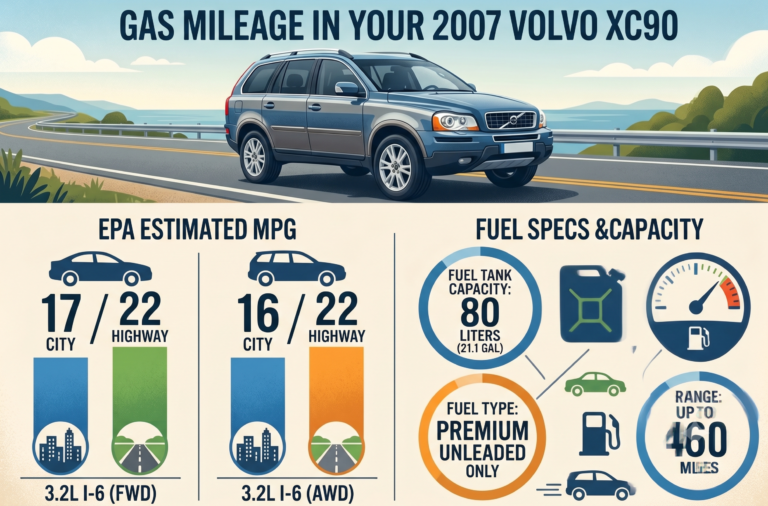
Yes. <cite index=”28-1″>Volvo requires premium fuel with an octane rating of 91 or higher for all B4, B5, B6, and T8 engines, and recommends 91 AKI for ideal performance and fuel economy.</cite> “Super unleaded” is simply the pump label many U.S. and Canadian stations use for their premium-grade fuel, so if you’re filling an XC90 built since the mid-2010s, that’s the button you want. An automotive writer who’s covered Volvo’s engine lineup changes since the T5/T6 era pulled together the requirements by engine below, since the answer actually shifts depending on which XC90 you own.
Pull-quote: Every current Volvo XC90 engine is built around premium fuel — “super unleaded” isn’t an upgrade here, it’s the baseline.
XC90 Fuel Requirements by Engine
Not every XC90 has the same rulebook, so match your engine code (check your window sticker, owner’s manual, or the VIN decode) to the table below.
| Engine | Years (approx.) | Minimum Octane | Volvo’s Recommendation | Runs on Regular 87? |
|---|---|---|---|---|
| T5 (turbo I4) | 2016–2019 | 87 (regular) | Premium for best performance | Yes, without reliability issues |
| T6 (turbo + supercharged I4) | 2016–2019 | 91 | 93 for peak output | Not recommended |
| B5 (mild hybrid turbo I4) | 2020–present | 91 | 93 | Not recommended |
| B6 (mild hybrid turbo + supercharged I4) | 2020–present | 91 | 93 | Not recommended |
| T8 / Recharge Plug-in Hybrid | 2016–present | 91 | 93 | Not recommended |
Quick Tip: The fastest way to settle this for your specific car is to open the fuel filler flap. Volvo puts the required octane rating right there on a printed decal — no manual required.
Why Some XC90 Engines Need Premium and Others Don’t
It comes down to compression and boost, not brand snobbery. Higher-output turbocharged and supercharged engines run tighter tolerances and more boost pressure, which raises the risk of pre-ignition (“knock”) on lower-octane fuel. Premium’s higher resistance to knock lets Volvo’s engine computer run more aggressive, efficient ignition timing.
That’s exactly why the old T5 — a lower-output, single-turbo four-cylinder — was tuned conservatively enough to tolerate 87 octane, while the T6’s supercharger-plus-turbo combo and the B6/T8’s higher outputs need the extra knock resistance premium provides.
<cite index=”31-1″>Even Volvo’s smaller SUVs follow the same split: the XC40’s B5 powertrain requires premium 91-octane gas, while the older T4 engine could run on regular 87.</cite> The XC90 pattern mirrors it almost exactly.
What Happens If You Put Regular Gas in an XC90 That Needs Premium
Nothing catastrophic happens on a single tank, but it’s not free either. Modern engine computers detect knock and pull ignition timing back to protect the engine, which means less power and worse fuel economy rather than immediate damage.
Real-world scenario: <cite index=”35-1″>One XC90 owner accidentally ran a tank of regular through their car and noticed it “performed like a dog” — reduced pep and a noticeable mileage hit — even though nothing broke.</cite> That lines up with what Volvo’s own engine management is designed to do: protect itself first, and let you feel the difference second.
Expert Insight: Regular gas in a premium-required engine is more like a gas mileage tax than a mechanical risk — you’ll notice it in the trip computer before you’d ever notice it in a repair bill. Making it a daily habit for a long-term ownership is where the real cost, and eventually the real risk, adds up.
Running low-octane fuel occasionally in an emergency — say, you’re down to fumes in a town with only one grade — isn’t something to panic over. <cite index=”34-1″>It’s better to add a small amount of regular gas to get to the next station than to risk running out of fuel entirely.</cite> Just top up with premium as soon as you can and don’t make it a habit.
Does Ethanol Content Matter?
Yes, but not in the way octane does. <cite index=”30-1″>Standard E10 gasoline, with up to 10% ethanol, is safe to use in the XC90.</cite> <cite index=”33-1″>Volvo does specifically warn against using gasoline that contains lead or manganese as a knock inhibitor, and recommends avoiding aftermarket fuel additives beyond winter gas-line antifreeze.</cite> Higher-ethanol blends like E15 or E85 aren’t approved for the XC90 and can affect both performance and warranty coverage, so it’s worth checking the pump label before you fill up at a station offering multiple ethanol blends.
Does “Super Unleaded” Mean the Same Thing as What Volvo Requires?
Generally, yes, but the terminology varies by region. In the U.S. and Canada, “premium,” “super,” and “super unleaded” typically all describe the same 91+ AKI fuel Volvo specifies. In the UK and much of Europe, “Super Unleaded” usually refers to 97–99 RON fuel, which comfortably clears Volvo’s minimum. Either way, the number on the pump matters more than the marketing name — look for 91 AKI (roughly 95–96 RON) or higher.
<cite index=”28-1″>TOP TIER detergent gasoline is also worth seeking out where available, since Volvo recommends it to help maintain engine performance and reliability over time, separate from the octane question.</cite>
Pros and Cons by Owner Type
The Daily Commuter
- Pro: Sticking with the recommended 93 AKI (where required) keeps performance and fuel economy at their best without any guesswork.
- Con: Premium costs more per gallon, adding up over a year of regular commuting.
The Road-Tripper
- Pro: E10 compatibility means most highway gas stations across North America work fine.
- Con: Rural stops with only regular gas mean planning ahead or accepting a temporary performance dip.
The Budget-Conscious Owner Considering a T5 or Older Model
- Pro: A T5-engine XC90 can legitimately run on regular 87 without reliability concerns, saving real money over years of ownership.
- Con: You’ll still likely see a small, noticeable performance and efficiency gain by using premium anyway, so the “savings” aren’t entirely free.
Alternatives Worth a Look
Choose the XC90 T5 (2016–2019) if: you want the flexibility to run on regular gas without a manufacturer red flag, and you’re comfortable with less power than the T6/B6.
Choose the XC90 B6 or T8 instead if: performance is the priority and you’re fine budgeting for premium fuel as part of ownership costs.
Consider a non-turbo competitor if: avoiding premium fuel altogether, permanently, is a hard requirement — many naturally aspirated V6 competitors in this class run on regular without any of the T6/B6/T8’s octane sensitivity.
FAQ
Do I have to use super unleaded/premium gas in my Volvo XC90? It depends on the engine. <cite index=”28-1″>B4, B5, B6, and T8 engines require premium with a minimum 91 AKI octane rating.</cite> Older T5 engines can run on regular 87 without reliability issues, though Volvo still recommends premium for best performance.
What happens if I accidentally put regular gas in my XC90? Nothing will break immediately. The engine computer adjusts timing to prevent knock, which typically shows up as reduced power and slightly worse fuel economy rather than damage. Fill up with the correct fuel on your next stop.
Is 89 octane (mid-grade) enough for a Volvo XC90? <cite index=”35-1″>Some owners have run mid-grade 89 octane for extended periods without noticing engine noise or performance loss, despite the filler flap specifying a 91 minimum.</cite> It’s not officially Volvo-approved, so treat this as an owner-reported workaround, not a manufacturer recommendation.
Does the Volvo XC90 need TOP TIER gasoline specifically? <cite index=”28-1″>Volvo recommends TOP TIER detergent gasoline where available to help maintain engine performance and reliability, though it’s a recommendation rather than a strict requirement tied to the octane rule.</cite>
How do I know which octane my specific XC90 needs? Check the decal on the inside of your fuel filler flap — Volvo prints the required octane rating directly on it, which is the fastest way to confirm without digging through the manual.
Key Takeaways
- Current Volvo XC90 engines (B5, B6, T8) require premium fuel, 91 AKI minimum, with 93 AKI recommended for best results.
- Older T5-engine XC90s (2016–2019) are the exception and can run on regular 87 without reliability concerns.
- “Super unleaded” at most North American pumps means the same 91+ octane fuel Volvo specifies.
- Accidentally using regular gas causes a temporary performance and mileage dip, not lasting engine damage.
- The fuel filler flap decal is the fastest, most reliable way to confirm your exact octane requirement.
Next Step
Check the decal inside your XC90’s fuel filler flap before your next fill-up to confirm exactly which octane your specific engine needs.