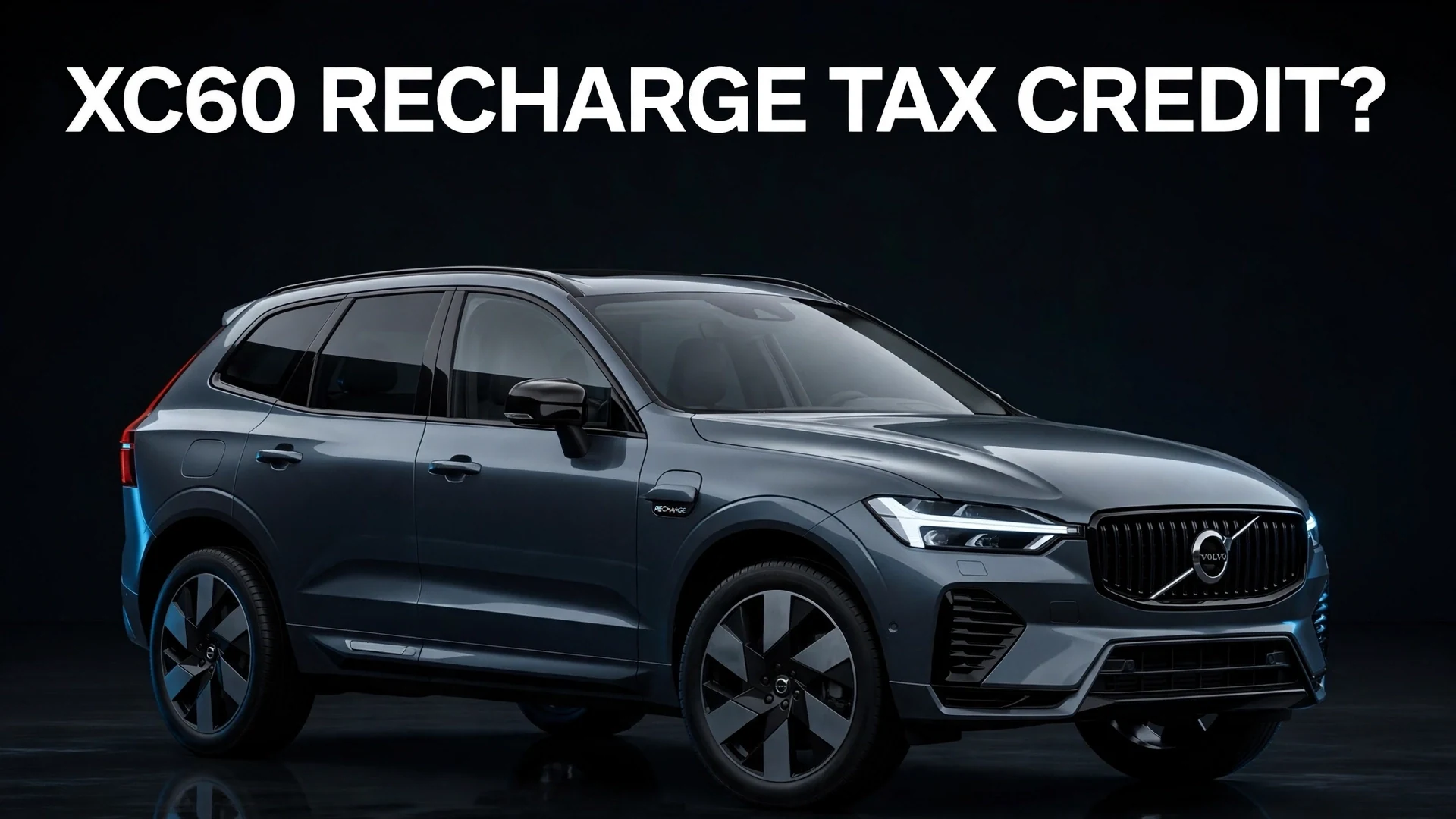
Does the Volvo XC60 Recharge Qualify for Tax Credit?

Old reviews still claim the XC60 Recharge qualifies for a federal tax credit. In 2026 the answer is no — but the history has two chapters. Pre-2022, the XC60 T8 did qualify: $5,002 (2018–2019), $5,419 (2020–2021). It lost eligibility in August 2022, when the Inflation Reduction Act required North American final assembly the Swedish-built XC60 couldn’t meet — and the program ended for everyone for vehicles acquired after September 30, 2025.
That history shapes today’s market: early T8s were effectively discounted by the tax code, later ones never were — yet all trade as used cars with no credit in play. A two- or three-year-old XC60 Recharge can be the luxury PHEV value pick, if you check the battery first.
Key Takeaways
- No federal credit in 2026 — 30D, 25E, and 45W all ended for vehicles acquired after September 30, 2025.
- It did qualify once: $5,002 (2018–2019) or $5,419 (2020–2021) under pre-2022 rules. The August 2022 IRA added a North America assembly rule; the Swedish-built XC60 lost eligibility overnight.
- The new auto-loan interest deduction also requires US final assembly — ruling out the XC60.
- State help is thin at this price: most PHEV rebates cap MSRP below a new XC60’s sticker. Colorado’s $750 credit (no income cap) is the exception.
- The opportunity is used: 2–4-year-old models list from the low $20,000s — but battery health is everything. Check State of Health first.
The Short Answer
No. No XC60 Recharge bought in 2026 qualifies for any federal tax credit. The new (30D, up to $7,500), used (25E, up to $4,000), and commercial (45W) credits all ended for vehicles acquired after September 30, 2025, under the One Big Beautiful Bill Act (Public Law 119-21).
One narrow exception: a binding written contract plus a payment on or before September 30, 2025 counts as acquisition then, so you can claim the credit at delivery. A reservation or refundable deposit alone didn’t count.
As for the XC60 specifically: it earned the credit under the original rules ($5,002–$5,419) but lost eligibility in August 2022 — the full two-chapter story is in the next section.
How the XC60 Recharge Won — Then Lost — the Credit
Chapter one: the original credit (2010–2022) scaled with battery size — $2,500 plus $417 per kWh above 5, no assembly rule. The T8’s 11.6 kWh pack meant $5,002 for 2018–2019; a small 2020 capacity bump raised it to $5,419 for 2020–2021.
Chapter two: in August 2022 the Inflation Reduction Act required final assembly in North America — disqualifying every Volvo plug-in hybrid sold in the US. Volvo has never built the XC60, or any Recharge, in North America (Ridgeville, South Carolina builds the S60 and EX90, not the XC60). The T8 fell off the qualifying list overnight and stayed off.
That history is a used-market decoder ring: a 2020 T8’s first buyer paid thousands less after the credit; a 2024 buyer paid full sticker — yet both compete at similar used prices. How the T8 evolved:
| Model years | Battery (gross) | EPA electric range | System power | Combined economy |
|---|---|---|---|---|
| 2018–early 2022 | 11.6 kWh | ~19–22 miles | 400 hp | ~57 MPGe / 26 mpg |
| Late 2022 (“Extended Range”)–2026 | 18.8 kWh | ~35–36 miles | 455 hp / 523 lb-ft | 63 MPGe / 28 mpg |
The late-2022 “Extended Range” update is the line that matters: nearly double the battery and range, 55 more hp. A 2022 could be either version — verify the battery, not just the year. New T8s run roughly $60,000–$72,000 by trim, which is also why most state rebates, with their MSRP caps, barely touch this car.
What Happened to the Federal Credit: A Timeline
The credit didn’t fade out — it hit a wall. This is the sequence that took a $7,500 incentive to zero:
The XC60 Recharge qualified under the original rules, lost eligibility in August 2022, and the program ended for everyone in September 2025.
The Other Federal Tax Break That Also Excludes the XC60
The 2025 law also created a 2025–2028 deduction of up to $10,000/year in auto loan interest (claimable even with the standard deduction) — but it too requires final assembly in the United States.
Other conditions: new vehicle, bought after 2024, under 14,000 lbs, first-lien loan, phaseouts above $100,000 MAGI ($200,000 joint). The Swedish-built XC60 fails the assembly test. Two federal incentives, same locked door.
What You Can Still Get in 2026
With federal purchase incentives gone, remaining savings are state and local — with one caveat: most state PHEV rebates cap MSRP below a $60,000-plus XC60. Figures below are current as of 2026, but programs shift fast (Oregon’s rebates were suspended in late 2025 on funding grounds) — confirm on the official page before counting on any figure.
| Program | What a PHEV buyer may get | The catch for an XC60 Recharge |
|---|---|---|
| Colorado vehicle credit | $750 refundable state credit for a new PHEV in tax year 2026; assignable to the dealer at purchase | No income cap, no MSRP ceiling — the most broadly usable option for this car. |
| Colorado Vehicle Exchange | Up to $9,000 (new) or $6,000 (used) for income-qualified residents replacing an older vehicle | Requires an eligible trade-in and pre-approval; funding is limited. |
| Massachusetts MOR-EV | Rebates for new/used EVs; PHEV amounts tiered by MSRP | The XC60’s price lands in the least generous tier — check current rules. |
| Maryland excise credit | $100/kWh up to $3,000 for PHEVs under $60,000 MSRP | A new XC60 Recharge exceeds the cap; a used one under it could qualify. |
| Federal 30C charger credit | 30% of home charger and install cost, up to $1,000 | Runs through June 30, 2026; census-tract eligibility rules apply. |
Many utilities also offer time-of-use rates or Level 2 charger rebates — none of it replaces a $7,500 credit, but stacked together it lowers the cost of running a plug-in hybrid with 35 miles of electric range.
The Smart Play in 2026: Buy Used
When the $4,000 used-vehicle credit (25E) died with the new-vehicle credit, it removed a price floor under used plug-in hybrids — and the XC60, with no credit supporting its new price after 2022, depreciated like a normal luxury car. Your advantage. Nationwide asking-price floors from 2026 listings:
Approximate asking-price floors from nationwide 2026 listings; actual prices vary by mileage, trim, and condition.
A two-year-old runs roughly half of new; a four-year-old roughly a third. Scrutinize 2022: early cars have the 11.6 kWh battery (~19 EPA miles), late “Extended Range” cars the 18.8 kWh pack (~35 miles). Same badge, different car. What determines your deal:
Used XC60 Recharge Buyer’s Guide: Battery Health Is Everything
On a used plug-in hybrid, the high-voltage battery is the most expensive component — the main thing separating a bargain from a money pit. A $200–$400 inspection with a battery-health report is the cheapest insurance. Here’s what to check:
Used XC60 Recharge battery-health checklist
Gradual capacity loss from aging is normal — the 70%-of-original threshold is where “normal” becomes a warranty claim. Most well-kept cars stay comfortably above it for years, which is why the SoH reading matters more than the odometer.
New vs. Used: The 2026 Math
Strip away the credit talk and it’s arithmetic: a new 2026 T8 at roughly $65,000–$72,000 is a full-price luxury purchase — fair for the warranty and the exact spec, but not a tax-driven deal. A 2023 Extended Range at ~$30,000 with 85%+ battery health delivers the same 455-hp powertrain and 35-mile electric range for less than half the money.
Fuel math favors the used car too, if you can charge at home: 35 electric miles covers the average American’s daily drive, and Volvo says about half the distance in its latest PHEVs is electric-only. The savings come from electrons, not the IRS.
Frequently Asked Questions
Did the Volvo XC60 Recharge ever qualify for the federal tax credit?
Yes, under the original pre-2022 rules: $5,002 for 2018–2019, $5,419 for 2020–2021. The August 2022 Inflation Reduction Act added a North America assembly requirement the Swedish-built XC60 couldn’t meet; it never returned to the list, and the program ended for everyone for vehicles acquired after September 30, 2025.
I bought an XC60 Recharge before the September 2025 deadline. Can I still claim the credit?
Only if it qualified under the rules then in effect. A 2018–2021 T8 bought new was eligible at the time. But one acquired from August 2022 through September 2025 wasn’t a qualifying vehicle under IRA-era 30D rules, so the binding-contract exception can’t create eligibility — it only helps buyers of vehicles that were on the list.
Does the new auto loan interest deduction apply to the XC60 Recharge?
No. The 2025–2028 deduction of up to $10,000/year in auto loan interest requires final assembly in the United States — plus a new vehicle, first-lien loan, and income phaseouts above $100,000 single / $200,000 joint. The Swedish-built XC60 Recharge fails the assembly test.
How do I check the battery health of a used XC60 Recharge?
Get a State of Health (SoH) reading — remaining capacity as a percentage of new — from a dealer diagnostic or an independent inspection ($200–$400); 85%+ is generally healthy. Also run a full-charge range test against the EPA figure: 19–22 miles for the 11.6 kWh pack, 35–36 for the 18.8 kWh pack. Volvo’s 8-year/100,000-mile battery warranty covers replacement if SoH drops below 70%.
Are there any state incentives for the XC60 Recharge in 2026?
A few. Colorado offers a $750 refundable credit for a new PHEV (no income cap), plus up to $9,000 through Vehicle Exchange Colorado for income-qualified buyers replacing an older vehicle. Most other state PHEV rebates cap MSRP below a new XC60’s price — a used one under the cap may qualify where a new one can’t. The federal 30C charger credit (30%, up to $1,000) runs through June 30, 2026, subject to location rules.
The Bottom Line
The XC60 Recharge doesn’t qualify for a tax credit in 2026 — though it did pre-2022, before the assembly rule ended that. The used market has done what the tax code no longer does: 455 hp and 35 electric miles from the low $20,000s. Buy the battery, not the badge.