How Long to Charge a Volvo EX30?t

How Long to Charge a Volvo EX30? Every Charger Type, Explained
You just got (or are about to get) a Volvo EX30. You want one simple answer: how long until it’s charged? Unfortunately, it depends on which charger you use — and the difference is dramatic. We’re talking anywhere from 25 minutes to over 30 hours. Yes, really.
Here’s the good news: once you understand the three charging levels, the decision is obvious for most people.
TL;DR
- DC Fast Charger (Level 3): 10% → 80% in about 25–30 minutes (as of 2025)
- Level 2 Home Charger (240V): Full charge in roughly 6–8 hours overnight
- Level 1 (standard 120V outlet): Only a few miles per hour — fine for light daily top-ups, painful for a low battery
- The EX30’s max DC charging speed is 150–153 kW on Extended Range trims
- For most owners, Level 2 home charging is the sweet spot — plug in at night, wake up full
The Quick Answer: Volvo EX30 Charging Time by Charger Type
The EX30 is actually a solid charger for its size. Its relatively small battery paired with decent peak power means you don’t need to sit at a charging station for 45 minutes like you would with a larger SUV.
On a modern DC fast charger in ideal conditions, the EX30 can go from 10–80% in around 25–30 minutes, and from 20–80% in roughly 20–25 minutes. At home on a 240V Level 2 charger, expect a full charge to take 8–11 hours depending on battery size and circuit amperage.
Think of it this way: if charging were a coffee order, DC fast charging is an espresso shot — quick and powerful. Level 2 is a slow-brew you set up before bed. Level 1 is waiting for water to boil on a camping stove.
Volvo EX30 Charging Times: Full Comparison Table
| Charger Type | Power | 10–80% Time | Full Charge (0–100%) | Best For |
|---|---|---|---|---|
| Level 1 (120V outlet) | ~1.4 kW | 30+ hours | 40–50+ hours | Topping off only |
| Level 2 (240V home) | 7–11 kW | ~4–5 hours | 6–8 hours | Daily home charging |
| DC Fast Charge (CCS) | Up to 153 kW | 25–30 min | ~70 min | Road trips, quick stops |
(as of May 2025)
Level 1 Charging: The “It’ll Do” Option
Level 1 charging works — but only barely for most people. You plug the included portable cord into a standard household outlet and let it trickle in power overnight.
Level 1 charging at standard outlets delivers only a few miles per hour, which Volvo itself recommends only for topping off a nearly full battery — for instance, at a friend’s home.
Pull quote: “Level 1 charging is like filling a swimming pool with a garden hose. It works. You’ll just be there for a while.”
Level 1 can work if you only drive 20–30 miles a day and plug in every night, but it’s marginal if you regularly run the battery low. If you’re commuting 50+ miles daily, this will leave you perpetually anxious.
Choose this if: You live in an apartment with only a 120V outlet available, or you already charge at work during the day and just need a small overnight top-up.
Level 2 Charging: The One Most Owners Actually Use
Level 2 is the real daily driver for EX30 owners. You install a 240V wall charger (or use a public Level 2 station), and the car refills overnight while you sleep.
When charging with a Level 2 charger, the EX30 can gain around 30 miles of range per hour. This means you can easily top off your battery overnight while you sleep, ensuring your vehicle is ready for the next day’s commute.
On a 40–50A circuit in U.S. homes, you’ll see roughly 25–35 miles of range per hour, making a 10–90% overnight charge take roughly 6–8 hours — easily done between dinner and your morning commute.
Expert Insight 💡 The EX30’s onboard AC charger accepts up to 11 kW. Most home installations in the U.S. deliver 7–9 kW depending on your circuit, so you’re close to the car’s ceiling already. Upgrading to a 50A circuit squeezes out the last bit of speed.
Real-world scenario: You arrive home with 25% battery after a 45-mile commute. You plug into your Level 2 charger at 6 PM. By 10 PM, the car is back at 90%+. You wake up to a “full tank” without ever thinking about it again. This is the EX30 ownership experience at its best.
Choose this if: You have a garage or driveway, drive more than 30 miles a day, or simply don’t want to think about charging anxiety.
DC Fast Charging: Road Trip Mode
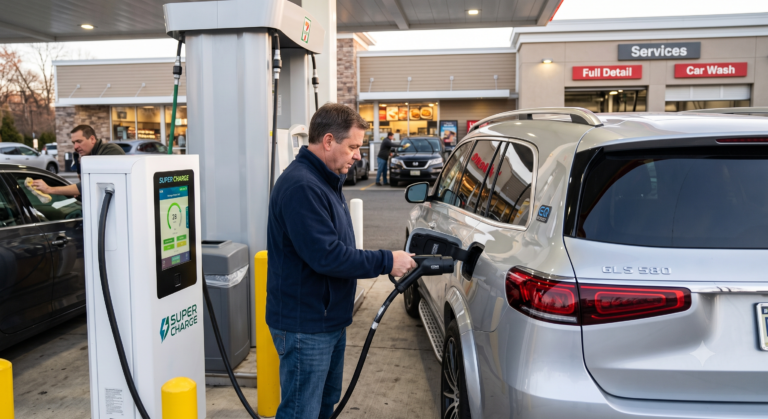
DC fast charging is where the EX30 shines for travel. When you’re on the highway and need to add range quickly, CCS fast chargers deliver serious speed.
The EX30 has two main battery sizes: about 49 kWh usable for the Standard Range (LFP) and 64 kWh usable for the Extended Range (NMC). DC fast charging peak power runs roughly 134 kW for the Standard Range and 150–153 kW for Extended Range trims.
Real-world charging tests show the session starting at 3% SoC with power around 20 kW, then shooting up to about 150 kW at 8% SoC. By 30% SoC, the rate dropped to 130 kW, falling to 120 kW at 40%, and reaching just 67 kW by 70%. At 80%, it settled at 45 kW.
This tapering is completely normal — all EVs slow down as the battery fills up. It’s also why stopping at 80% instead of 100% on a road trip is almost always the smarter call. You get most of the range in a fraction of the time.
Quick Tip ⚡ The EX30 automatically preconditions its battery when you navigate to a charging station. Let it do its job — arriving with a warm battery can shave minutes off your fast charge session.
On a road trip, planning in 120–150 mile segments with 15–25 minute stops keeps you squarely in the EX30’s fastest charging zone. On older 50 kW units, expect 10–80% to take closer to 50–60 minutes.
Choose this if: You’re on a road trip, in a genuine time crunch, or your battery is dangerously low in an unfamiliar area.
Pros & Cons by Persona
🏙️ The City Commuter (50 miles/day, no home garage)
Pros: Public Level 2 chargers at work or parking garages are increasingly common; DC fast charging near urban centers is widely available. Cons: Without home charging, you’re relying on public infrastructure — which can be unreliable or occupied. Level 1 from an apartment outlet is genuinely stressful.
🏡 The Suburban Homeowner (30–40 miles/day, has a garage)
Pros: Level 2 home charging is the perfect fit — set it and forget it. A 2024 J.D. Power survey found home charging is cited as the top ownership satisfaction driver among EV owners. This is EX30 ownership at its easiest. Cons: Upfront cost of Level 2 charger installation ($500–$1,500 depending on location). A minor inconvenience once.
🛣️ The Weekend Road Tripper (occasional long drives)
Pros: The EX30’s 25–30 minute 10–80% DC charge time means pit stops fit naturally into a bathroom-and-coffee break. In real-world testing, the EX30 recouped 177 miles of range in 30 minutes on a DC fast charger. That’s impressive for a compact SUV. Cons: Fast charging from near-empty to 100% is slower — one full charging test from 3% to 100% took one hour and ten minutes total. Plan stops to stay in the sweet spot (10–80%).
What Affects Charging Speed?
Not all charging sessions are equal. A few factors that make a real difference:
Battery temperature is the big one. Cold batteries charge significantly slower. Volvo’s battery preconditioning feature (activated when you navigate to a charger) helps, but winter charging will still be slower than summer sessions.
State of charge matters too. The EX30 charges fastest between roughly 10–50% SoC. Above 80%, charging intentionally slows to protect the battery cells.
Charger quality varies widely. A 150 kW Electrify America or Tesla Supercharger station will perform very differently from an aging 50 kW unit at a highway rest stop.
Quick Tip 🌡️ In cold weather, pre-heat your cabin via the Volvo app before unplugging. This warms the battery simultaneously and helps maintain better charging speeds on your next DC fast charge stop.
How Does the EX30 Compare to Similar EVs?
| Model | Battery (usable) | DC Fast Charge Peak | 10–80% Time |
|---|---|---|---|
| Volvo EX30 Extended Range | ~64 kWh | 150 kW | ~25–30 min |
| Tesla Model Y Standard Range | ~57.5 kWh | 170 kW | ~25 min |
| Hyundai Kona Electric | ~64.8 kWh | 100 kW | ~41 min |
| Mini Cooper SE (2024) | ~54.2 kWh | 95 kW | ~30 min |
The EX30 holds its own well here. It’s not quite as quick as a Tesla on DC, but it significantly outpaces the Kona Electric, which is a direct competitor.
Expert Insight 💡 A 2025 industry analysis of compact EVs found that models with sub-70 kWh batteries and 130+ kW peak DC charging consistently deliver the best “real-world road trip experience” because their faster relative charging speed compensates for smaller battery capacity.
FAQ
How long does it take to charge a Volvo EX30 from dead to full? From near-zero (3%) on a DC fast charger, expect about 60–70 minutes to reach 100%. On Level 2 at home, figure 8–11 hours. Nobody recommends running the battery to zero regularly, though.
Can I charge a Volvo EX30 at a Tesla Supercharger? Yes — Volvo EVs have access to the Tesla Supercharger network in North America via the NACS adapter. However, one real-world test found the EX30 couldn’t connect at a Supercharger despite Volvo EVs having network access, so results can vary. Electrify America and ChargePoint are reliable alternatives.
What’s the cheapest way to charge a Volvo EX30? Charging at home on a Level 2 charger overnight is almost always the cheapest option, especially if you’re on a time-of-use electricity plan that offers lower rates at night. Public DC fast charging is convenient but can cost 3–4x more per kWh depending on the network.
Should I charge my EX30 to 100% every night? Volvo and most battery engineers recommend a daily limit of around 70–80% for regular use, saving 100% charges for road trips. Volvo specifically notes that Level 3 charging is useful for quick refuels on road trips, and recommends only charging to 80% to support battery longevity.
Does the Volvo EX30 come with a home charger? The EX30 comes with a portable Level 1 cordset. A Level 2 wall charger is sold separately and requires professional installation. Many buyers use Volvo’s partnership with home charging installation services for a smoother setup.
Key Takeaways
- DC fast charging (Level 3) gets you 10–80% in about 25–30 minutes — plenty quick for a road trip stop
- Level 2 home charging is the backbone of daily EX30 ownership: ~30 miles per hour, full overnight refill
- Level 1 (120V outlet) is a last resort — fine for topping up, not for running your commute
- Charging slows above 80% SoC — stop at 80% on road trips to save time
- Cold weather and charger quality both significantly affect real-world charging speed
- The EX30’s 150 kW peak DC capability is competitive for its class and battery size
What Should You Do Next?
If you’re buying an EX30, budget for a Level 2 home charger installation from day one. It transforms the car from “requires planning” to “effortless.” Get quotes from a certified electrician, and check whether your local utility or state offers EV charger rebates — many do, and the savings can be significant.
Already own one? Download the Volvo Cars app, set a daily charging limit of 80%, and enable scheduled charging to hit off-peak electricity rates overnight. You’ll barely think about charging again.