How to Add Coolant to a 2006 Volvo XC90?

Your dash just lit up with a coolant warning, or maybe you popped the hood out of habit and noticed the reservoir looking a little low. Either way, you need to know exactly where that reservoir is and what to pour into it before you do anything else.
TL;DR:
- The coolant reservoir on a 2006 XC90 sits in the engine bay, accessible after removing a panel or hatch cover
- Only add coolant when the engine is cold — never open the cap on a hot engine
- Use a coolant with corrosion inhibitor mixed 50/50 with water, or a pre-mixed formula
- Fill to the MAX line, never past it, and never use water alone
- If you’re topping off often, you likely have a leak, not just normal consumption
Short answer: Let the engine cool, find the reservoir in the engine bay, and add a 50/50 mix of Volvo-approved coolant and water up to the MAX line. It’s a five-minute job once you know where to look — but a low reservoir that keeps coming back usually means something else needs attention.
Where Is the Coolant Reservoir on a 2006 Volvo XC90?
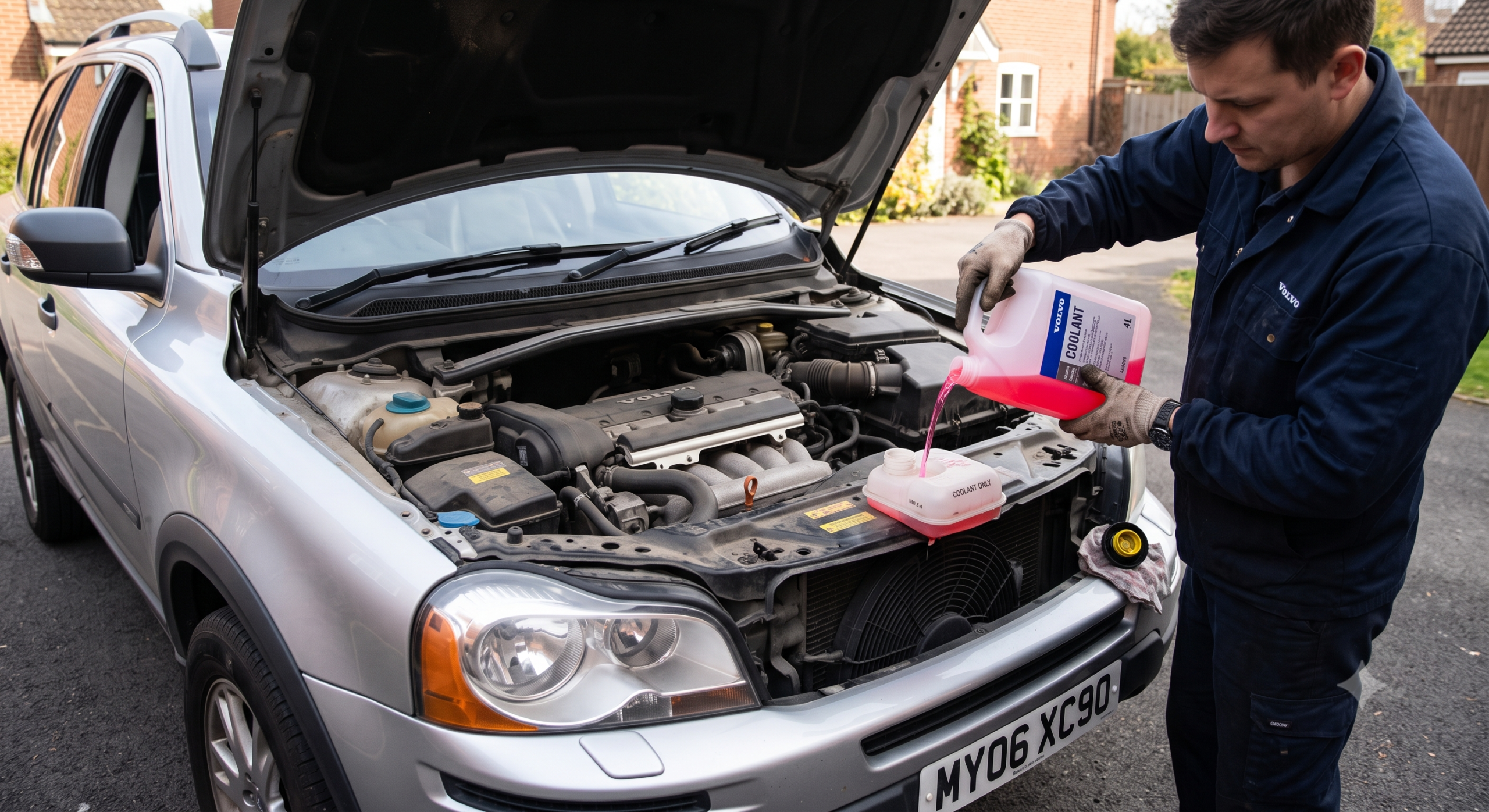
The 2006 XC90’s coolant reservoir is a translucent plastic tank tucked into the engine bay, often positioned near other service components on the front passenger side. On many first-generation XC90s, it’s shared across the 2.5T, 3.2L I6, and 4.4L V8 engines, so the general location is consistent regardless of which engine you have.
Quick Tip: The tank is usually translucent on purpose — you should be able to see the coolant level right through the plastic without even opening the cap, as long as it isn’t caked in road grime.
One owner working on a 2006 XC90 V8 during a timing belt job noted that this same reservoir often needs to be temporarily relocated for other repairs, since it shares space with the area mechanics need to access for belts, the alternator, and the power steering pump.
How Do You Safely Open the Coolant Reservoir?
Never open a hot reservoir — this is the step where people get hurt. Removing the coolant reservoir cap on a warm engine can cause it to fly off at high speed with hot fluid spraying out, so always wait for the engine to cool completely first.
Expert Insight: If you absolutely must check the coolant on a warm engine, open the cap in small stages, pausing to let pressure release each time, and keep your face and hands clear of the opening.
Coolant is toxic if ingested and can be harmful with skin contact, so wear gloves, keep it away from kids and pets, and wipe up any spills immediately.
What Coolant Should You Use in a 2006 Volvo XC90?
Not all coolant is interchangeable, and mixing types can cause real damage. Volvo recommends coolant with a corrosion inhibitor mixed with water at a 50/50 ratio, and explicitly warns against mixing different coolant types in the same system.
Here’s a real-world scenario worth avoiding: you’re low on coolant, so you grab whatever bright green jug is on the shelf at the auto parts store and top it off — not realizing your XC90’s system already has a different formula in it. Mixing incompatible coolants can cause the mixture to break down, leaving you with reduced corrosion protection and a bigger repair bill down the line.
Choose pre-mixed 50/50 coolant if: you want a grab-and-go option with no measuring involved. Choose concentrated coolant if: you’re comfortable mixing it yourself with distilled water at an exact 50/50 ratio and want more control over the process.
Step-by-Step: How to Add Coolant to a 2006 XC90
- Park on level ground and let the engine cool completely. A hot system is under pressure and unsafe to open.
- Open the hood and locate the coolant reservoir, removing any panel or hatch covering it.
- Clean around the cap before opening it, so debris doesn’t fall into the system.
- Check the level against the MIN and MAX markings printed on the tank.
- Add your 50/50 coolant mixture slowly, using a funnel to avoid spills, until the level reaches the MAX line — never above it.
- Replace the cap securely and reassemble any panels you removed.
Quick Tip: If coolant is pooling under the car, you smell coolant steam, or you’ve had to add more than about two quarts, stop and get the vehicle towed rather than driving it — that’s a sign of a real cooling system problem, not routine top-off.
Coolant Task Comparison: Routine Top-Off vs. Warning Sign
| Situation | What It Usually Means | What To Do |
|---|---|---|
| Level slightly below MAX, no warning light | Normal, gradual evaporation over time | Top off with 50/50 mix |
| Recurring “Coolant Low” light despite full tank | Possible faulty level sensor | Check sensor wiring/connector |
| Coolant visibly leaking or pooling | Hose, tank, or gasket failure | Stop driving; get it inspected |
| Sweet smell inside the cabin | Possible heater core leak | Have a mechanic check promptly |
Why Does My 2006 XC90 Keep Showing a Low Coolant Warning?
If you’re topping off constantly, the reservoir isn’t the real story — something else usually is. One documented case involved a “Coolant Low – Stop the Car” warning appearing even with a full, normal-temperature system, which owners traced back to the coolant level sensor at the bottom of the reservoir tank.
That sensor is notoriously easy to damage. It can be prone to failure specifically when the reservoir tank is lifted or relocated without first disconnecting the sensor’s electrical connector, which is a common step during other engine bay repairs.
Age is a factor here too. On these older XC90s, the reservoir tank plastic itself can turn brittle over the years to the point where fittings crack or break off entirely, which is a maintenance item separate from just adding fluid.
Pros and Cons by Owner Type
The DIY weekend mechanic
- Pro: Adding coolant yourself takes minutes and costs little beyond the coolant itself
- Con: Misdiagnosing a leak as “normal” consumption can let a small problem become an expensive one
The daily commuter who just wants it handled
- Pro: A quick dealer or shop top-off avoids any risk of doing it wrong
- Con: Costs more for something this simple, and you’ll still want to know if it’s leaking
The high-mileage owner (150,000+ miles)
- Pro: Regular coolant checks catch aging hoses and tanks before they fail
- Con: Older plastic components, including the reservoir itself, become more failure-prone and may need proactive replacement
FAQ
Can I just use water instead of coolant in an emergency? No — never refill with water only, since it increases the risk of freezing and offers no corrosion protection. If coolant genuinely isn’t available, use water only to get to the nearest service point, then flush and refill properly as soon as possible.
How do I know if my 2006 XC90’s coolant level sensor is bad? A classic sign is a “Coolant Low” warning appearing even when the tank is visibly full and the engine temperature reads normal — this often points to the sensor rather than an actual low level.
Is it normal to add coolant every few weeks? No. Needing to top off that frequently points to a leak somewhere in the system, not normal fluid consumption, and it’s worth having inspected before it turns into overheating.
What happens if I overfill the coolant reservoir? Overfilling past the MAX line can create pressure-related issues in the system, so always stop right at the marked line rather than filling to the very top of the tank.
Can I mix different brands of coolant? It’s best not to. Manufacturers warn against mixing different coolant types, since incompatible formulas can reduce corrosion protection and potentially damage the cooling system.
Key Takeaways
- Always let the engine cool before opening the coolant reservoir — this is the most important safety step
- Use a 50/50 mix of Volvo-approved coolant and water, or a pre-mixed equivalent
- Fill to the MAX line only, and never top off with plain water
- Frequent top-offs usually mean a leak or a failing level sensor, not normal use
- The reservoir tank itself can become brittle with age on higher-mileage first-gen XC90s
- Coolant is toxic — wear gloves, avoid ingestion, and clean up spills right away
What To Do Next
If you’re topping off more than once every few weeks, get the cooling system pressure-tested at a shop before it turns into an overheating issue on the road.