How to Change the Timing Belt on a Volvo XC90?

That timing belt hiding behind your XC90’s engine cover is either quietly doing its job or quietly counting down to a catastrophic engine failure — and there’s no dashboard light that warns you before it snaps.
TL;DR:
- Not every XC90 engine has a timing belt — some use a timing chain that never needs replacement
- The 2.5T five-cylinder engine’s belt interval is 120,000 miles, while the T6 twin-turbo interval is 105,000 miles
- These are interference engines, meaning a broken belt can bend valves and cause major, expensive engine damage
- Always replace the tensioner, idler pulley, and water pump at the same time as the belt
- Plan for a full day if it’s your first time, even though experienced DIYers can finish in a few hours
Short answer: If your XC90 has a belt-driven engine (2.5T or T6), it needs replacing at 105,000–120,000 miles regardless of how it looks. It’s a serious job involving precise timing marks, so budget real time for it — or real money if you’re paying a shop.
Does Every Volvo XC90 Engine Have a Timing Belt?
No — this is the first thing to check before you do anything else. The 3.2L inline-6 engine used in later first-generation XC90s runs a timing chain, which requires no scheduled replacement, unlike the belt-driven 2.5T and T6 engines.
Quick Tip: Check your engine code before ordering parts or booking a shop appointment. A 3.2L owner chasing a “timing belt interval” is chasing a job their engine doesn’t even have.
If you’ve got a 2.5T (five-cylinder turbo) or a T6 (2.9L or later 3.2L twin-turbo six-cylinder), you do have a belt, and it absolutely needs attention on schedule.
How Often Does the Volvo XC90 Timing Belt Need Replacing?
The interval depends on which engine you have, and getting this wrong in either direction costs you. The 2.5T’s timing belt and tensioner replacement interval is 15 years or 150,000 miles, though earlier guidance for the standard interval across most 5-cylinder engines runs at 120,000 miles or 10 years, whichever comes first.
The T6 runs on a shorter clock. Volvo’s schedule calls for the timing belt to be replaced at 105,000 miles on T6 models, compared to the longer interval on the naturally-timed five-cylinder engines.
Expert Insight: If you’re buying a used XC90 and there’s no maintenance record for the timing belt, assume it’s overdue and budget for the job immediately — don’t gamble on “it looks fine.”
Timing Belt vs. Timing Chain by Engine
| Engine | Type | Replacement Interval | Interference Engine? |
|---|---|---|---|
| 2.5T (5-cylinder turbo) | Belt | ~120,000 mi / 10 yrs (some PZEV: 150,000 mi / 15 yrs) | Yes |
| T6 2.9L (early twin-turbo six) | Belt | ~105,000 mi | Yes |
| 3.2L inline-6 | Chain | No scheduled replacement | N/A |
| 4.4L V8 | Chain | No scheduled replacement | N/A |
Why Does It Matter So Much If the Belt Breaks?
This isn’t like a serpentine belt squealing and stranding you — it’s a fundamentally different kind of failure. These are interference engines, meaning a broken timing belt can bend the valves, turning a routine maintenance item into an extremely expensive repair.
Think of it like a marching band where the belt keeps every section on the same beat. When the belt snaps, the pistons and valves stop moving in sync, and in an interference engine, they physically collide inside the cylinder. That’s the difference between a $600 maintenance job and a $4,000+ engine repair.
One veteran technician’s rule of thumb: tensioners and water pumps tend to fail before the belt itself typically does, so waiting past the interval isn’t a guaranteed disaster — but it’s not a bet worth making on purpose.
What Do You Need Before Starting This Job?
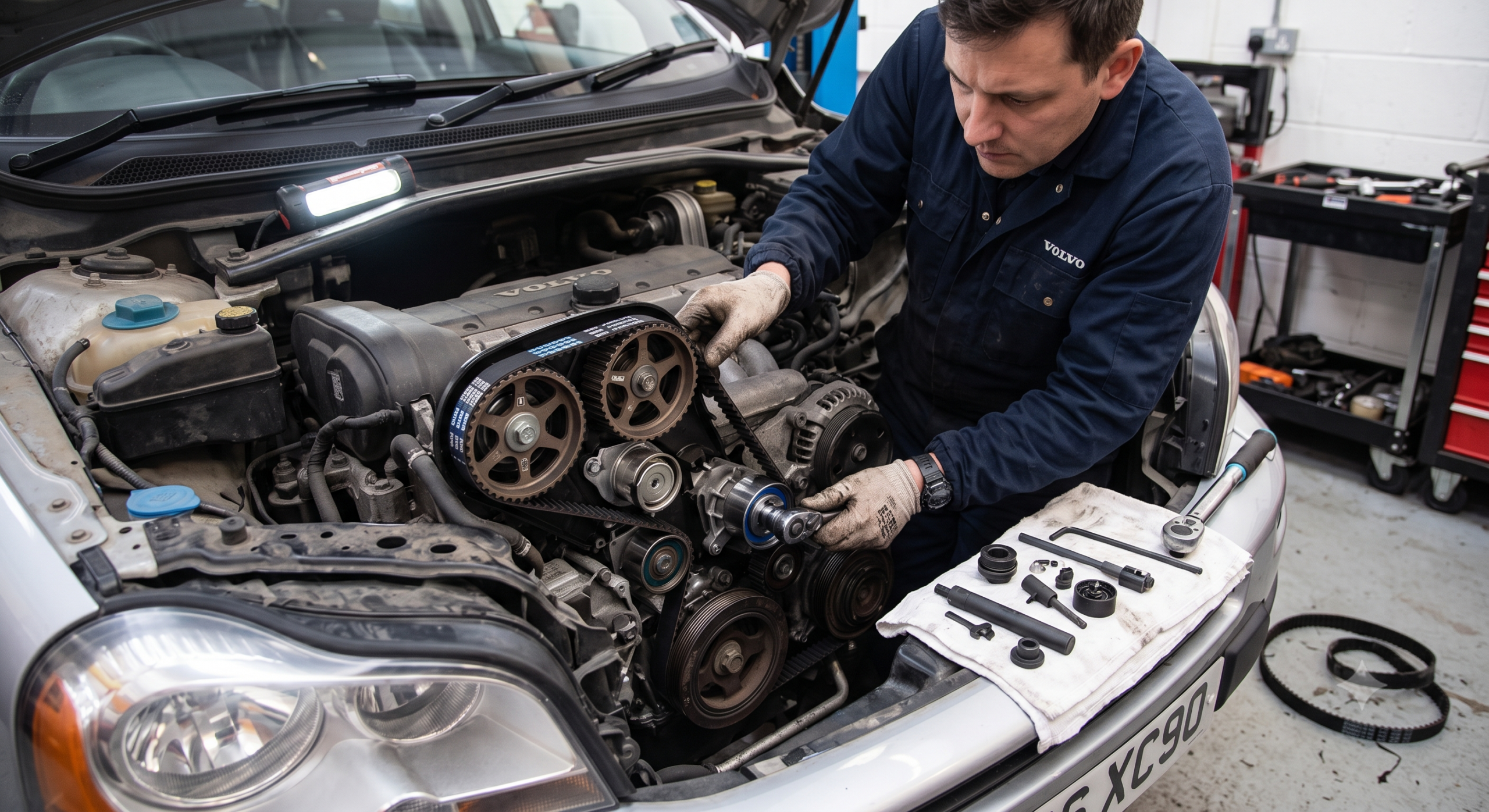
Beyond the belt itself, this job requires specialized tools and a full parts list, not just a wrench and an afternoon. A proper job includes Volvo special tools for locking the crankshaft and installing the front seal, along with genuine parts for the tensioner, idler bearing, and pulleys.
Real-world tip from someone who’s done it: mark the cam and crank pulley positions with a sharpie or nail polish before removing anything. Owners who’ve done this repeatedly say marking is easier to see and trust than trying to read the factory-stamped timing marks, especially for the pulley mark that’s hardest to spot.
Choose the DIY route if: you’ve done timing belt jobs before, have a full day free, and are comfortable working with precise torque specs and alignment marks. Choose a shop for this if: it’s your first interference-engine timing job, or you don’t have access to Volvo-specific locking tools.
Step-by-Step Overview: Changing the Timing Belt
- Disconnect the battery negative cable before touching anything in the engine bay.
- Remove the front underbody guard and air ducting to access the front of the engine.
- Drain the coolant properly — don’t skip disposal, since it’s toxic.
- Remove the top timing cover and related sensor housings on both cam sides.
- Lock the crankshaft in position using the correct locking tool, turning it to align with the crankshaft stop.
- Remove the old belt, tensioner, and idler pulley together, keeping the new belt out of the way until you’re ready to route it.
- Route the new belt over the crank gear, idler pulley, cam pulleys, water pump, and finally the tensioner last, since it goes on tightest.
- Reinstall the tensioner and idler, aligning timing marks carefully on both cam pulleys before tightening anything fully.
- Rotate the engine by hand through two full rotations to confirm the timing marks stay aligned.
- Reassemble everything in reverse order, including the coolant refill and covers.
Quick Tip: Some owners skip removing the crank pulley entirely, instead pulling the lower plastic cover and walking the old belt off and the new one on — it’s tighter working space, but it saves a genuinely difficult extra step.
Should You Replace Anything Else While You’re In There?
Yes — and skipping this part is the most common regret owners mention. It’s standard practice to replace the timing belt, tensioner, idler pulley, and water pump together during this job, since they’re all exposed at the same time anyway.
Here’s the logic: you’re already paying in labor time (or your own Saturday) to get to these parts. Replacing a $40 water pump now costs almost nothing extra in labor; replacing it in six months means tearing the whole front of the engine apart again.
Pros and Cons by Owner Type
The confident home mechanic
- Pro: Doing it yourself can save hundreds of dollars in shop labor
- Con: A mistimed belt can silently cause engine damage that doesn’t show up until later
The first-time XC90 owner
- Pro: A shop with Volvo-specific tools reduces risk on a job with zero margin for error
- Con: Interference-engine timing jobs aren’t cheap — expect a real bill for parts and labor
The used-XC90 buyer with no service history
- Pro: Treating an unknown belt as “due now” protects you from a surprise engine failure
- Con: You’re paying for a job that might have already been done, just undocumented
FAQ
How do I know if my XC90 has a timing belt or a timing chain? Check your engine — the 2.5T and T6 (2.9L/3.2L twin-turbo six) run belts, while the standard 3.2L inline-6 and V8 engines run chains that don’t need scheduled replacement.
What happens if I ignore the timing belt interval? On these interference engines, a broken belt can bend the valves, resulting in a major engine repair rather than a simple belt swap.
Can I just replace the belt without the tensioner and water pump? You can, but it’s not recommended — those components are already exposed during the job, and replacing them together avoids paying for the labor twice.
How long does a Volvo XC90 timing belt job take? Experienced DIYers report finishing in around 2.5 hours, but plan for a full day if it’s your first time.
Is the Volvo XC90 T6 timing belt interval shorter than the 2.5T? Yes — the T6 is due at 105,000 miles, compared to roughly 120,000 miles (or longer on certain PZEV-classified five-cylinder models) for the 2.5T.
Key Takeaways
- Confirm your engine type first — chain-driven engines don’t need this job at all
- 2.5T belts are due around 120,000 miles; T6 belts are due sooner, around 105,000 miles
- These are interference engines, so a broken belt risks serious, expensive engine damage
- Replace the tensioner, idler pulley, and water pump alongside the belt while everything’s already apart
- Mark your timing positions with a sharpie or paint before disassembly for far easier reassembly
- If there’s no service record on a used XC90, treat the belt as overdue rather than assuming it’s fine
What To Do Next
Pull up your specific engine code and mileage against the intervals above, and if you’re within 10,000–15,000 miles of the limit — or have no service record at all — get this scheduled before it schedules itself.