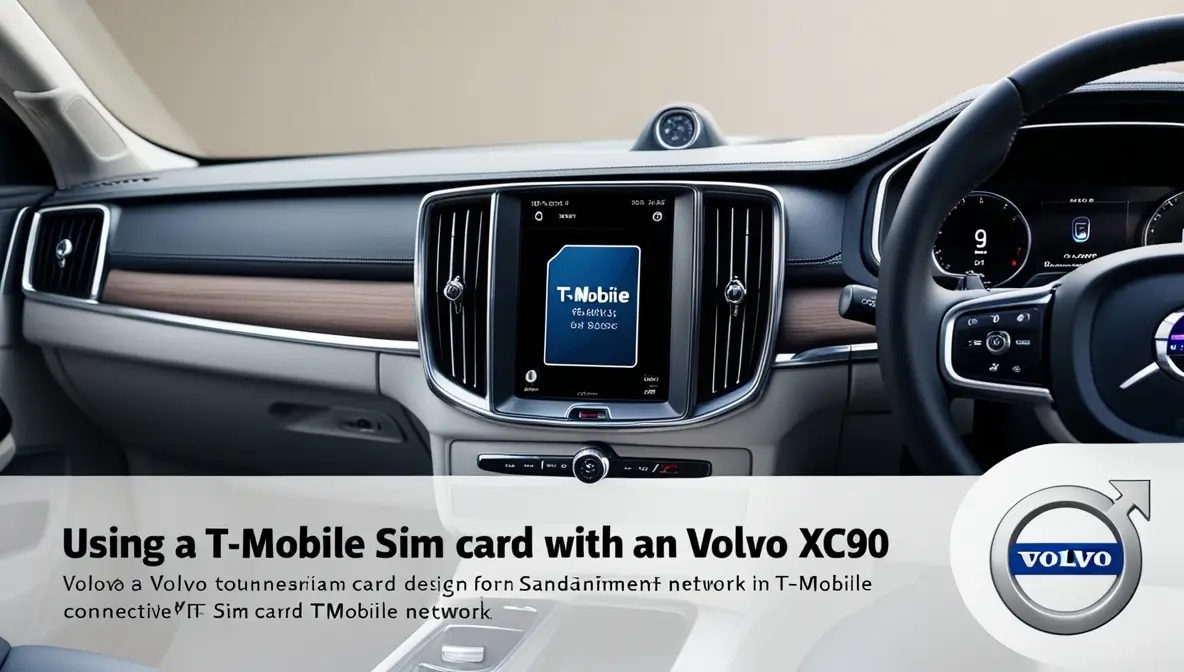
How to Use a T-Mobile SIM Card in a Volvo XC90 (Full Setup & APN Guide)

Using a T-Mobile SIM card in a Volvo XC90 provides native in-car Wi-Fi hotspot connectivity, Sensus connected apps (Spotify, Pandora, Weather), and live traffic updates without paying for expensive dealer data subscriptions. This setup is compatible with 2016–2022 XC90 models equipped with a physical micro-SIM card slot located in the cargo floor compartment. It requires a dedicated Mobile Internet (data-only) SIM card and proper APN configuration (fast.t-mobile.com).
2016–2022 XC90 (Sensus Connect)
Cargo Area Right-Side Floor Panel
fast.t-mobile.com (IPv4/IPv6)
T-Mobile Mobile Internet (Data-Only)
Why Use a T-Mobile SIM Card in Your Volvo XC90?
When purchasing a second-generation Volvo XC90 (2016–2022), many owners are shocked to discover that using in-car apps like native Spotify, Pandora, TuneIn Radio, and real-time weather alerts—as well as broadcasting a high-speed Wi-Fi hotspot for passenger tablets—requires an active cellular data connection. While dealerships often push high-cost OEM bundled data subscriptions running $25 to $40 per month through AT&T, the vehicle contains an unlocked cellular modem capable of running third-party data SIM cards.
T-Mobile is widely regarded by Volvo enthusiasts on SwedeSpeed and VolvoXC forums as the most economical and high-performing carrier for Sensus Connect. By adding a simple T-Mobile Mobile Internet line (often available for as little as $10/month on existing family plans), you gain robust 4G LTE coverage, high-speed streaming audio without phone tethering, and an onboard Wi-Fi hotspot for the entire family.
Select your mobile carrier and model year to generate exact APN connection strings, SIM slot locations, and network band specifications.
fast.t-mobile.com
Micro-SIM (3FF)
None / PAP
Trunk Floor Compartment
Hardware Requirements & SIM Card Sizing
Before touching your vehicle’s dashboard, it is vital to ensure you have the exact required SIM card hardware. Failure to use the proper card type will result in the SIM disappearing into the chassis or failing to establish a network handshake.
- SIM Card Form Factor: The Volvo XC90 modem utilizes a Micro-SIM (3FF) slot. Modern carrier SIM kits arrive as 3-in-1 punch-out cards. If your T-Mobile card is punched out to the smallest Nano-SIM size, you must use a rigid plastic Nano-to-Micro adapter. Warning: Never insert a loose nano-SIM without an adapter, as it can slide past the contact pins and become permanently wedged inside the modem assembly.
- Data Plan Type: Request a T-Mobile Mobile Internet (MI) Data-Only Plan or a Tablet Plan. Do not use an active phone voice line SIM card. Voice lines will be detected and blocked by T-Mobile’s IMEI profiling system.
- SIM PIN Verification: Ensure the SIM card does not require a PIN code on boot. If your carrier provided a PIN-locked SIM, insert it into a standard smartphone first, navigate to Cellular / Security Settings, and permanently turn off SIM PIN protection.
Step-by-Step Installation: Locating the Slot & Configuring APN
fast.t-mobile.com in all lowercase letters. Leave Username and Password completely blank. Set Authentication to None or PAP. Enable Data Roaming.Volvo Modem Specifications Across Generations
| Volvo Model Years | Cellular Hardware Type | SIM Card Slot Location | Compatible Plan Types | Supported Frequencies / Bands |
|---|---|---|---|---|
| 2016–2019 XC90 | 3G / 4G LTE Telematics Mod | Cargo floor right-hand side hatch | Data-only Mobile Internet (MI) | LTE Bands 2, 4, 12 (1900, 1700, 700 MHz) |
| 2020–2022 XC90 | Cat-4 LTE High-Speed Modem | Cargo floor right-hand side hatch | Data-only Mobile Internet (MI) | LTE Bands 2, 4, 12, 66 (Extended AWS) |
| 2023–2025 XC90 | TCAM eSIM (Android Auto OS) | Embedded Telematics Unit (No tray) | Volvo Digital Services Subscription | Full multi-carrier 4G/5G fallback |
Common Troubleshooting & Diagnostic Solutions
If you have installed the SIM card and completed the APN setup but the Sensus screen fails to connect, follow these diagnostic steps:
1. “No Network Available” or Crossed-Out Signal Bars
Turn off the vehicle, step out, lock the doors, and wait 5 minutes for the Central Electronic Module (CEM) to enter deep sleep. Unlock the vehicle, cycle the ignition, and check the top status bar. A valid cellular connection will display signal strength bars accompanied by a small globe or 4G icon.
2. Checking Modem Fuse
If the modem status remains permanently grayed out in Sensus, check the electrical fuse. In the rear cargo fuse panel, locate Fuse 5 (5A) which protects the Telematic Control Module. If blown, replace with a genuine automotive fuse.
Summary Verdict: Maximum In-Car Connectivity for Minimal Cost
Installing a T-Mobile SIM card in your 2016–2022 Volvo XC90 transforms your vehicle into a dedicated high-speed mobile hotspot while powering native streaming apps and live cloud navigation for a fraction of the dealer subscription cost. With the correct fast.t-mobile.com APN and a data-only line, your Scandinavian sanctuary remains fully connected wherever your adventures lead.
Volvo Telematics Modem Architecture & T-Mobile LTE Frequency Bands
To establish a reliable 4G LTE data connection using a T-Mobile SIM card in a Volvo XC90, understanding the vehicle’s internal cellular modem hardware is essential. Second-generation XC90 models (SPA platform, 2016–2022) utilize a factory telematics module engineered by Sierra Wireless / Telit, integrated into the Infotainment Head Unit (IHU) and connected to the high-gain roof shark-fin antenna via dual coaxial low-loss cables.
T-Mobile’s nationwide LTE network operates across specific radio frequency bands. The Volvo factory modem supports the primary bands required for high-speed connectivity:
- Band 2 (1900 MHz PCS): Core urban and suburban LTE coverage providing high bandwidth for audio streaming and map rendering.
- Band 4 / Band 66 (1700/2100 MHz AWS): Primary metropolitan high-density data network.
- Band 12 (700 MHz Block A): T-Mobile’s extended-range low-band LTE frequency, essential for signal penetration through concrete parking structures and rural highway corridors.
Deep Dive: Access Point Name (APN) Configuration & IP Addressing
When you insert a standard retail T-Mobile SIM card into the XC90’s trunk card reader, the modem will often establish an active radio link with the cell tower but fail to transmit data packets. This occurs because Volvo Sensus defaults to generic carrier APN profiles. To enable bidirectional IP routing, you must manually calibrate the Access Point Name:
- Navigate to Settings > Communication > Car Modem Internet on the 9-inch center touchscreen.
- Select Access Point Name (APN) and enter:
fast.t-mobile.com(all lowercase, no spaces). - Ensure the Username and Password fields are left completely blank. T-Mobile authenticates data sessions directly via the SIM card’s unique IMSI (International Mobile Subscriber Identity) chip.
- Set Authentication Type to
NoneorPAP. - Set IP Protocol to
IPv4/IPv6. If your Spotify or TuneIn apps fail to stream music while Google Maps works, force the protocol toIPv4, as legacy QNX multimedia daemons can struggle with pure IPv6 routing.
Managing In-Car Wi-Fi Hotspot & Client Device Bandwidth
Once your T-Mobile SIM card is actively routing data, the XC90’s integrated 2.4 GHz 802.11b/g/n Wi-Fi router broadcasts a private cabin network capable of supporting up to eight simultaneous devices. To optimize performance and prevent rapid data throttling:
Under Settings > Communication > Car Wi-Fi Hotspot, configure a robust WPA2-PSK security passphrase. If passengers are streaming high-definition 4K video on tablets, T-Mobile’s automated network management may deprioritize your in-vehicle connection after 50GB of monthly data consumption. Limiting streaming apps on connected tablets to 720p or 1080p guarantees sustained bandwidth for the vehicle’s critical native apps.
Frequently Asked Questions