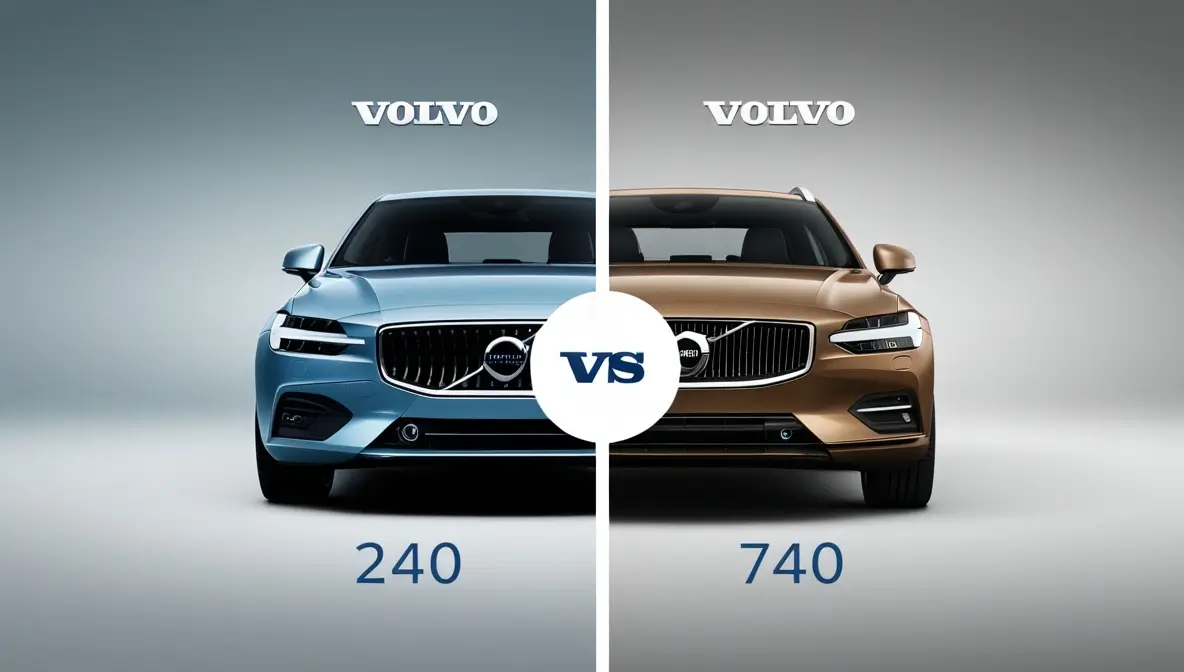
Volvo 240 vs 740: A Comprehensive Comparison of Iconic Swedish Engineering

Remember that boxy tank-like car your college professor drove? You know, the one that seemed to survive everything from snowstorms to fender benders without a scratch? Chances are it was either a Volvo 240 or 740. These Swedish workhorses didn’t just set the standard for safety – they became cultural icons that still turn heads today.
Wondering which of these Swedish classics might be right for you? While the 240 earned its reputation as the ultimate “professor’s car” with its utilitarian charm, the 740 stepped things up with a dash of luxury without sacrificing that legendary Volvo reliability. Let’s dive into what makes each model special.
🚗 Quick Fact: Both the 240 and 740 are known as “redblock” Volvos due to their distinctive red-painted engine blocks!
Overview of the Volvo 240 and Volvo 740
Introduction to the Volvo 240 (1974-1993)
Picture this: It’s 1974, and Volvo dropped what would become one of the most recognizable cars ever made. The 240 burst onto the scene like a Swedish tank wrapped in a family car’s body. With its distinctive shape that screamed “safety first, style… well, maybe third or fourth,” it quickly became the go-to choice for practical-minded drivers.
The 240 came in two main flavors: a sturdy sedan and a cavernous wagon that could swallow everything from IKEA furniture to camping gear. Under the hood, you’d find engines ranging from modest 4-cylinders to peppier turbocharged versions that could make this brick move quickly.
💡 Pro Tip: Looking for a 240? The post-1981 models got better rust protection and improved electronics.
What made it special? Three things stand out:
- Built like a tank (seriously, these things regularly hit 300,000 miles)
- Simple enough that you can fix most issues with basic tools
- Heated seats standard (in 1974!) because, well, Sweden
Introduction to the Volvo 740 (1984-1992)
Enter the 740 – Volvo’s attempt to say, “Hey, we can do luxury too!” Launched in 1984, it was like the 240’s more sophisticated cousin who studied abroad. While keeping the family’s boxy DNA, the 740 smoothed some rough edges and added more comfort.
The 740 grabbed attention with its cleaner lines and upmarket feel. The Turbo models were particularly special, offering surprising performance that could catch several BMWs off guard at stoplights.
Feature 240 740
Design Style Pure utility Refined utility
Target Market , Practical professors Upscale families
Standard Features Basic but bulletproof More luxurious
Performance (Base) Adequate More Responsive
Exterior Design and Body Structure
Volvo 240 Exterior Characteristics
The 240’s design is about as aerodynamic as a brick. But that’s part of its charm! The front end features what fans lovingly call the “coffin hood” – a long, flat surface that makes spotting a 240 as easy as finding a penguin in the desert.
The body panels were thick enough to survive a minor apocalypse, and the paint quality was surprisingly good for its era. Key design elements that made the 240 distinctive include:
- Upright greenhouse with excellent visibility
- Chrome bumpers that could double as park benches
- Those iconic square headlights (post-1981)
🔧 Fun Fact: The 240’s front end was designed with so much crushed space mechanics that it could survive a collision with a small planet!
Volvo 740 Exterior Characteristics
Think of the 740 as the 240 after a makeover show. It kept the family resemblance but added some style. The wider stance and slightly lower roofline gave it a more modern appearance, while better aerodynamics meant it didn’t create its weather system at highway speeds.
Notable improvements over the 240 included:
- Better door seals that kept water outside where it belongs
- Improved rust protection (though still check those wheel wells!)
- Slimmer pillars for a more contemporary look
Interior Features and Comfort
Volvo 240 Interior Features
Ever sat in a Swedish living room from the 1970s? That’s pretty much what the 240’s interior feels like. These cabins were built with a “function over flash” mindset that would make Marie Kondo proud. Everything has its place, and while it might not be fancy, it sure is practical.
The seats deserve special mention – they’re surprisingly comfortable for long trips. Notable interior features include:
- Heated front seats (way ahead of its time!)
- Simple, easy-to-read gauges
- Enough headroom for a family of giants
🛋️ Pro Tip: If you find a 240 with intact door pockets, buy a lottery ticket – you’re having a lucky day!
The dashboard might look basic by today’s standards, but everything is where you need it. No need to dive through seventeen menus just to turn on the defroster. Fair warning: those plastic bits can get brittle with age, so handle them carefully!
Volvo 740 Interior Features
The 740’s interior is like the 240’s after it got promoted and started shopping at higher-end stores. Luxury touches become immediately apparent:
- Real wood trim (on GLT models)
- Power everything (when it works!)
- Climate control that controls the climate
The cabin feels noticeably more upscale, with better sound insulation and more comfortable seating. Ironically, some folks find the 240’s seats more comfortable – go figure!
Interior Feature 240 740
Seat Comfort Surprisingly Good More Adjustable
Dashboard Basic but Functional and More Sophisticated
Noise Level Chatty Library-Like
Space Usage Efficient Slightly More Cramped
Performance and Engine Specifications
Engine Options and Configurations for Both Models
Let’s talk about what’s under those long, flat hoods. Both models share some engine DNA, most notably the legendary “redblock” engine family. The B230F engine became the gold standard – reliable enough to make Toyota engineers nod in approval.
Here’s a fun comparison of power outputs:
- Base 240: “Eventually” mph
- Turbo 240: “Oh, actually pretty quick!” mph
- Base 740: “Respectable” mph
- Turbo 740: “Wait, was that a Volvo that just passed me?” mph
🏎️ Quick Fact: The turbocharged versions of these cars were faster than many sports cars of their era – just don’t tell the insurance company!
Transmission Choices
Both cars came with manual and automatic transmissions, though finding a manual these days is like finding a unicorn who speaks Swedish. The 740’s overdrive was a game-changer for highway cruising, turning these boxes into surprisingly decent road trip companions.
Manual transmission fans note that the M46 manual in these cars is smoother than butter on a hot Swedish pancake. The automatics? They’re… reliable, let’s say. They won’t win any races but probably outlive us all.
Safety and Durability
Safety Features in the 240 vs. 740
If there’s one thing Swedes know besides meatballs and flat-pack furniture, it’s safety. Both cars were built like medieval fortresses but with more crumple zones and fewer drawbridges.
The 240’s safety innovations were groundbreaking for its time:
- Crumple zones front and rear
- Side impact protection
- Three-point seatbelts that work
The 740 took these features and added:
- Better structural reinforcements
- More sophisticated crash protection
- Improved side impact resistance
🛡️ Safety Fact: Both models were so safe that insurance companies often gave discounts for driving one!
Longevity and Reliability Comparison
These cars don’t just age – they evolve. It’s common to see both models with odometer readings that look like phone numbers. Key durability factors:
In the 240:
- Engine block stronger than Viking resolve
- Simple electronics that rarely fail
- Rust-resistant body (except in the Rust Belt, where everything rusts)
In the 740:
- More sophisticated but still reliable
- Better rust protection
- More complex electronics (both a blessing and a curse)
Cost of Ownership and Maintenance
Typical Maintenance Issues in the 240
Owning a 240 is like having a very low-maintenance pet rock – it doesn’t ask for much, but you should probably check on it occasionally. Common maintenance points:
- Suspension bushings (they eventually remember they’re made of rubber)
- Fuel injection system (mostly just needs cleaning)
- Door hinges (a bit of oil keeps them happy)
🔧 Money-saving tip: Learn to do basic maintenance yourself – these cars are LEGO sets for adults!
Typical Maintenance Issues in the 740
The 740 requires a bit more attention, like a cat that’s learned to appreciate the finer things in life. Watch out for:
- Electronic gremlins (especially in the climate control)
- Power window regulators
- More expensive parts overall
Market Value and Collectibility
Market Value Trends for the Volvo 240
The 240 has achieved something remarkable – it’s become cool. Yes, that brick-shaped car your professor drove is now considered hip. Value trends show:
- Clean wagons commanding premium prices
- Turbo models becoming legitimate collectibles
- Original low-mileage examples reaching surprising values
Market Value Trends for the Volvo 740
The 740 sits in an interesting spot – not quite as collectible as the 240, but still desirable for the right buyer. Market highlights:
- Turbo models hold value best
- Wagon versions are preferred over sedans
- Original condition matters more than with 240s
💰 Investment Tip: Look for well-maintained Turbo wagons – they’re the sweet spot for future value!
Remember, whichever model you choose, you’re not just buying a car – you’re joining a community of enthusiasts who appreciate these Swedish tanks for what they are: incredibly well-built machines that refuse to die, no matter how many times you forget to change the oil.
Choose the 240 if you want:
- Ultimate simplicity
- Easier DIY maintenance
- More “classic” appeal
Go for the 740 if you prefer:
- More modern amenities
- Better highway manners
- A touch more sophistication
Either way, you’ll have a car that’ll probably outlast your next three relationships combined!
Real-World Performance and Daily Usability
Daily Driving Experience
Let’s talk about what it’s really like to live with these Swedish bricks. The 240 drives exactly like it looks – sturdy, predictable, and as exciting as a documentary on paint drying. But that’s not a bad thing! It’s like that reliable friend who always shows up to help you move.
The 240’s driving characteristics:
- The steering feels like a workout (no power steering in early models)
- Acceleration is more of a suggestion than a command
- Braking is surprisingly good for its era
The 740, meanwhile, feels more refined:
- Lighter steering feel
- Better highway stability
- More responsive throttle (especially in turbo models)
🚘 Daily Driver Tip: Both models make excellent year-round cars, but the 740 Turbo wagon is the ultimate Swiss Army knife of vehicles!
Winter Performance
If you’ve ever wondered why Swedes are so good at winter sports, just drive one of these cars in the snow. Both models handle winter conditions like they were born in an igloo.
Winter driving comparison:
Feature 240 740
Snow Traction Excellent Very Good
Heater Efficiency Sauna-like More Even
Cold Start Reliable Very Reliable
Defrost Speed Quick Quicker
Modification Potential
Popular Upgrades and Modifications
Here’s where things get interesting. Both models have huge aftermarket support, and you’d be surprised what these boxy beauties can do with a few tweaks.
Popular 240 mods:
- Engine swaps (everything from V8s to electric conversions)
- Suspension upgrades
- Turbo additions to non-turbo models
🔧 Mod Tip: The 240’s engine bay is so spacious that owners joke about installing a small apartment there!
740 modification trends:
- Performance chip tuning (especially for turbos)
- Improved intercoolers
- Suspension lowering kits
Community and Support
One of the best parts about owning either car is the community. Volvo enthusiasts are known for:
- Extensive online forums
- Regular meetups and shows
- Sharing maintenance tips and parts
Special Editions and Rare Variants
Unique 240 Models
Some 240 variants are rarer than a Swedish summer day. Notable special editions:
- 242 GT (the sporty one)
- 240 Turbo Evolution (homologation special)
- Canadian market “Export” models
Rare 740 Variants
The 740 had its share of special models, too:
- 740 GLE with the V6 engine
- Turbo+ models with factory upgrades
- Limited edition trim packages
🏆 Collector’s Corner: The rarest 240 variant is the 242 Group A Homologation car – only 500 were made!
Practical Considerations
Cargo Capacity and Utility
Both cars are practical enough to make a pickup truck jealous. The wagon versions can handle:
- Full-size appliances
- The entire dorm room moves
- Enough groceries to survive an apocalypse
Family-Friendly Features
These cars were designed with families in mind:
- Rear-facing third row in wagons
- Child seat anchors (ahead of their time)
- Excellent visibility for new drivers
Making Your Choice
When choosing the 240
Go for the 240 if you:
- Love the classic “brick” aesthetic
- Enjoy working on cars yourself
- Want maximum DIY potential
- Need a reliable daily driver
- Appreciate mechanical simplicity
When to Choose the 740
The 740 might be your better bet if you:
- Want more modern amenities
- Prefer better highway manners
- It is a bit more luxury
- Need better performance
- Value quieter operation
Future Classic Status
Investment Potential
Both models are gaining recognition as future classics, but in different ways:
- 240s are already appreciating, especially clean wagons
- 740 Turbos are starting to follow suit
- Both benefit from increasing interest in ’80s and ’90s cars
💎 Investment Insight: Original, unmodified examples of either model are becoming increasingly valuable!
Ownership Experience
The First Three Months
What to expect when you first buy one:
- Initial maintenance catch-up
- Getting used to the quirks
- Finding your local Volvo specialist
- Joining owner groups
Long-Term Relationship
Over time, you’ll discover:
- These cars become part of the family
- They’re conversation starters
- You’ll develop a weird pride in their boxiness
- You’ll probably want to buy another one
Final Thoughts
Whether you choose the charming simplicity of the 240 or the refined comfort 740, you’re getting a piece of automotive history that’s more reliable than your grandmother’s cookie recipe. These cars aren’t just transportation – they’re rolling proof that good design never goes out of style, even if that design happens to be shaped like a box.
Remember, the best choice depends on your specific needs and preferences. But one thing’s for certain: either way, you’ll end up with a car that’ll probably still be running long after we’ve all switched to flying cars!
🌟 Final Pro Tip: Whichever model you choose, find the best-maintained example you can afford. These cars are tough, but a well-cared-for example will save you money in the long run!