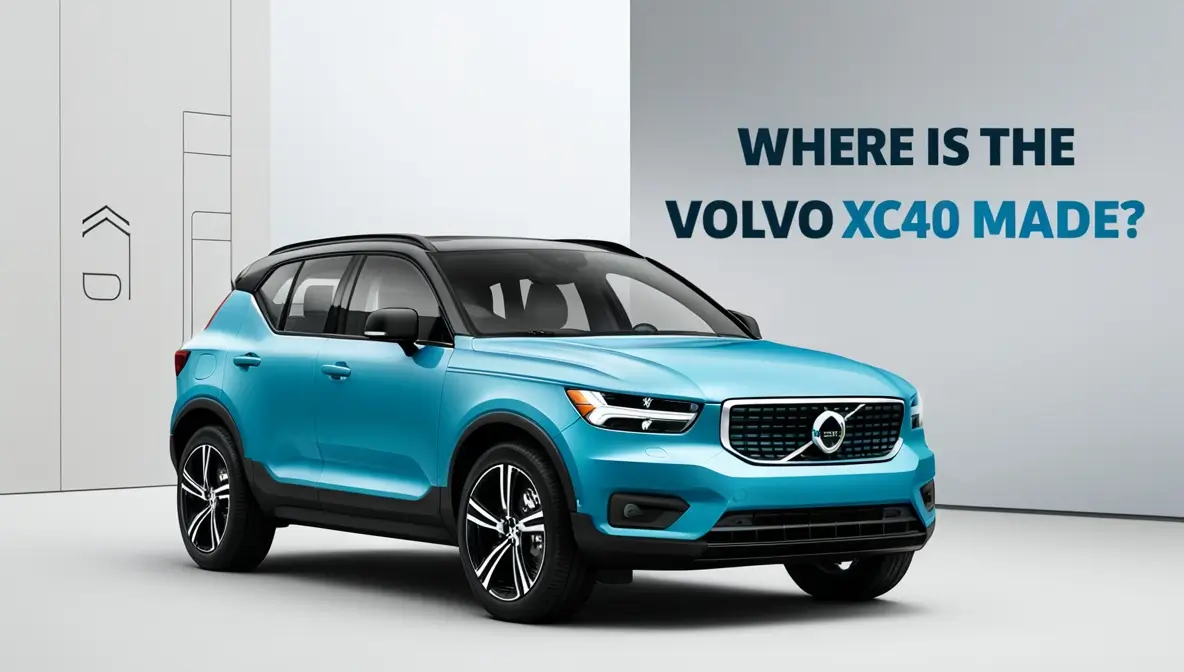
Where Is the Volvo XC40 Made?

Where Is the Volvo XC40 Made? (Every Factory, Explained)
You’re considering one of Volvo’s best-selling cars and a reasonable question surfaces: where on earth is this thing actually built? It’s a fair thing to want to know — especially if you care about trade tariffs, import duties, quality consistency, or simply satisfying your curiosity.
The short answer: most Volvo XC40s sold in Europe and North America are made in Ghent, Belgium. But depending on which variant you’re buying and which market you’re in, your XC40 may have a very different passport.
TL;DR
- The primary XC40 production plant is in Ghent, Belgium — where the one-millionth XC40 rolled off the line in 2024.
- A second production site in Luqiao (Taizhou), China serves the Asian market.
- A smaller assembly operation exists in Shah Alam, Malaysia for Southeast Asian markets.
- The XC40 is Volvo’s second-best-selling car globally, behind only the XC60.
- The car is Swedish in design and heritage, but Belgian in assembly for most buyers.
The Main Factory: Ghent, Belgium
For buyers in Europe, the US, and most global markets, the XC40 is made in Ghent, Belgium — and has been since the model launched.
Only seven years after assembling the first-ever XC40, the Ghent manufacturing plant in Belgium reached the milestone of producing its one-millionth XC40/EX40, illustrating the lasting global success of the model and Volvo’s strategy to build cars where it sells them.
The Ghent plant in Belgium, fully owned by Volvo Cars since 1972 and opened in 1965, specializes in compact and electric models. It has an annual capacity of around 280,000 units and features solar energy systems generating significant renewable power.
That’s not a satellite assembly shed — it’s one of Volvo’s most significant manufacturing sites, and the XC40 has been its flagship product.
The Ghent plant is the beating heart of XC40 production — and it has built over a million of them.
The Ghent plant produces the XC40 and XC40 Recharge, the V60 Cross Country, the C40 Recharge, and the fully electric EX30. So if you’re buying an XC40 in the UK, Germany, France, the US, Canada, or Australia, the odds are very high it rolled off the Belgian line.
The Second Factory: Luqiao (Taizhou), China
For buyers in China and parts of the Asian market, a different factory handles production.
XC40s for the Chinese market are built at a manufacturing plant in Luqiao, south of Shanghai, which is owned by Geely and operated by Volvo Cars. This brings XC40 production closer to the Chinese market and follows Volvo’s stated strategy to “build where you sell.”
The Luqiao plant in Taizhou, operational since 2019 and fully owned by Volvo since 2021, is dedicated to EV production on the Compact Modular Architecture (CMA) platform. It assembles the XC40 Recharge and Polestar 2.
Interestingly, the Luqiao plant also shares its production line with models from Lynk & Co and Polestar — all built on the same underlying CMA platform that underpins the XC40. It’s a bit like a shared commercial kitchen producing dishes for three different restaurants.
The Third Location: Shah Alam, Malaysia
There’s a third assembly site that doesn’t get much attention but is worth knowing about.
The Shah Alam plant in Malaysia, operational since 1967, is Volvo’s first assembly facility in Asia. It focuses on meeting regional demand through semi-knocked-down (SKD) and completely knocked-down (CKD) assembly processes. This plant assembles models including the XC40, C40 Recharge, and EX30, with local EV production starting in 2022, and exports to Southeast Asian markets including the Philippines and Vietnam.
This is a smaller-scale regional operation rather than a full global export hub — its role is primarily to minimize import duties for buyers in Southeast Asia and serve local markets more efficiently.
Where Is the XC40 Made? Full Summary by Market
| Your Market | Where Your XC40 Is Likely Made |
|---|---|
| Europe (UK, Germany, France, etc.) | Ghent, Belgium |
| United States & Canada | Ghent, Belgium |
| China | Luqiao (Taizhou), China |
| Southeast Asia (Malaysia, Philippines, Vietnam) | Shah Alam, Malaysia |
| Rest of Asia | Luqiao, China |
(As of 2025 — market allocations can shift; check VIN documentation for certainty)
Who Designed and Owns Volvo?
This trips people up, so here it is clearly.
Volvo Cars is owned by the Chinese Zhejiang Geely Holding Group Co., Ltd., but they work with Volvo Cars more as a technological partnership, with the Swedish brand maintaining a high level of design and manufacturing independence.
Volvo’s headquarters, design studios, and engineering operations remain in Gothenburg, Sweden — the city where the company was founded in 1927. The XC40 was conceived, designed, and engineered in Sweden. It just happens to be built primarily in Belgium.
Swedish soul. Belgian hands. That’s the XC40.
Geely’s ownership has actually enabled Volvo to expand its electric lineup faster than it could have independently — the shared CMA platform used by the XC40 was co-developed with Geely, which is why a Polestar and a Lynk & Co can roll off the same production line in China.
Real-World Scenario: Does It Matter Where Your XC40 Was Built?
Imagine you’re a buyer in London comparing two XC40s at different dealerships. Both have the same spec, the same warranty, the same service intervals. One was built in Ghent, one came from Luqiao. Is there a practical difference?
For quality and reliability: no meaningful difference. Volvo has made considerable investments in transforming Volvo Car Ghent into a global export hub, and the plant already produced more than 175,000 fully electric versions of the XC40/EX40 family. Both facilities follow identical Volvo quality standards.
Where it can matter: EU import tariffs on Chinese-made electric vehicles, introduced in 2024, can affect pricing on Chinese-built EVs sold into Europe. A Belgian-built XC40 Recharge avoids that tariff entirely. Worth checking with your dealer which production origin applies to the specific car you’re buying.
Expert Insight: You can identify where a specific car was built from its VIN (Vehicle Identification Number). The first character indicates the country of manufacture: “Y” = Sweden or Belgium (Volvo-specific prefix differs), “L” = China. Your dealer can decode this for you in under a minute.
The Ghent Plant: More Than Just an Assembly Line
It’s worth spending a moment on Ghent, because it’s genuinely impressive.
The Ghent plant has an annual capacity of around 280,000 units and features solar energy systems generating significant renewable power to enhance environmental performance.
The XC40 has been among Volvo’s three best-selling models since its introduction. In 2023, the XC40 was the second-best-selling Volvo, surpassed only by the XC60, and it held that position through the first nine months of 2024.
The Ghent facility was also upgraded to begin producing the fully electric EX30 from early 2025 — a sign that Volvo is doubling down on Belgium as its European EV manufacturing base.
Quick Tip: If you’re buying a new XC40 in Europe and want to confirm Belgian assembly, look for “Assembled in Belgium” on the vehicle’s certificate of conformity — the document that comes with every new car sold in the EU.
Pros & Cons by Buyer Perspective
For European Buyers
Belgian Production ✅
- No EU import tariffs (unlike Chinese-built equivalents).
- Short supply chain from factory to European dealerships.
- One of Volvo’s most experienced and highest-output plants.
Consideration ❌
- Components are still globally sourced — the “European” label applies to final assembly, not every part.
For US and Canadian Buyers
Belgian Import ✅
- Ghent is Volvo’s primary global export hub for the XC40 — cars are shipped directly to North America.
- No additional country-of-origin concerns for US trade policy (as of 2025).
- Same build quality as European-market cars.
Consideration ❌
- The XC40 does not currently qualify for the US federal EV tax credit, since it’s not assembled in North America. Buyers looking for that credit should look at the EX90 (South Carolina) instead.
For Southeast Asian Buyers
Malaysian Assembly ✅
- Locally assembled cars avoid heavy import duties, which can significantly reduce the on-road price.
- Faster delivery and easier parts availability in the region.
Consideration ❌
- SKD/CKD assembly means components arrive from elsewhere and are assembled locally — some buyers prefer fully factory-built vehicles.
The XC40 Platform: What It Shares and With Whom
The XC40 is built on Volvo’s Compact Modular Architecture (CMA), co-developed with Geely.
The XC40, Lynk & Co 01, and Polestar 2 are all based on the CMA platform co-developed with Geely. The Luqiao plant builds all three models of three different brands on a single production line.
This platform sharing is exactly how modern automotive manufacturing works — it’s how Volvo keeps the XC40 competitively priced while delivering genuine premium build quality. Think of it like how different airlines fly the same Boeing jet: the platform is shared, but the experience inside is distinctly their own.
FAQ
Is the Volvo XC40 made in Sweden? Not currently. The XC40 is primarily assembled in Ghent, Belgium. Volvo’s Swedish Torslanda plant in Gothenburg focuses on larger models like the XC60 and XC90.
Is the Volvo XC40 made in China? Some versions are. XC40s for the Chinese market are produced at the Luqiao plant in Taizhou. European and North American buyers receive Belgian-built cars.
Does the Volvo XC40 qualify for the US EV tax credit? No — as of 2025, the XC40 Recharge is assembled in Belgium, not the US, and therefore does not meet the North American assembly requirement for the federal EV tax credit. The EX90, built in South Carolina, does qualify.
Who owns the Ghent plant where the XC40 is made? Volvo Cars has fully owned the Ghent facility since 1972. It is not a joint venture — it is a wholly owned Volvo manufacturing plant.
How can I find out where my specific XC40 was built? Check the VIN on your vehicle’s documentation or ask your dealer for the certificate of conformity. The VIN’s country code will confirm the assembly location.
Key Takeaways
- The Volvo XC40 is primarily made in Ghent, Belgium — Volvo’s main global export hub for compact models.
- Over one million XC40/EX40 units have been built in Ghent since the model launched.
- A second factory in Luqiao, China produces XC40s for the Asian market.
- A smaller assembly plant in Shah Alam, Malaysia serves Southeast Asian buyers.
- The XC40 is Swedish in design, Belgian in production (for most markets), and Chinese-owned at the corporate level.
- The XC40 Recharge does not qualify for the US federal EV tax credit due to its non-US assembly location.
What to Do Next
If you’re shopping for an XC40 and the production location matters to you — whether for tax reasons, tariff concerns, or simply preference — ask your dealer to show you the certificate of conformity before you commit. It takes about 30 seconds and gives you the definitive answer for that specific car. For US buyers chasing an EV tax credit, a conversation with a Volvo dealer about the EX90 might also be worth your time.