Does the Volvo XC60 Have Parking Sensors?

You’re backing into a tight downtown spot, glancing between mirrors, guessing at inches — and wondering why your dashboard isn’t beeping like your last car did. The answer to whether your XC60 should be beeping depends on something most buyers never check on the window sticker: which sensors came with your specific trim.
TL;DR
- Yes, the Volvo XC60 has parking sensors — Volvo calls the full system Park Assist, and it covers front, rear, and side detection.
- Rear sensors are essentially a given across the range; front sensors have historically been inconsistent trim to trim, even within the same model year.
- Sensors are automatically active below 10 km/h (6 mph), with the rear also triggering if the car simply rolls backward.
- Warning tones get faster and more urgent as you close in — a continuous tone under 30 cm (1 foot), escalating to a rapid pulse under 25 cm.
- A 360° camera view with color-coded sensor overlays is available on higher trims, layering visual confirmation on top of the beeps.
The Quick Answer
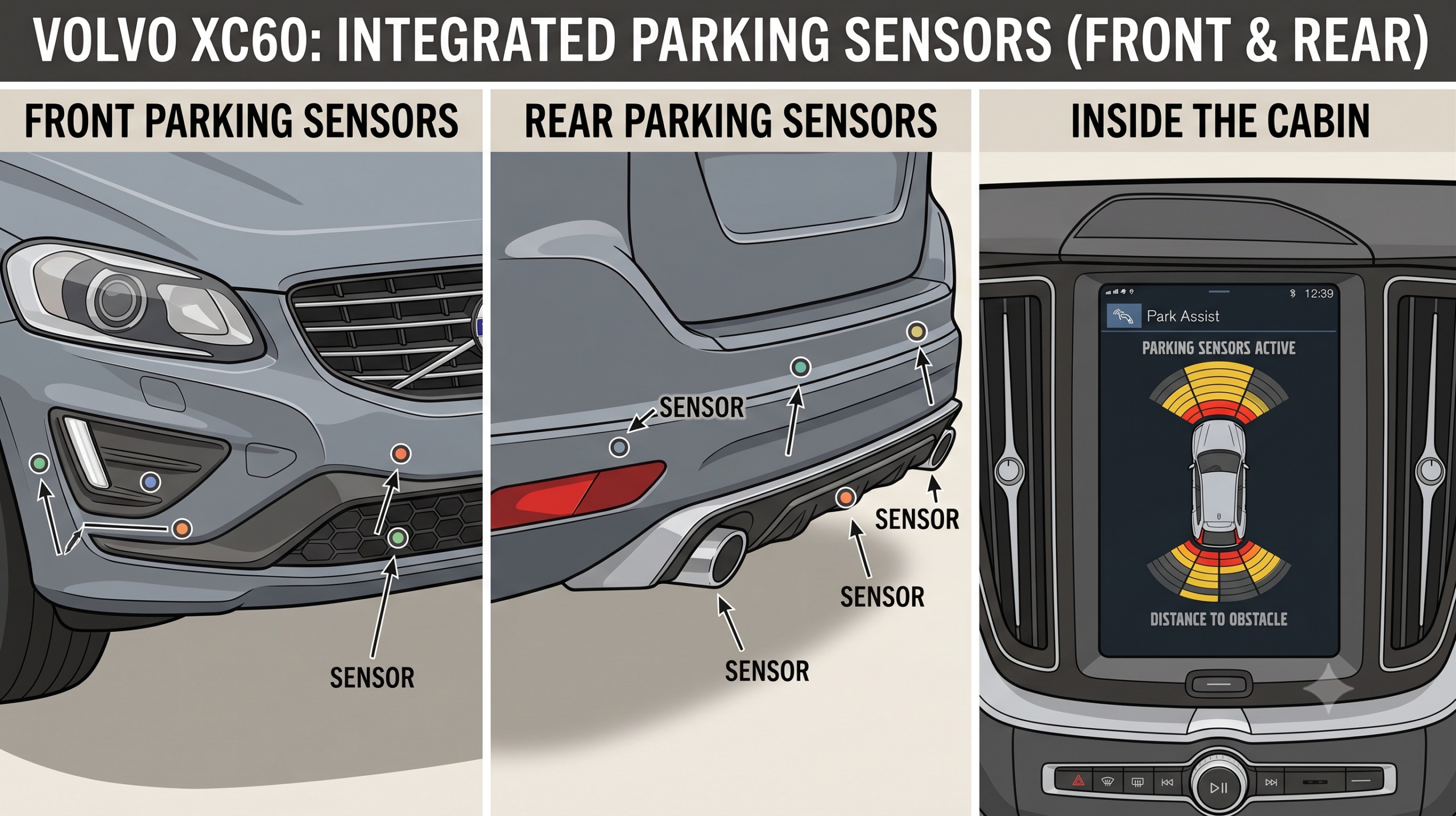
Yes, the Volvo XC60 comes with parking sensors as part of Volvo’s Park Assist system, which uses front, rear, and side sensors to warn you of nearby obstacles with sound and an on-screen display. Rear sensors are close to universal across XC60 trims, but front sensors have not always been standard — some Core-trim XC60s from the same model year have shipped with front sensors included, while others required a roughly $200 add-on. If having front coverage matters to you, it’s worth confirming on your specific build sheet rather than assuming.
How Park Assist Actually Works on the XC60
Front, Rear, and Side Coverage — Each With Its Own Rules
Volvo’s Park Assist isn’t one blanket system; each zone behaves a little differently. The front sensors activate automatically the moment you start the engine and stay active below 10 km/h (6 mph), monitoring roughly 80 cm (2.5 feet) ahead of the vehicle.
The rear sensors are more reactive — they switch on if the car starts rolling backward or when reverse gear is engaged, covering about 1.5 meters (5 feet) behind you. The side sensors cover a tighter 25 cm (0.8 feet) along the sides, but that range jumps up to about 90 cm (3 feet) diagonally once you turn the steering wheel, which is exactly when you’re most likely to clip a curb or a neighboring car.
Quick Tip: If you’re towing, know that the rear sensors automatically deactivate when a trailer is wired into the car’s electrical system. Towing with an aftermarket hitch accessory that isn’t wired in (like a bike rack) can trigger false alerts, so you may need to switch parking assistance off manually.
The Warning System Gets More Urgent as You Get Closer
Volvo tuned the audio feedback to escalate with proximity, which matters more than it sounds like it should when you’re focused on mirrors instead of a beep pattern. You’ll hear a steady, continuous tone once you’re within about 30 cm (1 foot) of an obstacle, which then shifts to a fast, intense pulse inside 25 cm (0.8 feet) — the “stop now” signal.
Expert Insight: New owners often mistake the front sensor beeping for a malfunction when parallel parking, since it’s easy to forget the front zone is live any time you’re under 6 mph, not just when backing up. It’s working correctly — it’s just watching both ends of the car at once.
Why Front Sensors Are the One to Double-Check
This is the detail that trips people up. Owner reports on Volvo forums describe identical Core-trim XC60s from the same model year where some window stickers listed front parking sensors as standard, and others listed the exact same feature as a roughly $200 optional add-on. Rear sensors, by contrast, are consistently included. If front coverage is a priority — say, for tight garage parking or nose-forward parallel spots — it’s worth confirming on the build sheet or window sticker rather than assuming trim level guarantees it.
Real-world scenario: A shopper comparing two nearly identical Core-trim XC60s at different dealerships finds one has front sensors baked in and the other lists them as a line-item option — same trim name, same model year, different actual equipment. That’s not a pricing error; it’s a documented equipment inconsistency worth asking about directly before you sign.
Comparison Table: Sensor Coverage by Feature
| Zone | Detection Range | Activation | Typical Availability |
|---|---|---|---|
| Front sensors | ~80 cm (2.5 ft) | Automatic, engine on, under 6 mph | Standard on most trims; has varied on some Core builds |
| Rear sensors | ~1.5 m (5 ft) | Reverse gear or rolling backward | Standard across nearly all trims |
| Side sensors | ~25 cm (0.8 ft), up to 90 cm (3 ft) diagonally when turning | Automatic, engine on, under 6 mph | Included with Park Assist package |
| 360° camera overlay | Visual, color-coded per sensor | Reverse gear or manual activation | Available on higher trims (Plus/Ultimate) |
Pros and Cons by Driver Type
The Tight-Garage or City Parker
- ✅ Front and side coverage together catch the two spots drivers misjudge most — nose clearance and diagonal swing while turning.
- ✅ The escalating tone genuinely helps you gauge distance without staring at a screen.
- ❌ If your build lacks front sensors, you’re back to guessing on nose-in parking exactly where it matters most.
The Frequent Trailer or Bike-Rack User
- ✅ Automatic deactivation with a properly wired trailer prevents constant false alarms.
- ❌ Aftermarket accessories without Volvo-genuine wiring can trigger false readings, requiring manual shutoff — an easy thing to forget before a trip.
The Visual Learner Who Distrusts Beeps Alone
- ✅ The 360° camera’s color-coded overlay turns an abstract tone into an actual picture of what’s close.
- ❌ That camera view is generally tied to higher trims, so it’s an added cost if your base trim doesn’t include it.
FAQ
Q: Does every Volvo XC60 trim have front parking sensors? A: Not reliably. Rear sensors are close to universal, but front sensors have varied even within the same trim and model year — check the specific build sheet.
Q: At what speed do the XC60’s parking sensors turn on? A: Front and side sensors activate automatically once the engine starts and remain active below about 10 km/h (6 mph). Rear sensors activate specifically with reverse gear or if the car rolls backward.
Q: Will my XC60’s parking sensors work while towing? A: Rear sensors automatically deactivate when a trailer is wired into the car’s electrical system, to avoid false alerts from the trailer itself.
Q: What’s the difference between Park Assist sensors and the 360° camera? A: The sensors provide audible distance warnings via front, rear, and side detection. The 360° camera, available on higher trims, adds a visual overlay showing exactly where each sensor is detecting something.
Q: Why do my front sensors keep beeping when I’m not backing up? A: That’s expected behavior — front sensors are live any time you’re moving under about 6 mph, not just in reverse, so slow forward maneuvers near obstacles will trigger them too.
Key Takeaways
- The Volvo XC60 has a full Park Assist system covering front, rear, and side sensors, not just a rear backup sensor.
- Rear sensor coverage is essentially guaranteed; front sensor inclusion has varied by build even within the same trim.
- Sensors activate automatically under 10 km/h (6 mph), with escalating audio warnings as you close in on an obstacle.
- Towing with a properly wired trailer automatically disables rear sensors to prevent false alerts.
- A 360° camera view on higher trims adds visual confirmation on top of the audio warnings.
Next Step
Before you finalize a trim, ask your dealer to confirm front parking sensor inclusion in writing on the build sheet — it’s the one piece of Park Assist that isn’t guaranteed just because you picked a certain trim name.