How to Change the Battery on a Volvo XC60?

Your XC60 won’t start, or you’re seeing a dim dashboard and a “Start/Stop Unavailable” message that wasn’t there last week. Before you assume the worst, know this: on a modern XC60, the battery might not even be under the hood — and that single detail trips up more DIYers than the actual swap does.
TL;DR
- Battery location depends on generation: first-gen XC60s (2010–2017) keep it in the engine bay; second-gen models (2018–present) often move it to beneath the rear cargo floor.
- Mild hybrid trims (B5/B6) have two batteries — the standard 12V and a separate 48V lithium-ion unit near the spare tire well.
- Always disconnect the negative terminal first, then positive; reverse the order when reinstalling.
- A “battery registration” reset is often needed afterward so the charging system knows a new battery is installed — skipping it isn’t dangerous, but it isn’t ideal either.
- Expect to re-enter a radio security code and lose some presets once the terminals are disconnected.
The Quick Answer
Yes, you can change the battery on a Volvo XC60 yourself with basic tools, but the process depends heavily on your model year. Older (2010–2017) XC60s keep the battery in the engine bay under a cover; 2018-and-newer models frequently relocate it beneath the rear cargo floor, and mild hybrid versions add a second 48V battery entirely. Get the location and battery type wrong and you’ll waste an afternoon looking in the wrong spot.
Step 1: Confirm Your Battery Location Before You Start
First-Generation XC60 (2010–2017): Engine Bay
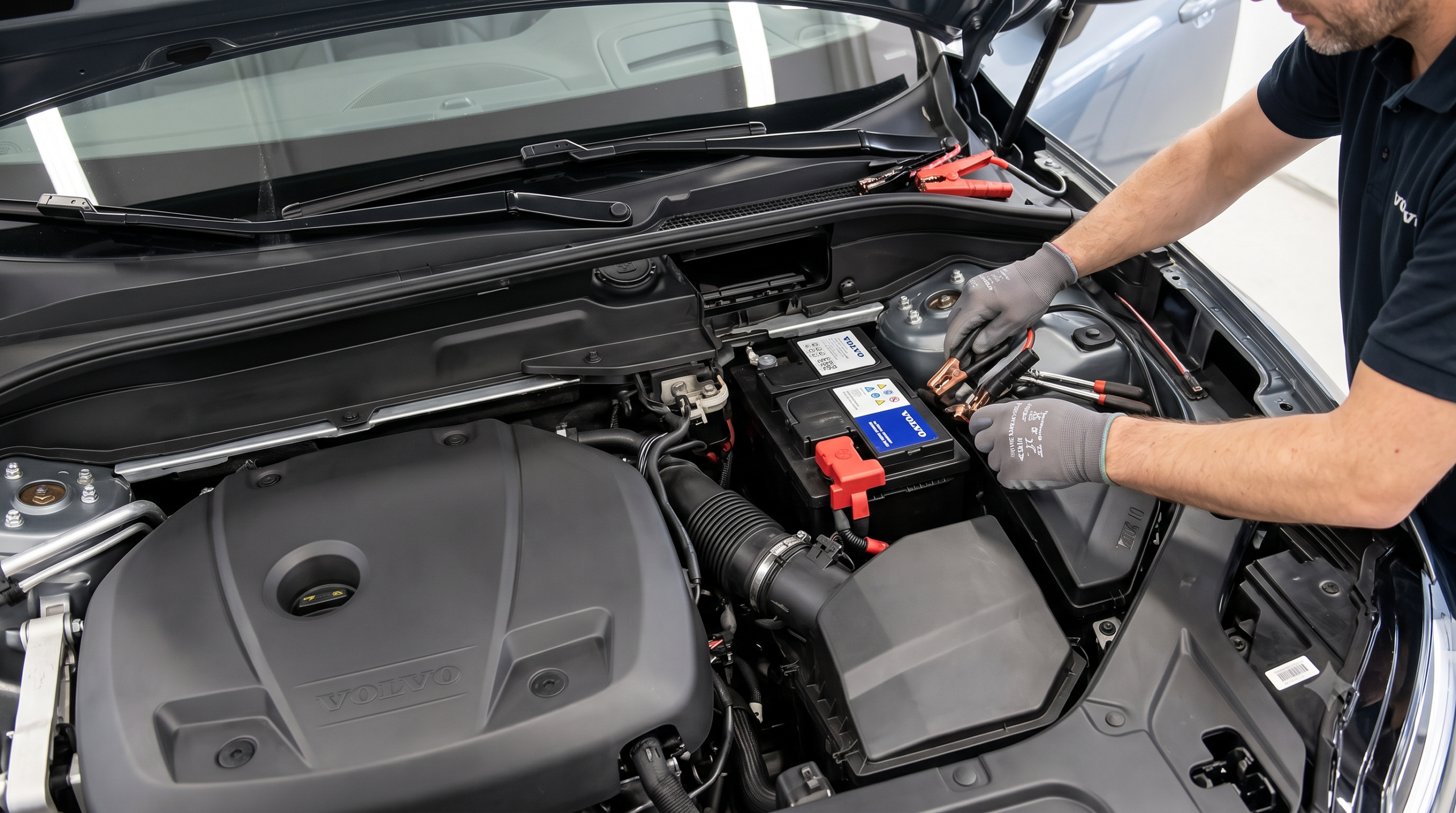
On these model years, the 12V battery sits toward the back of the engine bay under a protective cover and rubber molding. Lift the hood, remove the cover, and you’ll find the battery directly accessible with a socket wrench.
Second-Generation XC60 (2018–Present): Often Under the Rear Cargo Floor
This is where owners get stuck. In many second-gen XC60s — especially all-wheel-drive and higher trims — the 12V battery relocates beneath the rear cargo floor or behind trunk-area panels, not under the hood at all. You’ll need to lift the trunk mat and unscrew or unclip a plastic housing to reach it.
Quick Tip: If you pop the hood on a newer XC60 and see no obvious battery, don’t assume something’s broken. Check the trunk floor first — it’s the single most common reason people think their XC60 “doesn’t have a visible battery.”
Mild Hybrid Trims: Two Batteries, Not One
B5 and B6 mild hybrid XC60s add a 48V lithium-ion auxiliary battery, typically located near the spare tire well or an underfloor compartment, which powers the Integrated Starter Generator responsible for regenerative braking and smooth engine restarts. The standard 12V battery still handles ignition and electronics separately.
Expert Insight: Replacing only the 12V battery while ignoring a failing 48V unit is a common cause of a “Start/Stop Unavailable” warning that persists even after installing a brand-new 12V battery. If the warning won’t clear, the 48V system is worth checking before you assume the new battery is defective.
Step 2: Confirm the Right Battery Type and Size
Before buying anything, check your battery’s group size, cold cranking amps (CCA), and reserve capacity — this information is in your owner’s manual, or a dealer can pull it from your VIN. Volvo vehicles generally use one of three battery types: PowerFrame, Enhanced Flood, or AGM, and getting the wrong type can cause charging or fitment issues even if the physical size matches.
Owners on Volvo forums have reported successfully using non-OEM equivalents (Interstate, Duralast, and similar mainstream brands) as long as the group size, CCA, and voltage match the original spec — you don’t have to pay dealer prices for a comparable battery.
Step 3: Remove and Replace the Battery
- Park on level ground, engage the parking brake, and turn off the engine and all electronics.
- Put on gloves and safety glasses — corroded terminals can flake acid residue.
- Disconnect the negative (black) terminal first, then the positive (red) terminal, loosening each with a wrench.
- Remove any mounting bracket or strap holding the battery in place, note the terminal orientation, and lift the old battery out.
- Clean the battery tray if there’s any corrosion, using a baking soda and water mixture if needed.
- Set the new battery in the same orientation, reconnect the mounting hardware, then reconnect positive first, negative last — the reverse order from removal.
Quick Tip: Take a photo of the terminal layout and any hoses or wiring near the battery before you disconnect anything. It sounds unnecessary until you’re reinstalling and can’t remember which clip went where.
Step 4: Handle the Post-Installation Details
Real-world scenario: An owner swaps their own battery, starts the car, and everything seems fine — until the radio asks for a security code they’ve never used, and the Start/Stop system stays greyed out for days afterward. Neither issue means the job was done wrong; both are normal side effects of disconnecting the terminals.
- Radio security code: Disconnecting the battery often clears radio presets and may prompt for a security code, usually found on a sticker or card in your owner’s manual.
- Battery registration: Volvo’s charging system ideally needs to be told a new battery is installed so it charges at the correct rate for a fresh battery, which typically requires a compatible scan tool or a dealer visit. Skipping this isn’t dangerous, and many owners report no noticeable issues, but it’s a loose end worth tying up eventually.
- Start/Stop system: If it stays disabled after a straightforward 12V swap, double-check the 48V auxiliary battery on mild hybrid trims before assuming the new battery is faulty.
Comparison Table: DIY vs. Dealer Battery Replacement
| Factor | DIY Replacement | Dealer/Shop Replacement |
|---|---|---|
| Cost | Battery only: roughly $180–$300 for AGM | Battery + labor: often $100–$250 extra, sometimes $550+ at dealer pricing |
| Time | 20–45 minutes, longer on rear-cargo-floor layouts | Typically same-day |
| Battery registration reset | Requires your own scan tool or a follow-up visit | Included automatically |
| Best for | Comfortable working with hand tools, standard 12V swap | Mild hybrid systems, unclear “Start/Stop” faults, or no scan tool access |
Pros and Cons by Owner Type
The Confident DIYer
- ✅ Straightforward tools (10mm, 13mm sockets, basic wrench set) handle most of the job.
- ✅ Meaningful savings over dealer labor pricing, especially with a non-OEM equivalent battery.
- ❌ No built-in way to reset the battery registration without a scan tool of your own.
The Mild Hybrid (B5/B6) Owner
- ✅ Regenerative braking and smoother restarts are worth understanding, not just tolerating.
- ❌ Two-battery systems add real complexity — misdiagnosing which battery failed wastes time and money.
The First-Time Battery Swapper
- ✅ Older, engine-bay-accessible model years are genuinely beginner-friendly.
- ❌ Newer, rear-cargo-floor layouts are less intuitive and easy to misjudge without checking your specific model year first.
FAQ
Q: Where is the battery located on my Volvo XC60? A: It depends on model year — 2010–2017 models keep it in the engine bay, while many 2018-and-newer models relocate it beneath the rear cargo floor. Mild hybrid trims add a second 48V battery near the spare tire well.
Q: Do I need to reset anything after replacing the battery? A: Ideally yes — a battery registration reset tells the charging system a new battery is installed. It’s not dangerous to skip, but a dealer or compatible scan tool can complete it if you want it done properly.
Q: Why is my radio asking for a code after I replaced the battery? A: Disconnecting the terminals can trigger a security lockout on the radio. The code is typically found on a sticker or card included with your owner’s manual.
Q: Can I use a non-Volvo battery brand? A: Yes, as long as the group size, CCA, and voltage match your original specification — many owners successfully use mainstream brands rather than paying dealer prices for an OEM-branded battery.
Q: Why does my Start/Stop system stay disabled after a new battery install? A: On mild hybrid trims, this often points to the separate 48V auxiliary battery rather than the 12V unit you just replaced — worth checking before assuming the new battery is faulty.
Key Takeaways
- Battery location varies by generation — check whether yours is in the engine bay or beneath the rear cargo floor before starting.
- Mild hybrid B5/B6 trims have two separate batteries, and a persistent Start/Stop warning often points to the 48V unit, not the 12V.
- Disconnect negative first, reconnect positive first — the standard safety order.
- A battery registration reset and a radio security code are common, expected follow-ups, not signs something went wrong.
- Non-OEM batteries matching the correct group size and CCA are a legitimate, cost-saving alternative to dealer pricing.
Next Step
Before you buy a replacement battery, pull your VIN-specific spec (group size, CCA, and whether you have a 48V system) from your owner’s manual or a Volvo parts counter — getting that right the first time avoids a second trip entirely.