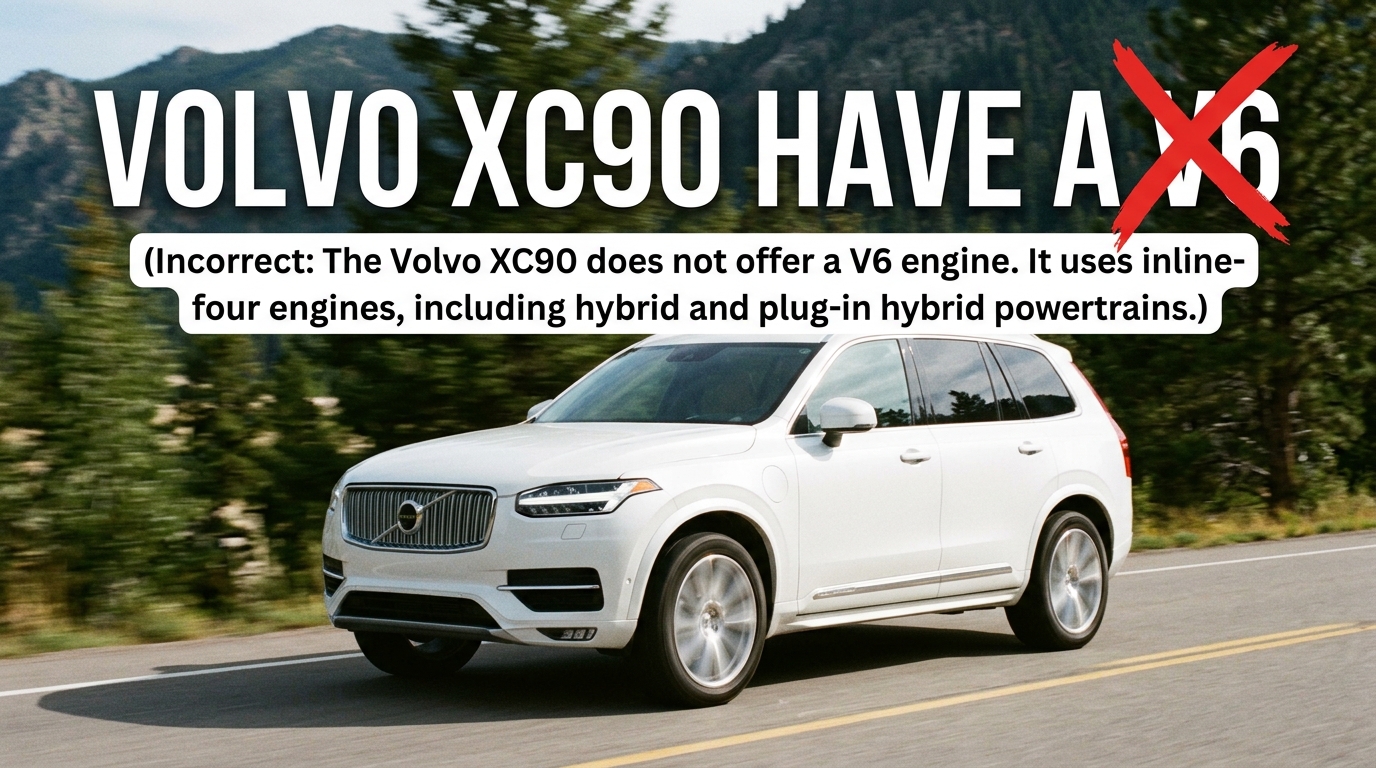
Does the Volvo XC90 Have a V6?

You’re comparing SUVs, someone mentions “V6 options,” and you assume the Volvo XC90 has one too — but when you check the specs, you can’t find it listed anywhere. That’s because you’re not missing anything.
TL;DR:
- No, the Volvo XC90 has never offered a true V6 engine
- The confusion usually comes from its inline-six engines (2.9L turbo and 3.2L naturally aspirated) or its Yamaha-built V8
- The first generation (2003–2014) offered inline-five, inline-six, and V8 options at different points
- The second generation (2015–present) uses turbocharged four-cylinder engines exclusively, including the plug-in hybrid T8
- If you want V6-like power, the modern B6 or T8 four-cylinder options come close or exceed it
Short answer: No, the Volvo XC90 does not have a V6 engine, in any model year. It’s had inline-five, inline-six, V8, and turbocharged inline-four engines, but a V6 has simply never been part of the lineup.
Why Do People Think the XC90 Has a V6?
The confusion makes sense once you see the engine names involved. The XC90 has offered both an inline-six (in “I6” or “SI6” form) and a V8, and it’s an easy mental shortcut to round those into “it probably has a V6 too” — but that engine layout was never actually offered.
Quick Tip: “Inline-six” and “V6” both have six cylinders, but the layout is completely different — inline-six cylinders sit in a single row, while a V6 splits them into two angled banks. The XC90 has only ever used the inline arrangement for its six-cylinder engines.
One especially confusing wrinkle: some online forums and listings for early first-generation XC90s use the phrase “XC90 V6” casually, even though the actual engine underneath is a 2.9-liter twin-turbocharged inline-six, not a true V6.
What Engines Has the Volvo XC90 Actually Had?
The full lineup spans four very different engine types across two decades. At launch, Volvo offered the 2.5T, a 2.5-liter turbocharged inline-five producing 208 horsepower, alongside the T6, a 2.9-liter twin-turbocharged inline-six producing 268 horsepower.
Two years later, Volvo added something entirely different. In 2005, Volvo debuted a Yamaha-designed 4.4-liter V8 producing 311 horsepower, which remained available through 2011 before being dropped from the lineup for 2012.
Volvo XC90 Engine Lineup by Generation
| Generation | Years | Engine Options | Layout |
|---|---|---|---|
| First (P2 platform) | 2003–2006 | 2.5T, T6 (2.9L twin-turbo) | Inline-5, Inline-6 |
| First (P2 platform) | 2005–2011 | 4.4L V8 | V8 |
| First (P2 platform) | 2007–2014 | 3.2L naturally aspirated | Inline-6 |
| Second (SPA platform) | 2015–present | B4, B5, B6, T8 (all 2.0L turbo) | Inline-4 |
Expert Insight: If you’re shopping used and see “XC90 T6” listed for a 2007-or-later model, don’t assume it’s the same 2.9L twin-turbo six as the early 2000s — Volvo reused engine naming conventions across very different actual engines over the years, so always check the liter size and cylinder count directly.
What Happened to the Six-Cylinder Engine?
Volvo swapped it for a different six-cylinder, not a V6. For 2007, Volvo dropped the turbocharged 2.9L inline-six and replaced the base engine with a 3.2-liter naturally aspirated inline-six producing 235 horsepower, paired with a six-speed automatic.
Here’s a real-world way to think about the shift: it’s less like Volvo added a new “type” of engine and more like swapping out one long, narrow six-cylinder engine for a slightly different long, narrow six-cylinder engine — same basic layout, different displacement and tuning approach.
Does the Current Volvo XC90 Have a V6 or V8?
No — the modern XC90 has moved entirely away from six- and eight-cylinder engines. Since its 2015 redesign, Volvo’s second-generation XC90 uses turbocharged 2.0-liter four-cylinder engines exclusively, across the B4, B5, B6, and T8 plug-in hybrid trims.
This is a deliberate, company-wide shift, not something unique to the XC90. Volvo built its Drive-E engine strategy around downsized, turbocharged four-cylinders across its entire lineup, prioritizing efficiency and electrification over larger, naturally displacement-heavy engines.
Choose the B6 if: you want strong four-cylinder power (295 horsepower) without the added cost or plug-in complexity of a hybrid. Choose the T8 if: you want the most power in the lineup (up to 455 horsepower combined) and don’t mind managing a plug-in hybrid system.
Is the V8 XC90 Worth Buying Instead?
If you specifically want a bigger, more traditional engine feel, the V8 first-generation model is the closest the XC90 ever got. That 4.4-liter Yamaha-built V8 was also used in the Noble M600 supercar, which says a lot about how capable the engine’s underlying design actually was.
But it comes with real trade-offs. This engine was only produced until 2010, and parts can be genuinely expensive — a new cylinder head runs around $4,000 and an ECU around $2,000, costs that can exceed what a used V8 XC90 itself is worth.
Pros and cons by buyer type:
The used-SUV bargain hunter
- Pro: V8 models can sell for $5,000 or less with high mileage
- Con: A single major repair can cost more than the car itself
The modern efficiency-focused buyer
- Pro: Current turbo four-cylinder engines deliver strong power with far better fuel economy
- Con: You lose the distinct V8 sound and character entirely
The Volvo enthusiast/collector
- Pro: The Yamaha V8 has a devoted following and genuinely interesting engineering pedigree
- Con: It’s a niche ownership experience that requires patience and a healthy repair budget
FAQ
Has the Volvo XC90 ever offered a V6 engine? No. It’s had inline-five, inline-six, V8, and turbocharged four-cylinder engines, but never a true V6 layout.
What’s the difference between the XC90’s inline-six and a V6? An inline-six arranges all six cylinders in a single straight row, while a V6 splits them into two angled banks — the XC90 has only ever used the inline layout for its six-cylinder engines.
When did the Volvo XC90 stop offering a V8? The 4.4L Yamaha-built V8 was dropped from the lineup for the 2012 model year.
Does the current Volvo XC90 offer any six-cylinder or V8 engine? No. Since the 2015 redesign, every XC90 has used a turbocharged 2.0-liter four-cylinder engine, including the plug-in hybrid T8.
Is the Volvo XC90 V8 reliable? It has a following for its engineering, but with production ending years ago, parts availability and cost are real concerns for anyone considering one today.
Key Takeaways
- The Volvo XC90 has never had a V6 engine in any model year
- Its six-cylinder options were always inline-six, not V6 — a 2.9L twin-turbo (2003–2006) and later a 3.2L naturally aspirated version (2007–2014)
- The 4.4L Yamaha V8 was offered from 2005 through 2011 before being discontinued
- Since 2015, every XC90 uses a turbocharged four-cylinder engine, including the T8 plug-in hybrid
- If you want V6-equivalent or better power today, the B6 or T8 are your closest modern options
- Watch trim naming carefully when shopping used — “T6” has referred to different actual engines over the years
What To Do Next
If six- or eight-cylinder power is what you’re really after, cross-shop a first-generation V8 XC90 against its ongoing parts costs before committing — otherwise, the modern B6 or T8 will likely serve you better long-term.
Editor Notes:
- Freshness note: Current-generation engine lineup (B4/B5/B6/T8) reflects the 2025–2026 model years; always confirm exact trim and engine offerings for the specific model year you’re shopping.
- Sources used: Wikipedia (Volvo XC90), FCP Euro generations guide, CarBuzz generation and Yamaha V8 history articles, J.D. Power model year history, Matthews Volvo Site, and Autopedia/Fandom XC90 reference page.
- Some real-world listings and forums use “V6” informally to describe the XC90’s inline-six engines; this article uses the technically accurate “inline-six” throughout, since the two layouts are mechanically distinct.