Where Is the Volvo XC60 Recharge Made?

You’re checking the window sticker on a Volvo XC60 Recharge and the “assembled in” line doesn’t say what you expected — Sweden, sure, but there’s more to this story, including a change coming soon that’ll surprise a lot of shoppers.
TL;DR:
- The Volvo XC60 Recharge is currently built primarily at Volvo’s Torslanda plant in Gothenburg, Sweden
- China’s Chengdu plant also produces XC60 units, mainly for markets outside the US
- Starting in late 2026, Volvo will begin building the XC60, including the Recharge plug-in hybrid, at its Ridgeville, South Carolina plant
- This will make the XC60 the second Volvo model actively produced in the US, alongside the electric EX90
- US-market XC60s have shifted production locations before, largely in response to tariffs
Short answer: Right now, your Volvo XC60 Recharge is most likely built at Torslanda, Sweden. That’s changing soon — Volvo is adding US production at its South Carolina plant starting in late 2026.
Where Is the Volvo XC60 Recharge Made Today?
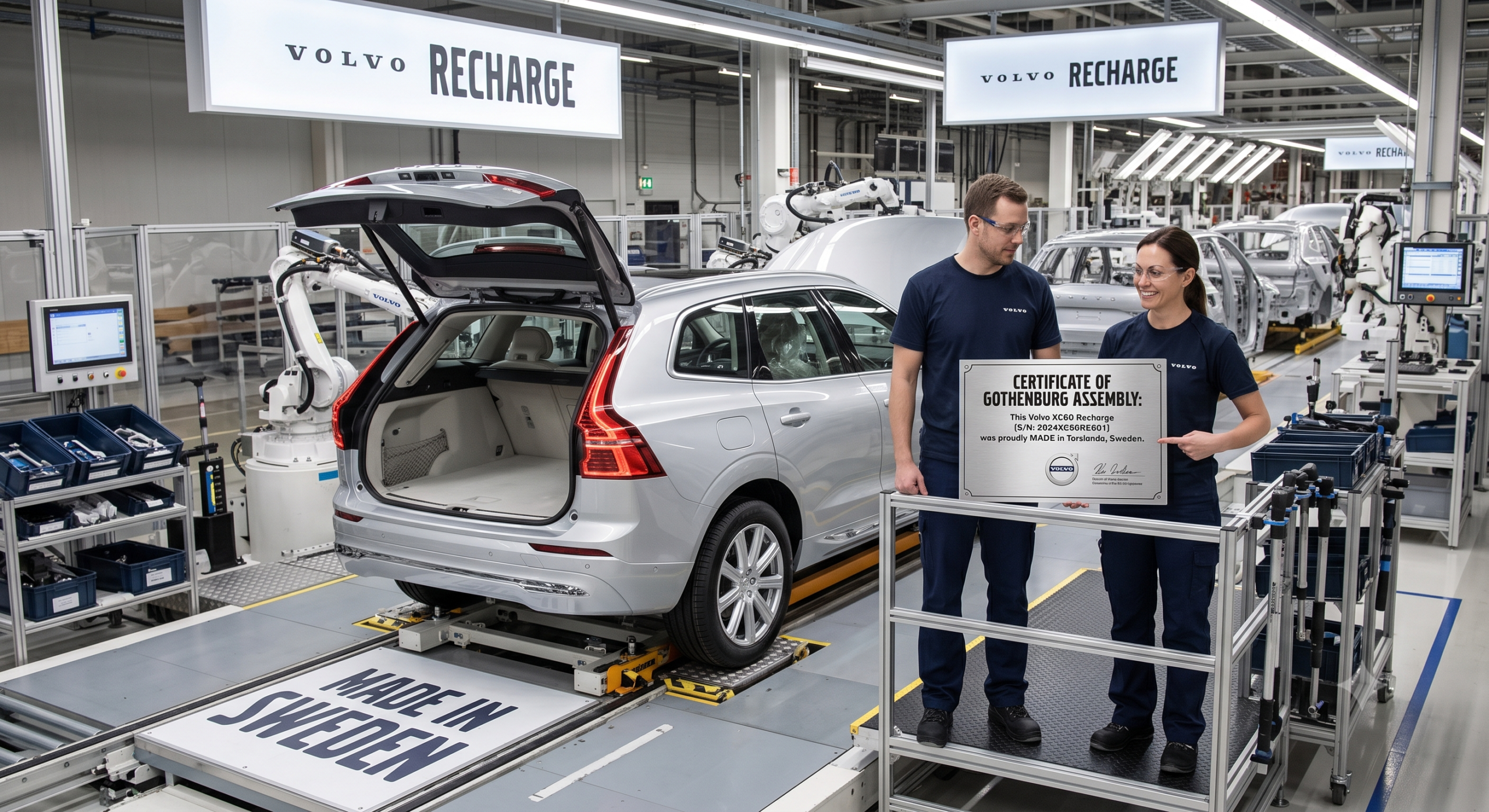
The XC60, including the Recharge plug-in hybrid version, is currently assembled primarily at Volvo’s Torslanda plant near Gothenburg, Sweden. This is Volvo’s largest and oldest manufacturing facility, and it’s where the vast majority of XC60s sold globally come from.
Quick Tip: If you’re looking at the window sticker or build sheet on a current XC60 Recharge, “Sweden” is the most likely country of origin you’ll see — though it’s always worth confirming on your specific VIN rather than assuming.
Is the XC60 Also Built Anywhere Else?
Yes — Sweden isn’t the only source. Volvo also builds the XC60 at its Chengdu plant in China, primarily to supply markets outside the United States.
This isn’t a new development. Volvo has used multiple global plants for the XC60 for years, largely because of just how popular the model is — it’s currently the company’s best-selling vehicle globally and in the US.
Current XC60 Recharge Production Locations
| Location | Role | Status |
|---|---|---|
| Torslanda, Sweden | Primary production plant | Active, ongoing |
| Chengdu, China | Supplies non-US markets | Active, ongoing |
| Ridgeville, South Carolina | US-market production | Starts late 2026 |
Has XC60 Production for the US Market Changed Before?
Yes, and understanding that history explains why the answer isn’t as simple as one country. Production of the XC60 started in Chengdu in 2013, with the vehicle also built at Volvo’s Torslanda, Sweden plant during that period.
Tariffs specifically drove a major shift. When 25% tariffs were placed on Chinese-made vehicle imports, Volvo shifted XC60 production for the US market to Europe, according to a report at the time, redirecting China’s output to other global markets instead.
Here’s a real-world way to think about it: Volvo essentially treats its factories like interchangeable kitchens making the exact same recipe — when tariffs made cooking in one kitchen too expensive for a particular customer, they simply started serving that customer from a different kitchen instead, without changing anything about the actual car.
Will the Volvo XC60 Recharge Be Made in the US?
Yes — and this is genuinely new information for anyone who researched this topic even a year ago. Volvo Cars will add its best-selling XC60 mid-size SUV, in both mild hybrid and plug-in hybrid form, to the production line at its Ridgeville, South Carolina plant, with production scheduled to start in late 2026.
This isn’t Volvo’s first US-built model. The Ridgeville facility currently assembles the fully electric EX90 SUV and the related Polestar 3, and it previously built the S60 sedan until that model was discontinued.
Expert Insight: Volvo has invested $1.3 billion in the Ridgeville plant over the past decade, including an expanded body shop, paint shop, and a dedicated battery pack production line — this isn’t a token assembly operation, it’s a full-scale manufacturing investment.
Why Is Volvo Moving XC60 Production to the US?
The move lines up with both business strategy and current trade pressures. Volvo has framed the shift as part of its ambition to build where we sell, and the timing lines up closely with rising tariff pressure on vehicles built in China and Europe for the US market.
The sales numbers back up why the XC60 specifically got this treatment. US sales of the XC60 rose almost 23% in the first half of 2025, with the model now accounting for roughly one out of every three Volvos sold in the country — making it too important to the US market to keep sourcing entirely from overseas.
Choose to wait for a US-built model if: buying American-assembled matters to you and you’re not in a rush — production doesn’t start until late 2026. Choose to buy now if: you want the current XC60 Recharge and don’t have a strong preference about assembly location, since the vehicle itself isn’t expected to change meaningfully in the switch.
Will the US-Built XC60 Recharge Be Different From the Current One?
Not in any major way that’s been announced. Volvo hasn’t revealed significant design changes for the US-built version, though buyers can expect the kind of updated tech and small refinements that typically come with any model-year update, rather than a fundamentally different vehicle.
The plug-in hybrid drivetrain itself is also well established at this point. The current XC60 Recharge T8 delivers 455 horsepower and 523 lb-ft of torque, with a 0-60 time of 4.5 seconds and roughly 35 miles of pure electric range — specs that reflect years of refinement on the same platform, regardless of which factory builds the specific unit.
Pros and Cons by Buyer Type
The “buy American” prioritizer
- Pro: A US-built XC60 Recharge will be available starting late 2026
- Con: You’ll need to wait, since current inventory is still Sweden- or China-sourced
The buyer who wants the vehicle now
- Pro: Current Sweden-built XC60 Recharge units are widely available today with no need to wait
- Con: You won’t have the option to specifically request a US-built unit until production ramps up
The tariff-conscious shopper
- Pro: US production should help stabilize pricing that’s been affected by import tariffs
- Con: Any near-term price benefit likely won’t show up until after production is fully established
FAQ
Is the current Volvo XC60 Recharge made in Sweden or China? Both, depending on the specific unit — Sweden’s Torslanda plant is the primary source, while China’s Chengdu plant supplies additional units, mainly for non-US markets.
When will the Volvo XC60 be made in the US? Production is scheduled to begin at Volvo’s Ridgeville, South Carolina plant in late 2026.
Why is Volvo moving XC60 production to the United States? It’s driven by both strategic goals to build closer to where vehicles are sold and by tariff pressures affecting vehicles imported from China and Europe.
Will a US-built XC60 Recharge be different from the current model? No major differences have been announced — expect the same core plug-in hybrid platform with typical model-year refinements.
Does the Volvo XC60 Recharge’s factory location affect its warranty or quality? Volvo uses standardized production processes across its global plants, so factory location alone shouldn’t be treated as a quality indicator.
Key Takeaways
- Today’s Volvo XC60 Recharge is built primarily in Torslanda, Sweden, with additional units from Chengdu, China
- US production begins in late 2026 at Volvo’s Ridgeville, South Carolina plant
- This move is driven by both sales strategy and tariff pressure, not a change to the vehicle itself
- The XC60 has shifted production locations before, largely in response to past tariff changes
- No major vehicle changes are expected with the shift to US assembly
- Always check your specific VIN or build sheet rather than assuming country of origin based on general reporting
What To Do Next
If assembly location matters to your purchase decision, ask your dealer directly which plant your specific XC60 Recharge came from — and if you specifically want a US-built unit, plan around the late-2026 production start rather than buying sooner.