How to Start a Volvo S60 Without a Working Key Fob?

Your S60 flashes “key not found” right as you’re already running late, and the fob in your hand feels as useless as a rock. Here’s the good part: Volvo built a backup into every keyless S60 for exactly this moment, and it doesn’t involve a tow truck.
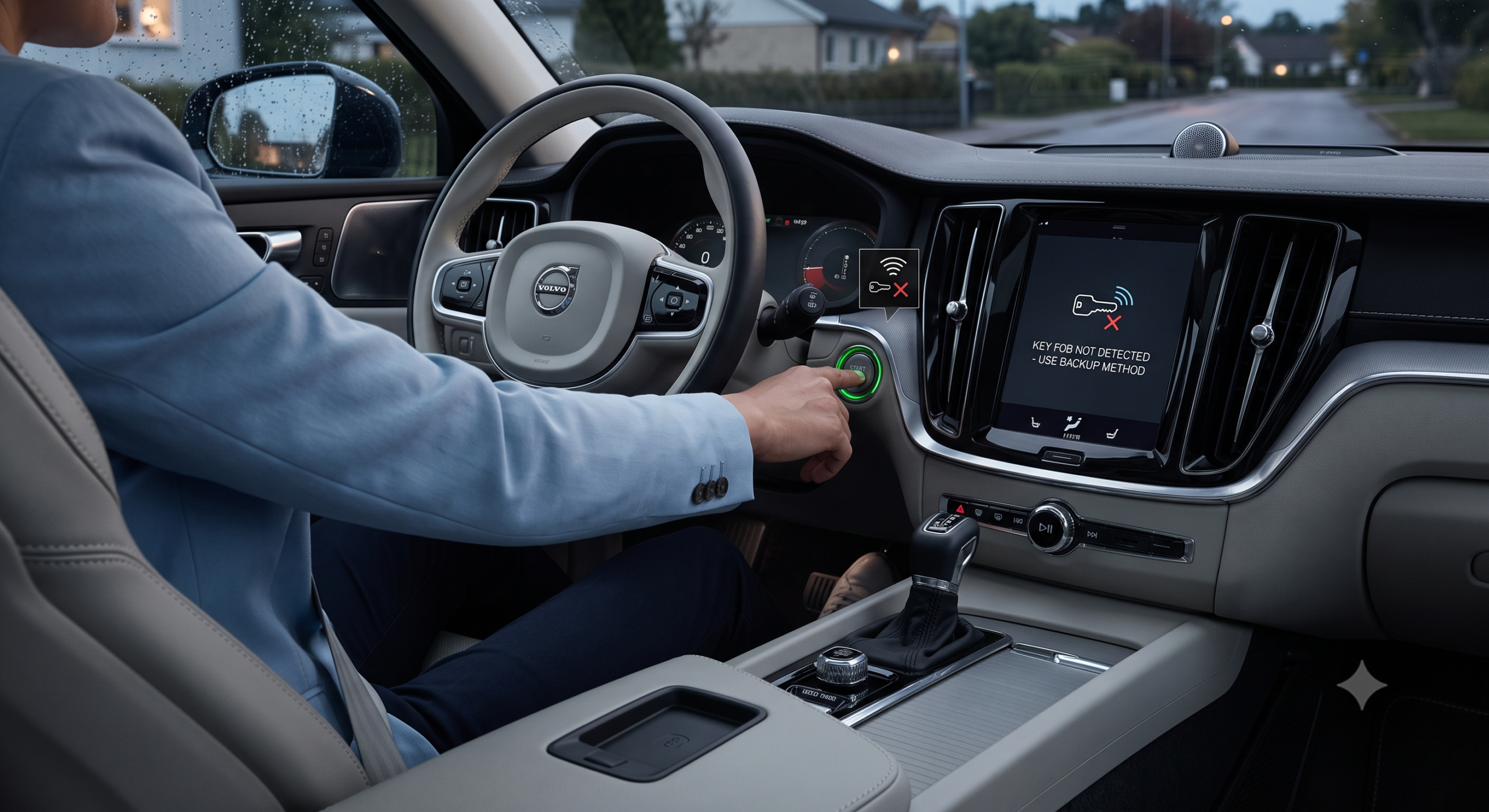
The short answer: every push-button-start Volvo S60 has a hidden backup that lets you start the car with a completely dead key fob battery. Which method you use depends on your S60’s generation — second-generation cars (2011–2018) use a dash-mounted key slot, while third-generation SPA-platform cars (2019 and newer) use an induction pad, usually in the cupholder or center console.
This guide is built from cross-referencing Volvo owner forums, dealership service explainers, and real reports from S60 owners who’ve been stranded by this exact issue, so you’re not guessing which method applies to your car.
TL;DR
- Every push-button S60 has a mechanical key blade hidden inside the fob for unlocking the driver’s door when the remote won’t respond.
- 2011–2018 S60s start by inserting the whole 5-button smart key into a dedicated slot on the dashboard.
- 2019+ S60s start by resting the dead fob on a marked backup reader pad, usually near the cupholders or center console.
- A dead fob battery does not disable the car — it just switches you from wireless to close-range RFID communication.
- If neither backup method works, the issue is more likely a drained 12-volt battery or a faulty antenna than the fob itself.
Why a Dead Fob Doesn’t Strand Your S60
Volvo’s keyless system runs on two separate technologies stacked inside one fob: a battery-powered radio signal for long-range unlocking, and a passive RFID chip that needs no battery at all. <cite index=”21-1″>The RFID chip inside the fob can be read by a loop of wire built into the car, which wirelessly energizes the chip through induction and provides enough power for it to send a signal confirming authorization to start the engine</cite>.
That’s the entire trick — your S60 was designed from the factory to work even with a completely dead fob, as long as you can get the key close enough to the right spot.
Quick Tip: If your dash shows a low key-battery warning before it dies completely, don’t ignore it. Some owners get a heads-up window to swap the CR2032 battery before they’re ever forced into the backup method.
Pull-quote: A dead key fob battery switches your Volvo to close-range mode — it doesn’t switch it off.
Step 1: Get Into the Car
If the fob is completely unresponsive, you may not even be able to unlock the door with the button. <cite index=”17-1″>Every Volvo key fob hides a mechanical key blade inside the case, which you access by pulling the driver’s door handle to reveal the hidden key cylinder, then inserting the blade and turning it clockwise</cite>.
Before you pull the blade, it’s worth one more try with the fob itself. <cite index=”17-1″>Holding the dead key fob directly against the driver’s side door handle while pulling can sometimes unlock the car, since there may be just enough residual power left to trigger one more unlock</cite>. It’s not guaranteed, but it costs nothing to try first.
Real-world scenario: Picture leaving your S60 at a park-and-ride overnight in freezing weather — cold temperatures are notorious for tanking coin-cell battery voltage. You come back to a fob that won’t unlock anything. Trying the “hold it to the handle” trick first, then falling back to the physical blade, covers both bases without needing tools.
Step 2: Start the Engine (By Generation)
2011–2018 S60 (second-generation, “Smart Key” fob): This generation uses a 5-button remote designed to be physically inserted into the car rather than just waved near it. <cite index=”26-1″>Owners of this generation carry what’s described as a “Smart Key,” a 5-button remote meant to be inserted into a dashboard slot</cite>, and one forum member confirmed the process directly: <cite index=”21-1″>looking for the key symbol at the bottom of the front cup holder area, placing the key on that symbol, and turning the ignition knob starts the car even with a fully dead fob battery</cite>.
2019+ S60 (third-generation, SPA platform, “brick” fob): Newer S60s use the flatter, rectangular-style fob shared with the XC60, XC90, and S90. Instead of an insertion slot, they use a resting pad. <cite index=”24-1″>One owner confirmed the process doesn’t strand the car at all — you open the door with the key blade in the remote, then start the engine by placing the key next to the antenna located in the cup holder, with the specific spot detailed in the owner’s manual</cite>.
Expert Insight: A 2025 automotive support explainer on dead key fobs notes that the exact backup reader location varies enough by model and trim that checking your specific owner’s manual is worth the two minutes it takes, rather than guessing at cupholder placement.
Backup Start Method by S60 Generation
| Generation | Fob Style | Backup Start Location | Door Unlock Backup |
|---|---|---|---|
| 2011–2018 (P3 platform) | 5-button “Smart Key” | Insert key fully into dash slot near ignition knob | Hidden blade in door handle |
| 2019+ (SPA platform) | Rectangular “brick” key | Rest fob on marked pad, usually near cupholder | Hidden blade in door handle |
Pull-quote: Your S60’s backup start spot isn’t a workaround — it’s a factory-designed feature hiding in plain sight.
When the Backup Method Doesn’t Work
If you’ve tried the correct method for your generation and the car still won’t start, the fob likely isn’t the real problem. <cite index=”19-1″>One S60/V60 owner traced their no-start issue to bent prongs inside the fob’s battery compartment rather than the battery itself, and fixing the prong alignment restored normal function</cite>. Others in the same thread reported the opposite pattern — <cite index=”19-1″>a fob that still unlocked and opened the tailgate but intermittently failed to be recognized at start-up even after a fresh battery was installed</cite>.
A weak 12-volt car battery is another common false alarm. If your S60’s electrical system doesn’t have enough voltage to power the induction reader, no amount of fob repositioning will help — that points toward jump-starting the car itself, not chasing the fob further.
Pros and Cons by Owner Type
The daily commuter caught off guard:
- Pro: Both generations have a genuinely free, tool-free backup method.
- Pro: You don’t need to call for help or wait for a locksmith.
- Con: If you don’t already know your fob’s exact resting spot, you’ll be searching your glovebox for the owner’s manual under pressure.
The used-S60 buyer inheriting an older fob:
- Pro: Learning the dash-slot method for a 2011–2018 car takes seconds once you’ve done it.
- Con: Used fobs and worn contacts (like bent prongs) are common on higher-mileage cars, so a fresh CR2032 doesn’t always fix everything.
The multi-driver household sharing one working fob:
- Pro: Knowing the backup method means a second driver isn’t stuck if the spare fob’s battery quietly died in a drawer.
- Con: If both fobs fail at once, a weak main battery becomes far more likely, and that’s a job for a mechanic, not a workaround.
Frequently Asked Questions
Can a Volvo S60 start with a completely dead key fob? Yes. <cite index=”24-1″>Volvo’s system is designed so a dead fob doesn’t strand the car — it opens with the key blade and starts by placing the key at the correct antenna spot</cite>, which varies slightly by generation.
Where exactly is the backup key slot on a 2011–2018 S60? <cite index=”21-1″>Owners describe a key symbol at the bottom of the front cup holder area where the fob is placed before turning the ignition knob to start the engine</cite>. Check your owner’s manual if you can’t locate the symbol quickly.
Why does my key fob unlock the trunk but not start the car? This pattern, <cite index=”19-1″>reported by one V60 owner whose fob unlocked and opened the tailgate but failed intermittently at start-up even after a battery replacement</cite>, usually points to a fob hardware issue like worn internal contacts rather than a simple battery problem.
Will jumping my car’s 12-volt battery fix a fob that won’t start the engine? Only if the actual problem was low system voltage rather than the fob. It’s worth ruling out, especially if your fob unlocks the doors fine but the car won’t start using either the normal or backup method.
Do I need to reprogram my key fob after replacing its battery? No. Replacing the CR2032 coin cell inside the fob doesn’t erase its pairing to your car — programming and battery replacement are two completely separate processes.
Key Takeaways
- Every push-button S60 has a battery-free backup start method built in from the factory, using RFID rather than the fob’s radio signal.
- 2011–2018 S60s require fully inserting the smart key into a dashboard slot; 2019+ S60s use a resting pad, usually near the cupholder.
- The hidden mechanical blade inside your fob handles door unlocking when the remote signal itself is dead.
- If the backup start method fails even when done correctly, suspect fob hardware wear or a weak 12-volt battery instead.
- Replacing your fob’s battery is simple and does not require reprogramming.
Try this first if your fob just went dead and you need to get moving right now: use the backup method for your generation before assuming you need a locksmith. Call a mechanic instead if both the normal and backup start methods fail, since that usually points to the car’s electrical system rather than the fob.
Next Step
Pop open your S60’s glovebox now, before you’re ever stranded, and confirm exactly where your generation’s backup reader is located so you’re not searching for it under pressure later.