What Is the Volvo XC40 Recharge P8? Complete History, Specs & Legacy

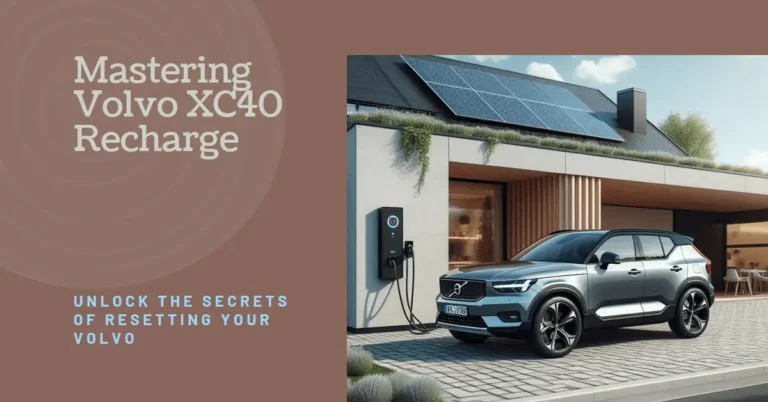
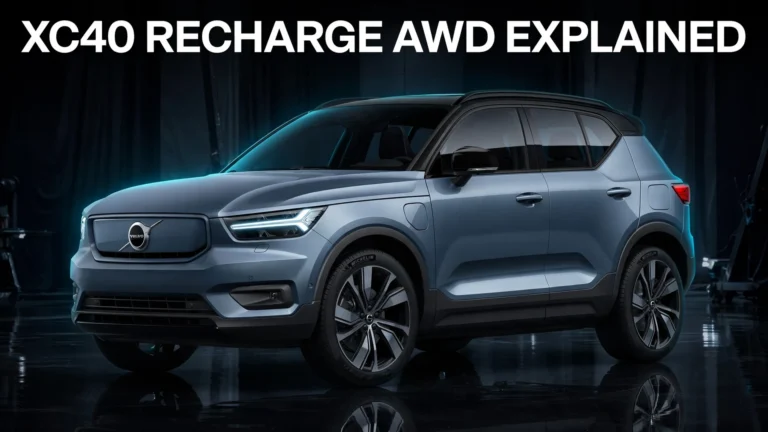
The Volvo XC40 Recharge P8 was Volvo Car Corporation’s first mass-produced pure electric vehicle, launching in 2021 on the Compact Modular Architecture (CMA). In Volvo’s nomenclature, ‘P’ stands for Pure Electric and ‘8’ designates the high-output 8-module, 78 kWh lithium-ion battery pack. Developing an astonishing 402 horsepower and 487 lb-ft of torque from dual permanent magnet electric motors, the P8 launched Volvo into the electric era before the badge was rebranded to ‘Recharge Twin’ in 2024 and officially renamed ‘EX40’ in 2025.
‘P’ = Pure Electric | ‘8’ = 8-Module Battery Pack
402 Horsepower / 487 lb-ft Torque (Dual-Motor AWD)
0 to 60 mph in 4.7 Seconds
Volvo EX40 Twin Motor
The Genesis of Volvo Electrification: The XC40 Recharge P8
When the Volvo XC40 Recharge P8 rolled off the assembly line in Ghent, Belgium in late 2020 as a 2021 model, it represented the most radical technological pivot in the Swedish automaker’s 94-year history. Volvo had pledged to become a fully electric luxury brand by 2030, and the P8 was the tip of the spear. Rather than designing an eccentric, polarizing electric compliance pod, Volvo took its most beloved, award-winning compact crossover—the XC40—and electrified it with jaw-dropping performance.
To many who test-drove it for the first time, the P8 was an absolute shock. Behind its subdued, elegant Scandinavian styling and closed front color-coordinated grille sat a dual-motor powertrain that developed a staggering 402 horsepower and 487 lb-ft of torque—producing acceleration violent enough to embarrass contemporary sports cars while seating five passengers in whisper-quiet luxury.
Compare the original 2021 XC40 Recharge P8 against newer Single Motor and Twin Motor editions to examine range, charging, and motor advances.
402 HP / 487 lb-ft
208–223 Miles (78 kWh)
4.7 Seconds
150 kW Peak (10-80% in 37 min)
Decoding the Nomenclature: What Does “P8” Actually Mean?
For decades, Volvo badges carried clear mechanical meanings: T5 designated a turbocharged 5-cylinder, T6 designated a twin-charged or 6-cylinder engine, and D5 designated a 5-cylinder diesel. In establishing its electric nomenclature, Volvo engineered the P8 designation:
- The Letter “P”: Stands for Pure Electric. This distinguished the model from Volvo’s ‘T’ series plug-in hybrids (which retained a combustion engine) and ‘B’ series mild hybrids.
- The Number “8”: Represents the battery energy hierarchy. The high-voltage lithium-ion pack was engineered with 8 distinct modular battery segments (housing 324 individual LG Chem pouch cells) totaling 78 gross kilowatt-hours (75 kWh usable).
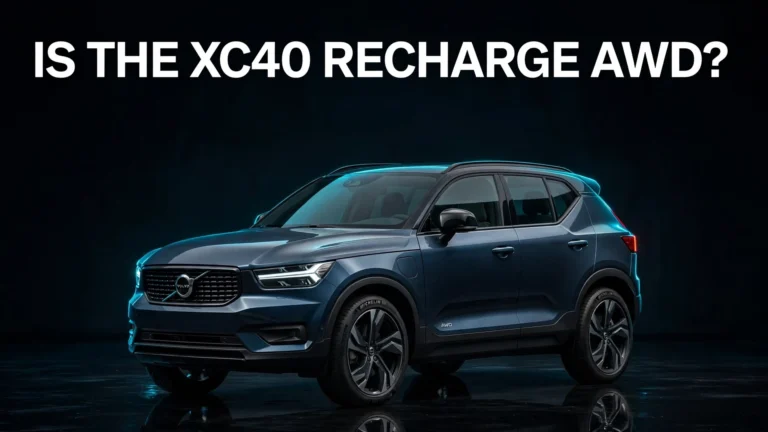
- AWD Badge: Denoted standard dual-motor all-wheel drive, featuring identical 150 kW permanent magnet synchronous motors on both the front and rear axles.
Engineering on the Compact Modular Architecture (CMA)
Unlike newer bespoke EV platforms, the P8 was engineered on Volvo’s multi-energy Compact Modular Architecture (CMA), co-developed with Geely. This required brilliant packaging engineering by Volvo’s Gothenburg team:
The Evolution: From 2021 P8 to the 2025 EX40
| Model Year & Badge | Motor Architecture | Battery Capacity | EPA Rated Range | DC Fast Charge Speed | Operating System |
|---|---|---|---|---|---|
| 2021 XC40 Recharge P8 | Twin Motor AWD (2x 150kW) | 78 kWh (75 usable) | 208 Miles | 150 kW (CCS) | Android Automotive 1.0 |
| 2022–2023 XC40 Recharge P8 | Twin Motor AWD (2x 150kW) | 78 kWh (75 usable) | 223 Miles (OTA update) | 150 kW (CCS) | Android Automotive 2.2+ |
| 2024 XC40 Recharge Twin | Asynchronous Front + Permanent Rear | 78 kWh (75 usable) | 254 Miles | 150 kW (CCS) | Android Automotive 3.0 |
| 2024 XC40 Recharge Single | Single Permanent Magnet Rear | 82 kWh (79 usable) | 293 Miles | 200 kW (CCS) | Android Automotive 3.0 |
| 2025 Volvo EX40 | Twin Motor AWD / Single RWD | 78 / 82 kWh | 254–293 Miles | 150–200 kW (CCS / NACS) | Android Automotive 3.1+ |
The P8 as a Used Luxury EV Bargain
For smart car buyers in the secondary market, the 2021–2022 Volvo XC40 Recharge P8 represents one of the single greatest used car values in the United States today. Early depreciation has compressed market prices down into the mid-$20,000 range. At that price, buyers receive:
- Supercar-rivaling 402 horsepower with all-wheel-drive traction.
- Volvo’s legendary 5-star crash safety and robust body construction.
- Transferable 8-year / 100,000-mile factory high-voltage battery warranty guaranteeing at least 70% state of health.
- Up-to-date Google built-in infotainment that continues to receive regular software updates.
Summary Verdict: The Milestone That Started an Electric Revolution
The Volvo XC40 Recharge P8 will forever be remembered as the pioneer that propelled Volvo into the modern electric era. Combining staggering dual-motor horsepower, bulletproof Scandinavian safety engineering, and connected Google software, the P8 laid the bedrock for every Volvo electric vehicle that followed.
Deciphering Volvo’s Naming Code: What “P8” Actually Stands For
When Volvo introduced its historic first mass-production battery electric vehicle in late 2020, it carried the technical designation Volvo XC40 Recharge P8 AWD. To decode the nomenclature:
- P (Pure Electric): Signifies Volvo’s 100% pure electric propulsion platform, containing zero combustion engine components.
- 8 (Battery Module Sizing Tier): Refers to the nominal 78 kilowatt-hour (kWh) traction battery pack, which is arranged in 8 major functional module banks across the chassis tunnel and rear floor pan. In Volvo’s internal nomenclature hierarchy, lower battery capacity vehicles (such as European 69 kWh models) carried the “P6” badge.
- AWD (All-Wheel Drive): Denotes the mechanical dual-motor drivetrain providing permanent electronic all-wheel drive with continuous torque vectoring.
Inverter Architecture & Front-to-Rear Torque Vectoring Dynamics
The XC40 Recharge P8 is powered by dual high-efficiency permanent magnet synchronous AC motors. The front and rear drive units are governed by high-speed inverters operating on 400 volts DC:
Rather than relying on mechanical driveshafts, viscous couplings, or multi-plate Haldex clutch packs like gas-powered AWD Volvos, the P8 governs power distribution entirely through electronic software code. High-frequency CAN-bus and FlexRay communications allow the traction management computer to modulate torque between the front and rear axles in less than 10 milliseconds (over 10 times faster than mechanical AWD systems). In cornering maneuvers, the system applies subtle braking torque to the inside wheels while routing motor torque to the outside wheels, delivering razor-sharp Scandinavian handling.
150 kW DC Fast-Charging Performance & Liquid Thermal Glycol Loop
Replenishing the P8’s 78 kWh battery pack on road trips is facilitated by an integrated Combined Charging System (CCS Combo 1) port supporting DC fast charging at speeds up to 150 kW:
| Battery State of Charge (SOC) | Charging Speed (kW) | Active Thermal Management Protocol |
|---|---|---|
| 10% to 35% SOC | 135 kW – 150 kW (Peak) | Maximum active glycol chilling via refrigerant heat exchanger |
| 35% to 55% SOC | 100 kW – 125 kW | Active cooling continues; cell temperature maintained below 95°F |
| 55% to 75% SOC | 65 kW – 90 kW | Tapering phase to protect lithium cathode crystalline structure |
| 75% to 80% SOC | 45 kW – 55 kW | 10% to 80% milestone reached in approximately 28 to 32 minutes |
| 80% to 100% SOC | 15 kW – 35 kW (Trickle) | Cell voltage balancing across all 216 individual battery cells |
Battery Management System (BMS) Cell Voltage Balancing
Inside the P8’s 78 kWh battery pack, the Battery Energy Control Module (BECM) monitors the individual voltage, internal resistance, and temperature of all 216 lithium-ion pouch cells. To maintain battery pack health, plug the vehicle into a Level 2 home charger and charge to 100% at least once per month. When the pack reaches 100%, the onboard charger enters a low-current trickle phase that bleeds minute amounts of energy through passive shunt resistors, balancing cell voltages within 5 millivolts of each other.
Frequently Asked Questions