Volvo Penta 3.0 vs Mercruiser 3.0?

Volvo Penta 3.0 vs Mercruiser 3.0?
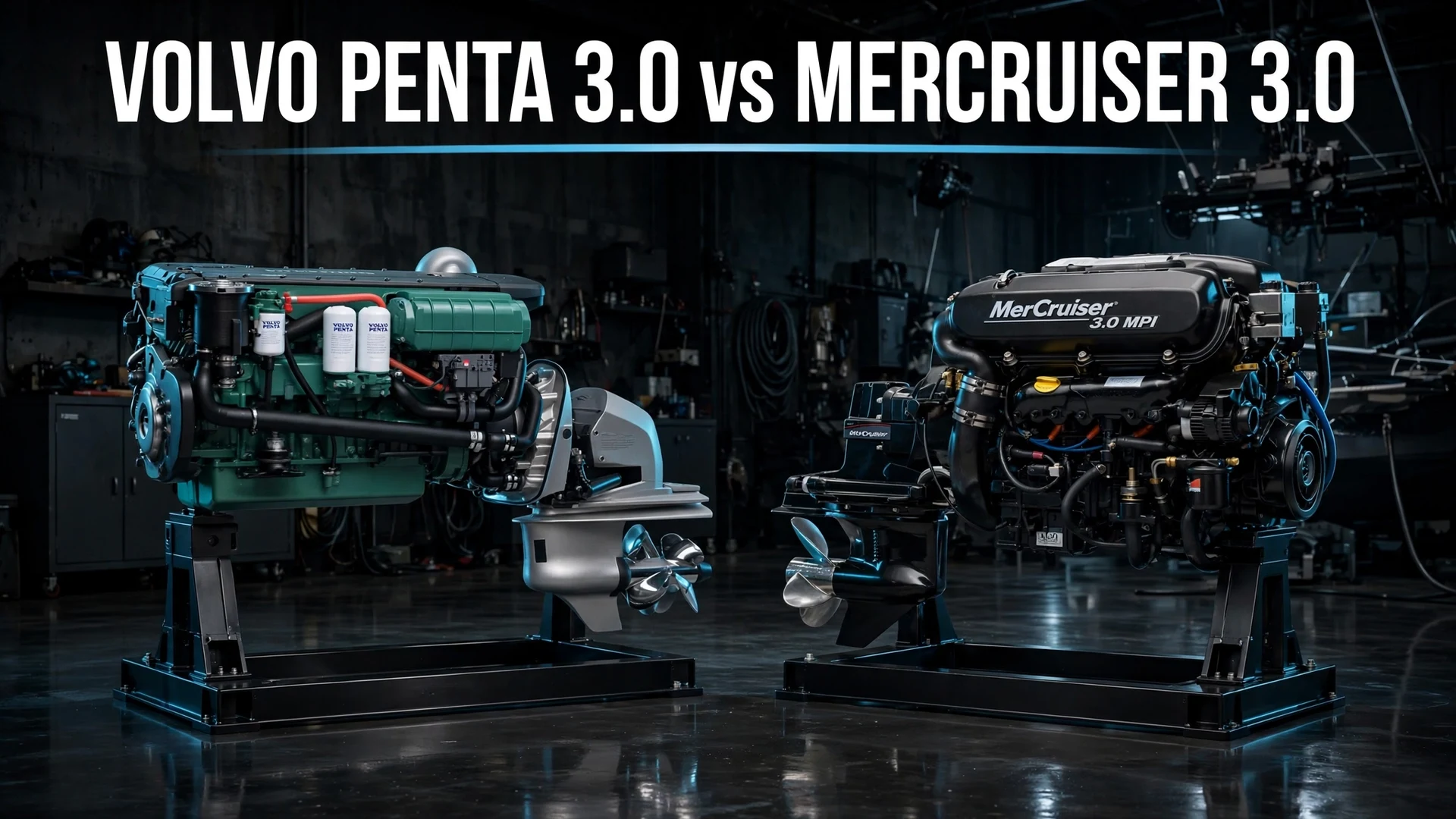
If you are shopping for a used runabout, bowrider, or pontoon with a 3.0-liter sterndrive, here is the single most important fact: under the badge, the Volvo Penta 3.0 and the MerCruiser 3.0 are essentially the same engine. Both are marinized versions of General Motors’ 3.0-liter (181 cubic inch) inline-four, rated at 135 horsepower. The real differences are not in the block — they are in the sterndrive bolted behind it, in parts availability, and in what you can still buy new today. Volvo Penta dropped the 3.0 from its lineup around 2011, while the MerCruiser 3.0 lives on through Mercury Remanufacturing and Quicksilver crate-engine programs aimed at repowering older boats.
Key Takeaways
- Both engines share the same GM-based 3.0L inline-four block and cylinder head, rated at 135 hp at 4,800 rpm.
- Volvo Penta sold its 3.0 (the 3.0GL/3.0GS) with the SX sterndrive and discontinued it around 2011 as emissions compliance costs rose.
- MerCruiser paired its 3.0 with the Alpha One drive, and the engine survives today as a remanufactured or 100%-new Quicksilver repower package.
- For a used-boat buyer, the MerCruiser/Alpha combination is the easier ownership proposition: parts are cheaper and every marine shop knows the Alpha drive.
- A complete MerCruiser 3.0 repower package lists around $17,000, while a rebuilt long block can be had for roughly $4,000 before labor.
Same heart, different badge
The Volvo Penta 3.0 and MerCruiser 3.0 both trace their roots to the same place: a cast-iron, pushrod inline-four that General Motors built in huge numbers for industrial and marine use. Displacing 3.0 liters (181 cubic inches) with a bore and stroke of 4.00 by 3.60 inches and a 9.3:1 compression ratio, the engine was marinized by both companies with their own manifolds, ignition systems, and accessories — but the block, crankshaft, pistons, and cylinder head are the same fundamental hardware. That shared DNA is why aftermarket manuals, gasket sets, and internal parts so often cross-reference between the two brands.
In factory trim, both were rated at 135 hp with a full-throttle operating range of 4,400 to 4,800 rpm, running on regular 87-octane fuel through a two-barrel carburetor. MerCruiser’s later versions used its TKS (Turn Key Start) carburetor with automatic enrichment, which genuinely made cold starts a one-turn affair. Dry weight of the dressed engine is in the region of 567 lb (257 kg), which is why the 3.0 became the default powerplant for 17- to 20-foot entry-level bowriders and pontoons: light, simple, and cheap to build.
So if the engines are the same, why does the choice matter? Because a sterndrive boat is an engine and a drive, and that is where the two diverge.
Volvo Penta 3.0: the one that got away
Volvo Penta marketed its version as the 3.0GL and 3.0GS, paired with the company’s SX sterndrive. The SX is a well-regarded drive — cone-clutch shifting gives it notably smooth engagement compared with older dog-clutch designs, and Volvo’s drive showers and corrosion protection earned a loyal following. On the water, a healthy Volvo 3.0/SX package is every bit as reliable as its MerCruiser counterpart.
The problem is the calendar. Volvo Penta trimmed its four-cylinder gasoline sterndrive lineup around 2011, a move widely attributed to the rising cost of making the old pushrod four comply with tightening EPA emissions rules — catalytic-converter aftertreatment on a low-margin entry engine simply did not pencil out. That means every Volvo Penta 3.0 on the water today is at least a decade and a half old, and factory-new replacement engines are not available. You can still buy remanufactured Volvo 3.0 long blocks (one marine retailer lists a remanufactured 3.0GL at $7,495 and a power-steering-equipped reman at $7,999), but the new-engine pipeline is closed.
Parts support is the other half of the story. Common service items — impellers, bellows, gaskets, tune-up kits — remain available through Volvo Penta dealers and the aftermarket. But drive-specific components for the SX tend to cost more than their Alpha equivalents, and fewer independent shops keep Volvo sterndrive parts on the shelf. If you buy a boat with a Volvo 3.0, budget for that reality rather than discovering it at haul-out time.
MerCruiser 3.0: the survivor
MerCruiser paired its 3.0 with the Alpha One sterndrive — the most common sterndrive ever built. That ubiquity is the MerCruiser 3.0’s superpower. Any marina in North America can service an Alpha drive blindfolded, and parts are available at automotive-store prices from a dozen aftermarket suppliers.
More importantly, the MerCruiser 3.0 never truly died. Mercury Remanufacturing continues to supply remanufactured 3.0L Alpha engines, and the Quicksilver Plus Series offers 100%-new-construction 3.0L crate engines (135 hp, three-year limited factory warranty) built specifically to repower boats originally built before 2008 in California and before 2010 in the other 49 states. Because these are new engines rather than repair assemblies, federal rules (EPA 1068.240) require the old engine core to be returned — a detail your dealer handles as part of the repower.
What does a repower cost? Current marine-retail listings put a complete MerCruiser 3.0L Alpha repower package at about $16,996, a fully dressed TKS engine at roughly $8,500, a Quicksilver new-construction crate engine near $8,626, a rebuilt long block around $4,000, and good used complete engines near $5,000 — all before labor, which typically adds several thousand dollars depending on the boat and region. Those numbers make the economic case clear: if the hull is sound, repowering a 3.0 boat is rational; if the hull is tired, the engine’s residual value will not save the deal.
Spec-for-spec comparison
| Specification | Volvo Penta 3.0 | MerCruiser 3.0 |
|---|---|---|
| Base engine | GM 3.0L inline-4, cast iron | GM 3.0L inline-4, cast iron |
| Displacement | 181 cu in (2,970 cc) | 181 cu in (2,970 cc) |
| Rated power | 135 hp @ 4,800 rpm | 135 hp @ 4,800 rpm |
| Full-throttle range | 4,400–4,800 rpm | 4,400–4,800 rpm |
| Compression ratio | 9.3:1 | 9.3:1 |
| Fuel system | 2-barrel carburetor | 2-barrel carburetor (TKS on later models) |
| Fuel requirement | 87 octane | 87 octane |
| Sterndrive | Volvo Penta SX (cone clutch) | MerCruiser Alpha One |
| New-engine availability | Discontinued ~2011 | Via Mercury Remanufacturing / Quicksilver |
| Parts cost & availability | Good, but pricier and less common | Excellent — the industry standard |
| Typical repower cost (parts) | ~$7,500 reman long block | ~$4,000 rebuilt long block / ~$17,000 full package |
Repower cost comparison
The chart below compares typical parts prices for getting a dead 3.0 back on the water, from a rebuilt long block to a complete drop-in package. Labor is extra in every case.
Which 3.0 situation are you in?
Buy on hull and drive condition, not the badge. Compression-test the engine, inspect the sterndrive bellows and gimbal bearing, and check for water in the gear lube. Between two equal boats, pick the MerCruiser/Alpha: cheaper parts and any-shop serviceability will pay you back every season.
The MerCruiser path is the practical one. A Quicksilver new-construction 3.0 or Mercury reman gives you a factory warranty and a straightforward Alpha swap. Repowering a Volvo SX boat is possible with a reman long block, but confirm drive parts availability for your specific SX generation before committing.
Both reward the same basics: annual impeller and gear-lube service, bellows inspection every few seasons, ethanol-aware fuel care for the carburetor, and winterization if you are in a freeze climate. The 3.0’s simplicity is its virtue — there is very little to go wrong that a competent DIYer cannot fix.
The drives: SX vs Alpha One
The Volvo SX shifts with a cone clutch, which engages progressively and feels refined at the helm — no clunk going into gear. The MerCruiser Alpha One uses a dog clutch that engages with a characteristic and entirely normal “clunk.” In durability terms both are proven, but the Alpha’s massive installed base means used drives, rebuild kits, and complete upper/lower assemblies are commodities. An Alpha can be rebuilt or replaced almost anywhere; an SX rebuild usually means ordering Volvo-specific parts and waiting. For a boat you plan to keep for years, that logistics gap matters more than any on-water difference.
Ownership economics
Day to day, running costs are similar: comparable fuel burn at cruise, the same oil and filter service, and the same winterization routine. The cost divergence appears at repair time. Alpha water pumps, bellows kits, and gimbal bearings are stocked everywhere at competitive prices; SX equivalents are available but typically cost 20–40% more and may need ordering. Over a decade of ownership, the MerCruiser’s parts ecosystem is worth real money — and real weekends not lost waiting on parts.
Verdict
Buy the MerCruiser 3.0 / Alpha One combination unless the Volvo-powered boat is significantly cheaper or better maintained. The engines are the same honest 135-hp workhorse, but MerCruiser’s living repower pipeline, cheaper parts, and universal serviceability make it the rational long-term choice. The Volvo Penta 3.0 is not a bad engine — it is an orphaned one — so only choose it when the boat’s condition and price compensate for the thinner support network.
Sources
- Mercury Remanufacturing 3.0L Alpha TKS specifications (135 hp, 181 CID, 9.3:1, 4400–4800 rpm) — legacy.marinepartsexpress.com PDF
- MerCruiser Quicksilver 3.0L crate engine details and pricing — perfprotech.com
- Quicksilver Plus Series 3.0L drop-in package, warranty and EPA core-return terms — marineengines4less.com
- Remanufactured and used 3.0L pricing (Volvo Penta and MerCruiser) — dougrussell.com marine engine catalog
- Volvo Penta 3.0 lineup discontinuation discussion — forums.iboats.com
Frequently asked questions
Are the Volvo Penta 3.0 and MerCruiser 3.0 the same engine?
Essentially, yes. Both are marinized versions of GM’s 3.0-liter (181 CID) inline-four, rated at 135 hp. The blocks, heads, and internals share the same architecture; the brands differ in manifolds, ignition, accessories, and — most importantly — the sterndrive.
Is the Volvo Penta 3.0 discontinued?
Yes. Volvo Penta dropped the 3.0-liter four-cylinder sterndrive from its lineup around 2011, reportedly because emissions-compliance costs made the low-margin engine uneconomical. No new Volvo Penta 3.0 engines are produced, though remanufactured units remain available.
Can you still buy a new MerCruiser 3.0?
Yes, effectively. Mercury Remanufacturing supplies remanufactured 3.0L Alpha engines, and the Quicksilver Plus Series offers 100%-new-construction 3.0L crate engines with a three-year limited factory warranty, built to repower boats made before 2008 (California) or 2010 (other states). A core return is required under EPA rules.
Which is better: the Volvo SX or MerCruiser Alpha drive?
The SX shifts more smoothly thanks to its cone clutch, but the Alpha One wins on ownership: parts are cheaper, available everywhere, and any marine shop can rebuild one. For long-term ownership, the Alpha’s support network outweighs the SX’s refinement.
How much does it cost to repower a 3.0-liter boat?
Parts typically run about $4,000 for a rebuilt long block, $5,000 for a good used complete engine, $8,500–$8,600 for a new Quicksilver/MerCruiser dressed engine, and around $17,000 for a complete Alpha repower package — before labor, which adds several thousand more.
What should I check when buying a used boat with a 3.0?
Compression-test all four cylinders, inspect the sterndrive bellows and gimbal bearing, check the gear lube for water intrusion, look for corrosion on manifolds and risers, and verify maintenance records. Budget for an immediate full service — impeller, fluids, filters, and tune-up — on any new-to-you boat.