Volvo FM vs FMX: Highway Logistics vs Severe Construction Compared

Volvo FM vs FMX: Highway Logistics vs Severe Construction Compared
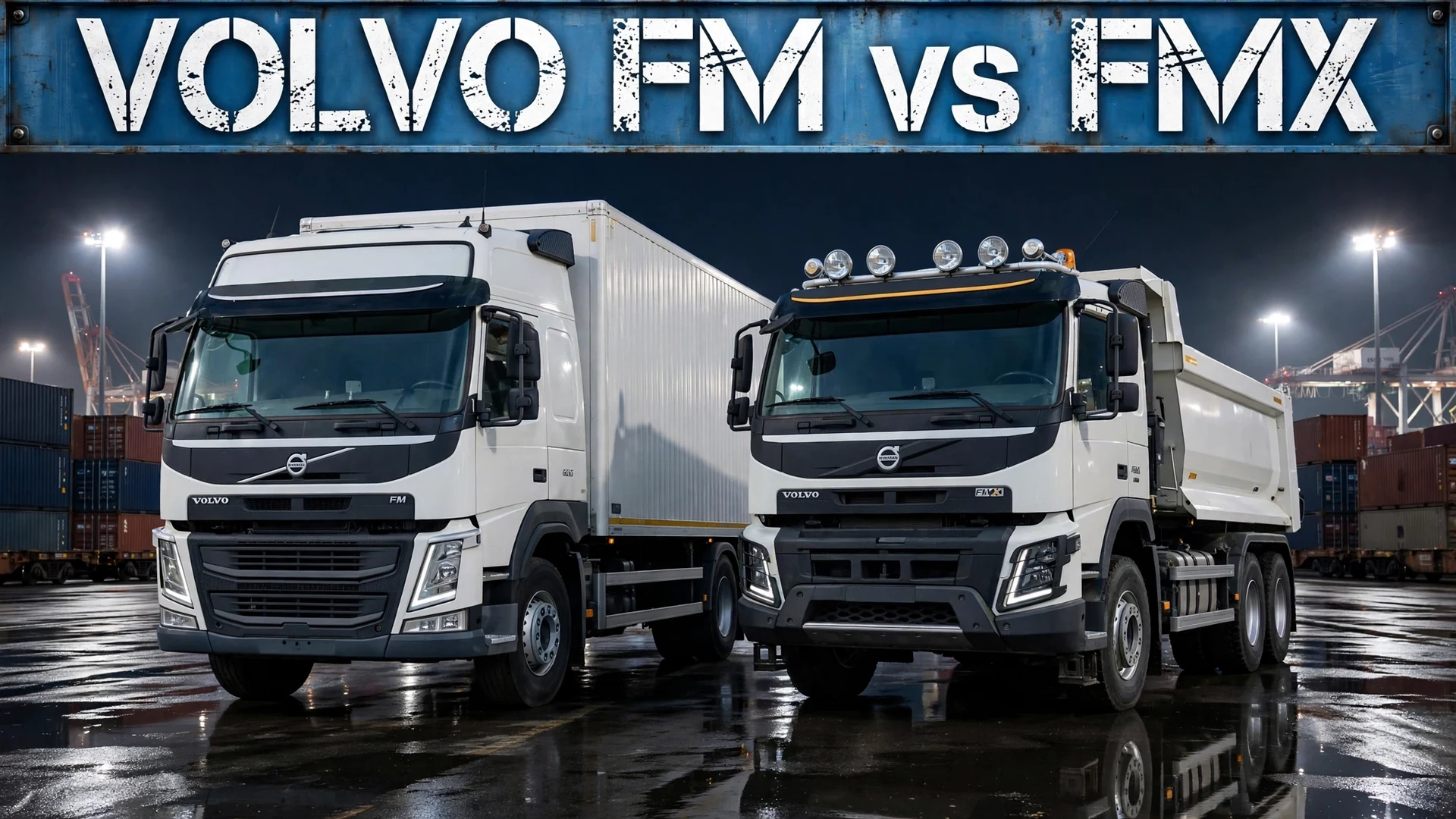
The Volvo FM and Volvo FMX share a cab, engines, and much of their DNA — but they are built for opposite ends of the working day. The FM is Volvo’s versatile all-rounder for regional distribution and long-haul work, while the FMX is a hardened construction specialist launched in 2010 at the Bauma show in Munich with a thicker chassis, higher ground clearance, and off-road hardware the FM simply does not offer. Choose the FM when your trucks live on pavement; choose the FMX when they earn their keep in quarries, on building sites, and down forestry tracks.
Key Takeaways
- The FM targets regional haulage and long distance: lower ride height, aerodynamic cabs, sleeper options, and efficiency-tuned drivelines.
- The FMX targets construction: reinforced chassis, up to ~300 mm ground clearance, steel bumpers, and Automatic Traction Control on driven-front-axle models.
- Both use Volvo’s D11 (330–450 hp) and D13 (380–540 hp) Euro 6 engines with the 12-speed I-Shift automated gearbox.
- The FMX’s toughness costs payload and fuel: a heavier chassis and taller stance versus the FM’s road efficiency.
- Fleet verdict: FM for tarmac, FMX for terrain — spec’ing the wrong one either strands trucks or burns money.
Two trucks, one family
Volvo Trucks developed the FMX directly from the FM platform, and the relationship shows: the cabs are closely related, the dashboard architecture is familiar to any FM driver, and the powertrain menu is shared. What Volvo changed is everything underneath and around the cab that determines where the truck can work. The FMX got a heavier-gauge chassis frame, revised suspension with greater travel, protected underbody components, and a front end designed to shrug off site damage — including a robust three-piece steel bumper option that a highway FM would never need.
The distinction matters because construction trucks live a fundamentally different life. A regional-distribution FM might cover 120,000 km a year on smooth asphalt with gentle loading cycles. An FMX tipper in a quarry faces steep, loose-surfaced grades, constant dust, and loading shocks from excavators dropping aggregates into the body. Volvo’s answer was not a trim package but a structurally different truck — which is why the FMX, rather than an optioned-up FM, became the default choice for aggregates, asphalt, demolition, and timber operators.
Powertrains: shared muscle
Both trucks draw from the same engine shelf. The 11-liter D11 spans 330 to 450 hp in Euro 6 form, and the 12.8-liter D13 spans 380 to 540 hp, with peak torque reaching 2,500 Nm on the FM’s top D13 tune. In independent road testing, a Volvo FM13-420 produced 420 bhp at 1,400–1,800 rpm with 2,100 Nm from 860 rpm, while an FMX13-460 delivered 460 bhp with 2,300 Nm — the same D13K architecture, calibrated for the FMX’s heavier working life.
Both pair these engines with Volvo’s 12-speed I-Shift automated manual, and both can be specified with Volvo Dynamic Steering — the electric-motor-assisted steering system that dramatically reduces low-speed steering effort, a genuine occupational-health benefit for drivers who spend their days maneuvering on sites. The FM counters with efficiency tuning: Volvo claims the D13/I-Shift combination cuts fuel use by up to 3% versus its predecessor, and the FM’s lower stance and aero cab options squeeze more from every liter on highway work.
Where they diverge: chassis and terrain ability
| Attribute | Volvo FM | Volvo FMX |
|---|---|---|
| Primary mission | Regional distribution, long-haul | Construction, quarry, forestry, off-road |
| Chassis | Standard road chassis | Thicker, reinforced construction chassis |
| Ground clearance | Road-optimized (lower) | Up to ~300 mm with air suspension |
| Front bumper | Composite aero bumper | Heavy-duty steel bumper option |
| Driven front axle option | Limited availability | 4×4, 6×6, 8×6, 10×6 with Automatic Traction Control |
| Cab focus | Sleeper comfort, aerodynamics | Day-cab durability, high entry, easy cleaning |
| Fuel efficiency | Tuned for low consumption on road | Trades efficiency for capability |
| Payload | Higher (lighter chassis) | Slightly reduced by tougher chassis |
| Engines | D11 330–450 hp, D13 380–540 hp | D11 330–450 hp, D13 380–540 hp |
| Gearbox | 12-speed I-Shift | 12-speed I-Shift |
The FMX’s off-road credentials go beyond marketing. Automatic Traction Control comes standard on its 4×4, 6×6, 8×6, and 10×6 models: when the system detects rear-wheel slip, it engages the front axle automatically through a dog clutch and transfer box in about half a second, then disengages on normal roads — a trick Volvo says saves up to 2% in fuel versus permanent all-wheel drive. Front bogie capacity on steel-sprung 8×4 FMX rigids was uprated from 18 to 20 tonnes, and construction-spec fuel tanks are mounted higher in the frame to preserve clearance.
Engine power range compared
Which fits your operation?
FM, no contest. Aerodynamic Globetrotter cabs, sleeper comfort for nights out, lower chassis for easy trailer coupling, and efficiency-tuned D13 powertrains. An FMX on long-haul work just burns extra fuel carrying a chassis it never uses.
FM. This is the FM’s home turf: day cabs or rest cabs, maneuverable wheelbases, D11 power for lighter work or D13 for heavier regional loads, and I-Shift keeping fuel bills down in stop-start duty.
FMX. The classic FMX application — 8×4 tippers thrive here. Reinforced chassis shrugs off loading shocks, high ground clearance clears quarry floors, and Automatic Traction Control gets you up loose grades that would strand a road truck.
FMX with driven front axle. Timber tracks demand the 6×6 or 8×6 with ATC, steel bumpers for the inevitable encounters with stumps and branches, and the easy-clean cab. Nothing in the FM range is built for this.
Running costs: the honest trade
The FMX’s capability is not free. Its heavier chassis trims payload — painful when you are paid by the tonne — and its taller stance and less aerodynamic form raise fuel consumption on any road miles the truck does cover. Tires wear faster on site work, and the high cab entry is a daily ergonomic tax on drivers. Conversely, putting an FM into quarry service is a false economy: cracked chassis components, grounding damage, and downtime will erase any purchase-price saving within a couple of hard years. Fleet managers who run mixed operations often split the fleet deliberately — FMs for the road legs, FMXs for the site legs — rather than compromising with one truck doing both badly.
Driving them back to back
Independent testers who have driven the range together note how civilized the FMX has become: the new-generation cab is quiet, the I-Shift is as slick as in the FM, and Volvo Dynamic Steering takes the sting out of low-speed site maneuvering. But the FMX never lets you forget what it is — you climb up into it, you feel the chassis’ sturdiness over broken ground, and on the highway the taller gearing and bluff front end remind you this truck would rather be somewhere rougher. The FM, by contrast, is the long-distance tool: settled, quiet, and at its best with a trailer behind it and miles ahead.
Verdict
There is no overall winner — there is only the right truck for the job. If your trucks spend their lives on pavement doing regional or long-haul work, the FM’s efficiency, payload, and driver comfort make it the smart money. If they work quarries, construction sites, or forestry tracks, the FMX’s reinforced chassis, ground clearance, and traction systems are not luxuries but necessities. Spec the FMX for tarmac and you waste fuel; spec the FM for terrain and you will break it. Match the truck to the terrain and both are excellent.
Sources
- Volvo FMX 8×4 launch history and Bauma 2010 debut — trucklocator.co.uk
- Road test data: Volvo FM13-420 and FMX13-460 specifications — truckingmag.co.uk
- FMX D11/D13 Euro 6 power outputs, ground clearance, Automatic Traction Control — transportengineer.org.uk, trucksplanet.com, globalhighways.com
- Volvo FMX460 driven review and construction chassis trade-offs — truckingmag.co.uk
Frequently asked questions
What is the main difference between the Volvo FM and FMX?
The FM is Volvo’s versatile truck for regional distribution and long-haul work, while the FMX is a hardened construction variant with a thicker chassis, higher ground clearance (up to ~300 mm), steel bumper options, and off-road traction systems. They share cabs and engines but are structurally different trucks.
When was the Volvo FMX launched?
The FMX was launched in 2010 at the Bauma construction equipment show in Munich, as Volvo Trucks’ dedicated push into the construction segment. It was developed from the FM platform with a reinforced chassis for quarry, forestry, and site work.
What engines do the FM and FMX use?
Both use Volvo’s D11 (11-litre, 330–450 hp) and D13 (12.8-litre, 380–540 hp) Euro 6 diesel engines, paired with the 12-speed I-Shift automated gearbox. The D13 offers up to 2,500 Nm of torque in FM tune.
Can the FMX be used for highway haulage?
It can, but it is the wrong tool: the heavier chassis reduces payload and the taller, less aerodynamic stance raises fuel consumption. The FMX only earns its keep when a meaningful share of its work is off-road or on construction sites.
What is Automatic Traction Control on the FMX?
ATC is standard on FMX models with a driven front axle (4×4, 6×6, 8×6, 10×6). It automatically engages front-axle drive via a dog clutch and transfer box when rear slip is detected — in about half a second — and disengages on normal roads to save up to 2% in fuel.
Which holds its value better, FM or FMX?
Both hold value well when specified correctly for their work, but a mis-specified truck depreciates faster: an FM with quarry damage history or an FMX with high road miles and worn site gear will both be harder to sell. Buy the truck that matches the work it will actually do.