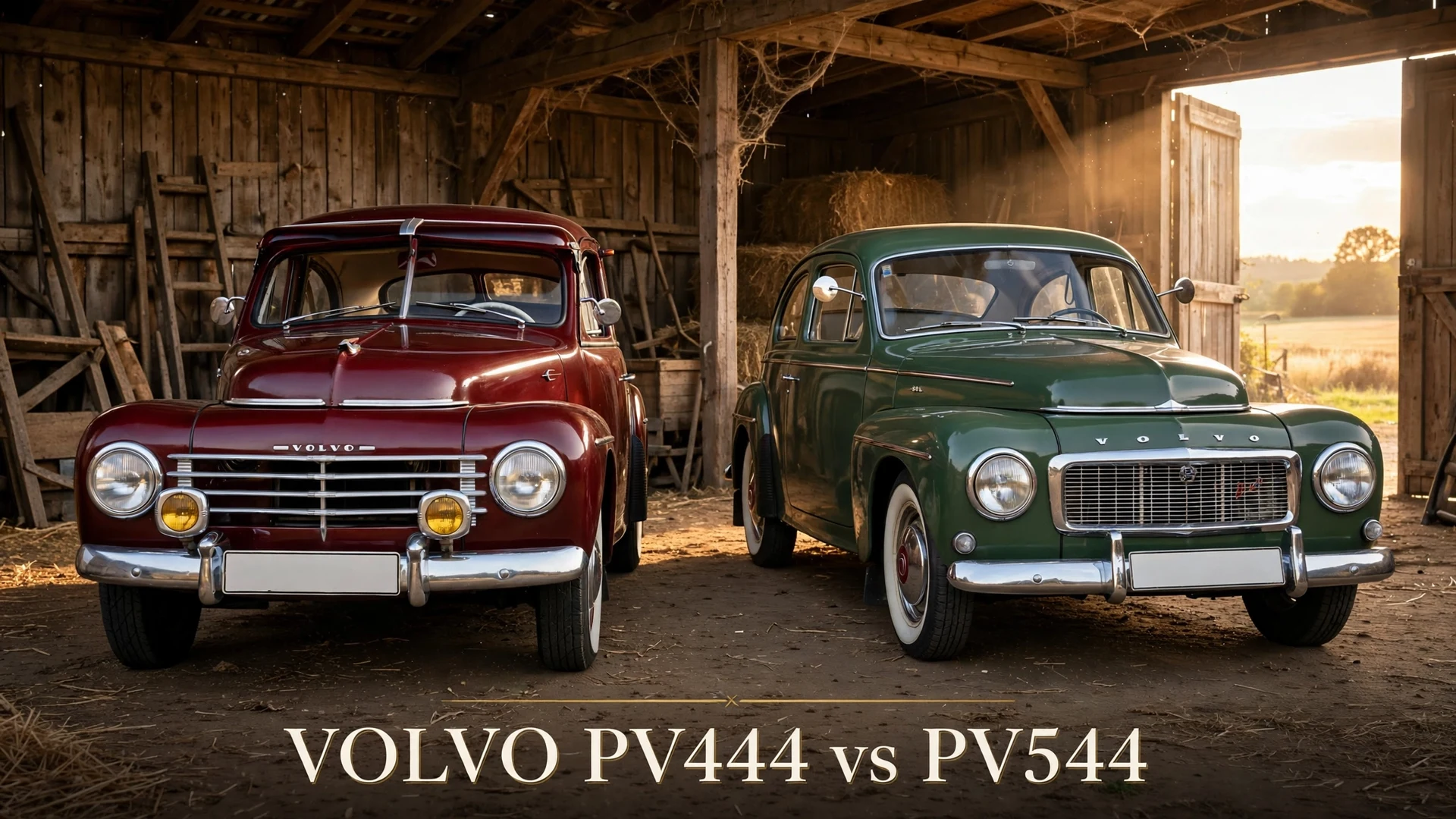
Volvo PV444 vs PV544: The Fastback Swedish Bricks That Built Volvo

Volvo PV444 vs PV544: The Fastback Swedish Bricks That Built Volvo
TL;DR: The PV544 (1958–1965) is an updated PV444 (1947–1958), not a different car. The 544 brought a one-piece curved windshield, a 4-speed gearbox, seating for five instead of four, and eventually the 1.8L B18 engine — the first of Volvo’s legendary Redblock family. Exactly 440,000 of the two combined were built over 18 years (about 244,000 of them 544s). The PV544 was also the first production car fitted with the three-point seatbelt, in 1959. Buy a 544 for usability; buy a 444 for historical purity.
| Key Takeaways | |
|---|---|
| What they are | PV444: 1947–1958. PV544: 1958–1965. Same unitary-body platform, same fastback shape |
| Key 544 upgrades | One-piece windshield, 4-speed manual, 5 seats, padded dash, 12V electrics, B18 engine option |
| Production | 440,000 combined; ~243,990 were PV544s |
| Safety milestone | PV544 was the first car with the three-point seatbelt (1959, Nils Bohlin’s design) |
| Verdict | 544 for driving and touring; 444 for the earliest, purest example of the breed |
One Car, Two Names: The History
During the early years of World War II, Volvo’s leadership concluded the company’s future depended on a smaller, more economical car than the big six-cylinder models it was known for. The result was presented in 1944 — and when the PV444 finally reached production in 1947, the Swedish public’s response was overwhelming; orders poured in. It was Volvo’s first unitary-body (unibody) design and its first four-cylinder car in nearly 20 years, powered by the stout 1.4-liter B4B overhead-valve engine.
By 1958 the PV444 was fourteen years into production and Volvo had already launched its intended replacement, the 122 Amazon. But the little fastback was so beloved — in Sweden and increasingly in America, where its rugged construction and frugal fuel economy won converts — that Volvo simply updated it and kept selling it alongside the Amazon. The PV544 arrived in August 1958 with the most extensive changes the car had ever received, and it stayed in production until 1965 (with the Duett wagon derivative running to 1969). When the end finally came, the car was so endeared to its owners that Volvo ran self-deprecating advertisements in late 1965 and early 1966 imploring PV drivers not to be angry with the company for killing it.
Timeline
444 vs 544: What Actually Changed
| Feature | PV444 (1947–1958) | PV544 (1958–1965) |
|---|---|---|
| Windshield | Two panes of flat glass | Curved one-piece windshield |
| Gearbox | 3-speed manual | 4-speed manual |
| Seating | 4 (hence “444”) | 5 (hence “544”) |
| Speedometer | Conventional dial | Ribbon/”thermometer” type |
| Taillights | Small units | Larger units |
| Dashboard | Hard dash | Padded upper half |
| Electrics | 6-volt | 12-volt (from 1962) |
| Engines | B4B / B14A / B16 | B16, then B18 (1961–62 on) |
| Safety | — | First 3-point seatbelts (1959) |
The “5” in PV544 literally denotes the fifth seat: Volvo widened the rear bench and fitted thinner front backrests to squeeze in one more passenger. The 1959 seatbelt milestone deserves emphasis — Nils Bohlin’s three-point design debuted on the PV544, and Volvo’s decision to make the patent freely available is one of the most consequential acts of corporate generosity in automotive history.
Engines: From B4B to B18
| Engine | Displacement | Power | Fitted to |
|---|---|---|---|
| B4B | 1.4L I-4 | ~40 hp | Early PV444 |
| B14A | 1.4L I-4 twin-carb | ~70 hp | Late PV444 (1955–57) |
| B16A / B16B | 1.6L I-4 | 60 / 85 hp | Late 444, early 544 |
| B18A / B18D | 1.8L I-4 | 75 / 90–95 hp | PV544 (1961–62 on) |
The B18 is the engine to have. Developed initially for the P1800 sports car, it introduced five main bearings and became the first of Volvo’s Redblock family — an engine architecture so durable it powered Volvos into the 1990s. The twin-carb B18D with 90–95 hp transformed the 544 from sturdy transport into a genuine rally weapon; the PV544 was a highly successful rally car in the late 1950s and early 1960s. Note the B4B/B14A power figures are approximate — factory ratings varied by market and year, and period documentation is inconsistent — while the B16/B18 figures come from Volvo’s own heritage specifications.
Driving and Owning Them Today
On the road, the differences are tangible. The 544’s 4-speed gearbox alone makes it a far more relaxed highway car than the 3-speed 444, and a B18D 544 will cruise at modern traffic speeds where an early B4B 444 feels happiest at a gentler pace. The 12-volt electrics (1962-on cars) simplify everything from lighting upgrades to fitting a modern radio, and the one-piece windshield dramatically improves visibility over the 444’s split glass.
Ownership reality: these are simple, rugged cars with excellent parts support by classic standards — the Volvo community and specialists stock most mechanical items, and the B16/B18 engines are famously rebuildable. Rust is the enemy; check floors, sills, and the spare-wheel well. Drum brakes all around demand respect and regular adjustment. Values have been climbing steadily: driver-quality 544s typically trade in the mid-five figures in today’s market, with exceptional B18D Sports and early 444s commanding more. Buy the most rust-free, complete example you can find — restoration costs dwarf purchase-price differences.
Which One Should You Buy?
Buy the earliest, most original PV444 you can find. A 1947–1950 B4B car in preserved condition is the purest expression of the design that saved Volvo — and the scarcest. Originality and documentation drive value here.
Buy a B18-powered PV544 (1962–1965). Four speeds, 12-volt electrics, 90+ hp, and the best brakes and visibility of the range. It’s the only PV you can genuinely tour in modern traffic without apology.
Buy a PV544 Sport with the B18D twin-carb engine. The rally pedigree, the Redblock genesis story, and the seatbelt-first history give the Sport the strongest narrative — and narratives drive classic values.
Buy the best-condition 544 your budget allows, regardless of year. Simplicity is on your side — no complex electronics, huge club support — but rust repair is not a beginner project. Pay for solid metal, not shiny paint.
Tip: the Duett wagon (P445/P210) shares PV mechanicals with added practicality and was built through 1969 — often better value than the saloons.
Verdict
There’s no loser here — the PV544 is objectively the better car (more gears, more seats, more power, seatbelts, 12 volts), and for anyone who wants to actually drive and enjoy a PV, a 1962–1965 B18 544 is the definitive answer. But the PV444 matters more historically: it’s the car that introduced unitary construction to Volvo, the car that proved a small Swedish sedan could conquer America, and the foundation everything else was built on. If your garage has room for the story rather than just the drive, the 444’s purity is irreplaceable. Most enthusiasts, though, should follow the market’s lead: the 544’s usability advantage is why ~244,000 of the 440,000 built wore the 544 badge.
Sources
- Volvo Cars Heritage (via mb.cision.com) — “VOLVO PV544 (1958–1965)” press material: August 1958 introduction, 243,990 produced, B16/B18 specifications (60/85 hp; 75/90/95 hp), Canadian plant 1963, rally success
- Wikipedia — “Volvo PV444/544”: production 1947–1965, 440,000 units, one-piece windshield, 4-speed gearbox, 1959 three-point seatbelt debut, B18 five-main-bearing design, 6V-to-12V change 1962, Duett to 1969
- Automacha — “The PV444 Was The Car That Shaped Volvo”: B16-powered 444 as “spunky sports sedan,” 444-to-544 transition alongside the Amazon
- Oldtimerfarm — 1960 PV544 B16 specifications: dimensions, 66 hp B16, 4-speed manual, RWD layout
Frequently Asked Questions
What is the difference between the Volvo PV444 and PV544?
The PV544 is an updated PV444: it gained a one-piece curved windshield (replacing split flat glass), a 4-speed manual (replacing the 3-speed), seating for five instead of four, larger taillights, a padded dashboard, 12-volt electrics, and eventually the 1.8L B18 engine. The body shape is essentially the same.
How many Volvo PV444 and PV544 were built?
Exactly 440,000 units were built during the 18-year production run from 1947 to 1965. About 243,990 of those were PV544s, leaving roughly 196,000 PV444s.
Was the PV544 the first car with seatbelts?
The PV544 was the first production car fitted with the three-point seatbelt, introduced in 1959. The design came from Volvo engineer Nils Bohlin, and Volvo made the patent freely available to other automakers.
What engine is in a Volvo PV544?
Early PV544s used the 1.6L B16 (60 or 85 hp). From 1961–62, Volvo fitted the 1.8L B18 — the first Redblock engine — in single-carb B18A (75 hp) and twin-carb B18D (90–95 hp) forms. The B18D Sport is the most desirable.
Are Volvo PV444 parts still available?
Yes, by classic-car standards support is good: Volvo specialists and owner clubs stock most mechanical parts, and the B16/B18 engines are simple to rebuild. Body panels and trim are harder — buy the most complete, rust-free example you can find.
What is a Volvo PV444 worth today?
Values have been climbing: driver-quality PV544s typically trade in the mid-five figures, with B18D Sports and exceptional early PV444s commanding more. Condition and originality matter far more than model year — restoration costs quickly exceed any purchase-price saving.