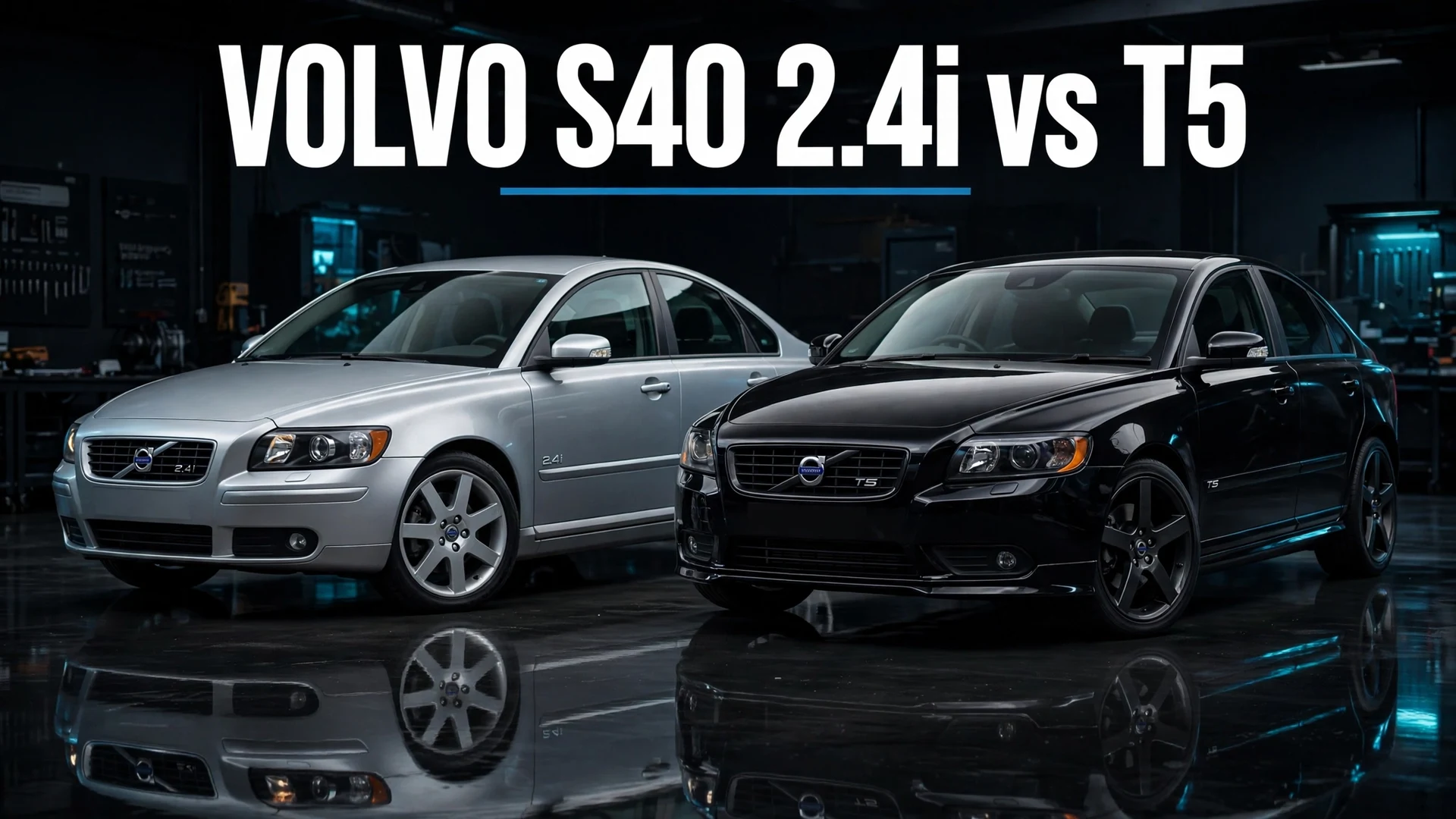
Volvo S40 2.4i vs T5?

Volvo S40 2.4i vs T5?
TL;DR: The Volvo S40 T5’s turbocharged 2.5-liter five-cylinder makes 218 hp (2004–2007) or 227 hp (2008–2012), while the 2.4i’s naturally aspirated 2.4-liter five makes 168 hp. That’s a 50–59 hp gap you feel every time you merge: the T5 hits 60 mph in about 6.7 seconds versus roughly 8.2 for the 2.4i. Fuel economy is nearly identical, and when new the T5 cost only about $2,860 more ($26,615 vs $23,755 for 2006). On the used market the premium is even smaller — which is why the T5 is the pick for most buyers, with the 2.4i reserved for those who prize simplicity and the lowest running costs.
| Key Takeaways | |
|---|---|
| Power | T5: 218–227 hp turbo / 2.4i: 168 hp naturally aspirated |
| Acceleration | T5: ~6.7 sec 0–60 / 2.4i: ~8.2 sec 0–60 |
| Fuel economy | Nearly identical — the turbo doesn’t punish you at the pump |
| Original price gap | About $2,860 (2006 MSRP: $26,615 vs $23,755) |
| Verdict | T5 for most buyers; 2.4i for maximum simplicity and lowest costs |
The Engines, Side by Side
Both engines are Volvo five-cylinders from the same family, and both are known for longevity — but they have completely different characters. The 2.4i (engine code B5244S4 in most years) is a naturally aspirated 2.4-liter making 168 horsepower at 6,000 rpm and 170 lb-ft of torque at 4,400 rpm. It’s smooth, honest, and perfectly adequate around town, but it needs revs to make progress — reviewers at the time noted you had to drop two gears to find passing power on the highway.
The T5 (B5254T3, later B5254T7) adds a light-pressure turbocharger to a 2.5-liter block. Early cars (2004.5–2007) made 218 hp; Volvo bumped it to 227 hp for 2008, with 236 lb-ft of torque available from just 1,500 rpm. That low-end torque is the whole story: where the 2.4i needs to be wound out, the T5 simply surges. The turbo runs modest boost, so power delivery is linear rather than explosive — strong, characterful, and relaxed rather than frantic.
Transmissions: the 2.4i came with a 5-speed manual or 5-speed Geartronic automatic, front-wheel drive only. The T5 offered the 5-speed automatic or a 6-speed manual (borrowed from the S60R), and T5 AWD models added Volvo’s Haldex all-wheel-drive system — a meaningful option if you drive in snow country.
Spec Comparison
| Spec | S40 2.4i | S40 T5 (2008+) |
|---|---|---|
| Engine | 2.4L NA inline-5 | 2.5L turbo inline-5 |
| Power | 168 hp @ 6,000 rpm | 227 hp @ 5,000 rpm |
| Torque | 170 lb-ft @ 4,400 rpm | 236 lb-ft @ 1,500–5,000 rpm |
| 0–60 mph | ~8.2 sec | ~6.7 sec |
| Top speed | ~130 mph | ~149 mph |
| Transmissions | 5-spd manual / 5-spd auto | 5-spd auto / 6-spd manual |
| AWD available | No | Yes (T5 AWD) |
| 2006 MSRP | $23,755 | $26,615 |
Power and Torque Compared
Real-World Driving: Where the Gap Shows
Around town at low speeds, the difference is modest — both pull away from lights cleanly, and the 2.4i’s lighter throttle response can actually feel calmer in traffic. The gap opens the moment you ask for more: highway merging, overtaking on two-lane roads, or climbing grades with passengers. The T5’s turbo delivers its 236 lb-ft from 1,500 rpm, so it simply walks away in situations where the 2.4i is downshifting and shouting.
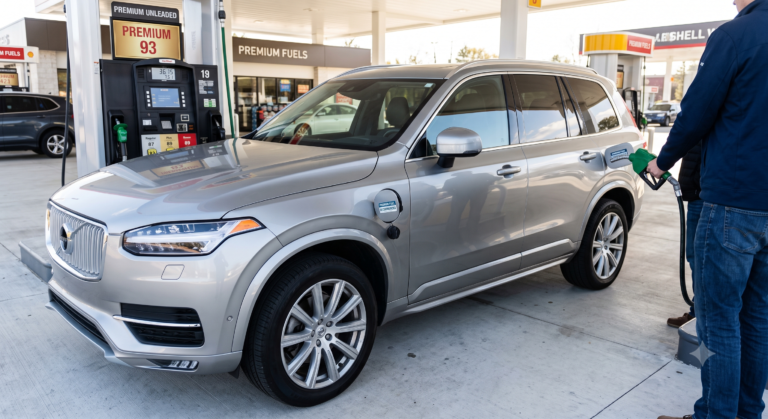
There are trade-offs. The T5 asks for premium fuel (Volvo recommends 91 octane for the turbo), while the 2.4i is happy on regular. The turbo adds heat, plumbing, and complexity — more parts that can eventually need attention on a 15+ year-old car. Insurance is typically a touch higher on the T5. And the 6-speed manual, while engaging, has long throws; the 5-speed Geartronic auto in either car is the relaxed choice.
On fuel economy, the surprise is how close they are: factory combined figures differ by only a few percent, because the small turbo lets the T5 cruise efficiently off-boost. Your right foot matters more than your engine choice here.
Reliability and Running Costs
Both engines belong to Volvo’s modular five-cylinder family with a strong reputation, and the S40’s Ford C1 platform (shared with the contemporary Mazda3 and European Focus) is well understood by independent shops. Neither engine has a systemic Achilles’ heel, but age-appropriate checks apply to both: PCV/breather system condition, oil leaks from cam seals, coolant hoses, and — on the T5 — turbo and intercooler plumbing. The 2.4i’s simplicity is a genuine asset at this age: no turbo, no intercooler, regular fuel.
Parts availability remains good, and the enthusiast community is deep — but buy on maintenance records, not mileage alone. A T5 with a thick service file will outlast a neglected 2.4i every time. Budget for the same age-related items on either car: suspension bushings, brakes, and the timing belt service if there’s no record of it being done.
What They Cost Today
On the current used market, clean S40s of either spec typically trade between $4,000 and $9,000 depending on mileage, condition, and region, with T5 models — especially manual and AWD examples — commanding the upper end. The original $2,860 MSRP gap has largely collapsed: you’ll often find a T5 listed within $1,000–$1,500 of a comparable 2.4i. At that spread, the T5’s extra performance, gearbox choice, and AWD option make it the stronger value unless the 2.4i you’re looking at is dramatically cleaner or cheaper. As always with cars this age, a documented maintenance history is worth more than low mileage alone.
Which One Should You Buy?
Either works — lean T5. The fuel-economy penalty is negligible, and the T5’s effortless torque makes commuting less tiresome. The 2.4i only wins if you find a pristine low-mileage example for meaningfully less money.
T5, preferably with the 6-speed manual. It’s the only S40 here with genuine pace (6.7 sec 0–60), and the turbo five has real tuning headroom if you ever want more. The 2.4i will always leave you wanting.
T5 AWD. The 2.4i was never offered with all-wheel drive, so winter traction settles this one by itself. Pair it with proper winter tires and it’s a superb cold-weather car.
2.4i. Lowest purchase price, regular fuel, simplest maintenance, cheapest insurance. It’s the rational minimum-cost way into a safe, comfortable small Volvo — just accept that it’s slow.
Tip: on the used market, the T5 premium over a comparable 2.4i is often under $1,500 — far less than the original $2,860 MSRP gap. At that spread, the T5 is the value play.
Verdict
The T5 wins this comparison for most buyers, and it’s not particularly close. You get 35% more power, 39% more torque, a second and a half off the 0–60 time, an available manual gearbox, and optional all-wheel drive — for a used-market premium that has shrunk to a fraction of the original price gap, with barely any fuel-economy penalty. The 2.4i’s case rests entirely on simplicity: it’s the right choice if you want the cheapest possible entry, the lowest running costs, and you genuinely don’t care about acceleration. Everyone else should buy the T5 — and buy the one with the best service history, not the lowest mileage.
Sources
- Volvo Cars media (via media-downloads.volvocars.com) — 2008 S40 model overview: 2.4i 168 hp, T5 increased from 218 to 227 hp for 2008, transmission details
- Volvo Cars press release (Jun 2005) — 2006 S40 model overview: MSRP $23,755 (2.4i) / $26,615 (T5) / $28,390 (T5 AWD), 218-hp T5 specification
- CarBuzz — 2008 Volvo S40 specs: 168 hp / 170 lb-ft 2.4i, 227 hp / 236 lb-ft T5, ~8.2s and ~6.7s 0–60 times
- Motor Trend — 2004 S40 first drive and 2005 T5 AWD long-term review: engine details, 6-speed manual, Haldex AWD, real-world driving impressions
- RAC (UK) — Volvo S40 2004–2012 used review: 6.5s 0–60 T5, driving character notes
Frequently Asked Questions
How much horsepower does a Volvo S40 T5 have?
The S40 T5’s turbocharged 2.5-liter five-cylinder made 218 horsepower from 2004 to 2007, and 227 horsepower from 2008 through 2012. The 2.4i’s naturally aspirated 2.4-liter made 168 horsepower throughout.
Is the S40 T5 faster than the 2.4i?
Yes, significantly. The T5 reaches 60 mph in about 6.7 seconds versus roughly 8.2 seconds for the 2.4i — a gap you’ll feel in every merge and overtake, thanks to the turbo’s 236 lb-ft of torque from just 1,500 rpm.
Does the S40 T5 require premium fuel?
Volvo recommends premium (91 octane) fuel for the turbocharged T5 to deliver its rated performance. The naturally aspirated 2.4i runs fine on regular unleaded, which is one of its small running-cost advantages.
Is the Volvo S40 T5 reliable?
The five-cylinder engines have a strong reputation, and the T5’s light-pressure turbo is not highly stressed. As with any 15+ year-old car, maintenance history matters most — check the PCV system, turbo plumbing, timing belt service, and overall records.
Did the S40 2.4i come with all-wheel drive?
No. All-wheel drive was only offered on the T5 (as the T5 AWD with a 6-speed manual or 5-speed automatic). The 2.4i was front-wheel drive only in every model year.
Which is cheaper to own, the 2.4i or T5?
The 2.4i: lower purchase price, regular fuel, no turbo hardware to maintain, and typically slightly cheaper insurance. The T5’s fuel economy is nearly identical, so the 2.4i’s advantage is in purchase price and simplicity rather than running costs.