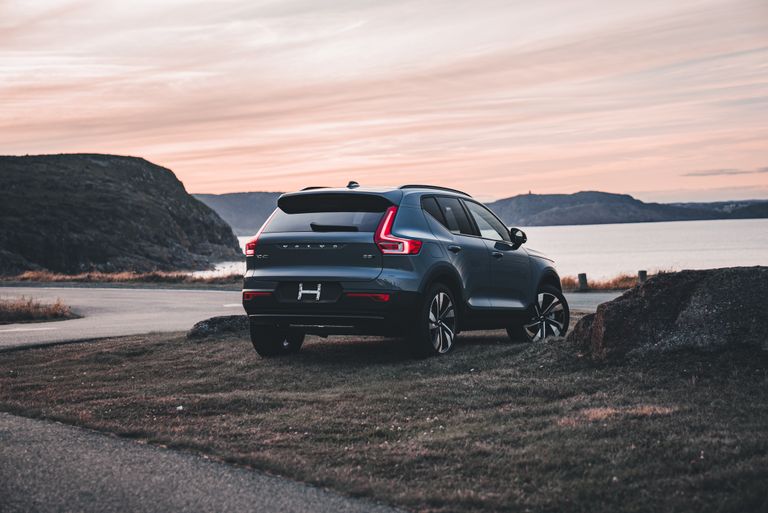

How Big Is the Volvo EX30?

Buying a car without knowing its size is like ordering furniture without measuring the doorway. You might love it — right up until it doesn’t fit. The Volvo EX30 is Volvo’s smallest SUV, and “small” means different things depending on whether you’re parking in a city garage or trying to fit two large suitcases in the boot.
Here’s every number you need, in plain terms.
TL;DR
- The EX30 is 166.7 inches long, 72.4 inches wide, and 61.2 inches tall — Volvo’s smallest SUV by a meaningful margin.
- Front seat space is surprisingly generous: 41.9 inches of legroom and 41.7 inches of headroom.
- Rear seat space is tighter: 32.3 inches of legroom — fine for kids, tight for tall adults on long trips.
- Cargo behind the rear seats: 12.4 cubic feet upright, 27.8 cubic feet with seats folded.
- The frunk holds 0.2 cubic feet — basically a charging cable cubby.
- The EX30 Cross Country rides 0.8 inches higher and has slightly different dimensions.
- For comparison: the EX30 is about 16 inches shorter than the Hyundai Ioniq 5.
Exterior Dimensions: The Numbers That Tell You If It Fits
The Volvo EX30 measures 166.7 inches long, 72.4 inches wide (without mirrors), and 61.2 inches tall. It sits on a 104.3-inch wheelbase and has 6.7 inches of ground clearance on standard trims.
In everyday terms: this is a compact urban crossover. It’s slightly longer than a VW Golf hatchback but considerably shorter than mainstream compact SUVs like the Hyundai Ioniq 5 or Volkswagen ID.4. Picture a car you could parallel park with your eyes half-open, and you’re in the right zone.
“The EX30 is short enough to slot into spots that would terrify an Ioniq 5 driver, yet tall enough to feel like an SUV rather than a lowered hatchback.”
Full Exterior Dimensions (Standard EX30)
| Measurement | Inches | Millimeters |
|---|---|---|
| Length | 166.7 in | 4,233 mm |
| Width (without mirrors) | 72.4 in | 1,836 mm |
| Height | 61.2 in | 1,554 mm |
| Wheelbase | 104.3 in | 2,649 mm |
| Ground Clearance | 6.7 in | 170 mm |
| Turning Circle | 35.1 ft | 10.7 m |
The turning circle of 35.1 feet is a city driver’s best friend. For reference, a Toyota Camry turns in about 38 feet. The EX30 is more nimble than a mid-size sedan in tight spaces.
EX30 Cross Country: Slightly Different Story
The EX30 Cross Country adds 0.8 inches of ride height, bringing ground clearance to 7.5 inches. It also gains rugged bumpers, wheel arch extensions, and skid plates, which add fractionally to the overall width. The height increases to approximately 61.8 inches due to the raised suspension. Length remains the same.
Interior Dimensions: Where the Real Story Is
Here’s the thing most spec sheets don’t tell you: the EX30’s interior is considerably more spacious than the exterior dimensions suggest. That’s because Volvo’s engineers pushed the wheels toward the corners of the car — something only possible with an electric drivetrain — which maximizes interior volume relative to overall footprint.
The result is a car that’s short on the outside and genuinely comfortable on the inside, at least in the front.
Front Row: Genuinely Roomy
| Measurement | Inches |
|---|---|
| Headroom | 41.7 in |
| Legroom | 41.9 in |
| Shoulder Room | 55.1 in |
| Hip Room | 54.3 in |
Those front legroom numbers are not a typo. The EX30 actually has more front legroom than Volvo’s flagship EX90, which starts above $80,000. It also has headroom comfortable enough for six-foot-plus drivers without the “helmet touching the ceiling” claustrophobia common in small hatchbacks.
“The EX30’s front cabin is one of the great surprises of the compact EV segment — it genuinely doesn’t feel like a small car from the driver’s seat.”
Rear Row: Honest Assessment Required
| Measurement | Inches |
|---|---|
| Headroom | 38.3 in |
| Legroom | 32.3 in |
| Shoulder Room | 53.0 in |
| Hip Room | 46.3 in |
32.3 inches of rear legroom is on the tighter side. For context, that’s similar to a Mazda CX-5 rear seat — tolerable for most adults on short trips, but not ideal for a 6-foot passenger sitting behind a 6-foot driver on a two-hour highway run. Kids and teenagers fit comfortably. Adults will notice it.
A real-world scenario: two adults in the front, two adults in the back, plus a weekend bag in the trunk — that’s the EX30’s sweet spot. Two adults in front, three adults in the back on a two-hour road trip — that’s where things start to get cozy in ways that aren’t entirely comfortable.
The rear seat does split 60/40, which is a practical touch for hauling awkward items like skis, bike wheels, or flat-pack furniture.
Cargo Space: Small Car, Clever Storage
The Numbers
| Configuration | Cubic Feet |
|---|---|
| Behind rear seats (seats up) | 12.4 cu ft |
| Full cargo (seats folded) | 27.8 cu ft |
| Frunk (front trunk) | 0.2 cu ft |
| Under-floor storage (trunk) | 2.2 cu ft |
12.4 cubic feet behind the rear seats is modest — roughly equivalent to a compact sedan trunk. Car and Driver testing found it holds about seven carry-on suitcases with all seats up. Fold the rear seats flat and you get 18 carry-on suitcases’ worth of space, enough for an IKEA run or a weekend camping trip if you pack strategically.
The frunk is functionally a charging cable drawer. At 0.2 cubic feet, it’s the automotive equivalent of a kitchen junk drawer — perfect for the charging cable, a pair of gloves, and not much else. Do not book it as luggage space.
The smart detail: the EX30’s trunk has a flat floor with a 2.2 cubic-foot underfloor compartment — useful for keeping charging cables, emergency gear, or groceries separate from the main cargo area.
Quick Tip: The EX30’s tall, upright hatch opening is better than the numbers suggest for loading bulky items. A short cargo floor is harder to use than a deep one, but the EX30’s flat floor and wide opening make it easier to slide things in than rivals with similar cubic footage.
How the EX30 Compares in Size to Key Rivals
If you’re deciding between the EX30 and other EVs, size context is everything. Here’s how it stacks up:
| Model | Length | Cargo (seats up) | Rear Legroom |
|---|---|---|---|
| Volvo EX30 | 166.7 in | 12.4 cu ft | 32.3 in |
| Volvo EX40 | 174.8 in | 20.5 cu ft | 35.5 in |
| Hyundai Ioniq 5 | 183.3 in | 27.2 cu ft | 38.4 in |
| Volkswagen ID.4 | 180.5 in | 30.3 cu ft | 37.8 in |
| Genesis GV60 | 177.5 in | 24.0 cu ft | 34.9 in |
The EX30 is 16.6 inches shorter than the Ioniq 5 — that’s a meaningful difference on a tight urban street. It’s also about 8 inches shorter than its own sibling, the Volvo EX40. What you gain in maneuverability, you trade in cargo room and rear legroom.
Pros & Cons by Buyer Persona
🏙️ The Solo City Commuter or Couple
Pros: The EX30’s compact footprint is a genuine advantage in dense urban environments. Its 35.1-foot turning circle beats most sedans. Parallel parking feels instinctive rather than anxious. The front seat is spacious enough for daily commuters of any height.
Cons: If you occasionally car-pool four adults, the rear seat is livable but not luxurious. Cargo space limits grocery runs to “one decent shop, not two.”
👨👩👧 The Small Family (Two Adults, One or Two Kids)
Pros: Child car seats fit without drama in the rear row. The rear headroom of 38.3 inches accommodates most primary-age children easily. The 60/40 split rear seat adds flexibility for strollers or sports gear.
Cons: If your kids are teenagers who have opinions about legroom, they’ll have those opinions loudly and frequently. The cargo area gets tight once a stroller is involved. Two checked bags and two carry-ons? You’re folding a seat.
🗺️ The Weekend Adventurer
Pros: The EX30 Cross Country’s 7.5 inches of ground clearance handles gravel roads and mild trails confidently. Seats-folded cargo space of 27.8 cubic feet handles camping gear for two reasonably well.
Cons: With rear seats up and adventure gear loaded, the EX30 runs out of room fast. For four people plus hiking gear plus camping equipment, it’s a Tetris puzzle. This is a car for two adventurers, not a family of four heading to a trailhead.
Quick Tips & Expert Insights
💡 Quick Tip — The Parking Gut Check: Before test-driving, measure your garage door opening and your tightest regular parking spot. The EX30 is 72.4 inches wide (without mirrors). Folded mirrors reduce width substantially — useful in tight spaces.
📐 Expert Insight — Wheelbase vs. Overall Length: The EX30’s 104.3-inch wheelbase is only 2.1 inches shorter than the larger XC40. Wheelbase largely determines rear legroom and ride comfort, so the EX30 rides and feels more spacious inside than its short overall length suggests. The short nose and stubby tail are where the length savings come from, not the passenger compartment.
🧳 Quick Tip — Real-World Cargo Test: Before buying, bring your actual weekend bag to the dealership and put it in the trunk. Better yet, bring it and your partner’s bag. Specs tell you cubic feet; your suitcase tells you the truth.
🔁 Expert Insight — The Cross Country Height Advantage: The EX30 Cross Country’s extra 0.8 inches of ride height makes a perceptible difference getting in and out, especially for older drivers or those with knee issues. If ease of entry matters to you, the Cross Country’s slightly taller stance is worth a look beyond its off-road credentials.
Alternatives: When the EX30’s Size Isn’t Quite Right
Choose the Volvo EX40 if…
…you need one size up without leaving the Volvo family. The EX40 is about 8 inches longer, offers notably more rear legroom (35.5 inches vs. 32.3), and nearly doubles the rear cargo space (20.5 cu ft vs. 12.4). It’s the EX30 for buyers who love the brand but travel with more people or more stuff.
Choose the Hyundai Ioniq 5 if…
…rear-passenger comfort and cargo space are non-negotiable. At 183.3 inches long, the Ioniq 5 is a genuinely roomy family EV with 38.4 inches of rear legroom and 27.2 cubic feet of cargo — roughly double the EX30 in both. You sacrifice the EX30’s urban agility, but gain a car the whole family can stretch out in.
Frequently Asked Questions
Is the Volvo EX30 considered a small SUV? Yes. Volvo classifies the EX30 as a subcompact SUV. At 166.7 inches long, it’s one of the smaller vehicles in the growing compact electric SUV segment, sitting below Volvo’s own EX40 in size and below mainstream rivals like the Ioniq 5 and Volkswagen ID.4. In day-to-day driving, it feels closer to a city hatchback than a traditional SUV.
Can tall people fit comfortably in the Volvo EX30? In the front, yes — the EX30 has 41.7 inches of headroom and 41.9 inches of legroom, which accommodates most six-foot-plus drivers without issue. In the rear, it’s tighter. Tall adults will notice the 32.3 inches of rear legroom on longer trips. If you regularly carry tall adult passengers in the back, the EX40 or Ioniq 5 offer more breathing room.
How does the EX30 compare in size to the Volvo EX40? The EX40 is about 8 inches longer (174.8 inches vs. 166.7), has a notably larger cargo area (20.5 cubic feet vs. 12.4 behind the rear seats), and offers more rear legroom (approximately 35.5 inches vs. 32.3). Both share similar front seat spaciousness. The EX30 is the city car; the EX40 is the family-trip car.
Is the Volvo EX30 frunk actually useful? Barely. At 0.2 cubic feet, the EX30’s front trunk is more of a practical joke than a practical feature — though it’s genuinely useful for storing your charging cable, keeping it away from the main cargo area. Don’t factor it into your luggage math.
How much bigger is the EX30 Cross Country than the standard EX30? The Cross Country adds 0.8 inches of ride height, bringing ground clearance from 6.7 to 7.5 inches. The length is the same. The raised suspension and wheel arch extensions add fractionally to the overall width profile. The interior dimensions are virtually identical to the standard EX30.
Key Takeaways
- 166.7 in long × 72.4 in wide × 61.2 in tall — Volvo’s smallest SUV, ideal for urban use.
- The front interior is surprisingly spacious, with more front legroom than Volvo’s own EX90 flagship.
- Rear legroom (32.3 inches) is the honest limitation — fine for kids and short trips, tight for tall adults.
- Cargo space: 12.4 cu ft with seats up, 27.8 cu ft folded — a compact car’s trunk with fold-flat flexibility.
- The frunk is a cable cubby, not luggage space.
- For one size up, the EX40 adds meaningful rear room and cargo without leaving the Volvo family.
- The EX30 Cross Country adds 0.8 inches of ride height and skid plate protection with the same passenger dimensions.
What Should You Do Next?
If size is your deciding factor: Book a test drive with your actual passengers. Sit in the back seat. Bring your regular weekend bag and put it in the trunk. Five minutes of real-world testing beats twenty minutes of reading spec tables.
If you need more space but love the EX30’s style: Ask your Volvo dealer to show you the EX40 back-to-back. The size difference is immediately obvious from the rear seat — and may be the data point that makes your decision easy.
If the EX30’s size is perfect for your life: It’s a genuinely excellent urban EV. Agile, stylish, and deceptively spacious up front — just go in knowing what the rear seat and cargo area can and can’t do.