What is the difference between Volvo C40 and XC40?

You walk into a Volvo showroom, see two cars that look almost identical from the front, and suddenly realize you have no idea which one to buy. That’s the C40 and XC40 in a nutshell — same platform, same powertrain, same interior. So why are they different cars? And more importantly, which one is right for you?
Let’s settle this properly.
TL;DR
- The C40 is electric-only; the XC40 comes in petrol, diesel, hybrid, and full EV variants.
- The C40 has a sleeker, coupe-style roofline; the XC40 is boxier and more traditional.
- The XC40 offers more cargo space — 57.5 cubic feet with rear seats folded versus 49 cubic feet in the C40.
- The C40 edges ahead on electric range: 297 miles EPA-estimated vs. 293 miles for the XC40 Recharge.
- If you have kids, tall passengers, or need max practicality, the XC40 wins. If you want to stand out, the C40 is the move.
The Core Answer: What Is the Real Difference?
The Volvo C40 and XC40 are built on the same platform and share almost the same interior — but they serve different buyers. The XC40 is a versatile, traditional-looking compact SUV available with multiple fuel types. The C40 is its sportier, electric-only sibling with a sleeker profile that sacrifices some practicality for style.
Think of it this way: the XC40 is the sensible older sibling who got straight A’s and plays team sports. The C40 is the one who showed up to graduation in a stylish jacket and refuses to explain where they got it.
Body Style: The Most Obvious Difference
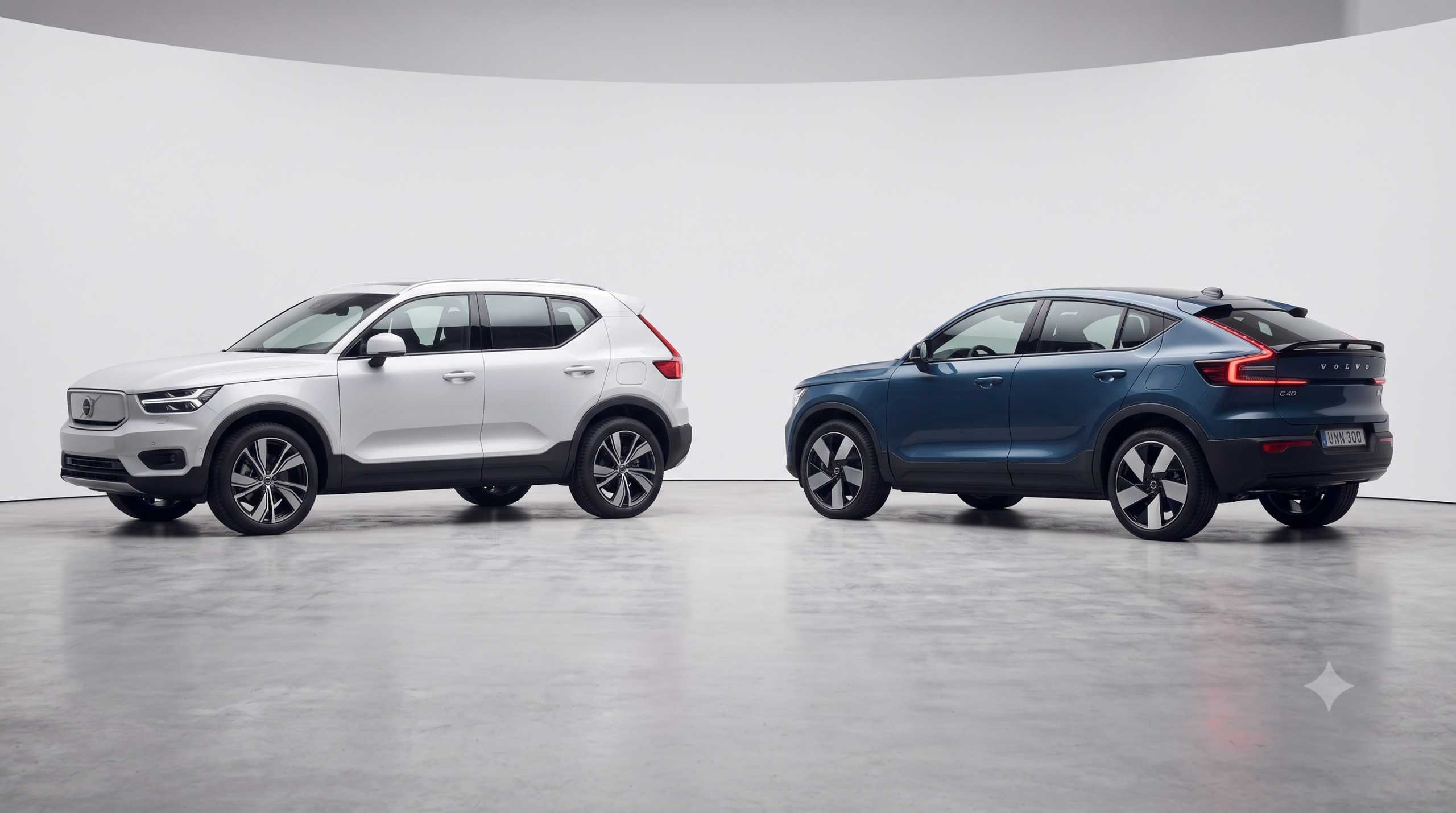
The C40 looks like a coupe that went to the gym; the XC40 looks like a proper SUV.
The C40 is slightly lower and features a coupe-styled rear with a strongly raked rear window, giving it a sportier and more aggressive look than the rest of Volvo’s SUV range. An angular spoiler atop the boot seals the deal.
The XC40, which launched five years before the C40, is a fairly typical-looking SUV — actually boxier than many similarly-sized competitors.
What this means in real life: The C40’s sloping roofline is striking from the outside but creates less rear headroom inside. Taller adults in the back seat may feel a little like they’re sitting inside a car tunnel. The XC40’s upright design gives rear passengers a more comfortable, airy experience.
Design in one line: The C40 turns heads; the XC40 turns no one away.
Powertrain Options: The Biggest Practical Difference
This is where the two cars truly diverge — and it matters enormously.
The C40 is strictly electric. The XC40 comes with endless options: petrol, diesel, mild hybrid versions of both, and a plug-in hybrid.
If you’re not ready to go fully electric — maybe you live in an apartment without a charger, or you do long rural drives regularly — the XC40 is your only option in this family. The C40 doesn’t offer a backup plan.
The C40 is an EV-only commitment. The XC40 lets you dip your toe in.
Electric Range and Performance (EV Versions Compared)
When both cars are wearing their electric hats, the differences shrink dramatically.
Both the XC40 Recharge and C40 Recharge are available with either a single motor and rear-wheel drive, or dual motors for all-wheel drive. The single-motor variant produces up to 248 horsepower and 310 lb-ft of torque. The dual-motor setup delivers 402 horsepower and 486 lb-ft of torque, taking either SUV from zero to 60 mph in 4.6 seconds.
When using a DC fast charger, both EVs charge from 10% to 80% in as little as 28 minutes.
| Spec | C40 Recharge | XC40 Recharge |
|---|---|---|
| EPA Range (Single Motor) | 297 miles | 293 miles |
| Horsepower (Dual Motor) | 402 hp | 402 hp |
| 0–60 mph (Dual Motor) | 4.6 sec | 4.6 sec |
| Starting MSRP (2024) | ~$53,600 | ~$52,450 |
| Cargo (seats up) | 15 cu ft | 16 cu ft |
| Cargo (seats down) | 49 cu ft | 57.5 cu ft |
| Ground Clearance | 171mm | 175mm |
Cargo Space and Practicality
The XC40 wins on space — and it’s not particularly close.
The XC40 Recharge offers 16 cubic feet of cargo space behind the second row, while the C40 Recharge offers 15 cubic feet. With the rear seats folded, the XC40 provides 57.5 cubic feet of total interior cargo volume versus 49 cubic feet in the C40.
That 8.5 cubic feet difference with seats down is roughly the size of a carry-on suitcase. If you’re frequently hauling bikes, strollers, or flat-pack furniture from certain Swedish retailers, you’ll notice it.
Quick Tip: Both models include a front trunk (frunk) for storing charging cables. It’s small, but it’s a genuinely useful place to keep a cable out of your main boot.
The C40 has body dimensions of 4,440 × 1,873 × 1,596mm, while the XC40 measures 4,440 × 1,863 × 1,657mm. Same length, slightly narrower, considerably shorter — that height difference is where all the lost headroom and cargo space goes.
Interior and Technology
Inside, these two cars are essentially the same — and that’s a compliment.
Both feature Volvo’s signature Scandinavian minimalism: a large portrait-format touchscreen dominating the dash, minimal physical buttons, and genuinely premium materials. Google is built in across the lineup, so you can use Google features through the in-dash screen or by voice.
Over-the-air updates are standard on both, and opting for the top-tier trim in either vehicle gets you the Harman Kardon premium sound system with 13 speakers and an air-ventilated subwoofer.
Expert Insight: One area where trim levels differ is the roof. The C40’s base trim includes a laminated panoramic roof with a power sunshade as standard. On the XC40, that feature arrives at the second trim level. So if natural light is important to you, the C40 gives it to you earlier — and cheaper.
Pros & Cons by Buyer Type
For Families with Young Children
XC40 ✅
- More rear headroom — growing kids stay comfortable longer.
- Upright roofline makes buckling in a car seat far less awkward.
- More cargo space for the inevitable mountain of stuff.
C40 ✅
- Electric-only means zero emissions on the school run.
- Slightly more range for longer family trips.
C40 ❌
- Limited rear headroom will become an issue as kids grow.
- No option for petrol/hybrid if you’re not ready to charge at home.
For Urban Professionals
C40 ✅
- Distinctive styling makes a statement.
- Slightly better aerodynamics and range per charge.
- Pure electric means near-zero running costs day to day.
XC40 ✅
- Hybrid versions available if your building doesn’t have a charger.
- Easier to live with if your lifestyle is still ICE-adjacent.
C40 ❌
- The sloping rear can make tight parking sensors slightly less effective — rear visibility is genuinely worse.
For Road-Trip Enthusiasts
XC40 ✅
- PHEV and petrol options eliminate range anxiety entirely.
- More boot space for long-haul luggage.
- Electric and plug-in hybrid XC40 models have 175mm of ground clearance — 4mm more than the C40.
C40 ✅
- Marginally better EPA range on the EV version.
- Panoramic roof standard, great for scenic drives.
C40 ❌
- EV-only on a long road trip requires more charging discipline.
Reliability and Safety
Both cars share so many parts that the C40 is very likely to perform just as reliably as the XC40, which performs very well in reliability surveys. Volvo has also displayed a clear dedication to quality and safety in its electric vehicles, including additional warranty cover for the batteries.
Both come loaded with standard safety equipment. A 360-degree parking view, blind-spot information system, collision avoidance warning, and rear cross-traffic alert are all included.
Safety nerds, breathe easy: both cars are Volvos, which means they were engineered by people who take crash statistics personally.
Expert Insight: A 2024 industry safety analysis found compact electric SUVs from established premium brands consistently outperform equivalently-priced non-premium alternatives on both active and passive safety metrics. Volvo sits near the top of that tier.
Price: How Close Are They Really?
The C40 Recharge starts at approximately $53,600 MSRP, while the XC40 Recharge starts at around $52,450 for the single-motor extended range. That’s roughly a $1,150 difference — essentially nothing at this price point.
If you want an XC40 with a petrol or hybrid engine, pricing starts lower, which does give the XC40 a broader accessibility range overall.
Quick Tip: If you’re choosing between these two and price is the deciding factor, you’re probably overthinking it. At this level, the decision is really about body style, fuel type, and cargo needs — not dollars.
Choose This If…
Choose the C40 if:
- You want the more distinctive, coupe-like look and don’t mind the slightly smaller boot.
- You’re fully committed to going electric and want a car that signals that clearly.
- Your passengers are mostly adults or small children (not lanky teenagers).
Choose the XC40 if:
- You need the flexibility of petrol, diesel, or hybrid — especially if home charging isn’t practical yet.
- You regularly use the full boot space.
- You have tall rear passengers or young kids in car seats.
- You prefer classic SUV proportions and better rearward visibility.
FAQ
Are the Volvo C40 and XC40 the same car? They’re built on the same platform and share the same interior, powertrain options (in the EV versions), and most technology. The differences are the body style (C40 is more coupe-like), cargo space (XC40 is larger), and available fuel types (XC40 also comes in petrol, diesel, and hybrid).
Does the C40 have more range than the XC40? Marginally, yes. The 2024 C40 Recharge gets an EPA-estimated 297 miles, while the XC40 Recharge gets 293 miles on the same single-motor powertrain. It’s a small difference in practice.
Which has more cargo space, the C40 or XC40? The XC40 wins clearly. With rear seats folded, the XC40 offers 57.5 cubic feet versus 49 cubic feet in the C40 — an 8.5 cubic foot advantage that matters on longer trips or big loads.
Can you get a petrol C40? No. The C40 is sold as electric-only. If you want petrol, diesel, or a plug-in hybrid, the XC40 is your only option within this model family.
Is the C40 or XC40 better for rear passengers? The XC40 is better for rear passengers, particularly taller adults. The C40’s sloping roofline reduces rear headroom noticeably, which real-world owners consistently flag as a downside.
Key Takeaways
- The XC40 is more versatile — available in more fuel types, with more cargo space and better rear headroom.
- The C40 is more distinctive — electric-only, sportier styling, marginally better EV range.
- Both share the same driving experience, interior quality, safety features, and technology.
- The price difference between EV versions is minimal (~$1,150 in the US market).
- Families with growing children or regular heavy-loading needs should lean XC40.
- Style-forward, all-in EV buyers who mostly carry adults will prefer the C40.
What to Do Next
Test drive both back-to-back if you can — ask the dealer to park them side by side. Sit in the back seat of each. Open both boots. The right one will be obvious within about 10 minutes. If your dealership only has one in stock, prioritize sitting in the rear seat, because that’s where the key difference lives.