What Gas Mileage Does a 2007 Volvo XC90 Get?

If you’re eyeing a used 2007 Volvo XC90, the fuel economy numbers probably won’t blow you away — but knowing exactly what to expect can save you from an unpleasant surprise at the pump.
This guide is compiled from EPA fuel economy data, Kelley Blue Book specifications, and real owner-reported mileage from Volvo enthusiast forums, so it reflects both official ratings and what people actually see in daily driving.
TL;DR
- The 2007 XC90 came with two engines: a 3.2L inline-six and a 4.4L V8.
- EPA-rated fuel economy is roughly 16–17 mpg city and 20–22 mpg highway for the six-cylinder.
- The V8 comes in lower, around 15 mpg city and 20 mpg highway.
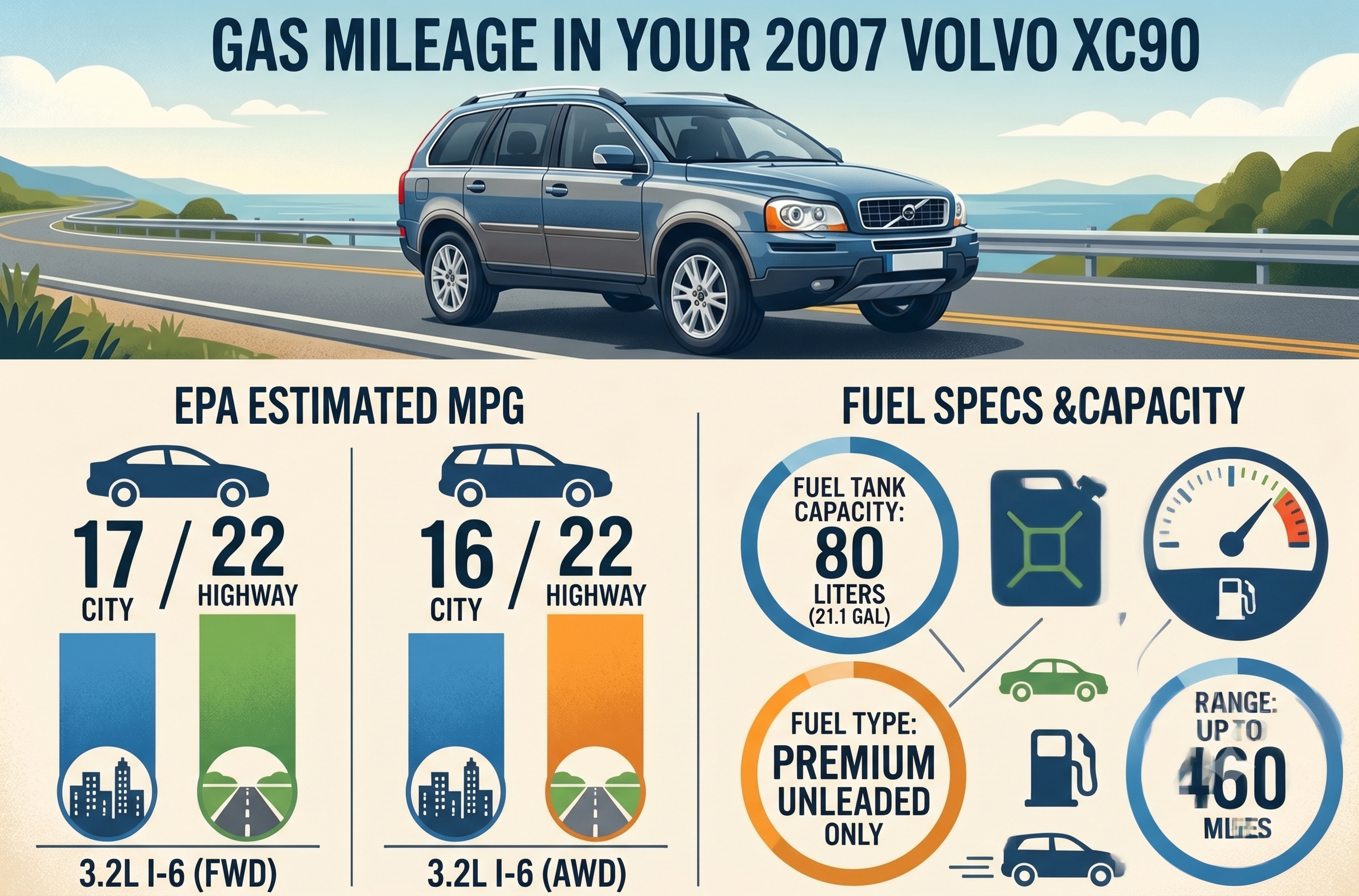
- Both engines require premium unleaded gasoline.
- Real-world owner reports vary widely — from around 13 mpg city with spirited driving to over 20 mpg on steady highway trips.
Here’s the short answer: the 2007 Volvo XC90 gets roughly 16–17 mpg city and 20–22 mpg highway with the 3.2L six-cylinder engine, or around 15 mpg city and 20 mpg highway with the 4.4L V8, and both require premium gasoline.
2007 XC90 Engine Options and Fuel Economy
The 2007 model year was actually a turning point for the XC90’s engine lineup, which matters for anyone comparing fuel economy numbers. This was the year the 3.2-liter inline-six replaced the older 2.5T turbo five-cylinder as the base engine, while the 4.4-liter V8 carried over as the performance option.
According to Kelley Blue Book’s official specifications, the 3.2-liter six-cylinder is EPA-rated at 17 mpg city and 22 mpg highway in front-wheel-drive form, or 16 mpg city and 22 mpg highway with all-wheel drive. The 4.4-liter V8 is rated lower, at 15 mpg city and 20 mpg highway.
Quick Tip: If fuel economy matters to you, the FWD version of the 3.2 six-cylinder is your best bet — AWD costs you roughly 1 mpg city compared to the front-drive model.
Combined MPG: What You’ll Actually See on Average
City and highway numbers only tell part of the story, since most driving is a mix of both. Edmunds’ combined mileage estimate for the 3.2 AWD model comes in around 18 mpg combined, based on 15 mpg city and 21 mpg highway.
For the V8 Sport AWD trim, Edmunds lists a combined estimate of 17 mpg, based on 15 mpg city and 21 mpg highway — figures that land close to, but not identical to, KBB’s numbers, which is common when different data sources use slightly different test trims or years within a generation.
Bold takeaway: the real-world gap between the six-cylinder and V8 is smaller than you might expect on paper — often just 1 to 2 mpg combined — because the V8’s extra weight and AWD-only setup offset some of its efficiency disadvantage.
Comparison Table: 2007 XC90 Fuel Economy by Engine
| Engine | Drivetrain | City MPG | Highway MPG | Combined (approx.) |
|---|---|---|---|---|
| 3.2L Inline-6 | FWD | 17 | 22 | ~19 |
| 3.2L Inline-6 | AWD | 16 | 22 | ~18 |
| 4.4L V8 | AWD | 15 | 20 | ~17 |
The takeaway: if you’re deciding between the two engines primarily on fuel cost, the six-cylinder in FWD form is the most efficient configuration Volvo offered for the 2007 XC90 — but AWD narrows that gap considerably.
What Real Owners Actually Report
EPA numbers are a useful baseline, but they don’t always match daily driving, especially on an SUV this size. Owner reports on Volvo enthusiast forums paint a wider range than the official ratings suggest.
One V8 owner described averaging around 14.5 mpg on a typical day, while another reported the trip computer showing 18 mpg with a 50/50 mix of city and highway driving. On sustained highway trips at moderate speeds, some V8 owners reported figures as high as 21 to 23 mpg, while aggressive city driving with more throttle input dropped as low as 13 mpg.
Expert Insight: Highway cruising speed makes a bigger difference than most people expect — one owner noted a jump from about 19.5 mpg at 80 mph to 21.5 mpg at 75 mph, just from a 5 mph reduction in cruise control speed.
Real-World Scenario: Choosing Between the Two Engines
Say you’re cross-shopping a used 3.2 six-cylinder and a V8 Sport trim at similar prices. If most of your driving is commuting and errands, the six-cylinder’s better city rating adds up meaningfully over a year of ownership — roughly 1 to 2 mpg city translates to real savings across thousands of miles.
If you’re prioritizing towing capability or acceleration and plan mostly highway driving, the V8’s fuel economy penalty is smaller than the city numbers suggest, since both engines land in a similar range once you’re cruising at steady highway speeds.
Pros & Cons by Buyer Type
The Daily Commuter
- Pros: The 3.2 six-cylinder FWD offers the best city fuel economy in the 2007 lineup
- Cons: Even the most efficient configuration only reaches around 17–18 mpg city — modest by modern standards
The Highway-Heavy Driver
- Pros: Both engines see their fuel economy gap narrow considerably at steady highway speeds
- Cons: Real-world highway numbers depend heavily on cruising speed, with even 5 mph making a noticeable difference
The Power-First Buyer
- Pros: The V8’s performance and towing capability come with a fuel economy penalty that’s smaller than expected in real-world use
- Cons: City driving and stop-and-go traffic hit the V8’s mileage the hardest
Alternatives Worth Considering
3.2L six-cylinder, FWD — choose this if fuel economy and lower running costs matter more to you than all-wheel-drive traction.
4.4L V8, AWD — choose this if you want stronger acceleration and towing capacity and are comfortable with a modest fuel economy trade-off.
FAQ
What is the EPA fuel economy rating for a 2007 Volvo XC90? It ranges from about 15 mpg city / 20 mpg highway for the V8 to 17 mpg city / 22 mpg highway for the FWD 3.2L six-cylinder, depending on engine and drivetrain.
Does the 2007 XC90 require premium gas? Yes — both the 3.2L six-cylinder and 4.4L V8 require premium unleaded gasoline.
Is the V8 XC90 much worse on gas than the six-cylinder? The EPA gap is modest, typically 1–2 mpg combined, though real-world city driving can widen that gap more than highway driving does.
What real-world MPG do owners actually get? Reports vary widely, from around 13–15 mpg with aggressive city driving to over 20 mpg on sustained highway trips at moderate speeds.
Does highway speed affect XC90 fuel economy significantly? Yes — owner reports show a noticeable mpg improvement even from small reductions in cruising speed, such as 80 mph down to 75 mph.
Key Takeaways
- The 2007 XC90 offered a 3.2L six-cylinder (17/22 mpg FWD, 16/22 mpg AWD) and a 4.4L V8 (15/20 mpg).
- Combined real-world estimates land around 17–19 mpg depending on engine and drivetrain.
- Both engines require premium unleaded gasoline.
- Owner-reported mileage varies substantially based on driving style and highway cruising speed.
- The fuel economy gap between the six-cylinder and V8 is smaller in practice than the EPA numbers alone might suggest.
Next Step
If fuel economy is a deciding factor in your used XC90 search, prioritize the FWD 3.2L six-cylinder trim — it consistently posts the best numbers across every source in this guide.