What Is a Volvo XC90 Motor?

Ask “what motor is in a Volvo XC90” and the honest answer is: it depends entirely on which one you’re looking at, because Volvo has used at least seven genuinely different engines under that same three-row SUV badge since 2003.
This guide is compiled from Volvo’s official specification data and historical model documentation across both XC90 generations, so it reflects the full engine lineup rather than just the current model.
TL;DR
- The first-generation XC90 (2003–2014) used five-cylinder, six-cylinder, and V8 engines.
- The second-generation XC90 (2015–present) switched entirely to a 2.0-liter turbocharged four-cylinder, shared across every trim.
- Current engines are badged B5 (247 hp), B6 (295 hp, adds a supercharger), and T8 (455 hp combined, plug-in hybrid).
- All modern XC90 engines include a 48-volt mild-hybrid system, even the non-plug-in versions.
- “Motor” in casual use almost always means the gasoline engine, but the T8 also has a real electric motor driving the rear wheels.
Here’s the short answer: a Volvo XC90’s “motor” is a turbocharged 2.0-liter four-cylinder gasoline engine if it’s a 2015-or-newer model — badged B5, B6, or T8 depending on power level — while first-generation XC90s from 2003 to 2014 used a five-cylinder, six-cylinder, or V8 engine depending on trim and year.
Why This Question Doesn’t Have One Answer
This is worth addressing up front, because it genuinely trips people up. The XC90 has existed for over 20 years across two structurally different generations, and Volvo completely reworked the engine lineup when the second generation launched.
Bold takeaway: since 2016, every single XC90 has used a four-cylinder engine — no exceptions, regardless of how powerful or expensive the trim is. If you’re picturing a six-cylinder or V8 “motor” in a modern XC90, that’s a first-generation memory, not a current one.
First-Generation Engines (2003–2014)
If your XC90 predates 2015, this is your engine family. The original lineup started simple and grew more varied over time.
At launch, Volvo offered a 2.5-liter turbocharged inline-five (badged 2.5T, ~208 hp) as the entry engine, and a 2.9-liter twin-turbocharged inline-six (badged T6, ~268 hp) above it. In 2005, Volvo added a 4.4-liter Yamaha-designed V8 (~311 hp) as the range-topping option. Starting with the 2007 refresh, the 2.5T was replaced by a naturally aspirated 3.2-liter inline-six as the new base engine.
Quick Tip: If you’re shopping a used first-gen XC90, the badge (2.5T, T6, 3.2, V8) tells you exactly which engine you’re getting — unlike some newer trims, these names map directly to specific engine hardware.
Second-Generation Engines (2015–Present)
This is where the XC90 changed direction entirely. All engines in the current XC90 are 2.0-liter four-cylinder Drive-E powertrains, a deliberate move away from the larger six-cylinder and V8 engines of the first generation.
Bold takeaway: this wasn’t downsizing for its own sake — Volvo paired the smaller displacement with turbocharging (and later supercharging) to match or exceed the old engines’ performance while improving fuel economy and emissions.
B5: The Standard Engine
The B5 is the entry-level engine on the current XC90, a turbocharged four-cylinder paired with a 48-volt mild-hybrid system. It produces 247 horsepower and 258 lb-ft of torque, with a 0–60 mph time around 7.3 seconds.
B6: The Stronger Option
The B6 builds on the same base engine but adds a supercharger alongside the turbocharger, unlocking 295 horsepower and 310 lb-ft of torque. That dual-charging setup is specifically aimed at eliminating turbo lag, giving noticeably quicker throttle response for merging or passing.
T8: The Plug-In Hybrid
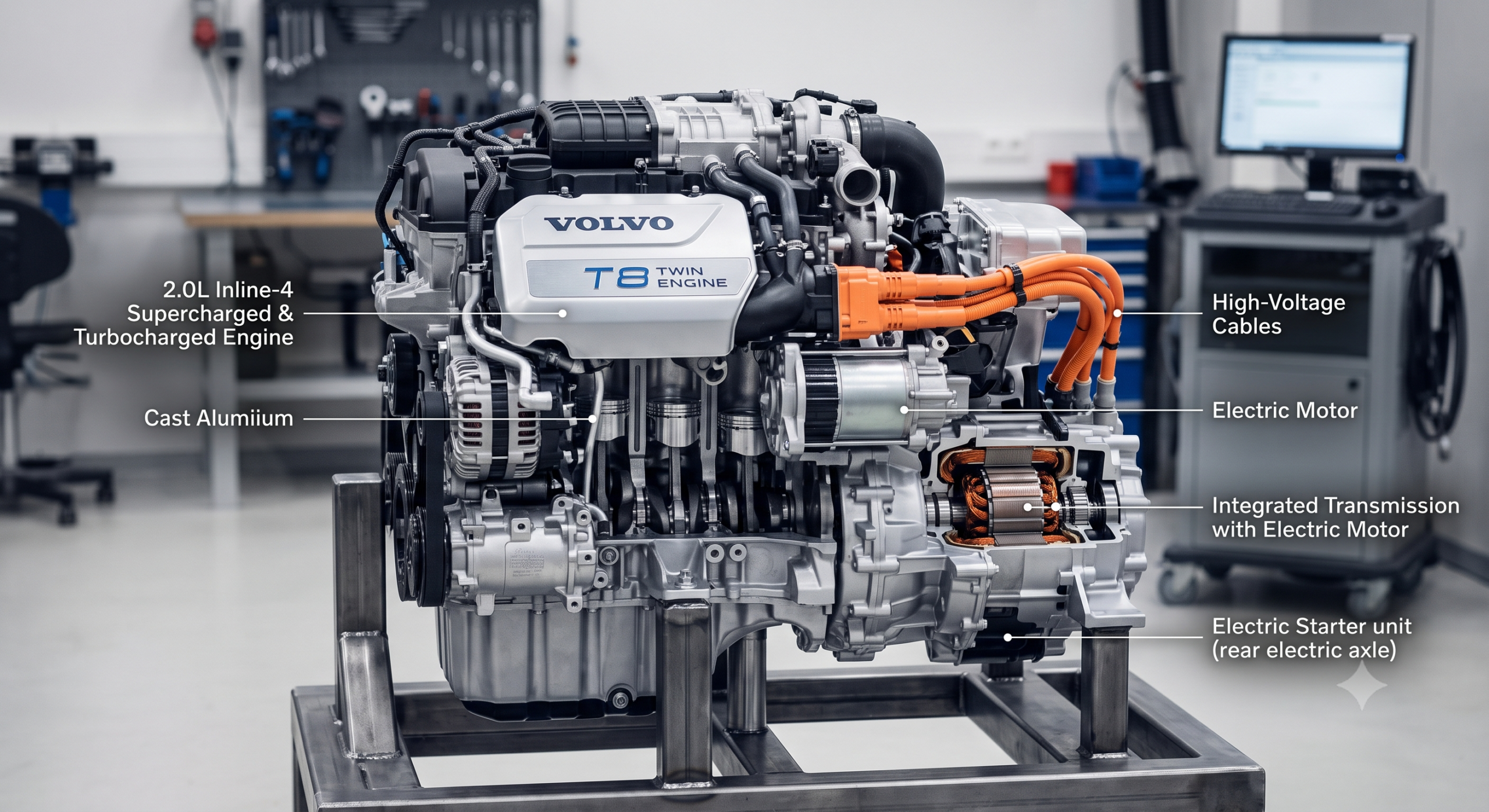
The T8 is the most complex “motor” in the current lineup, and it’s genuinely two motors working together — a turbocharged-and-supercharged version of the same 2.0-liter engine at the front, paired with an electric motor driving the rear wheels. Combined output reaches 455 horsepower and 523 lb-ft of torque, with 0–60 mph in around 5 seconds.
Expert Insight: On the T8, “the motor” can mean two different things depending on context — the gasoline engine up front, or the separate electric motor at the rear axle that also gives the car genuine electric-only range for short trips.
Comparison Table: XC90 Engines Across Generations
| Engine | Years | Displacement/Type | Horsepower |
|---|---|---|---|
| 2.5T | 2003–2006 | 2.5L turbo inline-5 | ~208 hp |
| T6 (first-gen) | 2003–2014 | 2.9L twin-turbo inline-6 | ~268 hp |
| V8 | 2005–2011 | 4.4L Yamaha-designed V8 | ~311 hp |
| 3.2 | 2007–2014 | 3.2L naturally aspirated inline-6 | ~235 hp |
| B5 | 2015–present | 2.0L turbo inline-4, mild hybrid | 247 hp |
| B6 | 2015–present | 2.0L turbo+supercharged inline-4, mild hybrid | 295 hp |
| T8 | 2016–present | 2.0L turbo+supercharged inline-4 + electric motor | 455 hp combined |
The takeaway: despite the huge variety across two decades, there’s a clear pattern — Volvo has consistently traded engine size for forced induction (turbo, then turbo-plus-supercharger, then hybrid assist) to keep power competitive while cutting displacement.
Real-World Scenario: Explaining “Motor” to a Non-Car Person
Say a friend asks what kind of “motor” is in your 2022 XC90 T8. The honest, complete answer is that it’s actually a combination — a turbocharged-and-supercharged four-cylinder gasoline engine working with a separate electric motor at the rear wheels, and depending on driving mode, either one can be doing most of the work at any given moment.
That’s a genuinely different answer than you’d give for a 2010 XC90 V8, where “the motor” is simply the 4.4-liter V8 up front — no ambiguity, no electric component involved.
Pros & Cons by Owner Type
The First-Gen Owner
- Pros: Simpler mechanically — one engine, no hybrid components to maintain
- Cons: Larger, older engine designs generally mean lower fuel economy than current options
The B5/B6 Owner
- Pros: Strong balance of power and efficiency from a proven, widely-used engine platform
- Cons: Some drivers miss the smoother character of the old six-cylinder engines, even with similar power output
The T8 Owner
- Pros: Genuine electric-only range for short trips, plus the strongest acceleration in the lineup
- Cons: More complex system overall, with battery and hybrid component maintenance considerations down the road
Alternatives Worth Considering
B5 — choose this if you want the most straightforward, efficient current engine without the extra cost or complexity of forced-induction upgrades or hybrid components.
T8 — choose this if you want the strongest performance and the option to do short trips entirely on electric power.
FAQ
What kind of motor does a Volvo XC90 have? It depends on the model year — first-generation XC90s (2003–2014) used five-cylinder, six-cylinder, or V8 engines, while every XC90 since 2015 uses a 2.0-liter turbocharged four-cylinder.
Does the modern XC90 have a six-cylinder or V8 engine? No — since 2016, every XC90 trim uses a four-cylinder engine, regardless of how powerful the specific badge (B5, B6, T8) suggests.
What’s the difference between the B5 and B6 engines? The B6 adds a supercharger alongside the turbocharger on the same base engine, boosting output from 247 hp to 295 hp and improving throttle response.
Is the T8 XC90’s motor gas or electric? Both — it combines a turbocharged-and-supercharged gasoline engine at the front with a separate electric motor driving the rear wheels.
How much horsepower does the most powerful XC90 engine have? The T8 plug-in hybrid produces up to 455 combined horsepower, the highest output currently offered in the XC90 lineup.
Key Takeaways
- The XC90’s “motor” varies enormously depending on model year — first-gen (2003–2014) used 5-cyl, 6-cyl, and V8 engines.
- Since 2015, every XC90 uses a 2.0L turbocharged four-cylinder as the engine base.
- B5 (247 hp) and B6 (295 hp, adds a supercharger) are the two current mild-hybrid gas options.
- T8 (455 hp combined) pairs the gas engine with a genuine electric motor for plug-in hybrid capability.
- All current engines include a 48-volt mild-hybrid system, even outside the plug-in T8.
Next Step
If you’re comparing a used first-gen XC90 against a current model, remember they’re not just different years — they’re completely different engine philosophies, so compare them on their own terms rather than assuming continuity.