
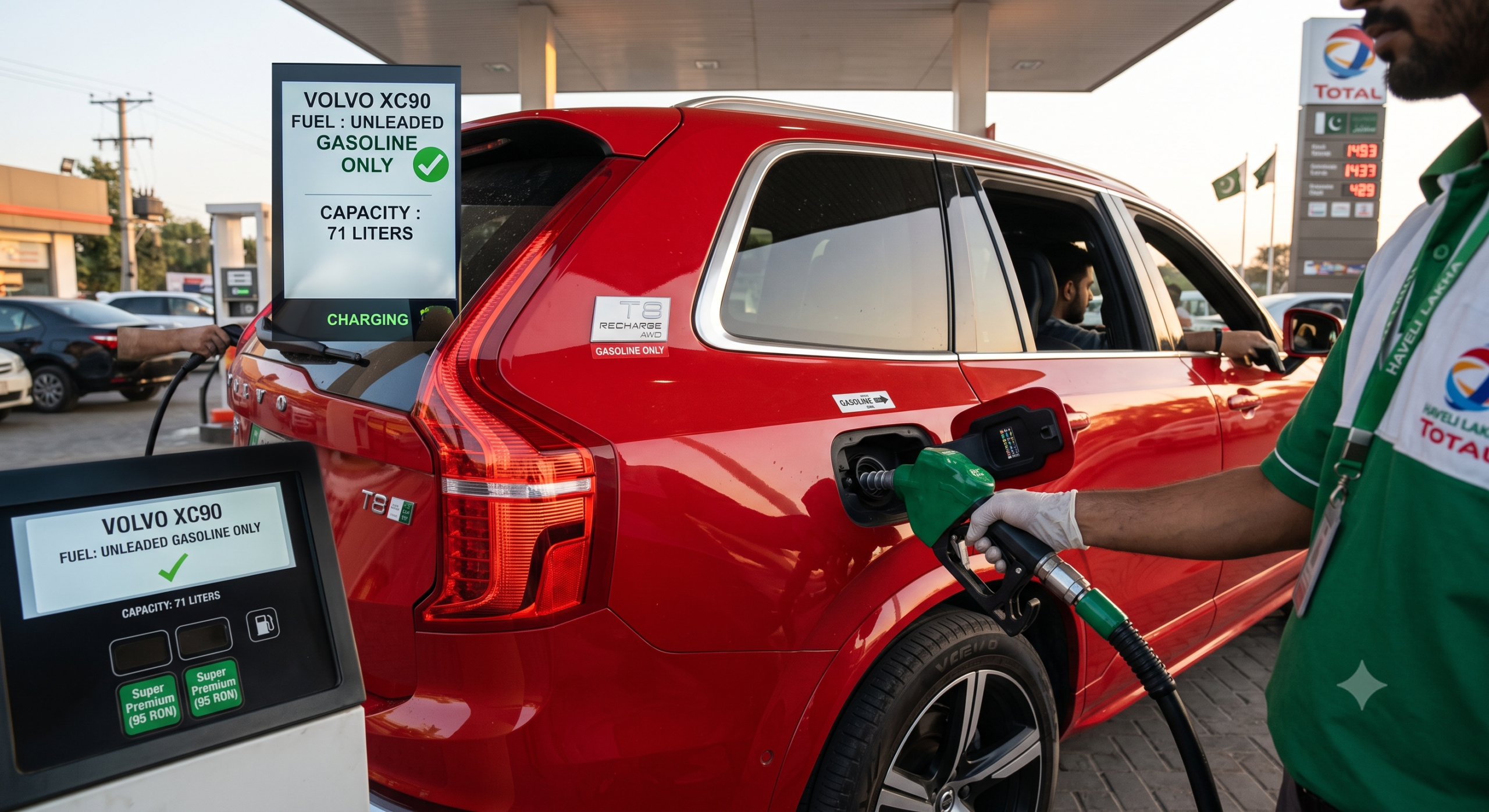
What Fuel Does the Volvo XC90 Take?

Put the wrong grade of gas in your XC90 and you probably won’t strand yourself on the highway — but you might notice your SUV suddenly feels a lot less eager to merge.
This guide is compiled from Volvo’s official fuel and octane documentation across current and recent XC90 model years, so the numbers reflect factory requirements, not dealership guesswork.
TL;DR
- Most gasoline XC90s require premium fuel, 91 octane (AKI) or higher; Volvo recommends 93 for best performance.
- The plug-in hybrid T8 Recharge runs on gasoline too, plus can be charged and driven on electricity alone for short distances.
- European and other global markets have offered diesel (D4/D5) XC90s, though diesel was discontinued for the model in 2024.
- Fuel containing up to 10% ethanol (E10) is approved; higher blends like E85 are not.
- Using lower-octane fuel generally won’t damage the engine, but it can measurably hurt performance and fuel economy.
Here’s the short answer: the gasoline Volvo XC90 requires premium fuel with a minimum 91 octane rating (93 recommended), the T8 model adds plug-in electric charging on top of that same gasoline requirement, and diesel XC90s — sold mainly outside North America — use standard diesel fuel until the engine option was discontinued in 2024.
Gasoline: What Octane Does Your XC90 Need?
This is the question most XC90 owners actually have, and the answer is more consistent than you might expect across model years. Volvo requires premium fuel, with an octane rating of 91 or higher, for all B4, B5, B6, and T8 engines, and recommends 93 octane for ideal performance and fuel economy.
That requirement applies broadly across recent gasoline XC90 trims — whether you have the B5 mild-hybrid four-cylinder or the higher-output B6. Bold takeaway: 91 octane (AKI) is the floor Volvo sets, not a suggestion — running lower-octane fuel regularly is something the engine can technically tolerate, but it’s outside spec.
Quick Tip: The exact octane requirement is printed right on a decal inside your fuel filler flap — that’s the fastest way to confirm your specific car’s requirement without digging through a manual.
What Actually Happens if You Use Regular Gas
This is where owner experience gets genuinely useful. It’s not that your engine will be damaged by a single tank of regular unleaded — modern engine management systems can adjust for it — but performance takes a real hit.
One owner who ran mid-grade 89 octane instead of the recommended 91 reported the car still performed reasonably well with no engine noise, while another XC90 owner who accidentally filled up with regular noted it performed noticeably worse and hurt gas mileage enough to be obvious. If you switch octane grades, expect it to take more than one fill-up before you notice any change in how the engine responds.
Expert Insight: Turbocharged engines like the ones in the XC90 are more sensitive to octane than older naturally aspirated engines, because the engine computer can pull back ignition timing to protect against knock — quietly costing you power and efficiency rather than throwing a warning light.
The T8 Plug-in Hybrid: Gas Plus Electric
If you have the XC90 T8 Recharge, the fuel question has two parts. It still uses the same premium gasoline requirement as the rest of the lineup, but it adds a plug-in battery that lets you drive on electricity alone for a portion of your trips.
At launch, the T8’s battery delivered a modest electric-only range, and Volvo has steadily grown that range with larger batteries in newer model years. In daily use, many T8 owners charge overnight and can complete short commutes without using gasoline at all, while the gas engine takes over automatically for longer trips or higher-power driving.
Diesel XC90s: Available Outside North America
This is the piece that often surprises US-based owners. The XC90 was never sold with a diesel engine in North America, but D4 and D5 diesel variants were offered in Europe and other global markets for years.
Bold takeaway: if you’re researching a European-market XC90 or importing one, the D5 diesel used a twin-turbo setup producing meaningfully more torque than the equivalent gas engines — but Volvo ended diesel production for the XC90 (and the brand overall) in March 2024, so newer diesel XC90s don’t exist.
Comparison Table: XC90 Fuel Types
| Powertrain | Fuel Type | Octane/Grade | Availability |
|---|---|---|---|
| B5 (mild-hybrid gas) | Gasoline | 91 AKI minimum, 93 recommended | Current, North America and globally |
| B6 (higher-output gas) | Gasoline | 91 AKI minimum, 93 recommended | Current, select markets |
| T8 Recharge | Gasoline + electric charging | Same as above, plus home/public charging | Current, North America and globally |
| D4 / D5 | Diesel | Standard diesel | Europe and other global markets, discontinued 2024 |
The takeaway: if you’re shopping for a new or recent XC90 in North America, diesel simply isn’t on the table anymore — it’s premium gas, with or without the plug-in hybrid option.
Real-World Scenario: Filling Up on a Road Trip
Say you’re on a road trip and the only station for miles has nothing but regular 87 octane. According to Volvo’s own guidance, this kind of emergency top-off with a lower grade won’t damage your engine, but it’s worth switching back to 91-or-higher at the next opportunity, since the car may need a fill-up or two before performance and fuel economy return to normal.
It’s the kind of situation where “it’ll be fine once” is genuinely true, but “I’ll just always run regular to save money” is where you start giving up real performance and efficiency.
Pros & Cons by Owner Type
The Daily Commuter
- Pros: Premium fuel cost is a small, predictable line item most owners factor into ownership costs upfront
- Cons: Premium consistently costs more per gallon than regular, adding up over high-mileage ownership
The T8 Plug-in Owner
- Pros: Regular home charging can meaningfully cut gasoline use for short trips
- Cons: Still requires premium fuel for the gas engine, so it’s not a way to avoid the octane requirement entirely
The Import/Enthusiast Buyer
- Pros: European D4/D5 diesel models offer strong torque and efficiency if importable in your region
- Cons: Diesel XC90s are no longer in production, so sourcing and parts support may shrink over time
Alternatives Worth Considering
91-octane “plus” grade — choose this if your regular station doesn’t carry a clearly labeled 93 premium; it meets Volvo’s stated minimum requirement.
TOP TIER-certified premium gasoline — choose this if you want to follow Volvo’s specific recommendation for maintaining long-term engine performance and reliability, since Volvo names this standard directly in its own fuel guidance.
FAQ
Does the Volvo XC90 require premium gas?
Yes — Volvo requires a minimum 91 octane (AKI) rating for its B4, B5, B6, and T8 engines, and recommends 93 octane for the best performance and fuel economy.
Can I use regular 87 octane gas in my XC90?
It generally won’t damage the engine, but it falls below Volvo’s stated requirement and will likely reduce performance and fuel economy compared to using the recommended octane.
Does the XC90 T8 Recharge need to be plugged in?
No — it can run entirely on gasoline like other XC90 models, but plugging it in regularly lets you take advantage of its electric-only driving range for shorter trips.
Is a diesel Volvo XC90 available in the US?
No — diesel XC90s (D4/D5) were sold mainly in Europe and other global markets, and Volvo discontinued diesel engines for the XC90 entirely in March 2024.
Can I use E85 or high-ethanol fuel in my XC90?
No — Volvo approves fuel containing up to 10% ethanol (E10), but higher ethanol blends like E85 are not permitted.
Key Takeaways
- Gasoline XC90s require a minimum 91 octane (AKI), with 93 recommended for best performance.
- Using lower-octane fuel generally won’t harm the engine but will noticeably reduce performance and efficiency.
- The T8 Recharge plug-in hybrid uses the same premium gasoline requirement as other trims, plus optional electric charging.
- Diesel XC90s (D4/D5) were sold outside North America but were discontinued along with all Volvo diesel engines in 2024.
- Fuel up to E10 (10% ethanol) is approved; higher ethanol blends like E85 are not.
Next Step
Check the decal inside your fuel filler flap to confirm your exact octane requirement, and stick with 91-or-higher premium at every fill-up for the best real-world performance.