How to Unlock a Volvo With a Dead Battery?

You walk up to your Volvo, hit the fob, and nothing happens — not even the usual click. Before you assume you’re locked out for good, there’s a mechanical backup built into every keyless Volvo for exactly this situation, and it has nothing to do with the fob’s own battery.
The short answer: a dead 12-volt car battery can lock you out because Volvo’s electronic door locks and keyless entry system both run on that same battery. Your first move is the hidden mechanical key blade tucked inside your fob, which unlocks the driver’s door lock cylinder directly. If that doesn’t fully release the door, jump-starting the car (or feeding it temporary power under the hood) is usually the next step, not force.
This guide pulls from Volvo owner’s manual documentation, dealership service explainers, and real troubleshooting threads from stranded Volvo owners, so you know which fix actually matches your situation.
TL;DR
- A dead 12V battery, not the fob’s coin-cell battery, is the more likely cause of a total lockout — check which one you’re actually dealing with first.
- Every keyless Volvo hides a mechanical key blade inside the fob for exactly this scenario.
- On most models, <cite index=”31-1″>turning the key blade clockwise about a quarter turn in the driver’s door lock unlocks that door only, and will trigger the alarm</cite>.
- If the mechanical key turns but the door still won’t open, the lock actuator itself may need power, meaning you’ll need to jump-start the car or call for help.
- Trunk and tailgate locks are usually power-dependent too, but most Volvos have a manual interior release lever as a backup.
Step 1: Confirm It’s the Car Battery, Not the Fob Battery
Before doing anything else, rule out the cheaper, faster problem. <cite index=”27-1″>A dead Volvo car battery doesn’t just affect the engine — it tends to take down other systems with it, including the door locks and key fob functions, and models like the XC90, S60, and XC60 are particularly known for this</cite>.
If your dash lights, interior lights, and dome light are all dark when you open the door manually, that points to the 12V battery rather than a simple dead fob. A dead fob alone won’t dim your dashboard.
Quick Tip: Try your key fob on a different car door, or ask someone to test it against the driver’s door from a few feet away. If it doesn’t respond at all — not even a faint click from the lock — the car’s battery is the more likely culprit.
Pull-quote: A dead key fob battery is a $5 fix. A dead 12V battery is a different repair entirely.
Step 2: Use the Hidden Mechanical Key Blade
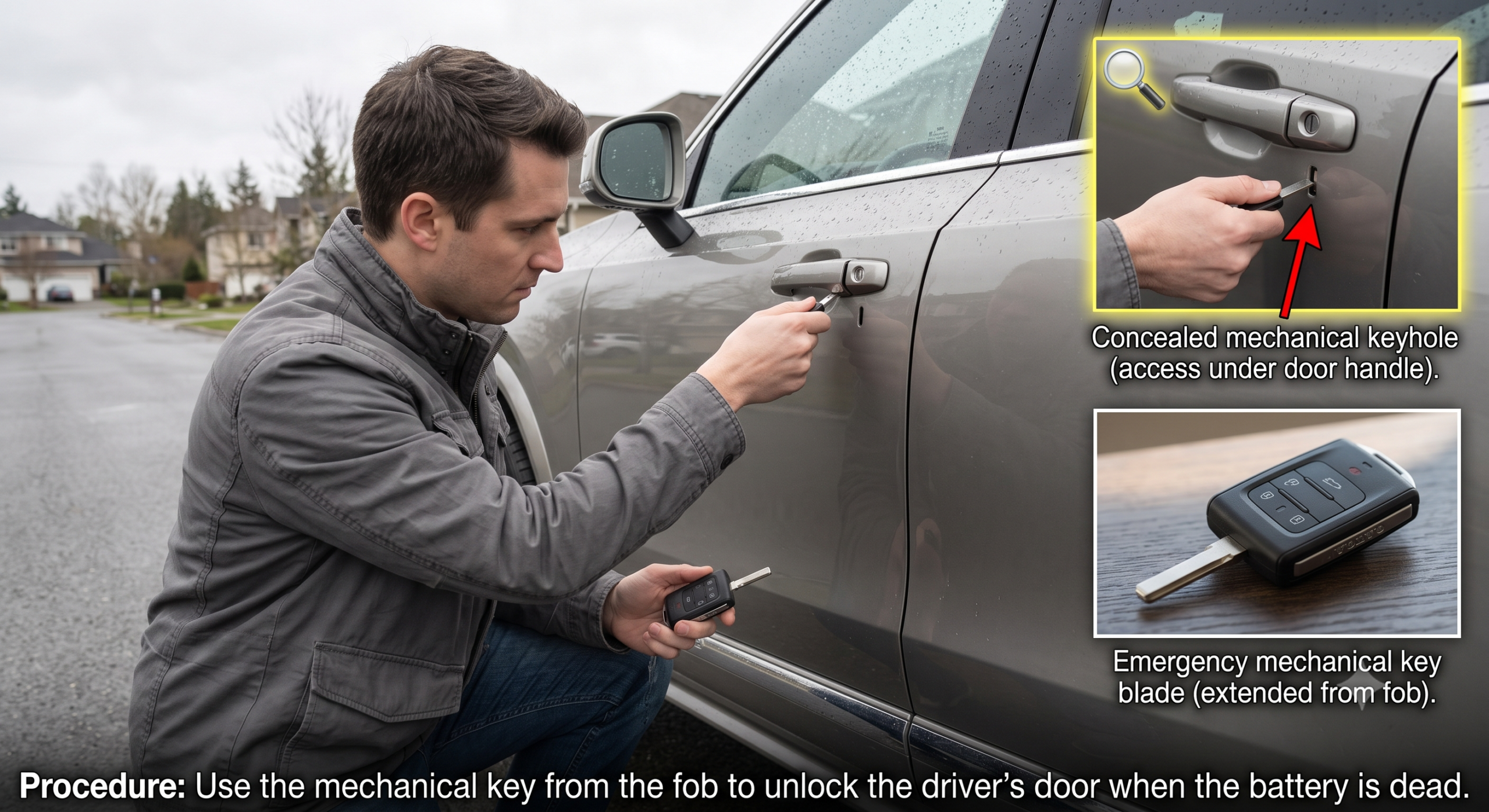
<cite index=”35-1″>Many early 2000s Volvo XC and V70 models lack an exterior key slot near the license plate light</cite>, but nearly every keyless-drive Volvo hides a mechanical key blade inside the fob itself. <cite index=”31-1″>To access the keyhole in the driver’s door, pry off the keyhole cover by inserting the key blade or a small screwdriver into the hole on the underside of the cover, then insert the key blade as far as possible into the lock and turn it clockwise about a quarter turn to unlock the driver’s door only</cite> — and expect the alarm to sound when you do.
That alarm is normal and not a sign something’s wrong. <cite index=”27-1″>A gentle touch matters here, since forcing the key can set off the alarm even faster and add a blaring soundtrack to an already stressful moment</cite>.
Real-world scenario: Picture coming out of a grocery store to a Volvo that won’t respond to the fob at all. You find the hidden keyhole, turn the blade gently, and the door unlocks — but the alarm starts blaring in the parking lot. That’s expected behavior, not a malfunction; get in, and the alarm typically stops once the ignition is engaged or the key is turned in the ignition.
Step 3: What to Do If the Key Blade Doesn’t Fully Unlock the Door
This is where Volvo lockouts get frustrating, and it’s a real, documented failure point — not a rare edge case. <cite index=”28-1″>In one case, the mechanical key was able to turn in the lock cylinder, but the door remained locked, and a service technician explained that the locks still need some power to function, so if the battery is entirely dead, that can prevent the door from unlocking even with the correct mechanical key</cite>.
<cite index=”29-1″>One owner confirmed this same mechanical detail from the other direction — the lock cylinder itself doesn’t require power to turn, so if the key doesn’t turn at all, that points to a different issue like a broken lock cylinder rather than the dead battery</cite>. In other words: if the key turns but nothing releases, suspect the battery and the actuator; if the key won’t turn at all, suspect the lock hardware itself.
Expert Insight: A Volvo service technician on a 2024 consumer support platform noted that once the 12V battery is completely dead rather than just weak, forced mechanical entry or professional roadside access becomes the realistic option, since the electric actuator inside the door simply has nothing to work with.
Decision Table: Key Turns, But What Happens Next?
| What You Observe | Likely Cause | Next Step |
|---|---|---|
| Key blade won’t turn at all | Faulty or damaged lock cylinder | Locksmith or dealer service, unrelated to the battery |
| Key blade turns, alarm sounds, door unlocks | Working as designed | Get in, start troubleshooting the 12V battery |
| Key blade turns, but door stays locked | Battery too dead to power the actuator | Jump-start the car or call roadside assistance |
Step 4: Powering Up the Locks From Outside
If you’re stuck outside with a fully dead battery and no spare key inside, some owners restore just enough power to the central locking system without ever getting inside first. <cite index=”35-1″>This involves attaching a jumper cable’s positive clamp to the exposed positive post under the hood and the negative clamp to a clean, verified chassis ground point, such as an engine mount bolt, then allowing a few seconds for the vehicle’s modules to wake before trying the fob or door switch again</cite>.
This isn’t a full jump-start — it’s a smaller, temporary power feed aimed specifically at waking the locking system. <cite index=”35-1″>Confirming proper polarity with a multimeter before connecting, and never letting the clamps touch each other while attached, are both essential safety steps here</cite>. If you’re not confident identifying the correct posts and grounds under your hood, this is a reasonable moment to call roadside assistance instead.
Pull-quote: Sometimes the fastest fix isn’t unlocking the door — it’s waking the battery first.
Step 5: Getting Into the Trunk Without Power
A dead battery often takes the trunk release with it too. <cite index=”27-1″>Most Volvo models rely on the same 12V battery to power the trunk or tailgate locks, but a manual release lever inside the car, usually near the driver’s seat or hidden in the glovebox area, can pop the trunk with a satisfying click even without electrical power</cite>.
If you can’t get into the cabin at all yet, this step has to wait until Step 2 or Step 4 succeeds first — there’s no way to reach the interior release from outside the car.
Pros and Cons by Situation
The driver locked out in a parking lot with tools on hand:
- Pro: The key-blade method costs nothing and takes under a minute when it works.
- Con: If the door won’t release even after the key turns, you’re stuck waiting for help anyway.
The driver with a second vehicle or jump pack nearby:
- Pro: Powering the lock system directly, or doing a full jump-start, solves the root cause instead of just getting you inside.
- Con: This requires comfort working under the hood and correctly identifying posts and grounds.
The driver without tools, in bad weather, or unsure of the car’s electrical layout:
- Pro: Roadside assistance or a locksmith removes all guesswork and risk of damaging the lock or actuator.
- Con: It costs money and takes time you may not have.
Frequently Asked Questions
Why won’t my Volvo unlock even though the key blade turns in the lock? <cite index=”28-1″>This usually means the door lock actuator itself doesn’t have enough power to physically release, even though the mechanical cylinder turned correctly</cite> — a fully dead 12V battery is the most likely cause.
Can I use the mechanical key on any Volvo, or only certain models? <cite index=”31-1″>Volvo’s owner’s manual documentation for models with keyless drive specifically describes locking or unlocking the driver’s door with the remote control’s detachable key blade</cite>, so this applies broadly across keyless-equipped Volvos, though the exact keyhole cover location can vary by model.
Is it safe to connect jumper cables directly to the locking system instead of jump-starting the engine? It can be, but <cite index=”35-1″>confirming polarity with a multimeter and using a verified, clean chassis ground point are essential precautions before attempting this</cite>. If you’re uncertain about any of these steps, it’s safer to call for professional help.
Will the car alarm going off during manual unlocking damage anything? No. <cite index=”31-1″>Manually unlocking the driver’s door with the key blade is documented to trigger the alarm as a normal part of the process</cite>, not a sign of a fault.
How do I avoid getting locked out like this again? Keep a portable jump starter in your trunk (accessed before you’re ever locked out), and periodically drive your Volvo long enough to keep the 12V battery properly charged, especially if it sits for weeks at a time.
Key Takeaways
- Rule out a simple dead fob battery first — a truly dead 12V battery usually dims interior lights too, not just the fob.
- Every keyless Volvo has a hidden mechanical key blade for manual door entry, typically behind a small cover on the driver’s door handle.
- If the key turns but the door won’t release, the actuator lacks power, not the lock itself — jump-starting is the real fix.
- A manual trunk release lever inside the cabin is your backup once you’re inside, since the trunk lock usually shares the same power dependency.
- When in doubt about jumper cable polarity or grounding points, call roadside assistance rather than risk damaging the electronics.
Try the key blade first if you have a few minutes and reasonably calm nerves — it’s free and often works outright. Call roadside assistance instead if the key turns without unlocking the door, since that’s a power problem no amount of jiggling the key will solve.
Next Step
Locate your Volvo’s hidden key blade and practice removing it once, in a calm moment, so you’re not fumbling with an unfamiliar mechanism the first time you actually need it.