Volvo Penta DPH vs DPI?

Repowering a boat with a Volvo Penta D4 or D6 used to mean one obvious drive choice. Now there are two, and picking wrong could mean paying for features you’ll never use—or missing out on the smoothest shifting Volvo has ever built.
TL;DR
- The DPI drive replaced the DPH as Volvo Penta’s newer Duoprop sterndrive, introduced as part of the next-generation D4/D6 engine packages
- DPI’s headline feature is a hydraulic clutch, which enables smoother, quieter shifting and low-speed “slip” trolling
- Electric steer-by-wire is standard on DPI, while DPH relies on hydraulic steering
- DPH is still available for boats built around all-hydraulic steering systems
- Both drives share many core components, including shafts, gears, bearings, and lower units
The core answer: the Volvo Penta DPI is the newer-generation Duoprop sterndrive that replaced the DPH, adding a hydraulic clutch for smoother shifting and standard electric steering—while the DPH remains available for boats that need all-hydraulic steering, and both drives share much of the same core mechanical hardware underneath.
What Makes the DPI Different From the DPH?
The DPI arrived as part of Volvo Penta’s next-generation D4 and D6 propulsion packages, replacing the DPH leg, though the DPH remained available for boats built around all-hydraulic steering systems. The standout upgrade is how it shifts.
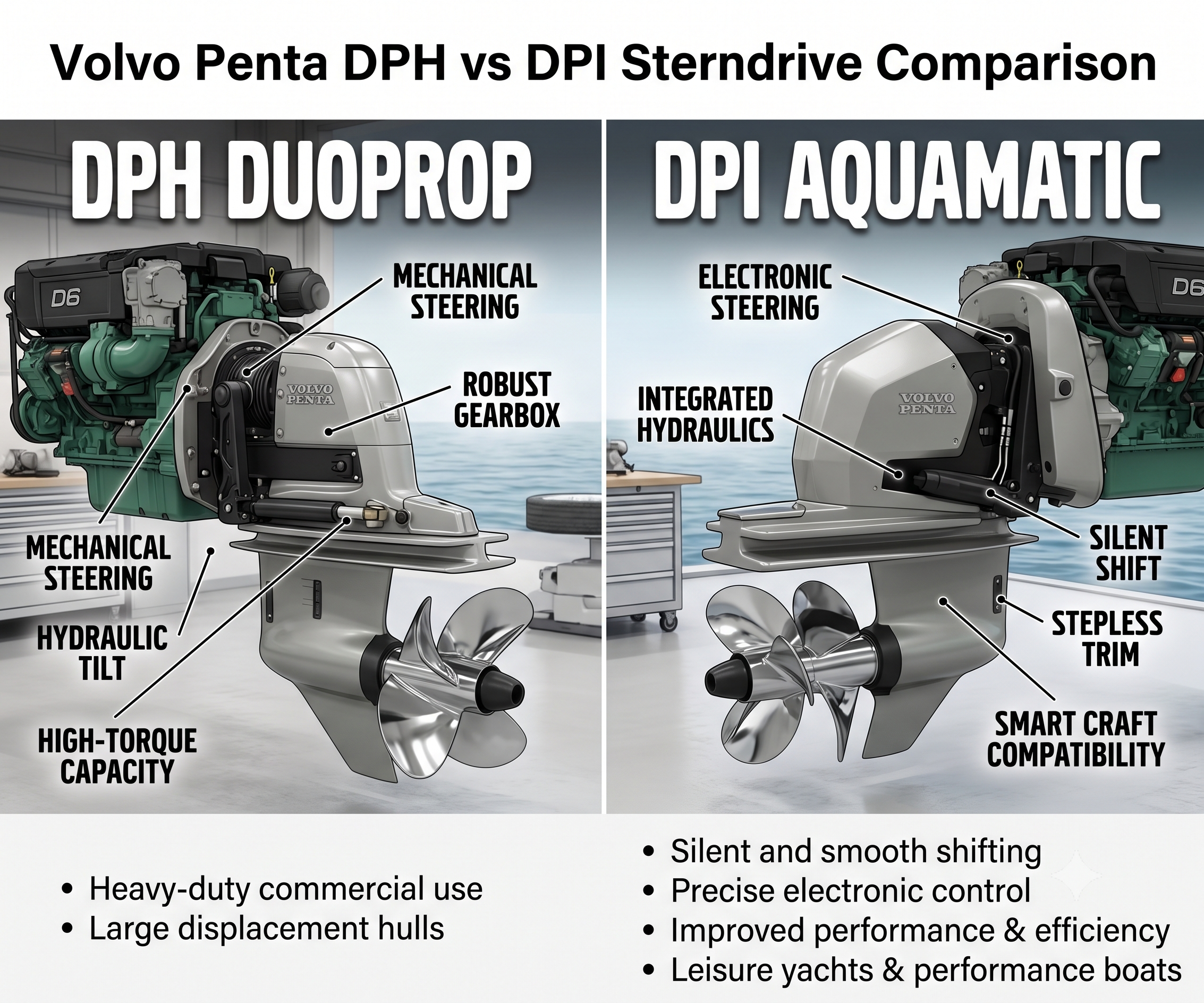
Owners and marine mechanics describe the DPI as an upgraded version of the DPH drive that uses a new hydraulic clutch plate for shifting forward and reverse, which softens shifts and reduces wear on the drive gears and bearings. Mechanically, though, the two aren’t as far apart as the feature list suggests—the DPH and DPI share the same shafts, gears, bearings, lower units, and many other components.
Quick Tip: If your boat’s steering setup is all-hydraulic and you’re not planning to rewire the helm, ask your dealer whether a DPH-based package still fits your boat—it may be the simpler retrofit.
DPH vs. DPI: Side-by-Side
| Feature | DPH | DPI |
|---|---|---|
| Shifting mechanism | Mechanical clutch | Hydraulic clutch (smoother, quieter) |
| Steering | Hydraulic | Electric steer-by-wire, standard |
| Low-speed/trolling control | Limited | Slow-speed slip mode, EVC-integrated |
| Joystick docking | Available | Improved, with optional Dynamic Positioning System |
| Core hardware (shafts, gears, bearings) | Shared design lineage | Shared design lineage |
| Availability | Still offered for hydraulic-steering boats | Standard on next-gen D4/D6 packages |
Pros and Cons by Boat Owner Type
Owners Prioritizing Smooth Docking
- ✅ The hydraulic clutch makes gear engagement a nearly silent affair compared to the mechanical clunk of older clutches
- ✅ Standard electric steering pairs well with joystick docking systems
- ❌ More electronic complexity means more potential points of failure
Owners With Existing Hydraulic-Steering Boats
- ✅ DPH remains a supported option, avoiding a full steering system overhaul
- ✅ Familiar mechanical clutch behavior for owners used to older Volvo drives
- ❌ Missing out on the smoother low-speed slip and trolling features of DPI
Long-Range Cruisers and Fishermen
- ✅ DPI’s slow-speed mode is useful for trolling and navigating speed-restricted waterways
- ✅ Reported fuel consumption improvements on next-gen packages, though real-world results vary by boat and conditions
- ❌ Diesel drivetrain repairs remain costly regardless of drive type, per long-time owner reports
Expert Insight: According to marine trade coverage of the D4/D6 relaunch, Volvo claimed increased service intervals of 20%, a 40% reduction in spare parts and fluids needed over the first 10 years, and a predicted 30% drop in unforeseen breakdowns for the next-generation packages that introduced the DPI drive.
Real-World Scenario
Picture a 33-foot sport cruiser getting repowered with twin D4-320s. With the DPI package, the owner gets standard electric steering, a joystick that docks the boat with barely a shudder from the drivetrain, and a trolling mode for slow-speed fishing days.
An owner keeping an older hull with hydraulic steering intact, on the other hand, might stick with a DPH-based package to avoid rewiring the helm—accepting the more traditional mechanical clutch feel in exchange for a simpler installation.
Should You Choose DPH or DPI?
Choose DPI if: you want the smoothest shifting available, plan to use joystick docking regularly, or need slow-speed trolling control.
Choose DPH if: your boat is already set up for all-hydraulic steering and you’d rather avoid a full helm rewire.
Quick Tip: Ask your Volvo Penta dealer whether optional programming like auto-trim assist and slow-speed outdrive control are included or need to be added—some owners report these aren’t automatically bundled with DPI packages.
FAQ
Is the DPI drive more reliable than the DPH? Both are built on shared core hardware, but the DPI’s hydraulic clutch is designed to reduce wear on gears and bearings compared to the DPH’s mechanical clutch.
Can I get a DPI drive on an older Volvo Penta engine? The DPI was introduced alongside Volvo Penta’s next-generation D4 and D6 engine packages, so availability depends on your specific engine and boat builder configuration—check with a dealer.
Does DPI require electric steering at the helm? Yes, electric steer-by-wire is standard with DPI, which removes the need for hydraulic steering cables and can simplify installation for builders.
Is the DPH being phased out completely? As of recent Volvo Penta documentation, DPH remains available specifically for boats built around all-hydraulic steering systems, alongside the newer DPI option.
What’s the biggest practical difference an owner would notice day-to-day? Most owners point to shifting smoothness—the DPI’s hydraulic clutch is notably quieter and gentler than the DPH’s mechanical shift feel, especially during joystick docking.
Key Takeaways
- DPI is the newer drive, built around a hydraulic clutch for smoother, quieter shifting
- Electric steer-by-wire is standard on DPI; DPH uses hydraulic steering
- DPH is still available for boats designed around hydraulic steering systems
- Both drives share major core components like shafts, gears, bearings, and lower units
- DPI adds features like slow-speed trolling mode and improved joystick docking
What To Do Next
Talk to your Volvo Penta dealer about your boat’s existing steering setup and intended use—trolling, joystick docking, or a straightforward repower—before deciding between a DPH or DPI package.