Volvo Penta D4 vs D6?

Pick the wrong marine diesel and you’ll either be underpowered fighting a following sea, or hauling around hundreds of extra pounds of engine you never needed. That’s the real stakes behind the Volvo Penta D4 vs D6 decision.
TL;DR
- The D4 is a 3.7-liter inline-4 diesel, currently offered up to 320 hp
- The D6 is a 5.5-liter inline-6 diesel, currently offered up to 480 hp
- The D6 runs smoother by design — inline sixes are inherently better balanced than inline fours
- Both share the same modernized common-rail fuel system, running at 2,000 bar pressure
- Choice mostly comes down to boat size, weight, and how much power your hull actually needs
This comparison draws on Volvo Penta’s own technical materials and independent marine press coverage of the most recent generation of these engines, current as of mid-2026.
So which is right for your boat? In short: the D4 suits smaller, lighter boats in the 28–38 foot range where weight savings and fuel economy matter most, while the D6 is the better fit once you’re pushing into 40+ foot boats or twin-engine installations that need more horsepower per engine. Both are part of the same reengineered platform Volvo Penta rolled out with more power, improved fuel efficiency, and higher reliability across the board — the most powerful D4 now delivers 320 hp (up from 300 hp), while the punchiest D6 now offers 480 hp (up from 435 hp).
Quick Tip: If you’re replacing an older D4 or D6 on the same boat, don’t assume you need to jump to the newer, higher-output variant — matching your original horsepower rating is often the safer call unless you’ve specifically identified a performance gap.
What Are the D4 and D6, Exactly?
The D4 and D6 are Volvo Penta’s mid-range marine diesel engines, and they’ve been a mainstay of the recreational and light-commercial marine market for over two decades. The D4/D6 propulsion packages were introduced back in 2003, and with more than 100,000 of them sold to date, this is Volvo Penta’s highest-volume diesel platform.
Volvo Penta’s most recent overhaul is the most comprehensive refresh of its four- and six-cylinder diesel drivetrains since their 2005 launch, touching the engines, the electronic controls, and the drive units together as one integrated system.
Pull-quote: The D4 and D6 share the same DNA — the real question is how much horsepower your hull actually needs to carry.
D4: The Compact, Lighter Option
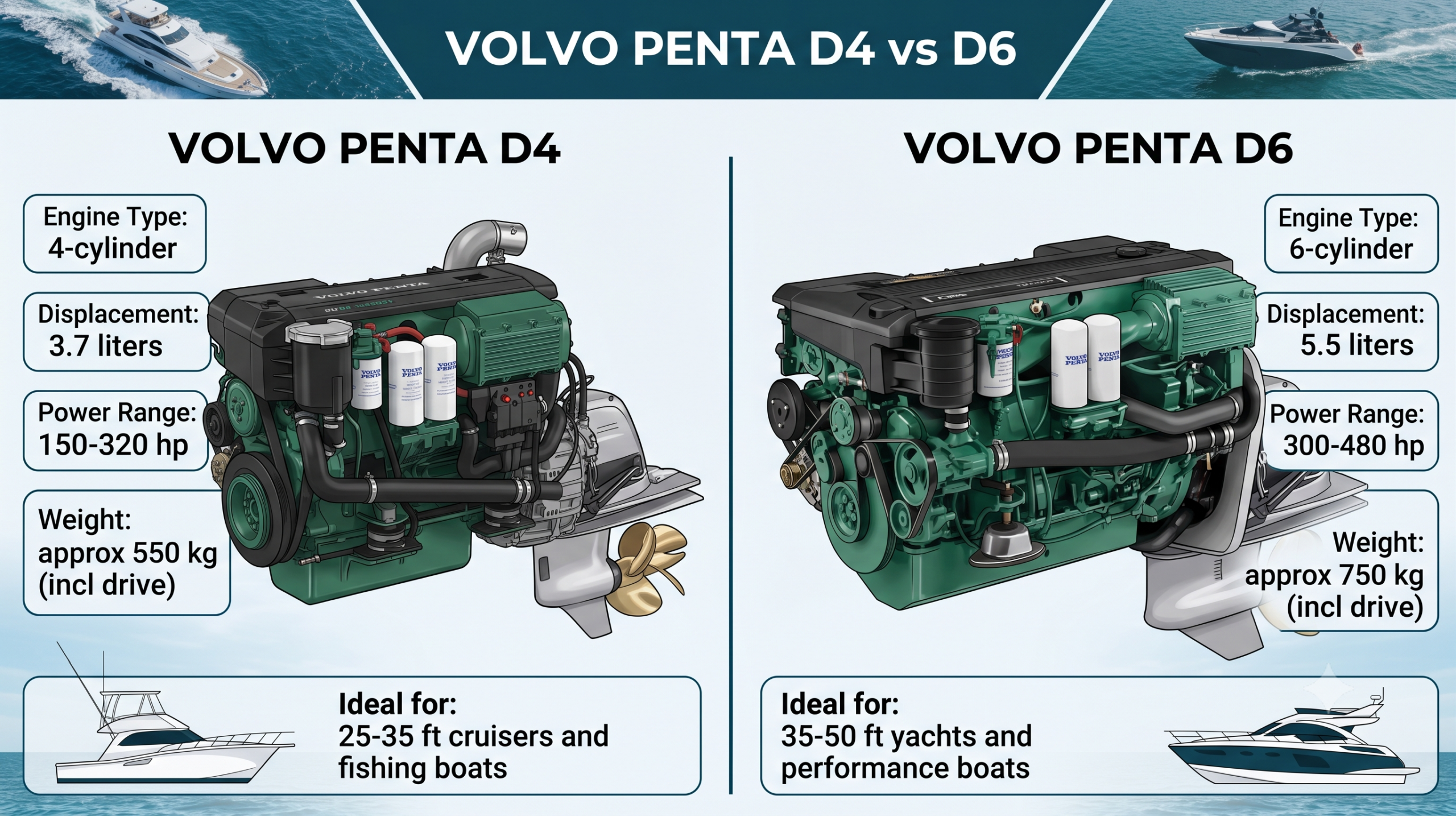
The D4 is a 3.7-liter inline-4 diesel, delivering common-rail fuel injection, double overhead camshafts, and a turbocharger in a genuinely compact package. It’s designed to punch above its displacement — the current top-spec D4 reaches 320 hp, an output figure that would have required a much larger engine a generation ago.
Picture a 33-foot day cruiser doing coastal hops with a family of four aboard — that’s squarely D4 territory. One recent test of a Sargo 33 fitted with the new D4-320s found the boat felt very lively on the water, which speaks to how far the smaller engine has come in the latest generation.
D4 at a Glance
- Displacement: 3.7 liters
- Configuration: Inline-4
- Power range: up to 320 hp (current top spec)
- Common rail pressure: 2,000 bar
D6: The Smoother, More Powerful Option
The D6 is Volvo Penta’s inline-6 diesel, displacing 5.5 liters and currently topping out at 480 hp in its highest configuration. The extra two cylinders over the D4 aren’t just about power — they fundamentally change how the engine feels at the helm.
As before, the six-cylinder D6 is considerably smoother than the lumpier D4, since inline sixes are inherently better balanced than straight fours. If you’ve ever felt a four-cylinder diesel’s characteristic vibration through the helm at idle, that’s exactly the difference the D6’s extra cylinders are designed to smooth out.
Expert Insight: If your boat spends a lot of time at low cruising speeds or at anchor with the generator-adjacent engine running, the D6’s smoother idle characteristics are worth the added weight and cost for comfort alone — not just outright power.
D6 at a Glance
- Displacement: 5.5 liters
- Configuration: Inline-6
- Power range: up to 480 hp (current top spec)
- Common rail pressure: 2,000 bar
Side-by-Side Comparison
| Spec | Volvo Penta D4 | Volvo Penta D6 |
|---|---|---|
| Displacement | 3.7L | 5.5L |
| Cylinders | Inline-4 | Inline-6 |
| Max output | 320 hp | 480 hp |
| Smoothness | Good, but noticeably rougher than D6 | Inherently smoother, better balanced |
| Typical boat size | 28–38 ft | 38–55+ ft |
| Best for | Weight-conscious, fuel-efficient cruising | Larger boats, twin installs, sportier performance |
Choose the D4 if you want a lighter, more fuel-efficient engine for a smaller cruiser and don’t need to push past roughly 38 feet of boat. Choose the D6 instead if you’re powering a larger vessel, running twin engines, or simply want the smoother, more refined feel that comes with an extra pair of cylinders.
Fuel Efficiency and Running Costs
Both engines benefit from the same fuel-system upgrade, and the gains land differently depending on where you sit in the power range. The high-pressure common rail injection system now operates at 2,000 bar (up from 1,600), improving fuel economy by between 1% and 7%, with the largest gains showing up at the lower horsepower ratings.
In terms of raw consumption, a D6 rated at 370 hp burns roughly 76.7 liters per hour at full output, while a 435 hp D6 burns around 81.0 liters per hour — numbers that scale roughly with power output rather than with a dramatic efficiency penalty for the bigger engine. Actual fuel burn on your boat will vary with propeller pitch, hull weight, and water conditions, so treat published figures as a baseline rather than a guarantee.
Quick Tip: Get a fuel-flow meter installed if you’re serious about comparing real-world D4 vs D6 running costs on your specific hull — dealer spec-sheet numbers assume ideal conditions that rarely match actual cruising.
Reliability and Maintenance
Both engines share the platform’s broader reliability improvements from the recent redesign, including a stronger crankshaft and new coatings aimed at reducing wear. New materials introduced in the latest generation include a Diamond-Like Carbon coating on the piston pin to reduce friction and increase durability, alongside a strengthened crankshaft designed to handle the higher power outputs.
Maintenance intervals have also improved across both engines. The new-generation D4/D6 engines offer reduced maintenance costs thanks to extended service intervals, fewer service items, and simpler maintenance procedures, with an onboard service assistant that tracks maintenance status and displays time remaining until the next service.
Before Volvo Penta finalized this generation, engineers logged roughly 15,000 hours of endurance testing across various boats and conditions, including individual test runs of 300 hours each — enough to simulate a transatlantic crossing from Sweden to New York.
Pros and Cons by Buyer Type
The Weekend Cruiser
- ✅ D4: Lighter weight improves fuel range and reduces strain on smaller hulls
- ✅ D4: Lower purchase and maintenance cost than a comparable D6 install
- ❌ D4: Less headroom for future repowering to higher performance needs
The Offshore/Sportfishing Owner
- ✅ D6: Smoother running at extended cruise for long days on the water
- ✅ D6: More power available for twin-engine performance builds
- ❌ D6: Added weight and cost compared to D4 on the same size hull
The Light-Commercial Operator
- ✅ D6: Higher horsepower ceiling handles heavier work loads
- ✅ D6: Extended service intervals reduce operational downtime
- ❌ D4: May be underpowered if load requirements grow over time
FAQ
What’s the main difference between the Volvo Penta D4 and D6? The D4 is a 3.7-liter inline-4 diesel making up to 320 hp, while the D6 is a 5.5-liter inline-6 diesel making up to 480 hp with inherently smoother running characteristics.
Which is more fuel efficient, the D4 or D6? Both use the same 2,000-bar common rail fuel system, and fuel economy gains from the latest redesign are largest at the lower horsepower ratings — meaning the D4 tends to see the biggest efficiency benefit relative to its size.
What boat sizes are the D4 and D6 designed for? The D4 generally suits boats in the 28–38 foot range, while the D6 is more common on 38-foot-and-larger boats, including twin-engine performance and light-commercial installs.
Are the D4 and D6 available with IPS pod drives? Yes — both engines are available in IPS, Inboard, and Aquamatic sterndrive configurations, so drive type isn’t a limiting factor when choosing between them.
How long have the D4 and D6 been in production? The platform was introduced in 2003, with over 100,000 units sold, and has since gone through several major generational updates, most recently a comprehensive overhaul of the engines, electronics, and drive units.
Key Takeaways
- The D4 is a 3.7L inline-4 (up to 320 hp); the D6 is a 5.5L inline-6 (up to 480 hp)
- The D6 runs smoother by design due to its inline-6 configuration
- Both engines share the same updated 2,000-bar common rail fuel system and reliability upgrades
- Boat size and weight, not just raw power preference, should drive your choice between them
- Both are available across IPS, Inboard, and Aquamatic sterndrive configurations
Which One Should You Choose?
If you’re powering a lighter cruiser under about 38 feet and want to keep weight and running costs down, the D4 is the smarter fit. If you’re on a larger boat, running twins, or simply want the smoothest possible ride, step up to the D6.