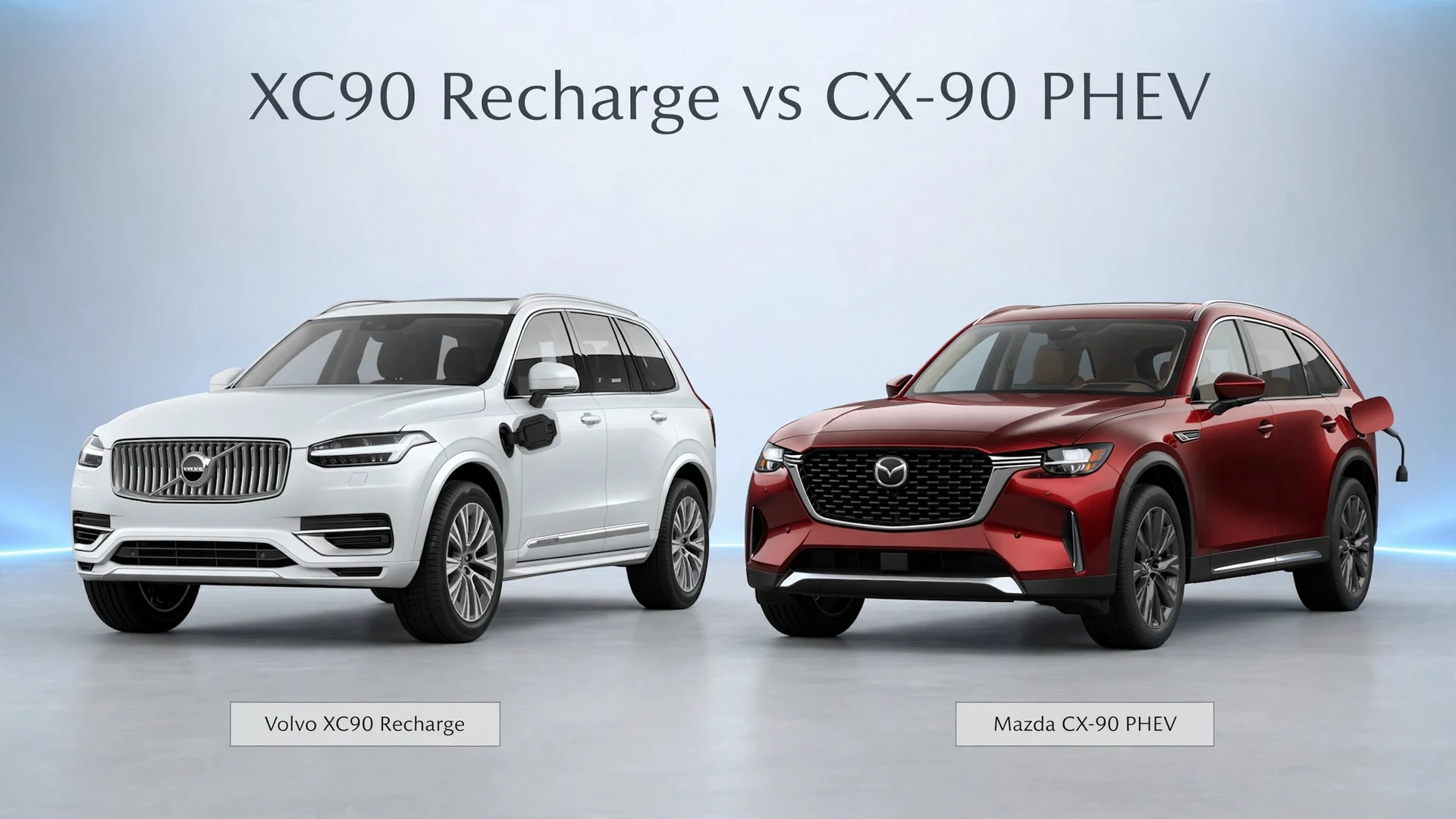
Volvo XC90 Recharge vs Mazda CX-90 PHEV?

Volvo XC90 Recharge vs Mazda CX-90 PHEV?
Two three-row plug-in hybrid SUVs, two philosophies, and a price gap north of $20,000. The Mazda CX-90 PHEV (323 hp, 26 miles EPA electric range, from $50,495) is the value disruptor — rear-biased handling, an available eight-seat layout, and genuine premium feel for mainstream-plus money. The Volvo XC90 Recharge (455 hp, ~33 miles EPA range, from roughly $72,000) is the established flagship — far more powerful, longer electric range, 5,000-lb towing, and a stronger safety and warranty story. The verdict: the Mazda wins on value and driving engagement; the Volvo wins on power, range, towing, and luxury polish. Buy the Mazda with your head, the Volvo with your heart — and your charger.
- Price: CX-90 PHEV from $50,495 (2026); XC90 Recharge from ~$72,000 — a $20,000+ gap that buys a lot of electricity.
- Power: XC90 455 hp / 523 lb-ft vs CX-90 323 hp / 369 lb-ft — the Volvo is decisively quicker (0–60 in 5.0 s).
- Electric range: XC90 ~33 miles EPA vs CX-90 26 miles; batteries are close (18.8 vs 17.8 kWh) but the Volvo goes further.
- Towing: XC90 5,000 lb vs CX-90 3,500 lb — no contest for trailers.
- Space: CX-90 seats up to 8 and has more maximum cargo (74.2 cu ft); XC90 seats 7 with a more usable third row for adults.
- Warranty: Volvo 4 yr/50k basic vs Mazda 3 yr/36k — the Volvo’s coverage is stronger.
- Verdict: Mazda for value and dynamics; Volvo for power, range, towing, and flagship luxury.
Price: The $20,000 Question
This is the comparison’s defining fact. The 2026 Mazda CX-90 PHEV starts at $50,495 in Preferred trim; even a loaded Premium Plus stays well under $65,000. The XC90 Recharge starts around $72,000 and climbs past $80,000 in Ultra trim with options. You’re not choosing between two $70,000 SUVs — you’re deciding whether the Volvo is worth roughly 40% more.
| Price point | Mazda CX-90 PHEV | Volvo XC90 Recharge |
|---|---|---|
| Starting MSRP (2026) | $50,495 | ~$72,000 |
| Well-equipped | ~$58,000–62,000 | ~$78,000–82,000 |
| Basic warranty | 3 yr / 36,000 mi | 4 yr / 50,000 mi |
| Powertrain warranty | 5 yr / 60,000 mi | 4 yr / 50,000 mi |
| Hybrid battery warranty | 8 yr / 100,000 mi | 8 yr / 100,000 mi |
| Scheduled maintenance included | No | First 2 visits (US) |
The Mazda’s powertrain warranty is actually longer (5/60k vs 4/50k), but the Volvo’s bumper-to-bumper coverage and included maintenance tilt total ownership coverage back toward Gothenburg. Still, $20,000 buys roughly 130,000 miles of fuel in the Mazda — the Volvo can’t close that gap on running costs alone.
Powertrain and Performance
| Specification | Mazda CX-90 PHEV | Volvo XC90 Recharge |
|---|---|---|
| Engine | 2.5L turbo 4-cyl | 2.0L turbo 4-cyl |
| Electric motor | 173 hp / 199 lb-ft | 143 hp / 228 lb-ft (rear axle) |
| System power | 323 hp | 455 hp |
| System torque | 369 lb-ft | 523 lb-ft |
| Battery | 17.8 kWh | 18.8 kWh (14.7 usable) |
| Transmission | 8-speed automatic | 8-speed automatic |
| Drivetrain | Rear-biased i-ACTIV AWD | Through-the-road eAWD |
| 0–60 mph | ~6.5 s (est.) | 5.0 s |
| Max towing | 3,500 lb | 5,000 lb |
| Fuel requirement (full power) | Premium recommended | Premium recommended |
The Volvo’s 132-hp advantage is the single biggest performance gap in this comparison — 5.0 seconds to 60 mph versus the Mazda’s mid-sixes. In EV mode the two feel closer than the specs suggest (the Mazda’s 173-hp motor actually outguns the Volvo’s 143-hp rear unit), but once the gasoline engines join in, the T8 walks away. The Mazda counters with the more engaging chassis: rear-biased all-wheel drive, well-weighted steering, and a sense of agility the heavier, comfort-tuned Volvo doesn’t chase.
Electric Range and Real-World Economy
Here’s a curiosity: the batteries are nearly the same size (18.8 vs 17.8 kWh), yet the EPA rates the Volvo at ~33 miles and the Mazda at 26. The difference is efficiency — the Volvo’s powertrain calibration and lighter EV-mode load extract more miles per kWh, and independent testing has confirmed the gap (one back-to-back test saw the Mazda’s battery expire after 18 highway miles versus 30 for the Volvo in winter conditions).
EPA combined ratings: 58 MPGe for the Volvo, 56 for the Mazda; once depleted, roughly 27 mpg vs 25 mpg. Owner reports suggest the Mazda’s real-world depleted economy lands at 26–30 mpg — respectable, but the car leans harder on its gasoline engine than the numbers imply, and its Charge mode (burning fuel to refill the battery) is widely described as inefficient. The Volvo’s larger usable reserve and stronger EV performance make it the better “electric car with a backup plan,” to borrow Volvo’s own phrase.
Both cars reward the same discipline: charge nightly, keep trips under the EV range, and fuel costs collapse. Both punish the same neglect: run them as conventional hybrids and you’re hauling expensive battery weight for single-digit economy gains.
Space, Seats, and Towing
The Mazda is the bigger vehicle: 201.6 inches long on a 122.8-inch wheelbase versus the Volvo’s 195.0 / 117.5. That shows up in seating flexibility — the CX-90 offers 6-, 7-, and 8-passenger configurations, while the XC90 tops out at 7 (6 with captain’s chairs). Maximum cargo favors the Mazda too: 74.2 cu ft versus 65.5.
But the Volvo fights back where it counts for towers and safety-minded families: 5,000 lb of towing capacity against the Mazda’s 3,500 — the difference between a midsize camper and a utility trailer. And the XC90’s third row, while no palace, is widely regarded as more adult-friendly than the CX-90’s tighter rearmost seats. The Volvo also brings its standard Pilot Assist, full LED headlights with active bending, and a safety suite that reviewers consistently rate as more comprehensive — rear automatic braking, traffic-sign recognition, and automatic high beams are standard on the XC90 but not all standard on the Mazda.
Reliability Records: Young vs Proven
Mazda CX-90: The CX-90 is a new platform (2024 debut), and early ownership reports flag the 8-speed automatic’s calibration — rough shifts, hesitation — plus a gruff engine note under load and occasionally overbearing driver aids. Real-world EV range inconsistency in cold weather is reported. None of this is catastrophic, and Mazda’s powertrain warranty (5 yr/60k) is reassuring, but the PHEV is a first-generation product in a way the Volvo no longer is. Long-term hybrid-battery and transmission durability is simply unproven.
Volvo XC90 Recharge: A decade into SPA production, the XC90’s issues are known quantities: the ERAD rear-drive unit failures on 2016–2021 cars (grinding, hesitation, loss of rear drive; expensive out of warranty), since improved; infotainment glitches; and the usual premium-SUV consumables. Buy 2022+ (big battery, revised ERAD) and the reliability picture is solid — boring, even, which is what you want.
Depreciation favors the Mazda buyer short-term (lower entry price) but the Volvo historically retains value slightly better in percentage terms. Insurance is higher on the Volvo, reflecting its price and repair costs.
Charging and Daily Electric Life
Neither SUV supports DC fast charging — these are home-charging vehicles, full stop. On a standard Level 2 (240V) home charger, the XC90’s 18.8 kWh battery replenishes in roughly 4–5 hours and the Mazda’s 17.8 kWh in a similar window; either is easily full by morning on an overnight charge. On a regular 120V household outlet, expect roughly double that. Public charging matters less than you’d think: with 26–33 miles of range, these cars live on home electricity, and owners who can’t install a Level 2 charger (apartment dwellers, street parkers) consistently report lower electric usage — which, as the economy section showed, erodes the whole point of the PHEV. Before buying either, honestly answer one question: where will it charge every night? If the answer is “a proper Level 2 setup,” both cars will delight. If the answer is vague, the Mazda’s lower purchase price at least limits your exposure to an expensive battery you’re not using.
Which Plug-In for You?
Verdict: Disruptor vs Establishment
The Mazda CX-90 PHEV is the rationalist’s choice — 80% of the Volvo’s capability and luxury for 70% of the money, with sharper handling and more seats as bonuses. The Volvo XC90 Recharge is the maximalist’s choice — decisively more powerful, longer-legged on electrons, a genuine 5,000-lb tower, and wrapped in a more refined, safer-feeling package. Drive both: if the Mazda’s dynamics and price make you smile, the Volvo’s premium is hard to justify. If you want the best plug-in three-row regardless of cost, the Volvo remains the benchmark the Mazda is chasing.
Sources
- rigrel.com — 2024 Mazda CX-90 PHEV vs 2024 Volvo XC90 Recharge comparison (pricing $49,945 vs $71,900; powertrain, towing, dimensions, warranties).
- autoblog.com — 2026 Mazda CX-90 PHEV specs (323 hp, 17.8 kWh, 26-mi EV range, $50,495 MSRP, 3,500-lb towing).
- designnews.com — CX-90 vs XC90 PHEV engineering comparison (motor outputs, 24 vs 18.8 kWh batteries, 25 vs 33-mi range, highway test 18 vs 30 mi).
- insideevs.com — 2025 Mazda CX-90 PHEV review (transmission behavior, real-world economy, driver-aid complaints, 56 MPGe).
- carsfrenzy.net — 2025 Mazda CX-90 specs (powertrains, cargo 14.9/40/74.2 cu ft, 6/7/8 seating).
- goodwinsvolvo.com — XC90 Recharge vs CX-90 PHEV (32 vs 26-mi range framing; standard safety equipment differences).
- zzdsport.com — 2025.5 XC90 specs (T8 455 hp/523 lb-ft, 33-mi range, 5.0 s 0–60).
Frequently Asked Questions
Which has more electric range, XC90 Recharge or CX-90 PHEV?
The XC90 Recharge: about 33 miles EPA (2025.5) versus 26 miles for the CX-90 PHEV — despite batteries of similar size (18.8 vs 17.8 kWh). Independent testing confirms the Volvo goes meaningfully further per charge.
How much cheaper is the Mazda CX-90 PHEV?
Substantially: the 2026 CX-90 PHEV starts at $50,495 while the XC90 Recharge starts around $72,000 — a gap of over $20,000 that persists up the trim walks.
Which is more powerful?
The XC90 Recharge, by a wide margin: 455 hp and 523 lb-ft versus 323 hp and 369 lb-ft, for 0–60 mph in 5.0 seconds against the Mazda’s mid-sixes.
Can the CX-90 PHEV tow as much as the XC90?
No. The CX-90 PHEV is rated at 3,500 lb; the XC90 Recharge at 5,000 lb. For trailers and campers, the Volvo is the clear choice.
Which is more reliable?
The Volvo’s issues are known quantities (ERAD on pre-2022 cars — buy 2022+); the Mazda is a newer platform with early reports of transmission calibration quirks and inconsistent cold-weather EV range. The Mazda’s 5-yr/60k powertrain warranty is longer, the Volvo’s 4-yr/50k basic warranty broader.
Does the CX-90 PHEV seat more people?
Yes — up to 8 in the CX-90 (6, 7, and 8-passenger layouts) versus 7 maximum in the XC90 (6 with captain’s chairs). The CX-90 also has more maximum cargo: 74.2 cu ft vs 65.5.