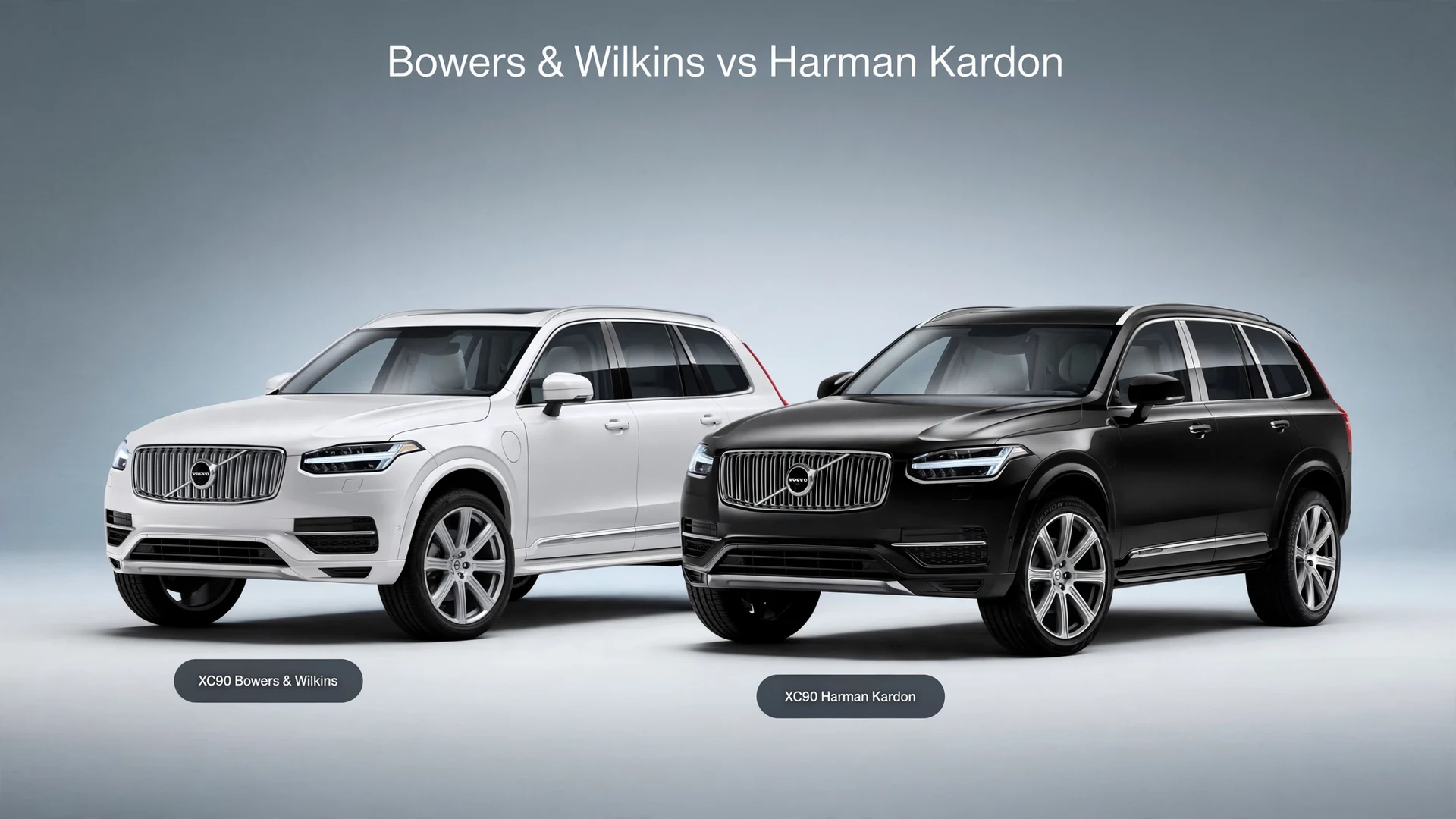
Volvo XC90 Bowers & Wilkins vs Harman Kardon?

Volvo XC90 Bowers & Wilkins vs Harman Kardon?
The XC90 offers two branded sound systems above its standard 10-speaker setup, and the gap between them is one of the largest in the industry. Bowers & Wilkins is the flagship: 19 speakers, a 1,400-watt 12-channel amplifier, a dashboard tweeter-on-top, Kevlar midranges, and an air-ventilated subwoofer — a $3,200 standalone option that reviewers routinely rank among the three best car audio systems in the world. Harman Kardon is the mid-tier: 14 speakers, standard on Ultimate/Ultra trim and optional on Plus, and a clear step down in scale and refinement. If you care about music, the B&W is worth every dollar; if you mostly listen to podcasts and radio, save your money — the Harman Kardon is perfectly enjoyable.
- Bowers & Wilkins: 19 speakers, 1,400 W, 12-channel Class D amp, tweeter-on-top, air-ventilated subwoofer, Dirac concert-hall software — $3,200 option (2026 US pricing).
- Harman Kardon: 14 speakers; standard on Ultimate/Ultra, optional on Plus; roughly a third of the B&W’s price when offered standalone.
- The real difference: not just louder — the B&W images like a concert hall, with a soundstage the HK can’t reproduce.
- Where they sit: both sit above the standard 10-speaker, 330 W high-performance system — which itself is decent.
- Reliability: neither system has widespread failure reports; the occasional complaint is door-panel rattle at high volume.
- Verdict: audiophiles should order the B&W without hesitation; everyone else will be happy with Harman Kardon.
Price and Position in the Lineup
Volvo structures XC90 audio in three tiers. The base High Performance system — 10 speakers, 330 watts — is standard on Core and perfectly serviceable. Above it sit the two branded systems this article compares.
Harman Kardon is the middle tier: 14 speakers with a dedicated amplifier. Volvo made it standard equipment on the Ultimate (now Ultra) trim and an option on Plus. When offered as a standalone option in earlier SPA model years, it was priced around $1,000–$1,250 — roughly a third of the B&W’s tariff (owner-reported dealer order-guide figures; exact pricing varied by model year).
Bowers & Wilkins is the flagship and always has been: a $3,200 standalone option on current window stickers (confirmed on a 2026 XC90 T8), available on Plus and Ultimate alike. Notably, the Ultimate badge does not include it — you pay the $3,200 on top of the top trim. In the UK it was historically a £3,000 option. This is important used-car intelligence: an “Ultimate” without the B&W line on its build sheet has the Harman Kardon system, not the flagship.
Hardware Head-to-Head
| Specification | Harman Kardon | Bowers & Wilkins |
|---|---|---|
| Speakers | 14 | 19 |
| Amplifier | Dedicated amp (power undisclosed) | 1,400 W, 12-channel Class D |
| Tweeters | Standard domes | 7 Nautilus 25 mm aluminium tweeters |
| Midrange drivers | Standard cones | 7 Kevlar-cone midranges (5×100 mm, 2×80 mm) |
| Woofers | Standard | 4 cone woofers (200/165 mm) |
| Subwoofer | Conventional | 250 mm air-ventilated subwoofer |
| Center speaker | Standard | Tweeter-on-top (dash-mounted) |
| Sound processing | Standard DSP | Dirac software; concert-hall modes |
| US option price (2026) | ~$1,000–1,250 standalone* | $3,200 |
| Standard on | Ultimate / Ultra | Neither — always optional |
*Harman Kardon standalone pricing is approximate, based on owner-reported order guides from earlier SPA model years; it is standard on Ultimate/Ultra, so most buyers never pay it separately.
The Technology That Separates Them
The spec sheet tells half the story; the engineering tells the rest. Volvo co-developed the B&W system from the XC90’s launch in 2015 with unusual seriousness — the acoustic tuning references Bowers & Wilkins’ work for demanding venues including London’s Abbey Road Studios, and Volvo’s own audio chief called it one of the top three automotive systems in the world at launch.
Three innovations are exclusive to the B&W. First, the tweeter-on-top: a sculpted aluminium tweeter protruding from the center of the dashboard — the first automotive application of B&W’s signature technology. It fires high frequencies directly at the listener instead of bouncing them off the windshield, dramatically increasing the ratio of direct to reflected sound. Second, the air-ventilated subwoofer: rather than a bolt-in box, the 250 mm sub is integrated into the car’s body structure, using the body cavity as its enclosure — Volvo described it as a possible world first — reaching down to a claimed 20 Hz. Third, Dirac Research software with selectable venue acoustics, including a recreation of the Gothenburg Concert Hall, which owners consistently describe as uncanny with classical and acoustic recordings.
The Harman Kardon system has none of this. It’s a well-executed conventional premium system — more speakers, more power, better tuning than the base setup — but it doesn’t attempt the B&W’s soundstaging tricks. Side by side, the difference reviewers keep returning to is image: the B&W places instruments in space; the HK plays music at you.
What Owners Actually Hear
Owner consensus across forums is unusually unified for a subjective topic. B&W owners describe it as the best factory car audio they’ve owned — detailed without harshness, with bass that is deep but controlled, and the concert-hall mode genuinely transformative for the right material. The most common criticism is that it reveals poor recordings and low-bitrate streaming; several owners report upgrading to lossless streaming specifically because the system exposed compression artifacts.
Harman Kardon owners are generally satisfied — “good, not great” is the recurring verdict. The most common complaints: bass that can sound boomy or muddy at higher volumes, and a soundstage that feels like it comes from the doors rather than the room. For podcasts, radio, and casual listening, few owners feel shortchanged.
The practical takeaway: the B&W’s advantage scales with source quality and listening attention. If your library is lossless and you notice these things, the $3,200 is money well spent. If your daily soundtrack is a true-crime podcast at 1.5× speed, it is not.
Reliability and Used-Buying Notes
Neither system carries a pattern of electronic failures — no widespread amplifier or speaker mortality is reported for either, which is notable given the B&W’s complexity. The most common issue is mechanical, not electrical: door-panel or trim rattle at high bass volumes, usually fixable with trim clips or damping. A few owners report the B&W’s center tweeter-on-top developing a buzz; check it with a frequency sweep if buying used.
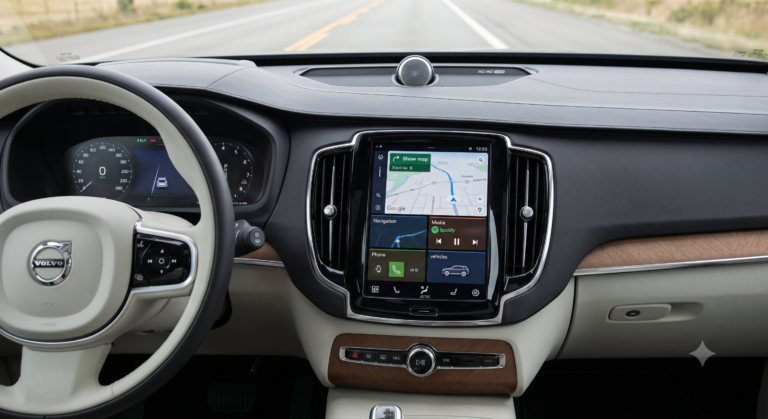
Used-buying advice: verify the actual audio system, not the trim. Sellers routinely advertise “premium sound” on cars that have the base 10-speaker setup, and “Ultimate” cars without the B&W option. The B&W cars are identifiable by the tweeter-on-top pod on the dashboard and the yellow Kevlar midrange cones visible behind the door grilles — check for both. A used XC90 with the B&W option typically commands a modest premium ($500–$1,000) over an equivalent HK car, making it the best-value way to get the flagship system.
One caution: retrofitting the B&W into an HK car is effectively impossible at sane cost — the amplifier, wiring, subwoofer integration, and software are all different. Buy the system you want; you can’t add it later.
Is the B&W Worth It for You?
Verdict: Two Different Missions
The Harman Kardon is a very good premium sound system; the Bowers & Wilkins is a statement piece — one of the finest factory audio systems ever fitted to a mainstream luxury SUV. The HK satisfies; the B&W delights. At $3,200 new it’s fairly priced for what it is, and on the used market it’s a no-brainer whenever you find it. Just remember: the Ultimate badge doesn’t include it, the yellow cones and dashboard tweeter are the proof, and whatever you choose, choose it at purchase — there’s no going back.
One practical tip that applies to both systems: audition them back-to-back at a dealer with music you know well, because showroom demos are tuned to flatter. Play something with a solo vocal and a double bass — the B&W’s Continuum midrange and the HK’s QuantumLogic processing reveal themselves (or don’t) within a minute. On the used market, B&W-equipped cars command only a small premium over HK cars, so filter for the dashboard tweeter and the yellow speaker cones in listing photos; they’re the visual proof. And whichever system the car has, run every speaker through its paces on the test drive — a silent tweeter is an expensive surprise, since neither system can be retrofitted afterwards.
Sources
- Volvo Cars press release via mb.cision.com / media-downloads.volvocars.com — B&W system engineering details (19 speakers, 1,400 W 12-channel Class D amp, Nautilus tweeters, Kevlar midranges, air-ventilated subwoofer, Abbey Road reference).
- volvocarsofcary.com — 2026 XC90 T8 window sticker (Bowers & Wilkins option $3,200).
- whathifi.com — Premium Sound by Bowers & Wilkins review (19 speakers, £3,000 option, tweeter-on-top, 1,400 W; base 10-speaker 330 W system).
- carenthusiast.com — Volvo XC90 stereo announcement (B&W vs 224 W 12-speaker High Performance alternative; Dirac software).
- volvocarsontario.com — XC90 audio overview (19-speaker B&W; 14-speaker Harman Kardon).
- carbuzz.com — 2025.5 XC90 first drive (B&W optional on Ultra, 1,410 W; Harman Kardon standard on Ultra).
Frequently Asked Questions
How many speakers does the XC90 Bowers & Wilkins system have?
19 speakers: 7 Nautilus 25 mm aluminium tweeters, 7 Kevlar-cone midranges, 4 cone woofers, and a 250 mm air-ventilated subwoofer — driven by a 1,400-watt, 12-channel Class D amplifier.
How much does the Bowers & Wilkins option cost on the XC90?
$3,200 on current US window stickers (2026 model year). It is a standalone option on both Plus and Ultimate/Ultra trims — it is not included with any trim level.
Is Harman Kardon standard on the XC90?
The 14-speaker Harman Kardon system is standard on the Ultimate (now Ultra) trim and optional on Plus. The base system is the 10-speaker, 330-watt High Performance setup.
What is the tweeter-on-top in the B&W system?
A sculpted aluminium tweeter mounted prominently on top of the dashboard — the first automotive use of Bowers & Wilkins’ signature technology. It fires treble directly at the listener, reducing windshield reflections for a more open, lifelike soundstage.
Is the Bowers & Wilkins system worth it over Harman Kardon?
For critical music listening, yes — owners and reviewers rate it among the best factory car audio systems in the world, with imaging and depth the HK can’t match. For podcasts and casual listening, the Harman Kardon is plenty and the $3,200 is better spent elsewhere.
Can you retrofit the B&W system to an XC90 with Harman Kardon?
Effectively no. The amplifier, wiring harness, integrated subwoofer, speakers, and software are all different, making a retrofit prohibitively expensive. Verify the dashboard tweeter pod and yellow Kevlar cones when buying used — buy the system you want.