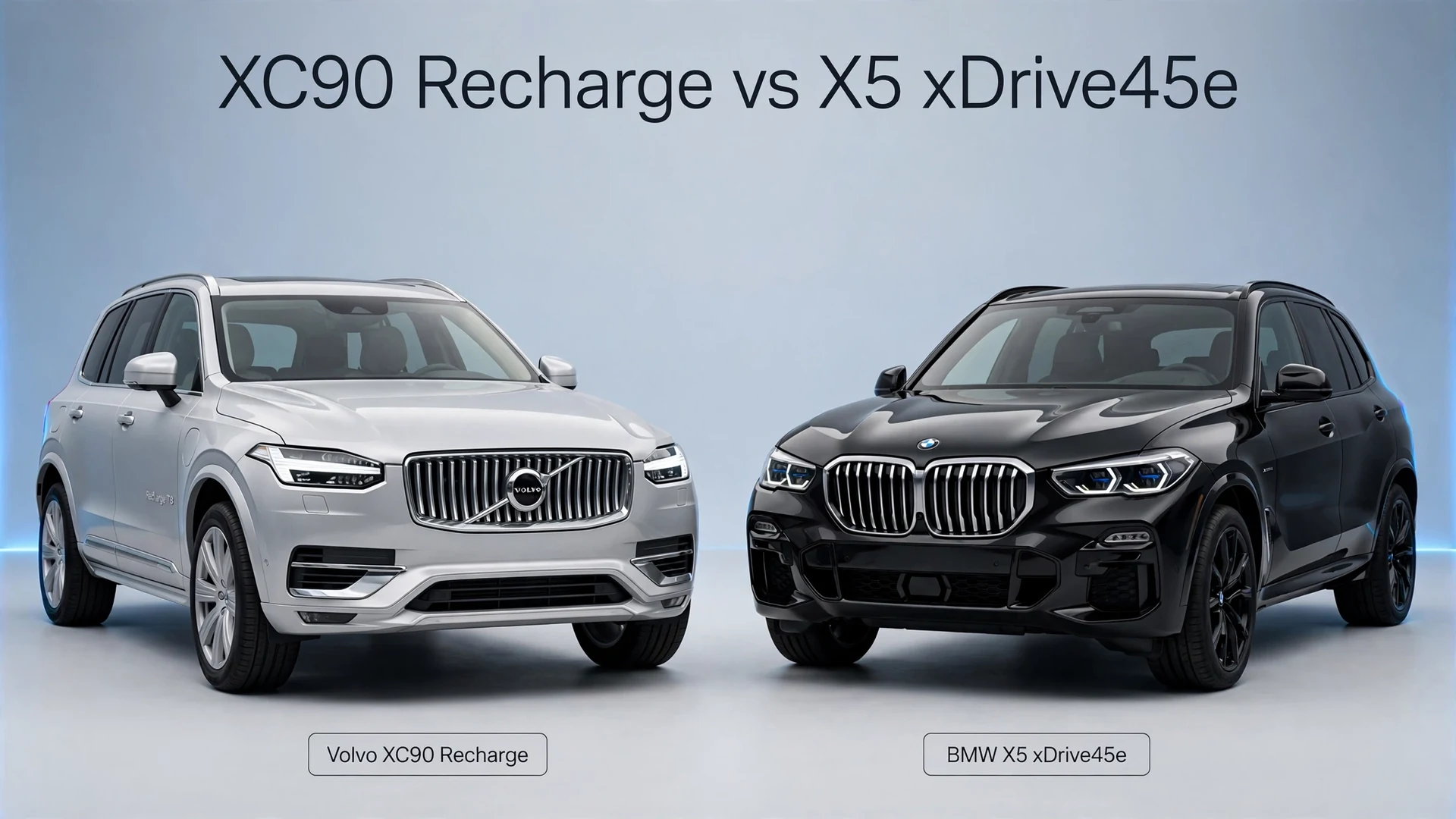
Volvo XC90 Recharge vs BMW X545e

Volvo XC90 Recharge vs BMW X545e
When readers type “X5 45e” they mean the BMW X5 xDrive45e (2019–2023), the plug-in hybrid rival that fought the XC90 T8 through the early 2020s. The honest verdict comes in two parts: against the 2021 XC90 T8 (400 hp, ~18-mile range), the X5 45e was the better plug-in hybrid — bigger battery, more electric range, and BMW’s superb six-cylinder; against the 2022+ extended-range XC90 (455 hp, ~32–33-mile range), the Volvo fights back hard and the choice becomes about seats and priorities: the X5 is five-seat only, the XC90 seats six or seven and tows more. Both are now used-only propositions — BMW replaced the 45e with the xDrive50e.
- Two comparisons in one: 2021 45e vs 2021 T8 (BMW wins clearly) and 2022–2023 45e vs extended-range T8 (a real fight).
- 45e specs: 3.0L twin-turbo I6 PHEV, 24 kWh battery, 389 hp / 443 lb-ft, ~30–31 miles EPA range, 0–60 in 5.3 s.
- T8 2022+: 455 hp / 523 lb-ft, 18.8 kWh, ~32–33 miles EPA range, 0–60 in 5.0 s.
- Seats: X5 45e is strictly five-seat; XC90 seats six or seven — decisive for larger families.
- Towing: X5 45e rated 7,200 lb vs XC90 T8’s 5,000 lb — the BMW is the stronger tower.
- Reliability: both have one headline issue — ERAD failures (Volvo, pre-2022) vs high-voltage battery recall (BMW, 2020–21).
- Verdict: 2021-era shoppers: BMW. 2022+ shoppers: genuinely toss-up — choose by seats, towing, and cabin priorities.
Why This Comparison Is Really Two Comparisons
Most head-to-heads pretend model years don’t matter. Here, they matter more than the badges. The BMW X5 xDrive45e barely changed across its 2019–2023 run — same 24 kWh battery, same 389-hp powertrain, minor software updates. The XC90 T8, by contrast, was fundamentally re-engineered for 2022: battery from 11.6 to 18.8 kWh, rear motor from 87 to 143 hp, engine simplified from twincharged to turbo-only, total output from 400 to 455 hp, EPA range from ~18 to ~32+ miles.
So there are two fair fights:
- 2021 vs 2021: 45e (24 kWh, ~30-mile range) vs T8 (11.6 kWh, ~18-mile range). The BMW’s battery is more than twice the size. This isn’t close.
- 2022–2023 vs 2022–2023: 45e (same as ever) vs extended-range T8 (18.8 kWh, ~32-mile range, 455 hp). Now the Volvo has the bigger usable battery, more power, and more range. This is a genuine contest.
Any comparison that blends a 2021 T8 against a 2023 45e (or vice versa) is comparing across Volvo’s powertrain revolution and tells you nothing useful. Keep the model years aligned.
Powertrain Specs: The Period Numbers
| Specification | BMW X5 xDrive45e (2021–2023) | XC90 T8 (2022–2023) |
|---|---|---|
| Engine | 3.0L twin-turbo inline-6 | 2.0L turbo inline-4 |
| Electric motor | 111 hp (integrated in trans.) | 143 hp (rear axle) |
| System power | 389 hp | 455 hp |
| System torque | 443 lb-ft | 523 lb-ft |
| Battery (gross) | 24.0 kWh | 18.8 kWh |
| EPA electric range | 30–31 miles | 32–33 miles |
| EPA rating | 50 MPGe | 57–58 MPGe |
| 0–60 mph | 5.3 s | 5.0 s |
| Max towing | 7,200 lb | 5,000 lb |
| Drivetrain | Mechanical AWD | Through-the-road eAWD |
The engineering philosophies differ instructively. BMW integrated its electric motor into the 8-speed transmission, keeping conventional mechanical all-wheel drive — simple, robust, familiar. Volvo put its motor on the rear axle with no mechanical link to the engine — more packaging-efficient and enabling true electric rear drive, but creating the unique ERAD component with its documented failure history (covered below). BMW’s six-cylinder is the more characterful engine by a mile; Volvo’s turbo four, while effective, never sounds like it belongs in a $75,000 car.
Seats, Space, and Practicality
This is where the comparison stops being about powertrains and starts being about families:
| Practicality | BMW X5 xDrive45e | Volvo XC90 T8 |
|---|---|---|
| Seating | 5 only | 6 or 7 |
| Cargo (seats up / max) | 33.9 / 72.3 cu ft | 12.6 / 65.5 cu ft |
| Max towing | 7,200 lb | 5,000 lb |
| Length | 194.3 in | 195.0 in |
| Third row | Not available | Standard |
| Air suspension | Optional / standard by year | Standard on T8 |
The X5 45e is a five-seater, full stop — no third row was ever offered on the hybrid. Its cargo bay is generous (the hybrid sacrifices about 5 cu ft to the two-row X5, still 33.9/72.3), and its 7,200-lb tow rating makes it the stronger trailer-puller. The XC90 counters with the third row — the whole reason many families cross-shop these cars — plus standard air suspension on T8 trims and Volvo’s more family-oriented cabin details (integrated booster cushion, more rear-seat versatility).
The rule is simple: if you need more than five seats, the Volvo wins by default. If you don’t, the BMW’s superior cargo volume and towing deserve serious weight.
Reliability: One Headline Issue Each
BMW X5 xDrive45e: The B58 six-cylinder and ZF 8-speed are among the industry’s most proven components — this powertrain’s foundation is excellent. The headline issue is the high-voltage battery recall of 2020–2021: contaminated battery cells (a supplier welding-debris issue) prompted BMW to recall and inspect thousands of PHEVs globally, with some cars receiving full battery replacements. Any used 45e must have documented recall completion — verify via BMW’s VIN checker or a dealer. Beyond that, watch for the usual G05 items: transfer-case and air-suspension wear at high mileages, and software-heavy gremlins. The 45e’s mechanical-AWD hybrid layout has no ERAD equivalent; its hybrid-specific hardware is the well-understood transmission-integrated motor.
Volvo XC90 T8: The ERAD rear-drive unit is the documented weak spot on 2016–2021 cars — grinding/clicking, hesitation, eventual loss of rear drive, with replacement costs in the thousands (UK owners report ~£9,000 for replacement, ~£3,500 for independent repair kits). The 2022+ hardware revision improved matters, but a used T8 still demands an ERAD oil-service history and a careful test drive listening for rear-axle noises. The twincharged 2016–2021 engine adds supercharger maintenance the 2022+ car drops.
On balance: a 2022–2023 example of either is a reasonable reliability bet with records. A 2020–2021 45e needs its battery recall verified; a 2021 T8 needs its ERAD scrutinized. Both reward specialist pre-purchase inspections.
What Replaced the 45e: The xDrive50e Sidebar
BMW discontinued the 45e after 2023, replacing it with the X5 xDrive50e: 483 hp, 516 lb-ft, a 25.7 kWh battery, and 39–40 miles of EPA electric range. It remains five-seat only. The 50e is objectively the better plug-in hybrid than the 45e in every measurable way — but it competes with the current XC90 Recharge (455 hp, ~33-mile range), where the Volvo’s third row and price advantage re-enter the equation. If you’re shopping new in 2025–2026, that’s your comparison; this article covers the period-correct 45e rivalry that most used buyers actually face.
Running Costs: Maintenance, Fuel, and Insurance
Both are premium plug-in hybrids, and both bill accordingly — but the structures differ. Scheduled maintenance: BMW’s Ultimate Care covered the first 3 years/36,000 miles of maintenance on new 45e models; Volvo covers the first two service visits on new XC90s. On the used market, that history matters: a BMW with dealer service stamps through the Ultimate Care period is the gold standard, while a Volvo missing its early services deserves scrutiny. Expect routine services (oil, filters, brake fluid, spark plugs at intervals) to run $300–$600 per visit at dealers for either car; independents specializing in German or Swedish cars cut that meaningfully.
Fuel and electricity: both demand premium gasoline for full rated output, and both reward nightly charging identically — the cost math from the B5-vs-T8 logic applies here too. The X5’s larger battery (24 kWh) costs slightly more per full charge but delivers its 30–31 miles; the Volvo’s smaller pack charges faster. Neither car’s hybrid system changes tire or brake economics much, though both benefit from regenerative braking extending pad life.
Insurance and consumables: expect the BMW to cost slightly more to insure — higher average transaction prices, pricier parts (especially the battery-adjacent hardware), and BMW labor rates. Tires are a wash: both run large, expensive rubber (the X5’s staggered setups can be pricier to replace). Budget $1,500–$2,500 annually for maintenance, tires, and insurance delta combined on either car, and get quotes before you buy — PHEV drivetrains nudge premiums up versus their conventional siblings.
Which Used PHEV for You?
Verdict: Years Matter More Than Badges
Line up a 2021 X5 45e against a 2021 XC90 T8 and the BMW wins on merit — double the battery, nearly double the electric range, and a sweeter powertrain. Line up 2022–2023 examples and it’s a genuine toss-up: the extended-range Volvo is more powerful, slightly longer-legged on electrons, and seats seven; the BMW tows more, drives better, and rests on more proven core components. For used buyers today, condition and history beat the spec sheet — buy the best-maintained example of whichever suits your seat count, and get a specialist inspection either way.
Sources
- carbuyer.co.uk — BMW X5 xDrive45e review (24 kWh battery, 389 hp/443 lb-ft, ~30-mile real-world EV range, boot space penalty).
- cargurus.ca — BMW X5 xDrive45e overview (specs, 0–60 5.3 s, towing 7,200 lb).
- myevdiscussion.com — X5 xDrive45e specs (50 MPGe, 30–31 mi EPA range).
- truecar.com — X5 xDrive45e vs XC90 Recharge data (seating, cargo, pricing context).
- viewsonvehicles.com — X5 xDrive50e successor specs (483 hp, 25.7 kWh, 39–40 mi EPA range).
- consumerreports.org — X5 xDrive45e reliability context (high-voltage battery recall history).
- greencarreports.com — Volvo 2022 PHEV overhaul (18.8 kWh, 455 hp, 32+ mi range).
- insideevs.com — Volvo ERAD failure explainer.
Frequently Asked Questions
What does BMW X5 45e mean?
It’s the BMW X5 xDrive45e (2019–2023), the plug-in hybrid X5: a 3.0L twin-turbo inline-6 paired with an electric motor, 389 hp total, a 24 kWh battery, and about 30–31 miles of EPA electric range. BMW replaced it with the xDrive50e for 2024.
Which is better, XC90 T8 or X5 xDrive45e?
It depends on model year. The 45e beats the 2021 (pre-facelift) T8 clearly — bigger battery, more range. Against the 2022+ extended-range T8 (455 hp, 32+ miles), it’s a toss-up: Volvo for 7 seats, BMW for towing and driving dynamics.
Does the X5 45e have a third row?
No. The X5 xDrive45e was strictly a five-seater — no third row was offered on the hybrid. If you need six or seven seats, the XC90 Recharge wins by default.
Which tows more, X5 45e or XC90 T8?
The BMW: 7,200 lb for the xDrive45e versus 5,000 lb for the XC90 T8. The X5’s mechanical all-wheel drive also suits sustained towing.
What should I check on a used X5 45e?
Verify the 2020–2021 high-voltage battery recall was completed (contaminated cells; some cars got new batteries). Check via BMW’s VIN tool or a dealer, and inspect air suspension and transfer case at high mileages.
What should I check on a used XC90 T8?
Listen for ERAD (electric rear axle) grinding or clicking, especially on 2016–2021 cars; demand ERAD oil-service history. Favor 2022+ cars with the 18.8 kWh battery, and get a hybrid-battery health check.