Volvo Penta IPS vs Zeus?

Volvo Penta IPS vs Zeus?
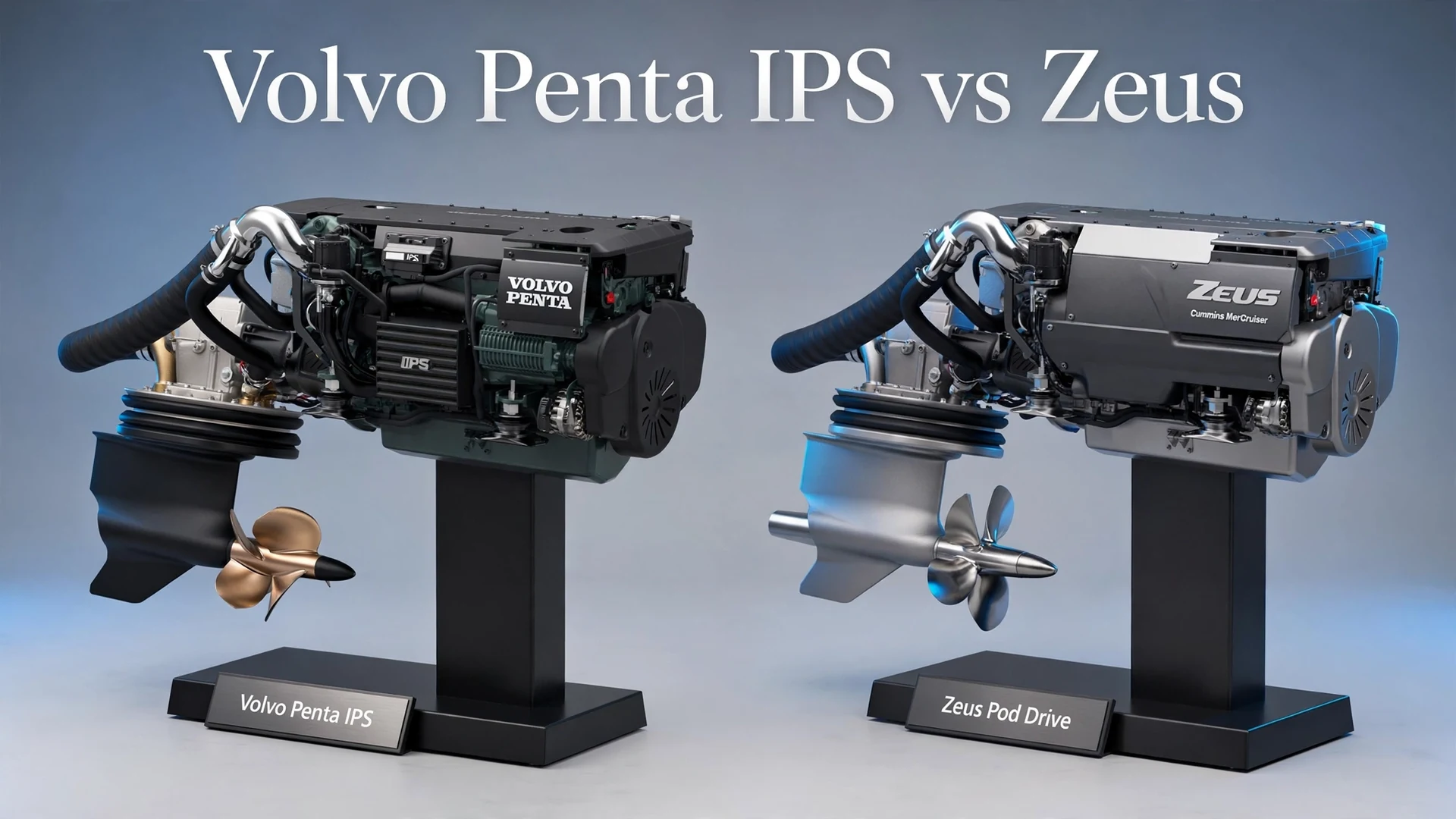
The two dominant pod-drive systems in recreational boating take opposite engineering paths to the same goal. Volvo Penta IPS (Inboard Performance System, launched 2005) mounts forward-facing, counter-rotating propellers on steerable pods under the hull; Cummins Zeus (from the former Cummins MerCruiser Diesel joint venture) uses aft-facing counter-rotating props on steerable pods with a unique breakaway design. Both deliver joystick docking, fly-by-wire controls, roughly 15–30% better efficiency than conventional straight shafts, and dramatically more usable cabin space. The honest verdict: neither pod is universally “better” — IPS dominates the market with far broader builder adoption and service coverage, while Zeus offers genuine engineering distinctions (notably its shear-away impact protection). For most buyers, the boat you love matters more than the pod beneath it. Here’s the full technical comparison.
- Core difference: IPS props face forward (puller); Zeus props face aft (pusher) — both are counter-rotating pairs on steerable pods.
- Efficiency: both claim ~15–30% improvement over conventional inboard shafts; neither architecture was proven universally more efficient than the other.
- Docking: both offer joystick control with station-keeping; both are dramatically easier to dock than shaft boats.
- Safety edge: Zeus was engineered with a breakaway concept to preserve hull watertight integrity after a severe underwater strike.
- Market reality: IPS is fitted by far more builders worldwide, with a much larger service network — a decisive practical advantage.
- Verdict: choose the boat first; between equal boats, IPS wins on support, Zeus on its impact-protection engineering.
What a Pod Drive Actually Is
Before comparing the two systems, it helps to understand what they replaced. A conventional inboard driveline runs the engine’s power through a transmission, down a long propeller shaft, through the hull via a stuffing box, to a fixed propeller under the boat. Steering comes from separate rudders; reversing and low-speed maneuvering are clumsy because the prop wash doesn’t vector. It’s proven and simple — and inefficient, with the shaft angled downward, the running gear dragging in the water, and the engines sitting amidships eating cabin volume.
A pod drive eliminates nearly all of that. The engine connects to a self-contained steerable pod mounted through the hull bottom; the propellers sit on the pod and the whole unit rotates to steer, vectoring thrust in any direction. No shafts, no rudders, no stuffing boxes. The engines move aft, freeing the mid-cabin for living space. Both IPS and Zeus follow this architecture — their differences are in the details of propeller orientation, engineering philosophy, and corporate history.
IPS: The Forward-Facing Puller
Launched in 2005, Volvo Penta IPS was the system that proved pods to the recreational market. Its signature is the forward-facing, counter-rotating propeller pair: the props sit ahead of the pod leg and pull the boat through the water rather than pushing it. Volvo’s rationale is hydrodynamic — the propellers work in undisturbed, “cleaner” water ahead of the gearcase, which improves grip and efficiency, much like a tractor propeller on an aircraft.
The trade-off, noted in industry analysis, is that the pod leg itself then sits in the props’ slipstream, adding a measure of form drag from the lower unit. Volvo’s counterargument has always been net efficiency: the complete IPS package — cleaner prop inflow, reduced shaft angle losses, integrated exhaust, and joystick maneuvering — delivers the widely cited 15–30% efficiency gain over straight shafts, along with higher top speed for a given horsepower, lower noise and vibration, and dramatically reduced emissions per mile.
IPS is offered in a wide range of sizes (from the IPS350 up through IPS1350-class units and beyond in commercial/marine-leisure applications), and it has been adopted by an enormous roster of builders — Tiara, Riviera, Marquis, and dozens more. That installed base is IPS’s greatest asset: parts, trained technicians, and surveyor familiarity exist nearly everywhere boats are sold.
Zeus: The Aft-Facing Pusher With a Breakaway
The Zeus system emerged from Cummins MerCruiser Diesel, the joint venture between Cummins and Mercury Marine — pairing Cummins diesel engines with MerCruiser’s drive engineering. (The venture itself later ended, with product and service responsibilities transitioning; Zeus support continued through the successor arrangements.) Zeus takes the opposite propeller approach: aft-facing, counter-rotating propellers that push the boat, with the pod leg ahead of the props.
Zeus’s headline engineering distinction is its breakaway/shear-away impact design. Pods hang below the hull, exposed to underwater strikes — the nightmare scenario is a pod tearing a hole in the hull bottom. Zeus was designed and tested so that in a severe impact, the drive is intended to shear away cleanly while preserving the hull’s watertight integrity. It’s a thoughtful answer to the most serious objection to pod drives, and it remains Zeus’s most distinctive technical feature.
Zeus also offers joystick docking with station-keeping (its Skyhook equivalent holds position against wind and current), fly-by-wire controls, and the same cabin-volume benefits as IPS. Builder adoption was narrower than IPS’s — concentrated among partners of the Cummins/Mercury ecosystem — which is the system’s practical weakness: fewer boats, fewer technicians, thinner parts distribution in some regions.
Head-to-Head Comparison
| Feature | Volvo Penta IPS | Cummins Zeus |
|---|---|---|
| Propeller orientation | Forward-facing (puller) | Aft-facing (pusher) |
| Propeller arrangement | Counter-rotating pair | Counter-rotating pair |
| Steering | Full pod rotation, vectored thrust | Full pod rotation, vectored thrust |
| Joystick docking | Yes, with station-keeping | Yes, with station-keeping |
| Efficiency vs straight shafts | ~15–30% claimed | ~15–30% claimed |
| Impact protection | Standard pod design | Breakaway/shear-away concept |
| Builder adoption | Very broad (global) | Narrower |
| Service network | Extensive worldwide | Thinner in some regions |
| Engine pairing | Volvo Penta diesels | Cummins diesels |
| Corporate lineage | Volvo Penta (ongoing) | Cummins MerCruiser Diesel JV (ended; support transitioned) |
Pods vs Conventional Shafts: The Baseline
| Attribute | Conventional straight shafts | Pod drives (IPS & Zeus) |
|---|---|---|
| Fuel efficiency | Baseline | ~15–30% better (maker-claimed) |
| Low-speed maneuvering | Rudders + prop wash; difficult | Vectored thrust + joystick; easy |
| Station-keeping | Not available | GPS position hold (both systems) |
| Cabin volume | Engines amidships eat space | Engines aft; more living space |
| Noise & vibration | Shaft angle + running gear drag | Lower (no shafts, better exhaust routing) |
| Maintenance skill needed | Any boatyard | Pod-trained technicians |
| Underwater-strike risk | Running gear somewhat protected | Pods exposed (Zeus breakaway mitigates) |
Efficiency: What the Numbers Actually Say
Both manufacturers have claimed roughly 15–30% better fuel efficiency than comparable conventional straight-shaft installations — and it’s important to read that claim correctly. It’s pod-vs-shaft, not IPS-vs-Zeus. Each maker benchmarked its own pod against traditional inboards, not against its rival.
The honest engineering assessment, echoed in independent marine-press analysis, is that neither orientation was proven universally superior. The forward-facing IPS props work in cleaner inflow water but drag the pod leg through their own slipstream; the aft-facing Zeus props avoid that particular penalty but work in water already disturbed by the leg. Real-world efficiency differences between the two systems on comparable hulls are small enough to be lost in the noise of hull design, loading, and sea state. If fuel economy is your deciding factor, compare specific boat models with published performance data — not pod philosophies.
Docking, Handling, and Daily Use
This is where both systems embarrass conventional shafts, and where the IPS/Zeus distinction nearly vanishes. Joystick control lets you translate the boat sideways, rotate in place, or hold station against wind and current — maneuvers that take shaft-boat owners years to master become intuitive in an afternoon. Both systems offer GPS-based station-keeping (Volvo’s Dynamic Positioning System; Zeus’s Skyhook equivalent), which is transformative for waiting at bridges, fuel docks, or locks.
Underway, both deliver precise steering with no rudder lag, integrated autopilot-friendly controls, and quieter operation than shaft boats (no shaft whine, better exhaust routing). Maintenance for both means periodic pod servicing: gear oil changes, anode replacement, bellows/boot inspection, and software updates. Pod service is more specialized than shaft service — which circles back to IPS’s network advantage. In a remote cruising ground, finding an IPS-trained tech is meaningfully easier.
Reliability, Corrosion, and the Strike Question
Pods live underwater permanently, so corrosion protection is critical for both: bonded anodes, active corrosion protection systems, and vigilant maintenance of seals and coatings. Early pod generations of all brands had teething issues (seal failures, corrosion events); modern units are far more robust, but they demand disciplined maintenance — neglected anodes on a pod are a five-figure mistake, where neglected anodes on a shaft boat are a nuisance.
The underwater-strike scenario deserves honest treatment because it drives real buyer anxiety. Any pod can be damaged by a severe strike; repairs are expensive for both systems. Zeus’s breakaway design is a genuine engineering response — tested to shear the drive away while protecting hull integrity. IPS relies on robust construction and standard impact design. Neither makes strikes cheap; Zeus arguably makes the worst case less catastrophic. For rocky or debris-prone cruising grounds, that distinction is worth weighing.
Buying Used: What to Check
Verdict: IPS on Network, Zeus on Engineering Detail
Volvo Penta IPS won the market: broader builder adoption, a deeper service network, and two decades of continuous development make it the safer ownership proposition for most buyers. Cummins Zeus answered with thoughtful engineering — the aft-facing props and especially the breakaway impact concept are genuinely distinctive. But in daily use, both dock like a dream, both save roughly 15–30% over shafts, and both demand disciplined pod maintenance. Buy the boat you love from the builder you trust; let the pod be the tiebreaker, not the decision.
Sources
- Boats.com buyer’s guide — pod drives compared: Volvo Penta IPS, Cummins Zeus, ZF Marine, Caterpillar; efficiency claims and design distinctions.
- Soundings Online (“Pod Power”) — IPS forward-facing vs Zeus aft-facing analysis; lower-unit drag discussion; Zeus breakaway concept.
- R Marine Jones (Volvo Penta dealer) — IPS system description and efficiency claims.
- Foundry Management / industry reporting — Cummins–Mercury Marine joint venture end and transition of product/service responsibilities.
Frequently Asked Questions
What is the main difference between Volvo IPS and Zeus?
The core difference is propeller orientation: Volvo Penta IPS uses forward-facing, counter-rotating propellers (puller), while Cummins Zeus uses aft-facing, counter-rotating propellers (pusher). Both are steerable pod drives with joystick docking.
Which is more fuel efficient, IPS or Zeus?
Both claim roughly 15–30% better efficiency than conventional straight shafts — but that’s pod-vs-shaft, not IPS-vs-Zeus. Independent analysis found neither orientation universally more efficient; real-world differences are small versus hull and loading factors.
Is Cummins Zeus still available?
The Cummins MerCruiser Diesel joint venture that produced Zeus ended, with product and service responsibilities transitioning to successor arrangements. Zeus support continued, but buyers — especially used-boat buyers — should verify service and parts availability in their region.
What is the Zeus breakaway feature?
Zeus was engineered with a breakaway (shear-away) concept: in a severe underwater strike, the drive is designed to shear away cleanly while preserving the hull’s watertight integrity — addressing the worst-case scenario for pod drives.
Are pod drives hard to maintain?
They demand more disciplined maintenance than shafts: regular gear-oil changes, anode replacement, seal/bellows inspection, and software updates. Neglected corrosion protection on a pod can become a five-figure repair. IPS’s larger service network makes qualified maintenance easier to find.
Should I choose a boat based on IPS vs Zeus?
Generally no — hull design, builder quality, layout, and dealer support matter far more. Between genuinely equal boats, IPS wins on service-network breadth; Zeus offers the distinctive breakaway impact design.