Volvo Pine Grey vs Osmium Grey?

Two Volvo owners can stand next to the exact same car in Pine Grey and walk away with completely different impressions — one sees a sophisticated dark grey, the other swears it’s secretly green. That’s the whole debate in a nutshell.
TL;DR
- Pine Grey is a color-shifting metallic that reads grey in flat light but pulls green, brown, or camo tones in direct sun
- Osmium Grey is a more consistent, industrial-looking dark grey/blue metallic with less dramatic light-dependent shift
- Both colors have been discontinued from Volvo’s current lineup — you’ll mostly find them on used 2017–2021 models
- Owner opinion is genuinely split on which is more distinctive versus more “boring”
- Neither color is currently offered on 2026-model-year Volvos, so this is a used-shopping decision, not a new-order one
I pulled this together from years of owner discussion threads and forum debates, since these are two colors people have strong, specific opinions about — this isn’t the kind of thing you get a clean answer for from a manufacturer spec sheet.
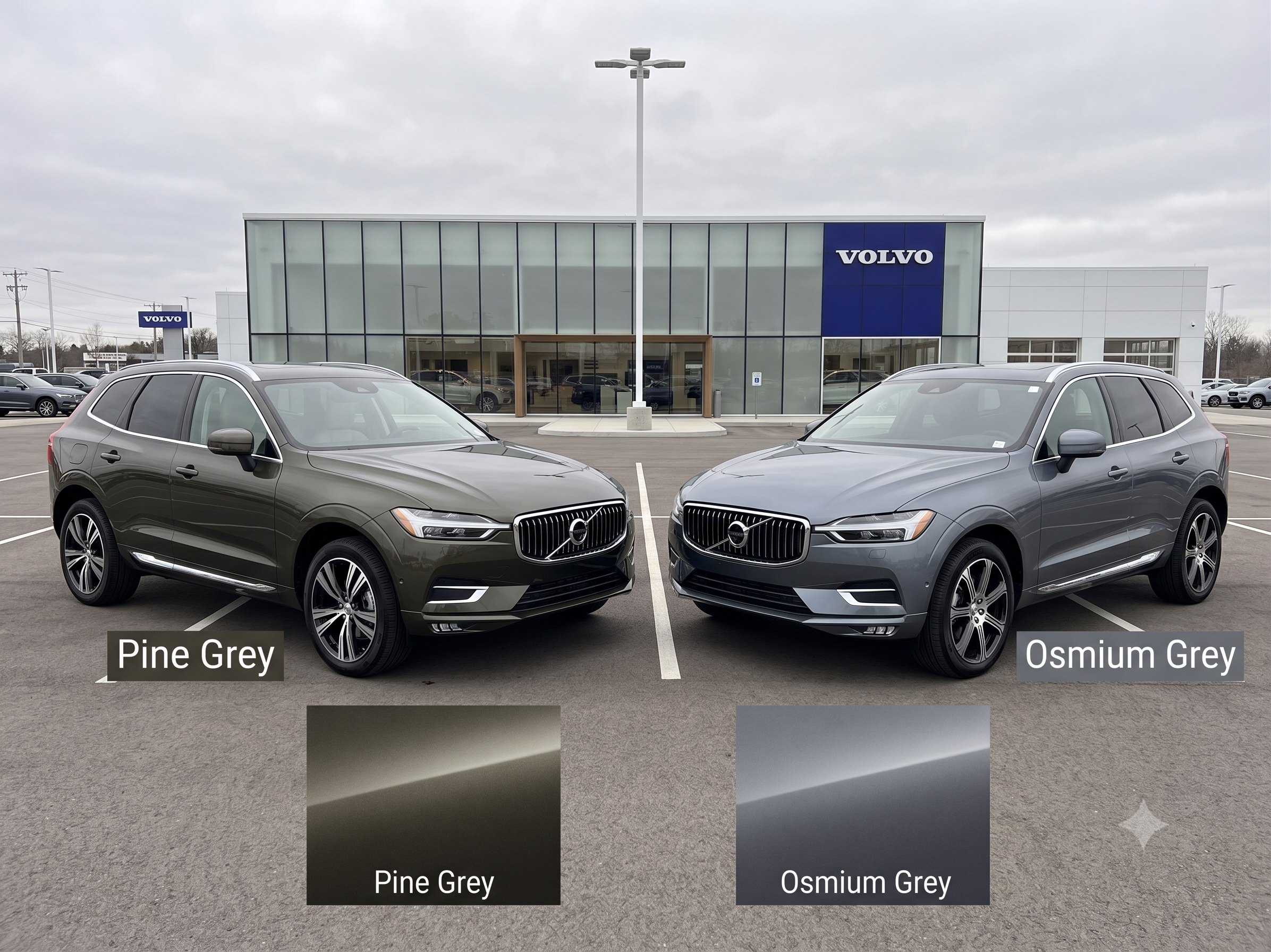
So which is better, Pine Grey or Osmium Grey? It really is subjective — but there’s a real, describable difference between them, and that’s worth knowing before you fall in love with a listing photo. Pine Grey is the color that changes personality depending on the light: it can really pop from grey to green to brown depending on lighting conditions, while Osmium Grey holds a steadier line — looking dark grey at night and a little more blueish during the day, with less of the dramatic tonal swing.
Quick Tip: If you’re shopping for either color used, ask the seller for photos taken in both direct sunlight and overcast conditions — a single listing photo genuinely won’t tell you what you’re getting with either shade.
What Is Pine Grey, Exactly?
Pine Grey is a metallic finish that Volvo offered across several models in the late 2010s, most notably the XC60, XC90, and V60. Its defining trait is how much it shifts depending on lighting — under streetlamps and sunshine it can shift from grey to green to brown, while in duller, overcast light it settles back down to a more ordinary-looking grey.
That color-shifting quality is exactly what makes it polarizing. Some owners describe it as genuinely hard to get a grasp of since it shifts depending on lighting, while others call it a really nice alternative to the sea of black, silver, white you see everywhere else on the road.
Pull-quote: Pine Grey isn’t one color — it’s three or four, depending on what the sun is doing that day.
What Owners Say About Pine Grey
- Frequently compared to Volvo’s earlier Caper Green, but with a darker undertone that mostly hides the green unless you’re in direct sunlight
- Reported to show swirl marks more visibly on large body panels like those on the XC90, so careful washing technique matters
- Consistently described by fans as “different” and a relief from an all-grey, all-silver, all-black market
What Is Osmium Grey, Exactly?
Osmium Grey is a darker, more industrial-leaning metallic that Volvo offered around the same era, commonly seen on the XC90, S60, and V90. Compared to Pine Grey’s dramatic shift, Osmium reads as more consistent — one longtime owner describes it as not as dark as a charcoal grey, but still significantly darker than silver, giving it real depth without tipping into a full black.
Where Pine Grey draws comparisons to green, Osmium draws comparisons to something more futuristic. One recurring owner description calls it very industrial, making the car look more like a concept vehicle — a compliment for buyers who want something that reads modern rather than nostalgic.
Expert Insight: If you’re pairing either color with a lighter interior like Blonde or Charcoal/Cardamom, Osmium Grey’s more consistent dark tone tends to create a cleaner, higher-contrast look than Pine Grey’s shiftier finish — several owners specifically call out this pairing as a standout combination.
Side-by-Side Comparison
| Trait | Pine Grey | Osmium Grey |
|---|---|---|
| Base tone | Grey with green/brown undertones | Grey with a slight blue tint |
| Light sensitivity | High — shifts noticeably by lighting condition | Lower — reads more consistently |
| Common description | Distinctive, divisive, “different” | Industrial, modern, understated |
| Models commonly found on | XC60, XC90, V60 (2017–~2021) | XC90, S60, V90 (2017–~2021) |
| Current availability | Discontinued | Discontinued |
Choose Pine Grey if you want a color that genuinely changes character depending on the light and don’t mind being asked “wait, is that green?” more than once. Choose Osmium Grey instead if you want something that reads consistently premium and modern without much day-to-day variation.
Are Either of These Colors Still Available New?
No — as of the current 2026 model year, neither Pine Grey nor Osmium Grey appear on Volvo’s active color palettes for the XC60, XC90, EX90, EX30, or XC40. Volvo has since shifted its grey offerings toward newer names like Vapour Grey, Aurora Silver, and Bright Dusk, alongside colors like Onyx Black, Denim Blue, and Mulberry Red across the current lineup.
That means if you specifically want Pine Grey or Osmium Grey, you’re shopping the used market — primarily 2017 through roughly 2021 model-year XC60, XC90, S60, V60, and V90 vehicles, depending on the specific color and trim year.
Quick Tip: When searching used listings, search both “Pine Grey” and “Pine Gray” (and “Osmium Grey”/”Osmium Gray”) — spelling varies by dealer and region, and inconsistent listings can hide inventory from a narrower search.
Which Color Holds Up Better on Which Model?
Owner opinion on model pairing is genuinely divided, but there’s a recurring pattern worth knowing. Multiple forum threads converge on a similar take: Pine Grey works best on the XC60 while Osmium Grey serves the XC90 better, though plenty of owners disagree and love the reverse pairing just as strongly.
Picture two shoppers cross-referencing the same used-car search: one finds a Pine Grey XC90 and loves how it looks bold and different against the SUV’s large panels; the other finds an Osmium Grey XC90 and prefers how it reads clean and consistent in every parking lot photo. Both are responding to real, well-documented traits of each color — this isn’t just random taste.
Maintenance and Paint Care Notes
Neither color requires unusual maintenance versus other Volvo metallics, but owners do flag a few practical notes worth knowing before you buy.
- Volvo’s clear coat from this era has been described by some owners as relatively soft, meaning both colors can show swirl marks from improper washing more readily than harder factory clears from other brands
- Standard care routines — clay bar, gentle wash mitts, a quality sealant or wax — work well on both colors according to detailed owner writeups
- Because Pine Grey’s finish is more light-reactive, minor swirl marks and imperfections can be more noticeable in direct sun than on Osmium Grey’s steadier finish
Expert Insight: If paint correction and swirl-mark visibility matters to you, Osmium Grey’s more consistent tone will generally hide minor imperfections better day-to-day than Pine Grey’s higher-contrast, light-reactive finish.
Pros and Cons by Buyer Type
The Distinctive-Look Shopper
- ✅ Pine Grey: Genuinely rare on the road, sparks conversation, changes character in different light
- ❌ Pine Grey: Divisive — some viewers strongly dislike the green undertone
The Resale-Focused Shopper
- ✅ Osmium Grey: More neutral, broadly appealing tone likely to resonate with more buyers
- ❌ Neither color is currently in production, so resale comps depend entirely on used-market demand rather than new-model color trends
The Detail-Oriented Owner
- ✅ Osmium Grey: Swirl marks and minor imperfections are less visually obvious day to day
- ❌ Pine Grey: More visible paint imperfections in bright, direct sunlight due to the color’s light sensitivity
FAQ
Is Pine Grey a green color or a grey color? It’s officially a grey metallic, but its finish shifts noticeably under direct sunlight and streetlights, often reading as green or brown depending on the lighting conditions.
Can I still order a new Volvo in Pine Grey or Osmium Grey? No. As of the 2026 model year, neither color appears in Volvo’s current exterior palette across the XC40, XC60, XC90, EX30, or EX90 — both are discontinued, and you’ll need to shop the used market for models from roughly 2017–2021.
Which color is more popular among Volvo owners, Pine Grey or Osmium Grey? Opinion is genuinely split in owner communities, with some strongly preferring Pine Grey’s distinctiveness and others preferring Osmium Grey’s more consistent, understated look — neither has a clear majority.
Does Pine Grey show dirt and swirl marks more than Osmium Grey? Owners generally report that Pine Grey’s light-reactive finish makes minor paint imperfections more visible in direct sunlight compared to Osmium Grey’s steadier tone.
What models were Pine Grey and Osmium Grey available on? Pine Grey was commonly available on the XC60, XC90, and V60; Osmium Grey was commonly available on the XC90, S60, and V90, generally across the 2017–2021 model years.
Key Takeaways
- Pine Grey is a color-shifting metallic that can read grey, green, or brown depending on lighting
- Osmium Grey is a steadier, more industrial dark grey/blue metallic with less light-dependent variation
- Both colors are discontinued from Volvo’s current lineup — you’ll find them only on used 2017–2021 models
- Owner opinion genuinely splits on which is more appealing, with no clear consensus favorite
- Osmium Grey tends to hide minor paint imperfections better; Pine Grey draws more attention (for better or worse)
Which Should You Choose?
If you want a color that’s genuinely different and don’t mind some viewers debating whether it’s grey or green, go with Pine Grey. If you want a consistent, modern-looking dark grey that reads the same in every lighting condition, Osmium Grey is the steadier bet.