Volvo XC90 Bowers & Wilkins vs Harman Kardon?

You’ve already picked your Volvo XC90 trim, powertrain, and seating layout. Now there’s one more decision hiding in the options list that can add thousands to your build: which premium audio system actually deserves your money, and which one just sounds good enough that you’d never notice the difference during the school run.
TL;DR
- Harman Kardon comes standard on the Ultra trim (available on Plus), with 14 speakers and 600–610 watts of power.
- Bowers & Wilkins is a paid upgrade (around $3,200) available on the Ultra trim, with 19 speakers and 1,410 watts of power.
- B&W adds a distinctive dashboard-mounted “tweeter-on-top” design element that Harman Kardon lacks.
- Owner feedback suggests the audible difference shrinks significantly at moderate volumes (around 50% or below).
- Choose Harman Kardon if you listen mostly at low-to-moderate volumes; choose Bowers & Wilkins if you crank the volume or want the audiophile-grade hardware regardless.
Volvo XC90 Bowers & Wilkins vs Harman Kardon: Quick Answer
Harman Kardon is the standard premium system on the Ultra trim and delivers genuinely good sound for the vast majority of everyday listening. Bowers & Wilkins is the paid step-up, delivering measurably more speakers, power, and audiophile-grade components — but the price only pays off fully if you actually listen loud and critically enough to hear the difference.
Pricing & Trim Availability
Harman Kardon premium audio is available on the Plus trim and comes standard on the Ultra trim across the current XC90 lineup, meaning many buyers get it without paying an extra line-item at all. Bowers & Wilkins, by contrast, is a paid option specifically on the Ultra trim, priced at around $3,200 according to recent reporting.
Quick Tip: Because Harman Kardon is often bundled into the Ultra trim’s base equipment, the real cost comparison usually isn’t “system A vs system B” — it’s “should I pay roughly $3,200 more for B&W on top of what I already get for free.”
Choose Harman Kardon if: you want strong sound quality without an additional line-item cost. Choose Bowers & Wilkins if: the extra ~$3,200 is worth it for audiophile-grade hardware and the highest-volume performance.
Hardware & Specs Compared
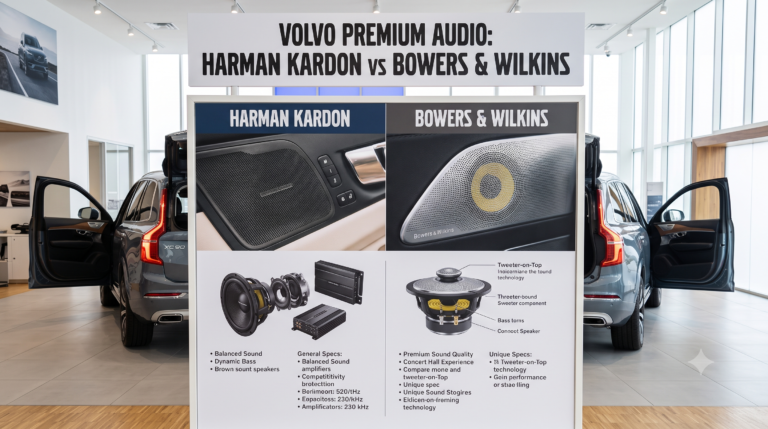
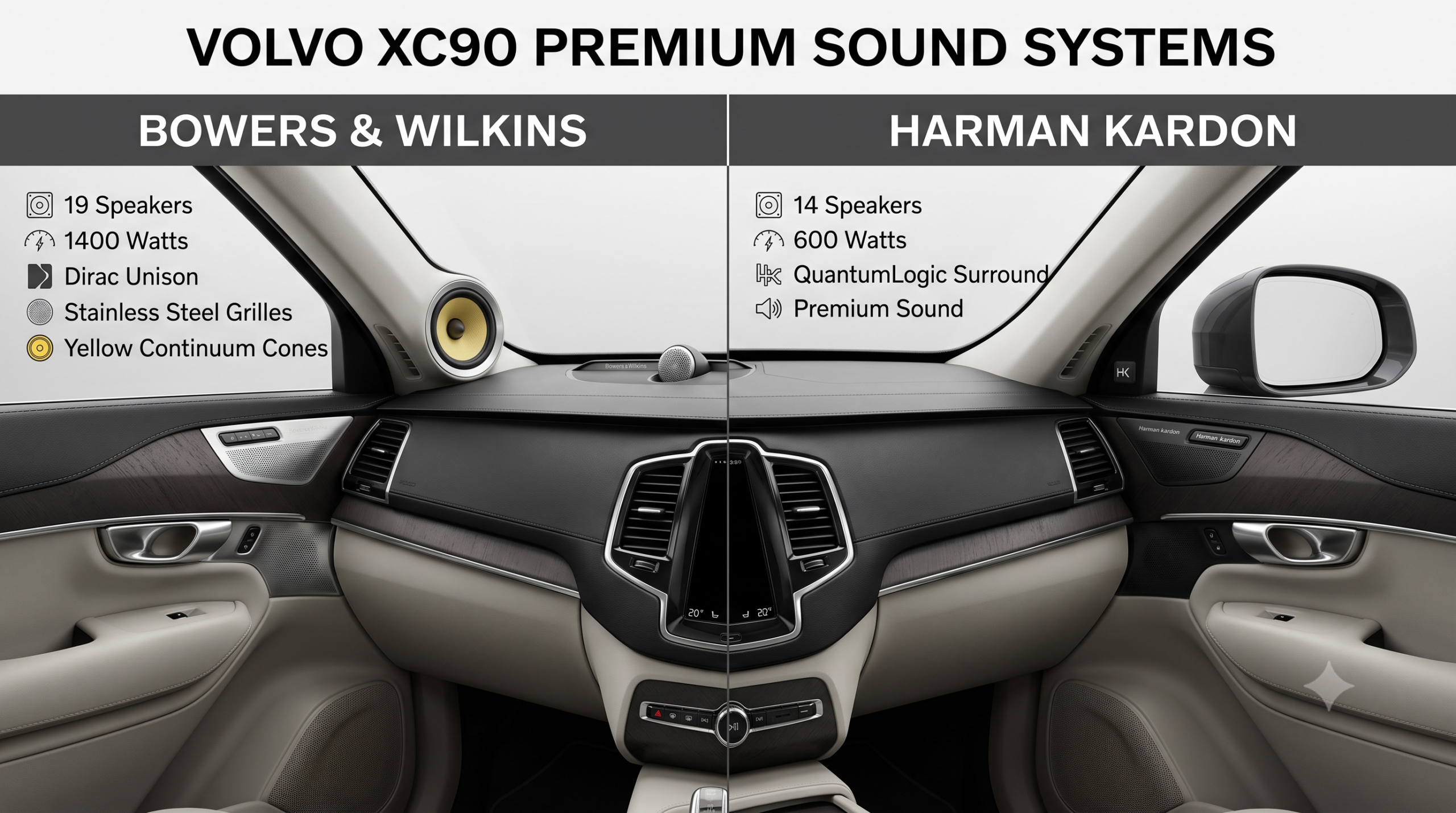
Harman Kardon’s Volvo system uses 14 speakers powered by a 600–610-watt amplifier, tuned specifically to the XC90’s cabin acoustics for what Harman describes as immersive, “sublime” sound from the driver’s seat to the third row.
Bowers & Wilkins steps up considerably: 19 speakers driven by a 12-channel Class D amplifier producing 1,410 watts, including aluminum tweeters with Nautilus technology, midrange drivers built from B&W’s proprietary Continuum composite material, and one of the first air-ventilated subwoofers integrated into a car body, which effectively turns part of the cabin itself into a subwoofer.
Pull quote: “B&W’s system doesn’t just add speakers — it adds an entirely different tier of driver materials and amplifier architecture.”
The Signature B&W Difference: Tweeter-on-Top
A 2025 automotive audio comparison often highlights that the single most distinctive physical feature separating these two systems is B&W’s dashboard-mounted tweeter. The Bowers & Wilkins system includes a “tweeter-on-top” design, a dedicated tweeter that sits raised on the center of the dashboard, aimed to send high frequencies directly at listeners rather than bouncing them off the windshield first.
Harman Kardon’s system, by comparison, uses a smaller flat speaker in that same dashboard position rather than a raised, dedicated tweeter — a difference several owners have specifically pointed to as one of the more noticeable distinctions between the two, even when the overall sound quality gap felt smaller than expected.
| Feature | Harman Kardon | Bowers & Wilkins |
|---|---|---|
| Speaker count | 14 | 19 |
| Power output | 600–610 watts | 1,410 watts |
| Amplifier channels | Multi-channel digital | 12-channel Class D |
| Signature dashboard tweeter | Small flat speaker | Raised “tweeter-on-top” |
| Subwoofer design | Standard | Air-ventilated, body-integrated |
| Trim availability | Plus (available), Ultra (standard) | Ultra only (paid option) |
| Approximate added cost | Included on Ultra | ~$3,200 |
| Signal processing | Dirac-based tuning | Dirac-based tuning |
Expert Insight: Both systems actually share Dirac-based digital signal processing under the hood — the differentiation is almost entirely in speaker count, materials, and amplifier power, not the tuning software itself.
Real-world scenario: A family that mostly listens to talk radio, podcasts, or music at moderate in-cabin volume during the daily school run or commute will likely find Harman Kardon delivers everything they need, with several owners reporting the two systems sound nearly identical below about 50% volume. An audiophile who wants to crank favorite tracks on long highway drives, or who simply wants the best available hardware regardless of daily listening habits, will hear — and likely appreciate — the clearer separation, deeper bass, and more open high-frequency reproduction that Bowers & Wilkins delivers at higher volumes.
Safety & Driver-Assist Tech
Audio system choice has no bearing on the XC90’s safety equipment or driver-assist features — both are purely audio upgrades layered onto whichever trim and safety package you’ve already selected. This is a comfort and entertainment decision, not a safety one.
Choose this if: safety factors into your audio system choice — it doesn’t, since neither option changes any safety equipment.
Pros & Cons by Buyer Type
The Everyday Commuter Who Listens at Moderate Volume
- Harman Kardon: ✅ Strong, clear sound at typical in-cabin volumes without paying extra.
- Bowers & Wilkins: ❌ The premium is harder to justify if you rarely push the volume high enough to hear the difference.
The Audiophile Who Wants the Best Available Hardware
- Harman Kardon: ❌ Noticeably behind B&W at higher volumes, according to owner comparisons.
- Bowers & Wilkins: ✅ More speakers, more power, and premium driver materials that reward critical listening.
The Budget-Conscious Ultra Trim Buyer
- Harman Kardon: ✅ Already included standard on Ultra — no additional spend required.
- Bowers & Wilkins: ❌ A meaningful additional cost on top of an already premium trim level.
Alternatives Worth a Look
If you’re cross-shopping audio-focused luxury SUVs more broadly, the Mercedes-Benz Burmester system is often mentioned as a comparable high-end alternative in this class, typically bundled into higher trims of Mercedes SUVs. Choose this if you’re comparing across brands rather than staying within the XC90 lineup.
If budget is the deciding factor and you’re not set on Ultra trim at all, remember that even the XC90’s standard 10-speaker system (on Core and Plus trims without the Harman Kardon upgrade) delivers solid everyday sound quality for many listeners. Choose this if premium audio isn’t a top priority and you’d rather put the money elsewhere.
Frequently Asked Questions
Is the Bowers & Wilkins upgrade worth $3,200 in the Volvo XC90? It depends on your listening habits — several long-term owners report the audible difference between B&W and Harman Kardon shrinks considerably at moderate volumes, so the premium mainly pays off if you regularly listen loud or care deeply about audiophile-grade components.
Can I get Bowers & Wilkins on the Plus trim? No, based on current Volvo trim structuring, Bowers & Wilkins is specifically tied to the Ultra trim as a paid option, while Harman Kardon is available on Plus and standard on Ultra.
What’s the biggest physical difference between the two systems? The most distinctive feature is B&W’s raised “tweeter-on-top” on the dashboard, designed to send high frequencies directly at listeners, versus Harman Kardon’s smaller, flush-mounted speaker in the same position.
Do both systems use the same tuning software? Yes, both Harman Kardon and Bowers & Wilkins systems in Volvo vehicles rely on Dirac-based digital signal processing for delay correction, phase balancing, and overall sound tuning.
Does upgrading to Bowers & Wilkins reduce cargo space or add weight? Neither system meaningfully affects cargo space or vehicle performance — the differences are entirely in audio hardware and sound quality, not practicality.
Key Takeaways
- Harman Kardon delivers strong value — standard on Ultra, with clear sound quality at everyday listening volumes.
- Bowers & Wilkins delivers meaningfully more hardware — nearly 40% more speakers and over double the power, for a real price premium.
- The audible gap between the two narrows significantly at low-to-moderate volumes, according to consistent owner feedback.
- B&W’s signature tweeter-on-top design is the most visually and audibly distinctive difference between the two systems.
- Your actual listening habits — not the spec sheet — should be the deciding factor here.
Next Step
Test both systems back-to-back at a dealership, playing the same track at both a moderate and a loud volume — that’s the only way to know whether your ears and your wallet agree on whether Bowers & Wilkins is worth the upgrade.