Volvo XC90 vs GMC Yukon?

Volvo XC90 vs GMC Yukon?
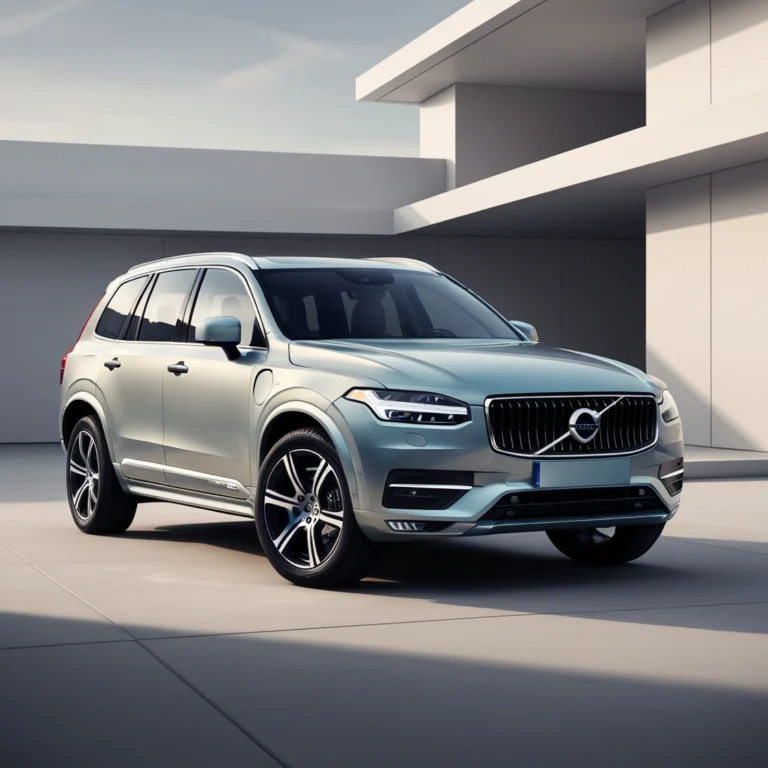
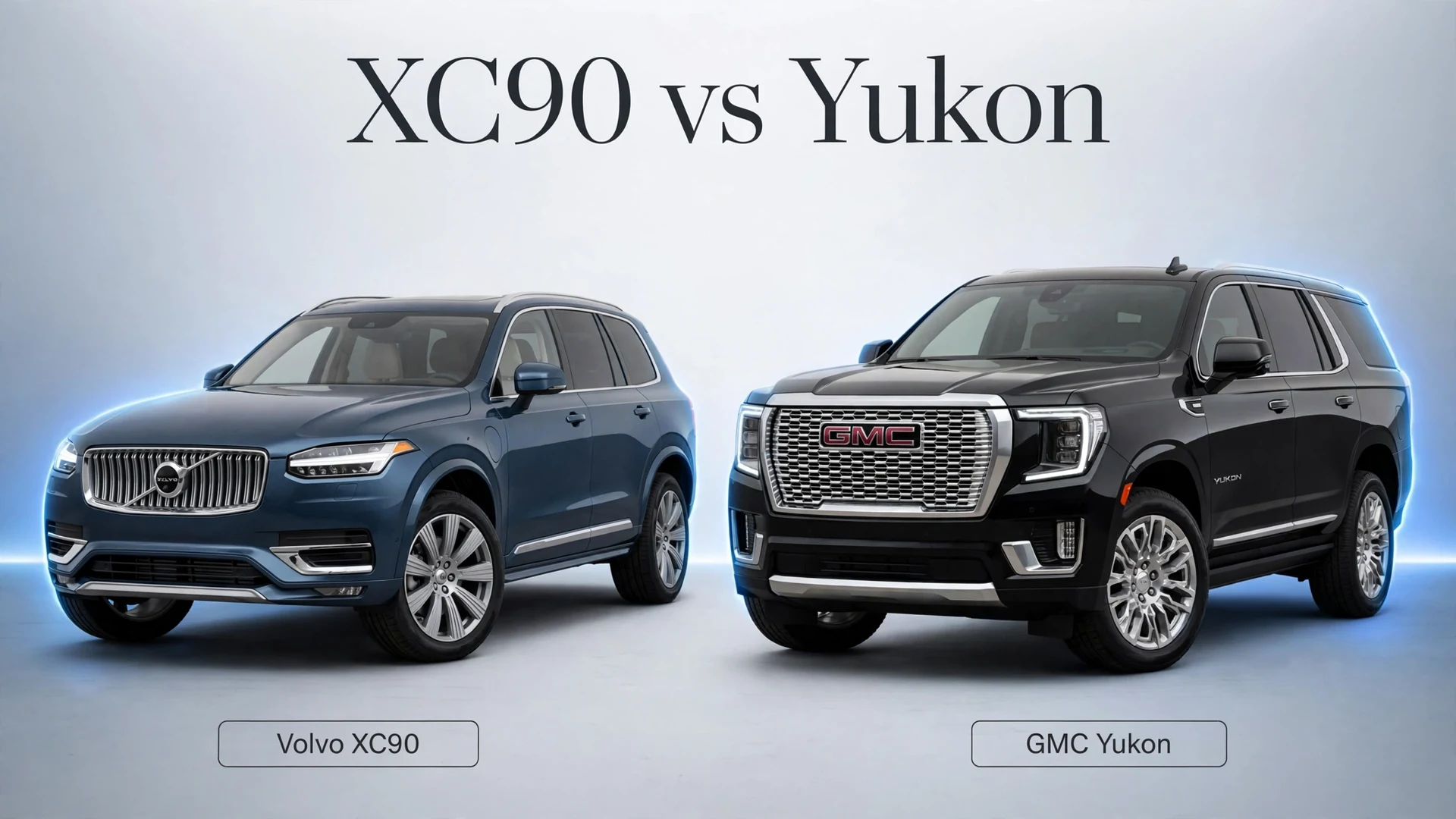
This is a comparison of two different species that happen to share three rows of seats. The Volvo XC90 is a unibody luxury crossover — car-like to drive, efficient (especially as a T8 plug-in hybrid), and loaded with safety tech. The GMC Yukon is a body-on-frame truck — 15 inches longer, up to 8 seats, V8 power, and up to 8,400 lb of towing. The verdict: buy the XC90 if your life is mostly pavement, passengers, and parking garages; buy the Yukon if you tow heavy, need maximum space, or want a proper truck. They overlap far less than the spec sheets suggest.
- Architecture: XC90 = unibody crossover (car-like); Yukon = body-on-frame truck (T1XX platform, shared with Tahoe/Suburban/Escalade).
- Size: Yukon 210.0 in long vs XC90 195.0 in; Yukon seats up to 8 (9 with front bench) vs XC90’s 7.
- Power: Yukon 5.3L V8 (355 hp) or 6.2L V8 (420 hp) or 3.0L diesel (277 hp); XC90 from 247-hp B5 to 455-hp T8 plug-in hybrid.
- Towing: Yukon up to 8,400 lb vs XC90’s 5,000 lb — the GMC is in another league.
- Economy: XC90 B5 23/30/26 mpg (T8 58 MPGe) vs Yukon 5.3L 15/20/17 mpg — the Volvo costs far less to fuel.
- Price: Yukon started at $58,200 (2024) — often cheaper than an equivalent XC90, but thirstier and truckier.
- Verdict: pavement luxury and efficiency: XC90. Maximum space, towing, and truck capability: Yukon.
Two Different Species
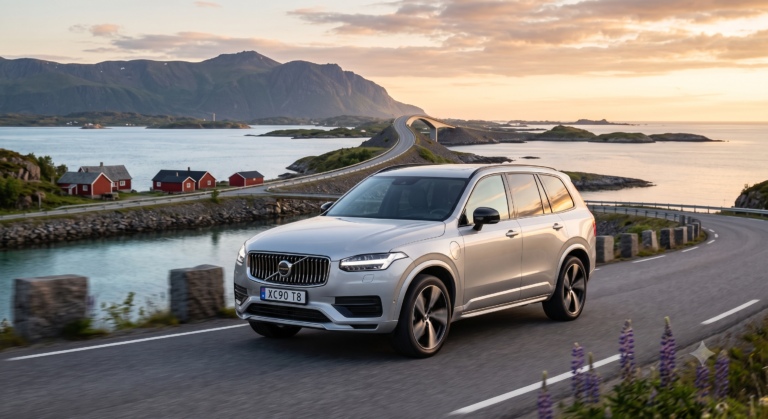
Before the numbers, understand what you’re comparing. The XC90 rides on Volvo’s SPA unibody platform — essentially a tall luxury wagon with standard all-wheel drive, independent suspension at all corners, and (on most trims) air suspension. It drives like a big car: composed, quiet, easy to park, and efficient.
The Yukon rides on GM’s T1XX body-on-frame platform — a separate ladder-frame chassis shared with the Chevrolet Tahoe/Suburban and Cadillac Escalade. It’s a truck with an SUV body: solid, tow-capable, and spacious, but taller, heavier, thirstier, and less agile. Its independent rear suspension (adopted in 2021) improved ride and third-row space enormously versus the old live axle, but it’s still 5,600+ lb of truck.
Cross-shopping them usually means one of two things: you need three rows and haven’t decided what kind of three rows, or you’re comparing a used Yukon Denali against a used XC90 Inscription at similar money. Either way, be honest about your use case — these vehicles optimize for opposite things.
Size and Space: The Yukon Is Enormous
| Dimension | Volvo XC90 | GMC Yukon |
|---|---|---|
| Length | 195.0 in | 210.0 in |
| Width | 79.1 in | 81.0 in |
| Height | 69.9 in | 76.5 in |
| Wheelbase | 117.5 in | 120.9 in |
| Seating | 6 or 7 | 7, 8, or 9 |
| Cargo behind 3rd row | 12.6 cu ft | 25.5 cu ft |
| Maximum cargo | 65.5 cu ft | 122.9 cu ft |
| Third-row legroom | 31.9 in | 34.9 in |
The Yukon doubles the XC90’s behind-third-row cargo (25.5 vs 12.6 cu ft) and nearly doubles maximum volume (122.9 vs 65.5). Its third row fits adults without apology; the XC90’s is best for kids and short trips. And the Yukon offers seating configurations the Volvo can’t touch — including a front bench on some trims for nine total.
The XC90’s size advantage is maneuverability: 15 inches shorter, narrower, lower, and thousands of pounds lighter. It fits in parking structures, turns tighter, and doesn’t need a spotter at the mall. (Need even more space? The Yukon XL stretches to 225 inches — Suburban territory the XC90 can’t follow.)
Powertrains: V8 Muscle vs Hybrid Efficiency
| Engine | Power | Torque | EPA economy |
|---|---|---|---|
| Yukon 5.3L V8 | 355 hp | 383 lb-ft | 15/20/17 mpg |
| Yukon 6.2L V8 | 420 hp | 460 lb-ft | 14/20/16 mpg |
| Yukon 3.0L diesel I6 | 277 hp | 460 lb-ft | ~21/27/24 mpg |
| XC90 B5 (2.0T mild hybrid) | 247 hp | 266 lb-ft | 23/30/26 mpg |
| XC90 B6 (2.0 twincharged MH) | 295 hp | 310 lb-ft | 22/28/24 mpg |
| XC90 T8 (plug-in hybrid) | 455 hp | 523 lb-ft | 58 MPGe, ~33-mi EV range |
Two philosophies, cleanly separated. The Yukon’s small-block V8s are old-school American muscle — the 6.2L’s 420 hp moves the big truck with authority, and the 3.0L Duramax diesel (460 lb-ft, ~24 mpg combined) is the range king and the smart tower’s choice. The XC90’s four-cylinders can’t match the V8s’ character, but the T8 plug-in hybrid out-powers everything here (455 hp / 523 lb-ft) while delivering 33 miles of electric range.
Fuel costs are where the comparison gets lopsided: a Yukon 5.3L at 17 mpg combined burns roughly 50% more fuel than an XC90 B5 at 26 mpg — and the T8, charged nightly, can use a fraction of either. Over 15,000 miles a year, the Yukon costs $1,500–$2,000+ more in fuel than the B5 at typical prices. The diesel narrows the gap but can’t close it.
Capability: Towing and Terrain
Towing is the Yukon’s home turf: up to 8,400 lb properly equipped (5.3L 2WD in max-trailering spec), versus the XC90’s 5,000 lb across the range. Big travel trailers, large boats, and car haulers belong behind the Yukon — the XC90 handles midsize campers, utility trailers, and boat trailers up to its limit, but it’s not a heavy-tower.
Off-road, the Yukon AT4 trim brings a two-speed transfer case, skid plates, and 32-inch all-terrain tires — genuine trail capability. The XC90’s all-wheel drive is a foul-weather and gravel-road system, not a rock-crawler; its 8.3 inches of clearance (with air suspension raised) handles snow and rutted tracks, not Moab. Neither is a Wrangler, but only one of them has a low range.
Reliability and Ownership
Yukon: The 5.3L V8 is GM’s workhorse — generally durable with basic maintenance, and the 10-speed automatic is well proven. The 6.2L has a more checkered record: lifter and valve-train issues (related to cylinder deactivation) have prompted warranty extensions and owner complaints — the 5.3 is the safer used bet. The 3.0L diesel is well regarded for economy and longevity but adds DEF/EGR complexity. Watch for the usual full-size-GM items: air suspension (on equipped trims), power running boards, and infotainment gremlins.
XC90: The B5/B6 mild hybrids are the safe choice — mature Drive-E hardware, no plug-in complexity. The T8 adds the ERAD rear-drive unit concern on 2016–2021 cars (buy 2022+). Volvo’s 4-yr/50k warranty beats GM’s 3-yr/36k bumper-to-bumper, and scheduled maintenance is included on the Volvo.
Depreciation: full-size GM SUVs hold value well in truck country; the XC90 depreciates faster in percentage terms, making used XC90s strong value. Insurance runs higher on the Yukon (more mass, more expensive repairs).
Daily Driving: The Truck Tax
Spec sheets don’t capture what the Yukon costs you every single day in convenience. At 210 inches long and 81 inches wide, it’s a tight fit in standard parking spaces and many home garages — measure yours before buying, especially with the power running boards deployed. Its 76.5-inch height clears most 7-foot garage doors, but roof-rack or antenna additions can make it exciting. The turning circle is wide, visibility over the long hood takes adjustment, and maneuvering in multi-story parking structures is a learned skill.
The XC90, by contrast, is 15 inches shorter, 2 inches narrower, and over 6 inches lower — it parks like the large crossover it is, slips into compact-adjacent spaces, and its lighter steering and tighter turning make urban life meaningfully easier. Ride quality favors the Volvo on pavement too: its standard air suspension (on most trims) delivers a calmer, quieter cruise than the Yukon’s truck-based setup, though the Yukon’s 2021+ independent rear suspension closed the gap considerably versus older generations.
This is the “truck tax”: every day you don’t need the Yukon’s capability, you pay for it in fuel, parking stress, and maneuverability. Every day you do need it, the XC90 can’t help you. Be brutally honest about the ratio — most suburban families use maximum capability a handful of days a year and pay the tax the other 360.
Which Three-Row for You?
Verdict: Choose Your Species
The XC90 and Yukon aren’t really competitors — they’re answers to different questions. If your question is “what’s the most refined, efficient, safe way to move my family on pavement?”, the XC90 wins walking away. If your question is “what’s the most capable way to move my family, their trailer, and their gear?”, the Yukon wins by the same margin. The buyers who get this wrong are the ones who buy the Yukon for school runs (and pay at the pump and the parking garage) or the XC90 for a 7,000-lb boat (and learn what “exceeding tow rating” means). Match the machine to the mission.
Sources
- edmunds.com — 2024 GMC Yukon specs (5.3L 355 hp/383 lb-ft, 15/20/17 mpg, 210.0 in length, 25.5 cu ft cargo).
- carbuzz.com — 2024 GMC Yukon pricing (base $58,200) and engine lineup (5.3L, 6.2L 420 hp, 3.0L diesel 277 hp/460 lb-ft).
- truecar.com — GMC Yukon towing (up to 8,400 lb) and trim data.
- carsforsale.com — GMC Yukon dimensions (81.0 in wide, 76.5 in high, 120.9 in wheelbase) and cargo (122.9 cu ft max).
- zzdsport.com — 2025.5 XC90 specs (B5 247 hp, T8 455 hp, 5,000-lb towing, dimensions, cargo).
- greencarreports.com — Volvo 2022 PHEV overhaul (T8 18.8 kWh, 455 hp).
Frequently Asked Questions
Which is bigger, XC90 or Yukon?
The Yukon, by a wide margin: 210.0 inches long versus 195.0, with 122.9 cu ft of maximum cargo against 65.5, and up to 8–9 seats versus 7. The XC90 is much easier to park and maneuver.
Which tows more?
The Yukon: up to 8,400 lb properly equipped, versus 5,000 lb for the XC90. For heavy trailers and large boats, the Yukon is the only choice of the two.
Which is more fuel efficient?
The XC90, decisively. The B5 manages 23/30/26 mpg and the T8 plug-in hybrid 58 MPGe with ~33 miles of EV range; the Yukon 5.3L V8 is rated 15/20/17 mpg. The diesel Yukon (~24 mpg combined) narrows but doesn’t close the gap.
Is the Yukon reliable?
Generally, with caveats: the 5.3L V8 and 10-speed auto are proven, but the 6.2L V8 has documented lifter/valve-train issues — the 5.3 is the safer used bet. The 3.0L diesel is well regarded but adds emissions-system complexity.
Can the XC90 go off-road like the Yukon?
No. The Yukon AT4 offers a two-speed transfer case, skid plates, and all-terrain tires; the XC90’s AWD is a foul-weather system with 8.3 inches of clearance — fine for snow and gravel, not for trails.
Which holds its value better?
The Yukon typically retains value better, especially in truck-friendly markets; the XC90 depreciates faster in percentage terms, which makes used XC90s strong value buys.