Where is the Volvo XC60 Made?

You’re about to spend north of $45,000 on a luxury SUV, and someone just told you it might be made in China. Now you’re Googling at midnight wondering whether your “Swedish” Volvo is actually Swedish at all. Totally reasonable response. Let’s sort this out properly.
The answer is nuanced — and honestly more interesting than a simple country name.
TL;DR
- Most XC60s sold globally are built in Torslanda, Sweden — Volvo’s flagship plant since 1964
- A version is also built in Chengdu, China, primarily for the Asian market
- XC60 production is coming to Ridgeville, South Carolina, USA, starting in late 2026
- Volvo is Swedish-designed and Swedish-headquartered but has been owned by Chinese automaker Geely since 2010
- All plants follow the same quality standards — the location of manufacture doesn’t affect the car’s safety ratings or build quality
Where Is the Volvo XC60 Made Right Now?
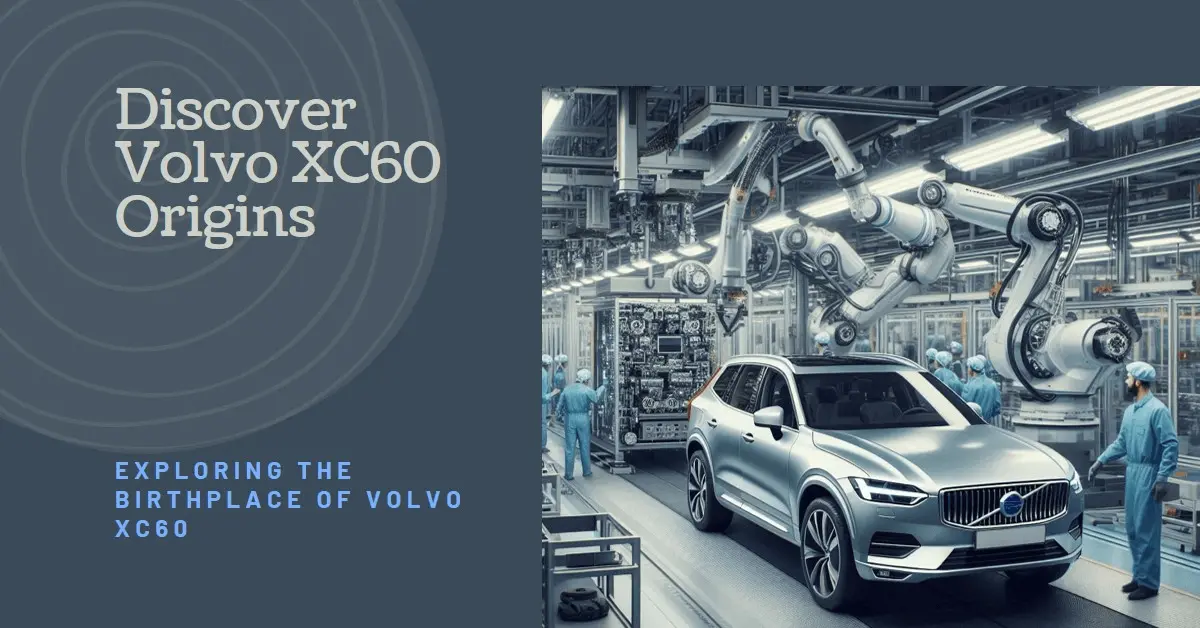
The short answer: the Volvo XC60 is manufactured in both Sweden and China. The primary production location is Torslanda, Sweden, where Volvo has a long-standing history of building vehicles. It is also produced in Chengdu, China, to meet growing demand in the Asian market.
If you’re buying in Europe, North America, or Australia, your XC60 almost certainly came from Sweden. The Chengdu plant primarily serves China and nearby Asian markets.
Where a Volvo is built matters less than you might think — and more than the marketing implies. Here’s the full picture.
The Swedish Home: Torslanda, Gothenburg
Volvo’s Gothenburg plant is the brand’s original production facility and has been operating since the 1950s. It produces the XC60, the V90 Cross Country, and the XC90.
The Torslanda Works is located on the island of Hisingen, about 12 km northwest of Gothenburg city centre. The plant marked fifty years of operation in 2014 under the motto “Increased capacity — for ever-higher quality.”
As of 2025, the plant has an annual production capacity of around 280,000 vehicles, operating on three shifts to produce approximately 60 cars per hour, and employs approximately 6,000 workers. Since its inception, Torslandaverken has produced more than 9.5 million vehicles.
That’s a lot of Volvos. (For context, that’s roughly enough to give every person in Sweden two cars each. Swedish efficiency in action.)
The facility incorporates climate-neutral operations, including hydroelectric power usage since 2008. So your Swedish-built XC60 was assembled using renewable electricity — something not every luxury brand can say about its flagship plant.
Expert Insight: Torslanda isn’t just a factory — it also holds the headquarters for Volvo Car Corporation, AB Volvo, and Polestar. The design, engineering, and executive leadership all sit on the same Gothenburg campus. This matters for quality control: the people making decisions about the car are steps away from where it’s built.
The Chinese Plant: Chengdu
In China, the Chengdu plant produces the S60, the XC60, the EX30, and the EX90, primarily for Chinese and regional Asian markets.
Volvo has operated in China since Geely’s acquisition in 2010, and the Chinese plants follow Volvo’s global quality standards and manufacturing processes. The same body structures, safety systems, and specifications apply whether the car rolls off a line in Sweden or Sichuan Province.
That said, if you’re buying in a Western market and want certainty about production origin, check your VIN. A VIN starting with YV1 indicates a Swedish-built Volvo. One beginning with LVS indicates Chinese manufacture.
Quick Tip: Check the window sticker (or ask the dealer) for the country of origin. For most North American and European buyers, the XC60 will be Swedish-built — but it’s always worth confirming, especially on demonstrator or pre-registered vehicles.
Where Is the XC60 Going Next? The USA — From Late 2026
This is the big news for American buyers specifically.
Volvo Cars announced it will add the XC60 to the production line of its US car plant in Ridgeville, outside Charleston, South Carolina. The facility is scheduled to start XC60 production in late 2026.
The XC60 has been Volvo’s best-selling model globally for years and is also the most popular Volvo model among US customers. In the first six months of 2025, XC60 sales in the US rose by almost 23 per cent.
The South Carolina plant already builds Volvo’s fully electric flagship EX90 SUV and the Polestar 3. With more than $1.3 billion invested over the last decade, the 2.3 million square-foot facility is equipped with a revamped body and paint shop, a state-of-the-art battery pack line, and the capacity to handle multiple platforms and technologies.
XC60 production is planned in both mild hybrid and plug-in hybrid variants, covering the two most popular powertrain choices for US buyers.
Volvo’s CEO put it plainly: “Adding the XC60 to our Charleston production line will further strengthen its position and attractiveness in the competitive US market, while supporting and creating American manufacturing jobs.”
Expert Insight: The timing of the US production announcement isn’t purely logistical. Volvo, owned by China’s Geely but headquartered in Sweden, has largely sidestepped US tariff impacts by manufacturing most US-bound vehicles in Europe. Building in South Carolina insulates future XC60 sales from any import duty changes — a strategic hedge as much as a capacity play.
The Global Manufacturing Map
| Plant Location | Country | Models Produced | Primary Market |
|---|---|---|---|
| Torslanda, Gothenburg | Sweden | XC60, XC90, V90 CC | Global (primary) |
| Chengdu | China | XC60, S60, EX30, EX90 | Asia |
| Ghent | Belgium | XC40/EX40, EX30 | Europe |
| Ridgeville, South Carolina | USA | EX90, XC60 (from late 2026) | North America |
| Shah Alam | Malaysia | XC40, XC60, S90 | Southeast Asia |
Who Actually Owns Volvo?
This is the question lurking behind the “where is it made” search for most people. Volvo feels Swedish. It looks Scandinavian. But who’s writing the cheques?
In 2010, Chinese automaker Geely acquired Volvo. Geely was founded in 1986 by Chinese billionaire Li Shufu and entered the carmaking business in 1997, becoming one of China’s top 10 automakers by 2002.
Volvo Cars is owned by the Chinese conglomerate Zhejiang Geely Holding Group Co., Ltd. However, Volvo Cars’ headquarters, which includes product development operations, marketing, and administrative departments, is located in Gothenburg, Sweden — the birthplace of Volvo Cars.
In practice, Geely operates more as a financial parent than a design director. Volvo’s engineering teams, safety research, and design studios remain Sweden-based. The cars are still conceived, designed, and crash-tested in Gothenburg. Geely provided investment and access to Chinese markets; Volvo retained its identity.
Geely Group’s 2024 automotive sales numbered over 3 million units across all its brands. Of these, over 760,000 were from the Volvo brand — an 8% increase over 2023 and a new sales record.
Does Manufacturing Location Affect Quality?
This is the real question. The honest answer: not in any meaningful way that should influence your purchase.
All Volvo plants — Sweden, China, Belgium, Malaysia — follow the same manufacturing processes, use the same components, and meet the same safety and quality specifications. The XC60’s five-star NCAP safety ratings apply regardless of where the individual car was assembled. Volvo’s homologation testing covers the model, not the plant.
Both Volvo facilities adhere to Volvo’s strict quality standards, ensuring that every XC60 meets the company’s reputation for safety, performance, and luxury, regardless of its production origin.
A real-world comparison: a Swedish-built XC60 and a Chengdu-built XC60 sold in China will use the same door steel, the same airbag systems, the same suspension geometry. The supply chain is global and consistent. What varies is shipping distance and, in some markets, which options or specifications are available.
Quick Tip: If you’re in North America or Europe and buying new from a mainstream dealer, manufacturing location is essentially a moot point — you’ll be getting a Swedish-built car. The China question becomes relevant only if you’re importing a grey-market vehicle or buying from an unusual channel.
Pros & Cons by Buyer Persona
The Brand-Heritage Buyer (“I want a real Swedish Volvo”)
Pros: The vast majority of XC60s sold in Western markets come from Torslanda — Volvo’s spiritual and physical home since 1964. The plant that opened when ABBA was still a decade away from forming still produces the XC60 today. That’s genuine continuity. Cons: Volvo has been Chinese-owned since 2010. If that matters to you philosophically, it’s a fact worth sitting with — though it hasn’t measurably affected engineering quality or safety in the 15 years since.
The Practical Value Buyer
Pros: Production location doesn’t affect residual values, reliability records, or running costs. An XC60 is an XC60 on the service ramp regardless of VIN origin. Cons: Slightly harder to verify origin at point of sale without asking specifically or checking the VIN. Most dealers won’t volunteer this information proactively.
The American Buyer Post-2026
Pros: XC60 production will begin in Ridgeville, South Carolina in late 2026, meaning US buyers will eventually get a domestically-assembled version — potentially with pricing advantages if tariff structures shift. Local production also means shorter delivery lead times. Cons: The US-built XC60 doesn’t exist yet as of mid-2026. If you’re buying now, you’re still getting a Swedish-built car.
Quick Tip: You can verify where your specific Volvo was built using a free VIN decoder tool. VINs beginning with YV1 = Sweden. LVS = China. Checking takes about 30 seconds and eliminates any guesswork at the dealership.
Alternatives: Choose This If…
Choose the XC90 if Swedish-built certainty is a non-negotiable priority. American-market examples of the XC90 are primarily made in Sweden, and there is no Chinese-built version for Western markets.
Choose a BMW X3 or Mercedes GLC if brand-country purity is paramount and Geely’s ownership of Volvo is a dealbreaker. Both are built in Germany or their respective global plants, with no Chinese parent-company ownership.
FAQ
Is the Volvo XC60 really made in Sweden? Yes — the XC60 is currently built at Volvo’s plant in Torslanda, Sweden, for global sales. Most XC60s sold in Western markets come from this facility. A version is also built in China for the Asian market.
Does Chinese ownership affect Volvo’s quality or safety? Not in any documented way. Volvo’s safety ratings, engineering standards, and build quality have remained consistent — and in many cases improved — since Geely’s acquisition in 2010. The Gothenburg engineering and design teams continue to lead product development.
How can I tell where my XC60 was built? Check the first three characters of your VIN. YV1 indicates Swedish manufacture. LVS indicates a Chinese-built vehicle. This information is also on the driver’s door jamb sticker.
Will US-built XC60s be different from Swedish ones? XC60 production in South Carolina is planned in both mild hybrid and plug-in hybrid variants, matching the most popular US specifications. The car will follow the same build standards as the Swedish plant — the same as the EX90 already being produced there.
When will the US-built XC60 be available? Production at the Ridgeville, South Carolina plant is scheduled to start in late 2026. First US-assembled XC60s would therefore arrive at dealerships in 2027 at the earliest.
Key Takeaways
- Most XC60s are built at Torslanda, Gothenburg, Sweden — Volvo’s oldest and largest plant, which has been producing cars since 1964
- A Chinese-built version exists for the Asian market, assembled in Chengdu, to the same quality standards
- US production begins in late 2026 at the Ridgeville, South Carolina facility
- Volvo has been owned by China’s Geely since 2010, but remains headquartered in Gothenburg with Swedish engineering leadership
- Manufacturing location doesn’t affect safety ratings, reliability, or resale value in any documented way
- Verify your specific car’s origin in 30 seconds using the VIN — YV1 = Sweden, LVS = China
What to Do Next
If Swedish production matters to you, ask your dealer specifically and request the VIN before signing. For most buyers in North America and Europe, the answer will be Torslanda — and if you want to see where your car comes from, Volvo offers public factory tours at the Torslanda plant in Gothenburg, complete with a visitor centre and café. Seeing 60 XC60s roll off the line per hour in Thor’s land — yes, that’s literally what Torslanda means — is quite something.