How to Use AWD in a 2005 Volvo XC90?

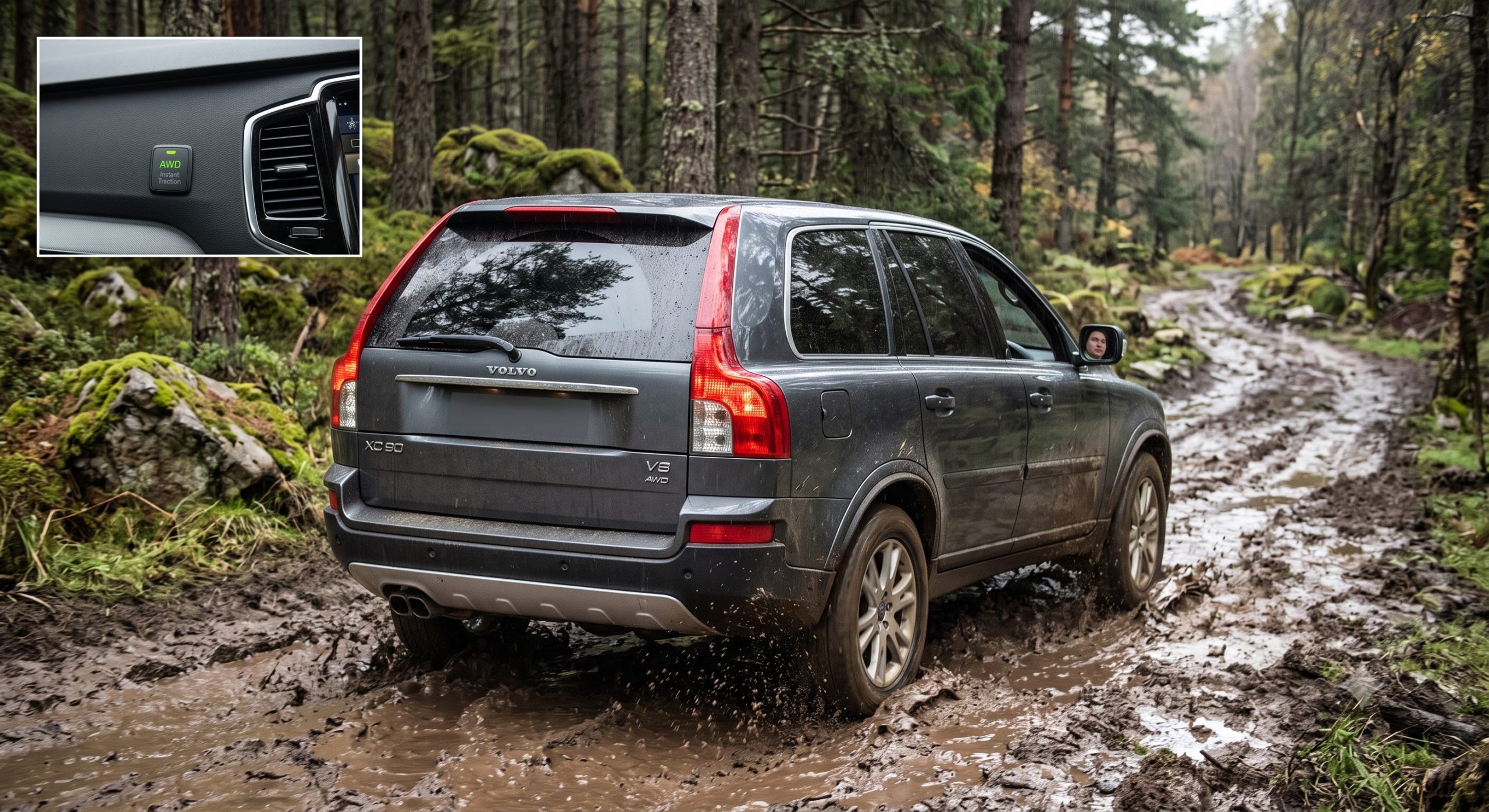
Here’s the short version: there’s no button to press, no dial to turn, and no “AWD mode” to switch on in your 2005 XC90. It’s already working, all the time, without you doing a thing.
That surprises a lot of new XC90 owners coming from trucks with selectable 4WD. Here’s what’s actually happening under the floor, and what you as the driver do and don’t need to worry about.
TL;DR
- You don’t “activate” AWD in a 2005 XC90 — it’s fully automatic and always monitoring, with no driver switch involved.
- The 2005 XC90 uses an early Haldex-based system that sends power to the rear wheels only when it detects front-wheel slip.
- Up to 65% of engine power can shift to the rear wheels in low-traction conditions.
- No dashboard light tells you AWD is “on” — you may just feel a subtle handling change on slippery surfaces.
- Maintenance matters more than driving technique: the Haldex fluid and filter need periodic service to keep the system responsive.
Do You Have to Turn On AWD in a 2005 XC90?
No — and this trips up a lot of owners switching from trucks with a 4WD lever or dial. <cite index=”52-1″>The Volvo all-wheel drive system uses a computer-controlled unit that transfers power back and forth between the front and rear wheels automatically, engaging power to the rear the instant the front wheels begin to lose traction and spin</cite>. There’s nothing for you to select.
<cite index=”51-1″>The XC90’s electronically controlled all-wheel drive system is completely automatic and one of the most technically sophisticated systems on the market for its time</cite>. Under everyday driving on dry pavement, the car runs mostly front-wheel drive for efficiency; the rear axle engages only when the system decides it’s needed.
Quick Tip: If you’re used to a truck’s 4WD Hi/Lo lever, resist the urge to look for a similar control in the XC90. There isn’t one — this system reads wheel speed and reacts on its own, faster than a person could flip a switch anyway.
How the 2005 XC90’s AWD System Actually Works
Volvo’s Haldex-based AWD works by watching for a difference in rotational speed between the front and rear wheels and reacting almost instantly when it detects one.
<cite index=”52-1″>The system uses a mechanical pump, control valve, and “wet” multi-plate clutch to distribute power to the rear wheels — when front and rear wheels rotate at the same speed, no power is transferred to the rear, but the instant the front wheels begin to lose traction and spin, the system introduces power to the rear</cite>. <cite index=”52-1″>A small auxiliary electric pump pre-pressurizes the system so that power transfer can happen almost instantly rather than lagging behind the slip</cite>.
That power transfer isn’t a fixed 50/50 split. <cite index=”51-1″>Normally anywhere between 5 and 65 percent of the power can be delivered to the rear wheels, depending on driving conditions</cite>, and <cite index=”51-1″>one front wheel needs only to slip through about a seventh of a single wheel revolution for the system to divert more power rearward</cite> — a response quick enough that most drivers never consciously notice it happening.
Real-world scenario: You’re pulling out onto a wet road and the front tires momentarily lose grip. Rather than a noticeable jolt or delay, the system has already started routing power to the rear before you’d even register the slip as a problem — <cite index=”51-1″>this quicker response compared to older viscous-coupling systems is exactly what minimizes the risk of the front wheels digging in on soft or slippery surfaces</cite>.
What the System Does Automatically (So You Don’t Have To)
Part of what makes this system easy to live with is that it also knows when not to be fully engaged, not just when to kick in.
<cite index=”51-1″>When the XC90 is being parked, the AWD system is controlled to prevent the front and rear axles from competing for power at full steering lock, which keeps low-speed maneuvering easy</cite>. <cite index=”51-1″>When the vehicle is braked, the AWD system deactivates so the brake and ABS systems can function effectively for stability and short stopping distances, and it’s similarly deactivated by the Dynamic Stability and Traction Control system if that system needs to intervene to counteract a skid</cite>.
In plain terms: the AWD system is designed to step out of the way of your other safety systems, not compete with them. You don’t need to remember to disable anything before braking hard or parking in a tight spot — it’s already handled.
Expert Insight: Volvo engineers reportedly tuned the system to preserve a slight, predictable understeer in extreme cornering, whether or not AWD is actively engaged — the goal was consistent, safe handling rather than a dramatic personality shift when the rear axle kicks in.
AWD System Generations: Where the 2005 XC90 Fits
Documentation on exactly which Haldex generation the 2005 XC90 uses is genuinely inconsistent across sources, which is worth knowing if you’re researching parts or repairs.
| Source | 2005 XC90 Generation |
|---|---|
| Volvo technical tips reference (automotivetechinfo.com) | Second-generation Haldex (used “up to 2005”) |
| Owner forum consensus (SwedeSpeed) | Likely Gen 2, based on physical component inspection |
| FCP Euro parts history | Lists 2005–2008 as fourth-generation Haldex, with third-gen starting 2003–2004 |
Given the conflicting documentation, the safest approach if you need an exact answer — say, for a parts order — is to have your specific VIN checked against Volvo’s VIDA system by a dealer or independent Volvo specialist rather than relying on model-year generalizations. <cite index=”57-1″>Even experienced owners comparing XC90s side by side have found visibly different Haldex coupler hardware across model years within the same generation window</cite>, so year alone isn’t always a reliable guide.
How to Keep Your AWD System Working Well
Since there’s no driving technique involved, the real “how to use it” answer for a 20-year-old XC90 is really about maintenance.
<cite index=”49-1″>The Haldex system’s oil filter needs to be replaced roughly every four years, corresponding to about 50,000 miles under a normal service schedule</cite>. Neglecting this is one of the most common reasons older Haldex systems lose responsiveness or develop noise over time.
Quick Tip: If your 2005 XC90 feels less confident in the rain or snow than it used to, an overdue Haldex fluid and filter service is one of the first things worth checking — not a sign the AWD hardware itself has failed.
Pros and Cons by Owner Type
The Snow-Belt Daily Driver
- ✅ Fully automatic system means one less thing to think about during a commute
- ✅ Quick response to slip helps with confident starts on icy hills
- ❌ At nearly 20 years old, the Haldex unit needs proactive fluid/filter service to perform as designed
The Used-XC90 Buyer
- ✅ AWD was widely available and well-regarded on this generation
- ❌ Generation/parts documentation conflicts across sources, so confirm exact system specifics by VIN before ordering parts
- ❌ Deferred Haldex maintenance is common on high-mileage used examples — budget for a service check at purchase
The DIY Maintainer
- ✅ Haldex fluid/filter service is a well-documented, accessible job compared to more complex modern AWD electronics
- ❌ Exact generation and part numbers can vary even within the same model year, so parts lookups require care
Frequently Asked Questions
Do I need to press a button to turn on AWD in my 2005 XC90? No. The system is always active and monitoring; there’s no manual switch or mode selection required.
How do I know if AWD is currently engaged? There’s no dashboard indicator for active engagement. You may notice a subtle change in how the car handles on slippery surfaces, but the system doesn’t announce itself.
Can I turn AWD off if I want front-wheel-drive-only handling? No, the system doesn’t offer a driver-selectable off mode. It’s designed to manage engagement and disengagement on its own, including deactivating automatically during braking or parking maneuvers.
How much power can go to the rear wheels? Up to roughly 65% of engine power can shift rearward under low-traction conditions, though the exact split adjusts continuously based on what the system detects.
Does the AWD system need special maintenance? Yes — the Haldex fluid and filter should be serviced on a schedule (roughly every four years or 50,000 miles) to keep the system responsive as it ages.
Key Takeaways
- AWD in the 2005 XC90 is fully automatic — there’s no switch, dial, or button for the driver to use.
- The system shifts power to the rear wheels within a fraction of a wheel rotation when it detects front-wheel slip.
- It automatically steps back during hard braking, ABS intervention, and tight parking maneuvers.
- Documentation on the exact Haldex generation used in 2005 conflicts across sources — confirm by VIN if it matters for parts or repair.
- Regular Haldex fluid and filter service is the real maintenance task that keeps this system performing as designed.
Next step: If your XC90’s AWD hasn’t had a Haldex fluid and filter service recently, that’s the first thing to check with a Volvo specialist — not a sign the system itself needs replacing.