XC90 FUEL ECONOMY ANALYSIS
What Gas Mileage Does a 2007 Volvo XC90 Get?
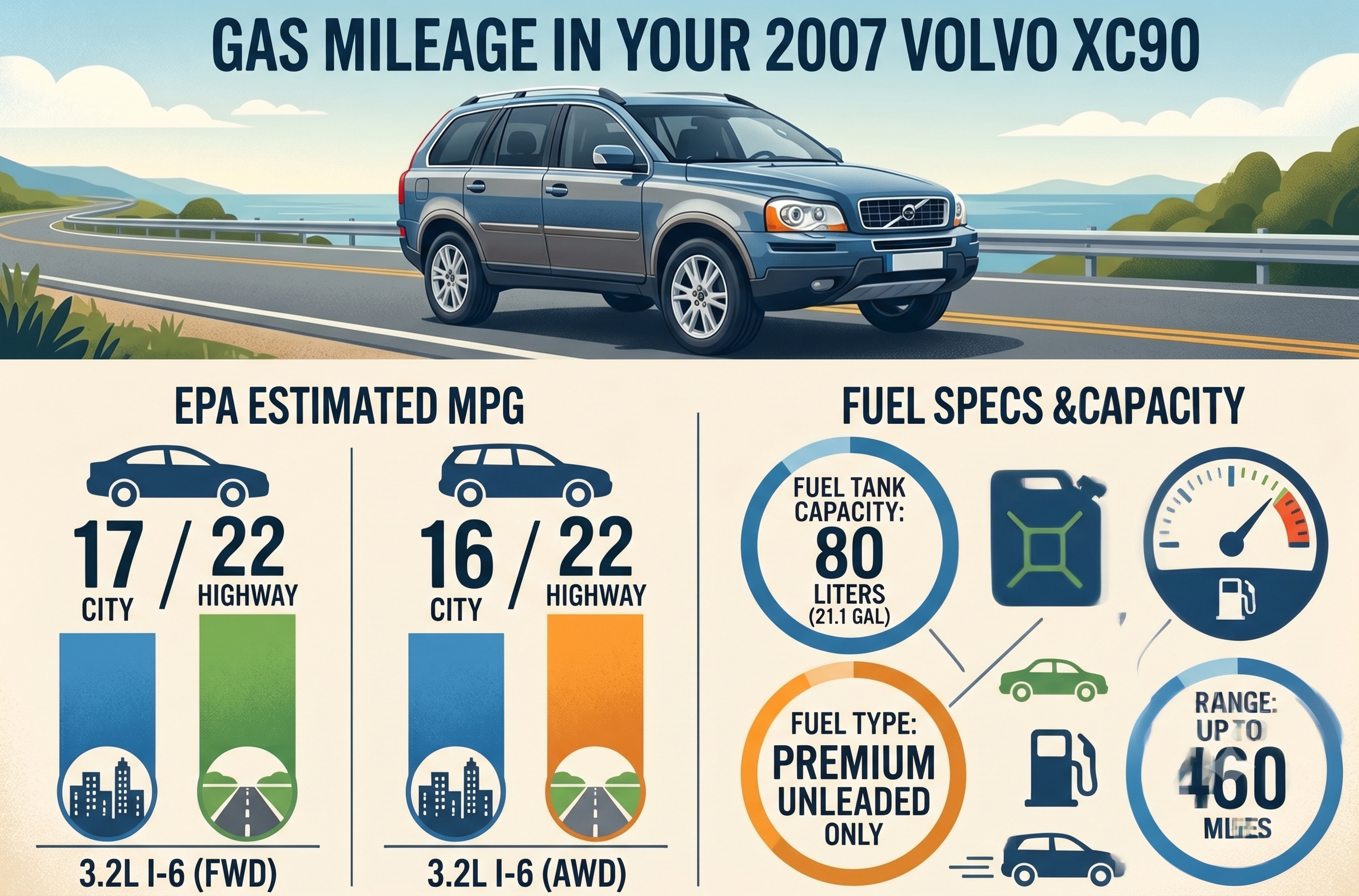
The 2007 Volvo XC90 was available with two primary gasoline engines in North America: a 3.2-liter naturally aspirated Inline-6 and a Yamaha-engineered 4.4-liter V8. The 3.2L Inline-6 gets an EPA-rated 14 MPG City / 19 MPG Highway (16 MPG Combined) in AWD, while the 4.4L V8 gets an EPA-rated 13 MPG City / 18 MPG Highway (15 MPG Combined). In real-world driving, most owners average between 14 and 18 MPG depending on tire pressure, terrain, and highway speeds.
3.2L Inline-6 (AWD)
14 City / 19 Hwy (16 Combined)
4.4L Yamaha V8 (AWD)
13 City / 18 Hwy (15 Combined)
Fuel Tank Capacity
21.1 Gallons (80 Liters)
Why Does the V8 Get Almost the Same Mileage as the 6-Cylinder?
One of the biggest surprises to prospective 2007 XC90 buyers is that the 311-horsepower 4.4L V8 burns almost identical fuel to the 235-horsepower 3.2L Inline-6.
The reason comes down to the XC90’s hefty 4,600 to 4,800 lb curb weight and upright Swedish wagon aerodynamics. Because the 3.2L Inline-6 produces only 236 lb-ft of torque, the 6-speed transmission must frequently downshift into 4th and 3rd gears to pull hills and merge onto highways. In contrast, the Yamaha V8 produces 325 lb-ft of low-end torque, allowing the transmission to stay locked in its taller 6th overdrive gear without laboring.
Interactive 2007 XC90 Fuel Cost & Range Calculator
Calculate your annual fuel expense, range per tank, and cost per mile based on your daily commute and current gas prices:
Official EPA Ratings vs Real-World Owner Mileage
| Engine & Drivetrain | EPA City | EPA Highway | EPA Combined | Real-World Observed MPG |
|---|
| 3.2L I6 FWD | 15 MPG | 20 MPG | 17 MPG | 16 – 19 MPG |
| 3.2L I6 AWD | 14 MPG | 19 MPG | 16 MPG | 15 – 18 MPG |
| 4.4L Yamaha V8 AWD | 13 MPG | 18 MPG | 15 MPG | 14 – 17 MPG |
| 2.4L D5 Diesel AWD (EU) | 24 MPG | 32 MPG | 28 MPG | 27 – 31 MPG |
EPA Ratings:
14 City / 19 Hwy / 16 Comb
Real-World:
15 – 18 MPG
Recommended Fuel:
87 Regular or 91 Premium
EPA Ratings:
13 City / 18 Hwy / 15 Comb
Real-World:
14 – 17 MPG
Recommended Fuel:
91+ Premium Required
5 Common Reasons Your 2007 XC90 Gets Terrible Mileage (& How to Fix It)
1
Clogged PCV Oil Trap Diaphragm
The positive crankcase ventilation (PCV) oil separator box mounted atop the engine contains a rubber diaphragm that tears after 100,000 miles. A torn diaphragm introduces an unmetered vacuum leak that makes the ECU dump excess fuel. If you hear a high-pitched whistling noise that stops when you pull the oil dipstick, replace the PCV oil trap immediately.
2
Sluggish Upstream Oxygen (O2) Sensors
Pre-catalytic Bosch wideband oxygen sensors degrade over 120,000 miles. When they become coated in soot, they bias lean, falsely signaling the engine computer to enrich the fuel mixture. Replacing the front O2 sensors typically restores 1.5 to 2.5 MPG.
3
Dragging Rear Parking Brake Shoes
The 2007 XC90 uses an internal drum-in-hat mechanical parking brake inside the rear brake rotors. Over time, the return springs corrode and snap, causing the brake shoes to drag continuously against the drum rotor, creating rolling drag and severe heat.
4
Fouled Mass Air Flow (MAF) Sensor & Throttle Body
Vapor blow-by deposits an oily film across the delicate MAF hot-wire element and the electronic throttle plate. Spraying both with dedicated MAF cleaner restores razor-sharp throttle calibration and air-fuel stoichiometry.
Frequently Asked Questions About 2007 Volvo XC90 Fuel Economy
Does the 2007 Volvo XC90 require premium 91 octane gas?
For the 4.4L Yamaha V8, premium 91 or 93 octane is strictly recommended to prevent ignition timing retardation and engine knock under load. For the 3.2L Inline-6, 87 regular octane is acceptable, although running 91 premium improves highway fuel efficiency by approximately 0.8 to 1.2 MPG.
What is the fuel tank capacity of the 2007 Volvo XC90?
All 2007 Volvo XC90 models have a large 21.1-gallon (80-liter) fuel tank capacity. When the low fuel warning lamp illuminates on the instrument cluster, approximately 2.6 gallons (10 liters) of reserve fuel remain.
How far can a 2007 Volvo XC90 go on a full tank of gas?
On pure highway road trips at 65-70 mph, a healthy 3.2L or V8 XC90 can achieve between 360 and 400 miles on a full 21.1-gallon tank. In heavy stop-and-go city commuting, range drops to roughly 270 to 300 miles per tank.
Can removing the roof rack crossbars improve gas mileage?
Yes! Factory square or aero roof crossbars create significant parasitic aerodynamic drag at interstate speeds. Removing the crossbars when not hauling cargo improves highway fuel economy by roughly 1.0 to 1.5 MPG.