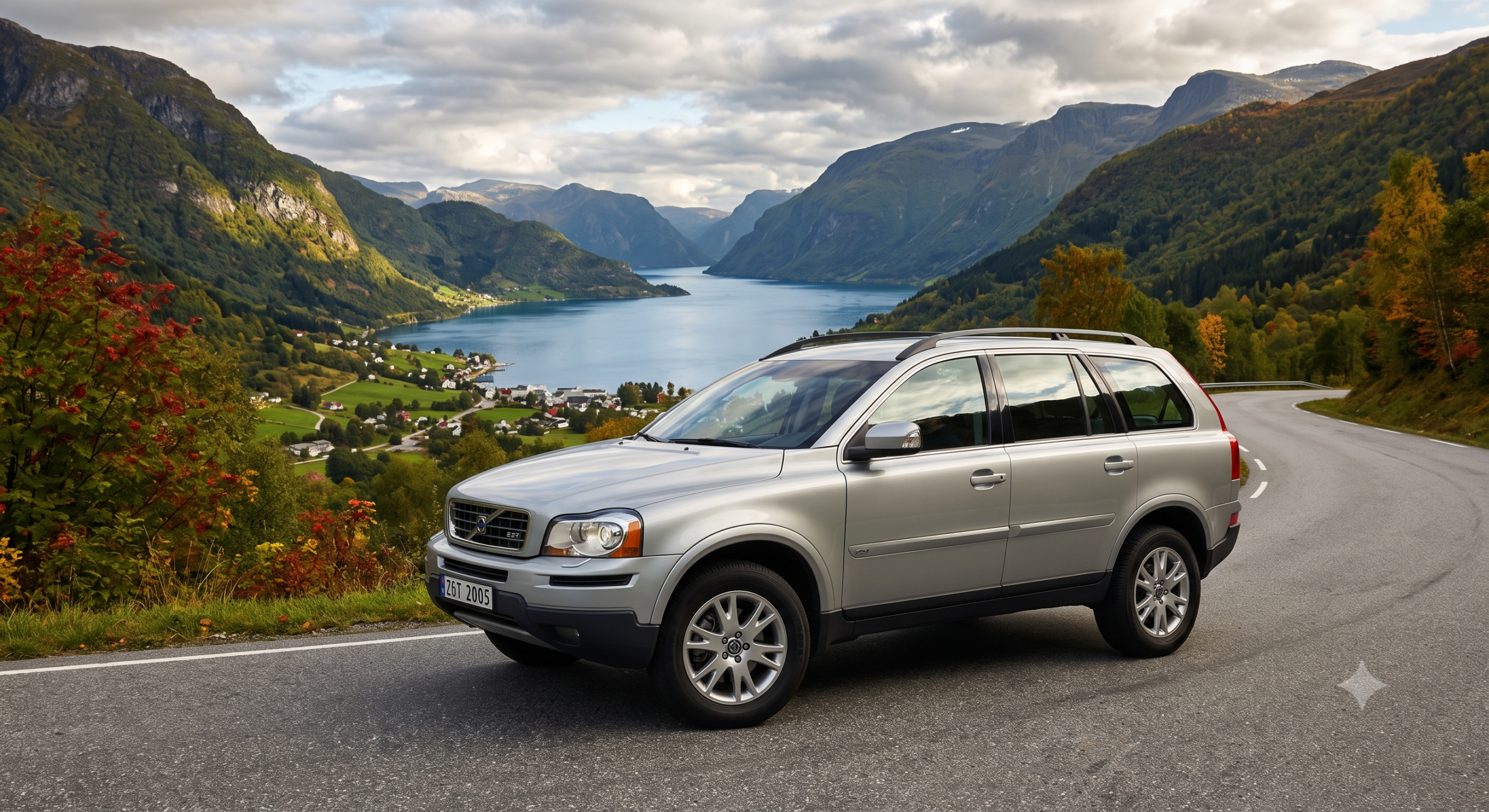
What Is a Volvo XC90 2.5T?

See “2.5T” badged on the back of a Volvo XC90 and wonder what you’re actually looking at? It’s not a trim name in the usual sense — it’s literally telling you what’s under the hood.
This guide is compiled from Volvo’s historical model documentation and cross-referenced technical specification databases, so it reflects the actual factory engine and trim details, not marketing shorthand.
TL;DR
- “2.5T” refers to the XC90’s entry-level engine and trim: a turbocharged 2.5-liter five-cylinder.
- It produces around 208–210 horsepower and 236 lb-ft of torque.
- It was the base engine option from the XC90’s 2003 launch through 2006.
- It came standard with front-wheel drive, with all-wheel drive available as an option.
- Starting with the 2007 model year, Volvo replaced it with a naturally aspirated 3.2-liter six-cylinder as the new base engine.
Here’s the short answer: the Volvo XC90 2.5T is the entry-level version of the first-generation XC90, powered by a turbocharged 2.5-liter inline-five engine producing around 208 horsepower, offered from the model’s 2003 launch through the 2006 model year.
What “2.5T” Actually Means
This naming convention is simpler than it looks once you break it down. The “2.5” refers to the engine’s displacement — 2.5 liters — and the “T” indicates it’s turbocharged.
Under that badge sits a B5254T2 turbocharged inline-five engine, producing 208 horsepower and 236 lb-ft of torque, paired with an Aisin-developed five-speed automatic transmission. It’s the same basic engine family Volvo used across several other models of that era, adapted for the XC90’s transverse, front-mounted layout.
Quick Tip: If you see “2.5T” on a specific listing, double check the model year — this exact engine was only offered from 2003 through 2006, so anything newer with a similar badge is a different engine entirely.
Where the 2.5T Sits in the Lineup
Understanding the 2.5T is easier with context on what else was available at the time. When the XC90 launched for the 2003 model year, Volvo offered exactly two trims: the 2.5T as the entry-level option, and the T6 above it.
The T6 used a more powerful 2.9-liter twin-turbo inline-six, producing 268 horsepower — a meaningful step up. Bold takeaway: the 2.5T wasn’t a stripped-down “economy” trim in the usual sense — it was simply the more accessible engine choice, while still offering full-size luxury SUV features across the rest of the vehicle.
Drivetrain: FWD Standard, AWD Optional
This is a detail that trips up some used-car shoppers. Unlike the T6, which came only with all-wheel drive, the 2.5T came standard with front-wheel drive, with Volvo’s Haldex-based all-wheel drive system offered as an optional upgrade.
That means two 2.5T-badged XC90s from the same year can have genuinely different drivetrains — one FWD, one AWD — so it’s worth confirming which configuration a specific used example has rather than assuming based on the trim badge alone.
Performance and Real-World Driving Feel
Numbers only tell part of the story, so it helps to know what the 2.5T actually feels like to drive. With 208–210 horsepower and 236 lb-ft of torque, period road tests recorded a 0–60 mph time in the range of about 9.2 to 9.9 seconds, depending on drivetrain and testing conditions.
That’s a genuinely modest number by modern standards, but it was reasonably competitive for a midsize luxury SUV in the mid-2000s, and the turbocharged five-cylinder was praised at the time for smooth, usable low-end torque rather than outright speed.
Comparison Table: 2.5T vs. T6 (2003–2006)
| Spec | 2.5T | T6 |
|---|---|---|
| Engine | 2.5L turbocharged inline-5 | 2.9L twin-turbocharged inline-6 |
| Horsepower | ~208–210 hp | ~268 hp |
| Torque | 236 lb-ft | 280 lb-ft |
| Transmission | 5-speed automatic (Aisin) | 4-speed automatic (GM-based) |
| Drivetrain | FWD standard, AWD optional | AWD only |
| Positioning | Entry-level | Performance trim |
The takeaway: the 2.5T is the more accessible, fuel-conscious choice of the original two-engine lineup, while the T6 trades some efficiency for meaningfully stronger acceleration and standard AWD.
What Happened to the 2.5T After 2006
If you’re cross-shopping model years, this matters. The 2.5T was discontinued as the base engine after the 2006 model year — for 2007, Volvo replaced it with a naturally aspirated 3.2-liter inline-six as the new entry-level engine, badged simply as the “3.2.”
Bold takeaway: if you’re specifically looking for the turbocharged five-cylinder experience, your model year window is genuinely limited to 2003 through 2006 — anything from 2007 onward with a similar “base trim” positioning is a different engine altogether.
Real-World Scenario: Shopping for a Used 2.5T
Say you’re comparing two used XC90s from the mid-2000s — one badged 2.5T, one badged T6 — at a similar price point. If your priority is fuel economy and a smoother daily commute, the 2.5T’s lighter, more efficient turbo-five is worth strong consideration, especially in front-wheel-drive form.
If you regularly need stronger acceleration for merging or occasional towing, or if all-wheel-drive traction matters where you live, the T6’s extra power and standard AWD may be worth the trade-off in fuel economy.
Pros & Cons by Buyer Type
The Budget-Conscious Buyer
- Pros: Lower original price point and often more affordable on the used market today
- Cons: Noticeably less power than the T6, which can feel underwhelming with a full load of passengers
The Snow-Climate Buyer
- Pros: AWD was available as an option, giving you traction without stepping up to the T6
- Cons: Not every 2.5T on the used market has AWD — you have to specifically confirm it
The Fuel-Economy Focused Buyer
- Pros: Generally better fuel economy than the T6 or later V8, especially in FWD form
- Cons: Still requires premium fuel, so the efficiency gain has real limits
Alternatives Worth Considering
T6 (2003–2006) — choose this if you want meaningfully stronger acceleration and don’t mind giving up some fuel economy, since AWD comes standard.
3.2 (2007 onward) — choose this if you want a similarly positioned “base” XC90 but prefer a naturally aspirated engine over a turbocharged one, and are shopping slightly newer model years.
FAQ
What engine is in a Volvo XC90 2.5T? It’s a turbocharged 2.5-liter inline-five engine (B5254T2), producing around 208–210 horsepower and 236 lb-ft of torque.
Does the Volvo XC90 2.5T have all-wheel drive? It came standard with front-wheel drive, with all-wheel drive available as an optional upgrade — so it’s important to confirm which a specific used example has.
What years was the XC90 2.5T available? It was offered from the XC90’s 2003 launch through the 2006 model year, after which it was replaced by a naturally aspirated 3.2-liter six-cylinder base engine.
How does the 2.5T compare to the T6? The T6 offers meaningfully more horsepower (268 hp vs. 208–210 hp) and torque, plus standard all-wheel drive, but with lower fuel economy than the 2.5T.
Is the 2.5T a good used SUV to buy today? It can be, particularly for buyers prioritizing fuel economy and a lower purchase price — though as with any 20-year-old vehicle, budget for maintenance regardless of trim.
Key Takeaways
- “2.5T” refers to the XC90’s original entry-level engine: a turbocharged 2.5L inline-five making around 208–210 hp.
- It was offered exclusively from the 2003 through 2006 model years.
- It came standard with front-wheel drive, with AWD available as an option.
- The T6 sat above it with a more powerful twin-turbo six-cylinder and standard AWD.
- Starting in 2007, Volvo replaced the 2.5T with a naturally aspirated 3.2L six-cylinder as the new base engine.
Next Step
If you’re shopping for a used 2.5T, confirm whether the specific vehicle has front-wheel or all-wheel drive before you fall in love with the price — it’s an option, not a given.