How Many Gallons of Oil Does a Volvo D13 Take?

Search this question and you’ll get answers ranging from 31 quarts to 44 quarts, which is a wildly unhelpful spread when you’re standing next to a truck with an empty pan. Here’s the number that actually comes from Volvo’s own factory spec sheet.
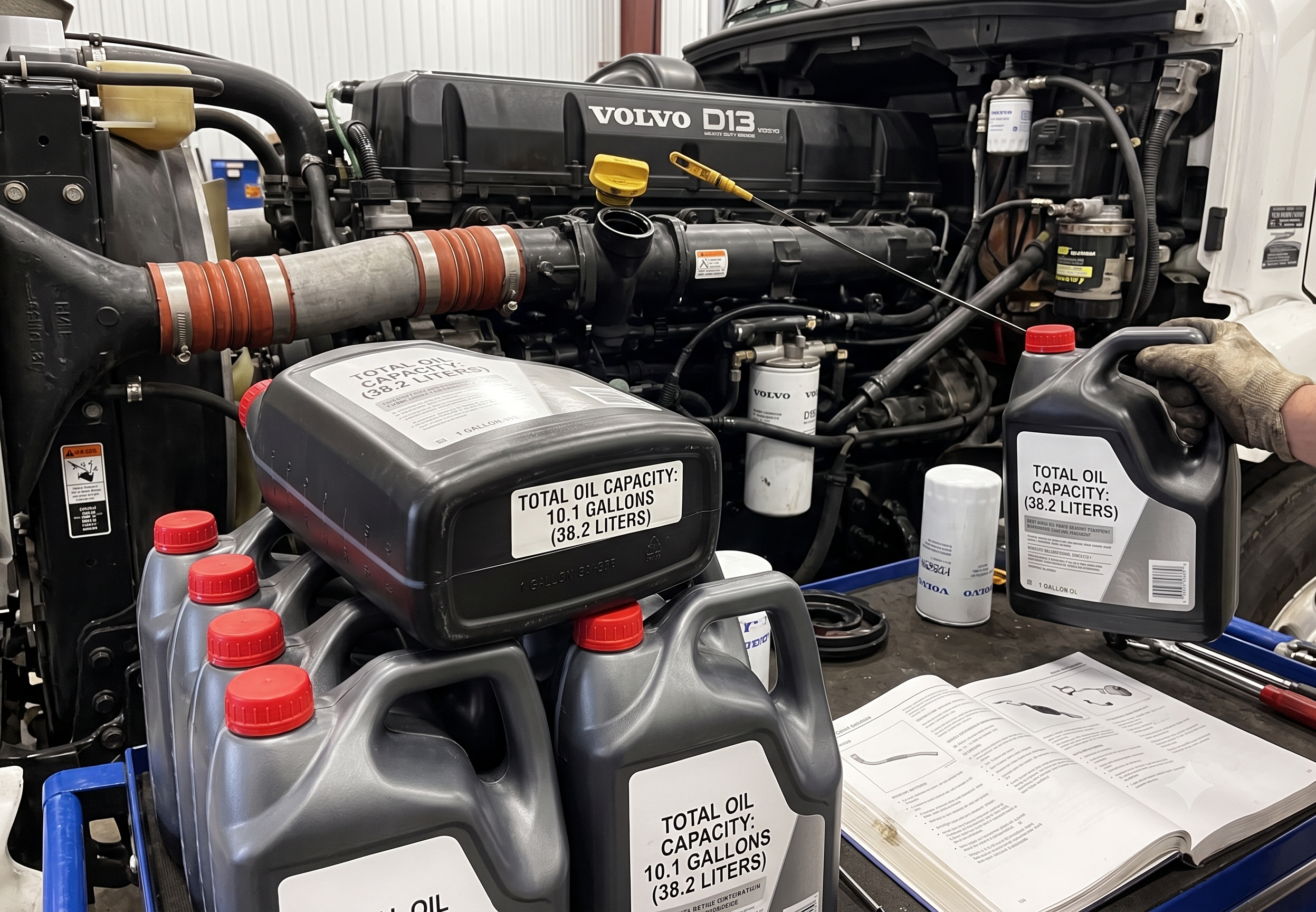
The short answer: a Volvo D13 engine holds 9.5 gallons (38 quarts / 36 liters) of oil, including the oil filter, according to Volvo Trucks’ official D13 engine family specification sheet. That figure applies to a standard oil and filter change; some technicians intentionally leave it slightly under that mark, and a few newer filter configurations shift the number by a quart or two.
This breakdown pulls directly from Volvo’s factory documentation, dealership service pages, and real fleet technician discussions, so you’re working from the actual spec instead of one of the many conflicting blog estimates floating around.
TL;DR
- Volvo’s own D13 engine spec sheet lists total lube oil capacity at 38 quarts (36 liters), which converts to 9.5 US gallons.
- This capacity includes the oil filter, not just the pan.
- Volvo-approved oil must meet VDS-4, VDS-4.5, or VDS-5 specifications depending on model year, typically in SAE 10W-30.
- Techs commonly fill to the midline on the dipstick rather than the top, since the D13 retains oil in the cooler and turbo after a fill.
- Online capacity figures for the D13 range from 31 to 44 quarts — the wide spread mostly comes from confusing it with the Detroit DD13 or citing outdated aftermarket estimates.
The Official Number, Straight From Volvo
Skip the blog math and go to the source. <cite index=”39-1″>Volvo’s own D13 engine family specification sheet lists “Total Lube Oil Capacity” directly in its fuel and lubrication section</cite>, and that figure is 38 quarts (36 liters) with the filter included. Converted to gallons, that’s 9.5 US gallons — which lines up exactly with what dealership service departments quote.
<cite index=”36-1″>A Dallas-area diesel repair shop’s published maintenance guide for the D12 and D13 lists a normal oil change, including filters, at 9.5 gallons for the D13</cite>, matching the factory number precisely. When a dealer-facing service shop and Volvo’s own spec sheet agree to the decimal, that’s about as solid as sourcing gets for this question.
Quick Tip: If you’re ordering bulk oil for a fleet, budget for 38 quarts (9.5 gallons) per D13, then round up slightly. Running one quart short mid-service is a bigger hassle than having a spare quart left in the jug.
Pull-quote: 9.5 gallons is the number straight from Volvo’s own D13 spec sheet — not an estimate.
Why So Many Other Sources Disagree
If you’ve seen numbers like 40 or 44 quarts, you’re not imagining things — several genuinely different figures are circulating, and they come from a few identifiable sources of confusion.
Confusion with the Detroit DD13: <cite index=”37-1″>One engine oil resource site notes that the Detroit Diesel DD13 — a different engine entirely — holds approximately 38 liters (40 quarts) of oil</cite>. That’s the Detroit engine, not the Volvo D13, but the similar naming trips up a lot of searches and citations.
Newer filter housing changes: <cite index=”38-1″>Volvo’s body builder documentation notes that model year 2020 D13 engines with a Variable Geometry Turbocharger, and 2021-and-later engines with turbocompound, use a revised oil filter housing configuration compared to earlier D13s</cite>, which can shift total capacity by a quart or two depending on exact configuration.
Rough, non-factory estimates: <cite index=”45-1″>One heavy-truck technician, asked directly about D13 oil capacity in a support chat, estimated it at “around 40 quarts” rather than citing an exact spec</cite> — a reasonable ballpark from someone troubleshooting a specific truck, but not the same as pulling the number from Volvo’s documentation.
Real-world scenario: Say you’re a fleet manager comparing three online “capacity charts” before ordering oil for six trucks, and they show 38, 40, and 44 quarts. Rather than splitting the difference, go with the 38-quart (9.5-gallon) figure from Volvo’s own spec sheet — it’s the one number in that mix actually sourced to the manufacturer.
How the Fill Process Actually Works
Getting to that 9.5-gallon total isn’t a single pour-and-done step, and rushing it is how overfill problems start.
Warm up first. Running the engine for several minutes before draining helps the oil flow fully out of the pan and passages, rather than leaving thick, cold oil clinging to internal surfaces.
Fill in stages, not all at once. <cite index=”37-1″>A typical service approach is to pour in about 35 quarts first, check the dipstick, then top off gradually rather than dumping the entire 38 quarts before checking the level</cite>.
Expect to stop short of the full mark. <cite index=”43-1″>Volvo D13 engines retain a small amount of oil in the oil cooler and turbo after a fill, and if there’s any sludge buildup in the oil cooler, it can hold roughly half a quart trapped in the upper head tubes</cite>. <cite index=”43-1″>Because of this retention behavior, experienced technicians often intentionally fill to the midline on the dipstick rather than the top, sometimes leaving out a full quart, to account for oil that will settle into those areas over the following minutes and miles</cite>.
Expert Insight: If you fill a D13 to the top line and then see the level creep even higher after driving, don’t assume you have a coolant or fuel contamination problem right away. That pattern is consistent with normal oil settling out of the cooler and turbo passages as the engine warms and runs.
D13 Oil Capacity vs. Similar Heavy-Duty Diesels
| Engine | Official Oil Capacity (With Filter) | Source Type |
|---|---|---|
| Volvo D13 | 9.5 gallons (38 qt / 36 L) | Volvo factory spec sheet |
| Detroit DD13 | ~10 gallons (40 qt / 38 L) | Third-party engine oil reference |
| Volvo D12 (predecessor) | 8.75 gallons | Dealer service documentation |
Pull-quote: Filling a D13 to the very top of the dipstick can actually cause a false overfill reading later.
Pros and Cons by Owner Type
The owner-operator doing their own oil changes:
- Pro: Knowing the exact 9.5-gallon figure prevents buying too much or too little oil per change.
- Con: Judging the midline-fill technique correctly takes a bit of hands-on experience the first few times.
The fleet manager ordering bulk oil:
- Pro: A confirmed factory number makes bulk ordering and cost forecasting far more predictable across a fleet of D13s.
- Con: Mixed fleet years (pre- and post-2020 filter housing changes) mean double-checking your specific trucks’ build dates is still worth doing.
The buyer of a used D13-powered truck:
- Pro: A correct oil fill from day one avoids the low-oil dipstick scares some owners report on higher-mileage trucks.
- Con: <cite index=”45-1″>Inaccurate dipstick readings and unexpected oil consumption have been reported on some D13s, so a single dipstick check after a top-off isn’t always the full picture</cite>.
Frequently Asked Questions
How many gallons of oil does a Volvo D13 take with a filter change? 9.5 gallons (38 quarts / 36 liters), according to <cite index=”39-1″>Volvo’s own D13 engine family specification sheet</cite>.
Why do some sources say the D13 takes 40 or 44 quarts? That’s usually confusion with the similarly named Detroit DD13, outdated aftermarket estimates, or capacity shifts tied to newer filter housing designs introduced on 2020-and-later D13 engines.
What oil does a Volvo D13 require? Depending on model year, Volvo requires oil meeting VDS-4, VDS-4.5, or VDS-5 specifications, generally in SAE 10W-30 for standard conditions.
Should I fill a D13 all the way to the top of the dipstick? Not necessarily. Many technicians intentionally stop at the midline, since the engine retains oil in the cooler and turbo that will settle in over the following minutes and miles.
Does the D13’s oil capacity change between model years? Slightly, in some configurations. Post-2020 D13 engines with revised turbocharger and filter housing designs can differ from the standard 38-quart figure by a quart or so, so checking your specific build’s documentation is worth doing for precise fills.
Key Takeaways
- 9.5 gallons (38 quarts) is the factory-confirmed oil capacity for a Volvo D13, including the filter.
- Wildly different online figures (31–44 quarts) mostly trace back to confusion with the Detroit DD13 or non-factory estimates.
- Fill in stages and check the dipstick along the way rather than pouring the full amount at once.
- Many technicians deliberately stop short of the full mark to account for oil retained in the cooler and turbo.
- Always match your oil to the correct VDS-4/4.5/5 specification for your D13’s model year.
Use the 9.5-gallon (38-quart) figure if you’re doing a standard oil and filter change on a mainstream D13. Double-check your specific build’s documentation if your truck is a 2020-or-newer model with the revised VGT or turbocompound filter housing, since capacity can shift slightly.
Next Step
Before your next oil change, confirm your D13’s exact build year and filter housing type against Volvo’s documentation, then order 9.5 gallons of VDS-approved oil with a little extra on hand for topping off.