Volvo Penta 280 vs 290?

Swap the wrong Volvo Penta outdrive onto your boat, and you could be re-cutting your transom before you ever hit the water. The 280-vs-290 question trips up even experienced boat owners.
TL;DR
- The 290 outdrive succeeded the 280, with most owners and mechanics agreeing the two are not fully parts-interchangeable
- The 290 has a larger transom shield and different trim ram placement compared to the 280
- Some components—like the lower unit and certain propeller hardware—can be compatible or adapted between the two with modification
- The upper gear housing is often the same core part across the 270/280/290 lineup, depending on vintage
- Mixing 280 and 290 components generally requires careful shimming and verification, not a simple bolt-on swap
The core answer: the Volvo Penta 290 is a later-generation Duoprop sterndrive that replaced the 280, featuring a larger transom shield and revised trim ram design—but the two are largely considered separate parts families, and swapping between them typically requires modification, correct shimming, and matching gear ratios rather than a straight swap.
What’s the Basic Difference Between the 280 and 290?
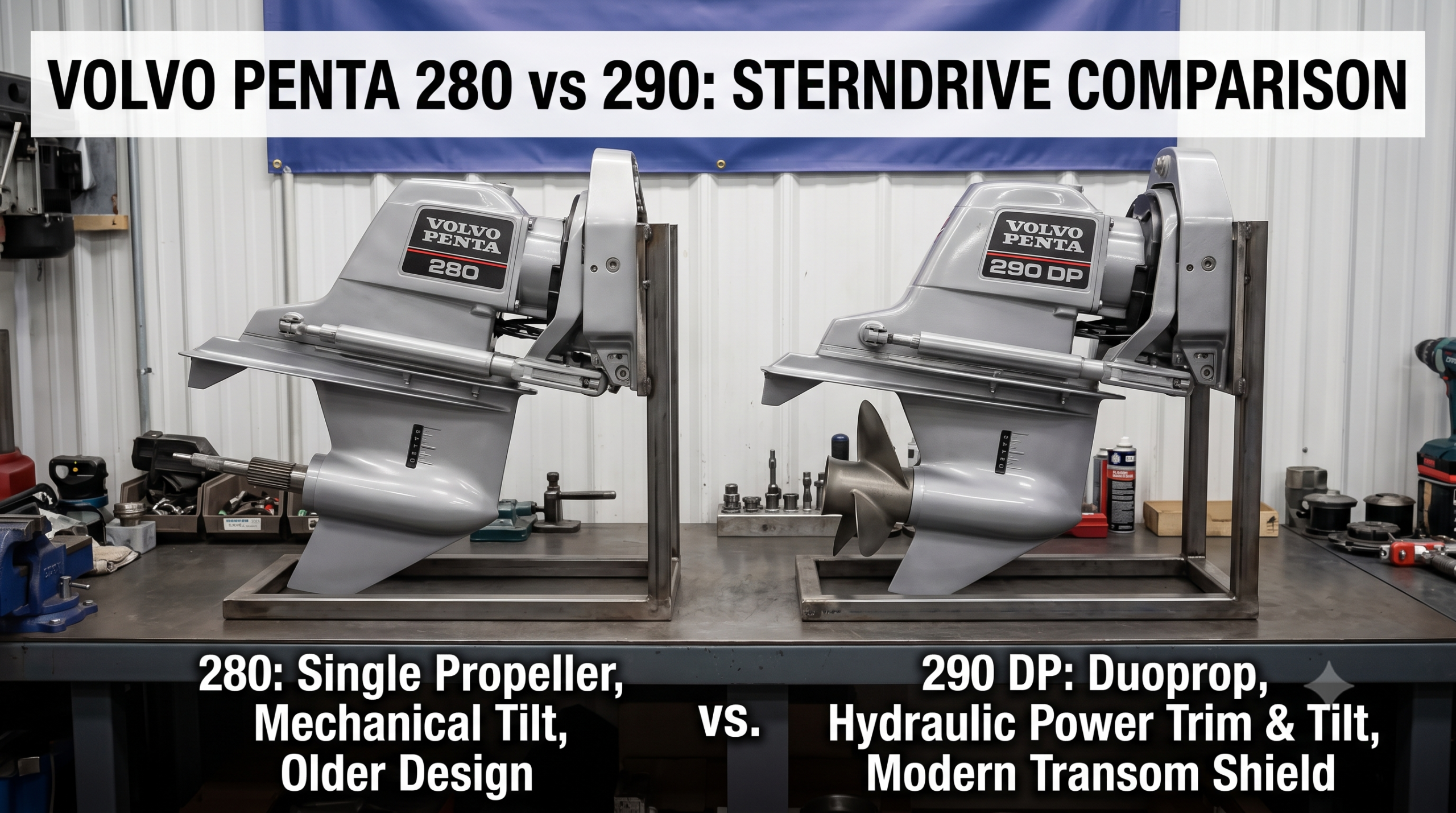
The 280 and 290 are both part of Volvo Penta’s Duoprop sterndrive lineup, used on inboard/outboard boats with gas and diesel engines. The 290 came later and is widely considered the more refined, if more complex, design.
Based on discussions among long-time Volvo Penta owners and mechanics, the two drives differ mainly in:
- Transom shield size — the 290’s shield is noticeably larger than the 280’s
- Trim ram location — the 290 houses trim rams inside the shield, while many 280 setups use external trim tabs (280T)
- Some internal components, like reverse-lock mechanisms, which vary by sub-version
Quick Tip: If you’re buying a used boat, don’t assume the outdrive matches the model badge on the transom—owners often upgrade to whatever current parts a dealer had in stock, so verify the actual drive in person.
280 vs. 290: Side-by-Side
| Feature | 280 Outdrive | 290 Outdrive |
|---|---|---|
| Era | Earlier generation | Later generation, replaced 280 |
| Transom shield size | Smaller | Larger |
| Trim ram location | Often external (280T) | Housed inside shield |
| Parts interchangeability | Limited with 290 | Limited with 280 |
| Reverse-lock mechanism | Present on some versions | Differs by sub-version (A/B/C/D/E) |
| Common use | Gas and diesel inboard/outboard setups | Gas and diesel inboard/outboard setups |
Pros and Cons by Owner Type
Budget-Minded DIY Owners
- ✅ 280 components and repair parts (like O-rings) are often cheaper and simpler to source
- ✅ Common issues on the 280 are frequently fixable without replacing major assemblies
- ❌ Older units may have more wear-related quirks after decades of service
Owners Considering an Upgrade Swap
- ✅ The 290’s improved shield and trim system can offer better performance and streamlining
- ✅ Some owners report more prop and gear ratio options with 290-generation lowers
- ❌ Trim ram repairs on the 290 can be significantly more expensive if hydraulic components fail
Owners Doing Mixed-Part Repairs
- ✅ In many cases, a 280 lower unit and 290 lower can be made to work together with correct shimming
- ✅ Propeller hardware is often shared or cross-compatible across 280/290 DP types
- ❌ Getting the gear ratio and shimming wrong can cause performance problems or damage
Expert Insight: Long-running discussions among marine mechanics on boating forums consistently note that while the upper gear housing is often shared across the 270/280/290 lineup for a given vintage, the lower units and shields typically are not interchangeable without modification.
Real-World Scenario
Imagine you’re restoring an older cruiser with a tired 280 outdrive and you find a 290 lower unit for sale locally. Before bolting it on, you’d want to confirm the mid-section shimming matches, check whether a splined sleeve coupling is needed, and verify your gear ratio suits your engine—small block, big block, or diesel.
Skip that step, and you risk a drive that doesn’t sit at the right depth relative to your keel, hurting both performance and longevity.
Should You Upgrade From a 280 to a 290?
Choose to stick with your 280 if: it’s running well, parts are available, and you want to avoid the cost and complexity of a shield/transom modification.
Choose to upgrade to a 290 if: you’re already replacing major components, want the more modern trim system, and are prepared for potentially pricier repairs down the line.
Quick Tip: Before any swap, verify your gear ratio needs—Duoprop lowers commonly come in different ratios depending on whether your engine is a V6, small block V8, big block V8, or diesel.
FAQ
Can I put a 290 lower unit on a 280 upper? In many cases yes, with correct shimming and possibly a splined sleeve coupling, though results can vary by the specific vintage of each part.
Is the 290 more reliable than the 280? Neither is universally “more reliable”—the 280 is often praised for simpler, cheaper repairs, while the 290’s trim system can be more expensive to fix when it fails.
Do 280 and 290 propellers interchange? Propeller hardware is frequently shared or cross-compatible across 280/290 DP types, but always confirm against your specific prop series.
What replaced the 290? Volvo Penta continued developing its sterndrive lineup with later DP-A, B, C, D, and E series drives, which built on and refined the 290 platform.
Why does the 290 have a bigger transom shield? The larger shield accommodates the 290’s internal trim ram design, which differs from the external trim tab setup common on 280T configurations.
Key Takeaways
- The 290 followed the 280 in Volvo Penta’s Duoprop lineup and features a larger transom shield
- Trim ram placement is a key visible difference between the two generations
- Full interchangeability is limited—swaps typically need shimming, correct gear ratios, and sometimes extra parts
- Propeller hardware is often shared across 280/290 DP types
- Always verify the actual installed drive on a used boat rather than assuming based on the model name
What To Do Next
Before buying parts or attempting a swap, pull up your drive’s serial number and cross-reference it with a Volvo Penta parts diagram or a trusted marine mechanic—vintage and sub-version matter more than the base model number alone.