Volvo Parking Climate vs Remote Start: Key Differences Explained

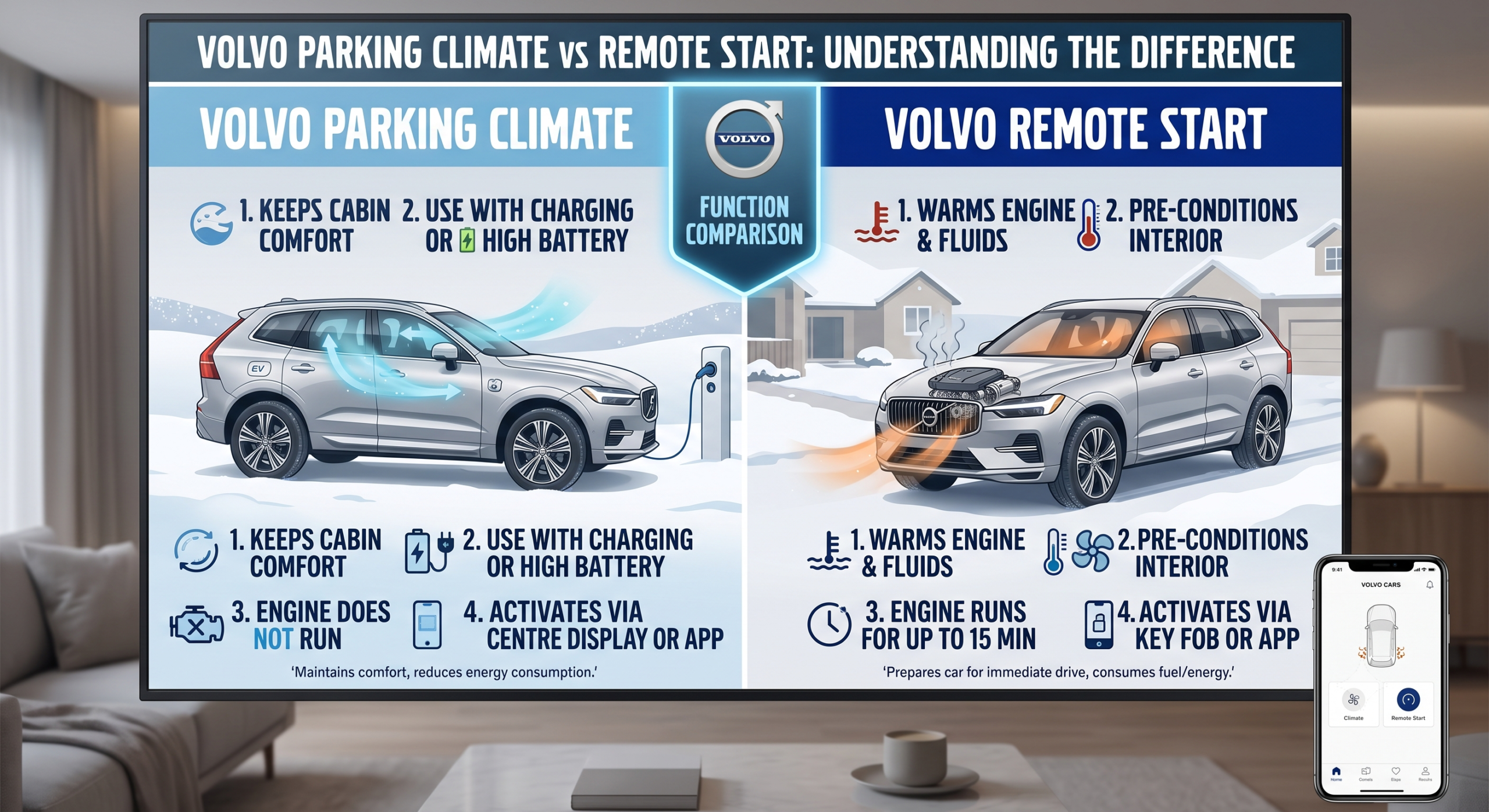
While both systems pre-warm or pre-cool the vehicle cabin before entry, they rely on fundamentally different engineering architectures. Remote Start (Engine Remote Start / ERS) physically cranks the internal combustion engine (ICE) to turn the mechanical A/C compressor and alternator, burning gasoline and emitting exhaust fumes. Parking Climate (Preconditioning) uses high-voltage electric components—including an electric high-voltage PTC cabin heater and electric A/C compressor—drawing power from the traction battery or wall charger without starting the combustion engine.
Electric Preconditioning (PHEV / BEV Only)
Combustion Engine Idling (Gas / Mild Hybrid)
Parking Climate: Yes | Remote Start: NO (Lethal CO)
Parking Climate can run on 240V Level 2 charging
The Technological Divide: Electric Heat vs Engine Combustion
If you have spent any time browsing the climate controls in the Volvo Cars app or tapping through the bottom tray of your Sensus or Google Automotive touchscreen, you have likely encountered the terms Parking Climate and Remote Start. While both features are designed to conquer extreme winter freezes and oppressive summer heat waves, their underlying mechanical mechanisms are polar opposites.
Understanding which system your specific Volvo uses—and how to maximize its efficiency—can save you hundreds of dollars in gasoline, protect your family from lethal carbon monoxide hazards, and preserve precious electric driving range on plug-in hybrid and pure electric models.
Select your Volvo powertrain, ambient climate, and energy costs to calculate 15-minute cabin preconditioning expense and emissions.
High-Voltage Battery / Grid Power
$0.18 (Electricity)
100% Safe (Zero Emissions)
0 Miles Lost (When Plugged In)
How Volvo Remote Start (ERS) Operates on Gas & Mild-Hybrid Models
On gasoline-only (T5, T6) and 48-volt mild-hybrid (B4, B5, B6) Volvos, the vehicle relies on Engine Remote Start (ERS):
- When triggered via key fob or mobile app, the starter generator cranks the 2.0-liter turbocharged Drive-E engine.
- The mechanical water pump circulates engine coolant through the block, warming up the engine oil and flowing heated coolant through the heater core inside the dashboard.
- In summer, the serpentine belt turns the mechanical air conditioning compressor to pump refrigerant through the evaporator.
- Drawbacks: Idling a cold combustion engine burns expensive premium gasoline (roughly 0.15 to 0.22 gallons per 15-minute cycle), causes engine soot buildup on intake valves, releases exhaust emissions, and is strictly illegal to run inside an enclosed residential garage.
How Volvo Parking Climate Operates on Recharge PHEVs & Pure Electric EVs
On Volvo Recharge models (T8 Plug-in Hybrids, C40, XC40 Recharge, EX30, and EX90), Volvo utilizes an advanced Parking Climate Preconditioning system:
- The combustion engine remains completely silent and turned off.
- Instead, the car powers a high-voltage Positive Temperature Coefficient (PTC) electric heater or a high-efficiency heat pump drawing power directly from the high-voltage lithium-ion traction battery pack.
- Air conditioning is driven by a hermetically sealed, high-voltage electric compressor that cools the cabin instantly without an engine running.
- The Shore Power Advantage: When your Recharge is plugged into a Level 2 (240V) home charging station, Parking Climate pulls energy directly from the electric grid! This preheats or precools your cabin without draining a single percent of battery energy, guaranteeing 100% of your rated electric driving range for your commute.
Full Architectural Comparison: Parking Climate vs Remote Start
| Technical Parameter | Volvo Parking Climate (Preconditioning) | Volvo Remote Start (ERS) |
|---|---|---|
| Available Powertrains | Recharge Plug-in Hybrids (T8) & BEVs (C40, EX30, EX90) | Gas & Mild Hybrids (B4, B5, B6, T5, T6) |
| Engine Status During Run | Combustion engine remains completely OFF | Combustion engine cranks and idles |
| Heating Mechanism | High-voltage PTC electric heater / Heat Pump | Engine coolant heat circulation via water pump |
| Cooling Mechanism | High-voltage electric A/C compressor | Belt-driven mechanical A/C compressor |
| Safe in Closed Garage? | YES (Zero toxic tailpipe exhaust fumes) | NO (Generates lethal Carbon Monoxide) |
| Grid Power Preconditioning | YES (Draws shore power from wall charger) | NO (Cannot utilize grid electricity) |
Automating Your Commute: Setting Departure Timers
One of the greatest features of Parking Climate is automated scheduling. Rather than remembering to pull out your smartphone on freezing mornings, you can program recurring departure timers:
Summary Verdict: The Clear Electric Advantage
While Remote Start is an invaluable winter lifesaver for owners of gas-powered Volvos, Parking Climate represents the pinnacle of modern automotive thermal management. It offers silent, zero-emission preconditioning that can safely run inside your home garage while preserving every mile of pure electric range when plugged into grid power.
Thermodynamics & Engineering: Pre-Conditioning vs Engine Remote Start
Among Volvo owners—particularly those driving modern Recharge Plug-in Hybrids (PHEVs) and Mild Hybrids (MHEVs)—confusion frequently arises regarding the difference between “Parking Climate” and “Remote Start”. While both features prepare the vehicle’s interior for departure, their underlying mechanical, thermodynamic, and electrical systems operate on entirely different principles.
| Feature Characteristic | Parking Climate (Pre-Conditioning) | Engine Remote Start (ERS) |
|---|---|---|
| Primary Powertrain Status | Engine OFF (Silent Electric Operation) | Engine ON (Gasoline Combustion Idling) |
| Heating Mechanism | High-Voltage PTC Electric Heater (7 kW) or Heat Pump | Engine Coolant Heat Exchange via Radiator Core |
| Cooling Mechanism | High-Voltage Electric A/C Scroll Compressor | Belt-Driven Mechanical A/C Compressor |
| Exhaust Emissions | Zero Emissions (Completely safe inside closed garages) | Tailpipe Carbon Monoxide & Hydrocarbons (Outdoor only) |
| Grid Pre-Conditioning | Draws power directly from wall charger while plugged in | Cannot run while high-voltage charging cable is locked |
| Maximum Runtime | Up to 30 minutes per scheduled departure timer | Strictly limited to 15 minutes (max 2 cycles) |
High-Voltage Grid Efficiency: Preserving Electric Range While Plugged In
The single most powerful advantage of Parking Climate on Volvo Recharge models (such as the XC60 Recharge, XC90 Recharge, and XC40/C40 Pure Electric) is grid-tethered pre-conditioning.
Heating an automotive cabin from 20°F (-6°C) to a comfortable 72°F (22°C) in freezing winter weather requires immense thermal energy—typically consuming 3.0 to 4.5 kWh of electricity. In a plug-in hybrid with an 18.8 kWh battery pack, consuming 4 kWh solely for cabin heating before leaving your driveway diminishes your pure-electric driving range by nearly 25%.
When you set a Departure Timer in the Volvo Cars app while connected to a Level 2 (240V / 16A or 32A) home charging station, Parking Climate draws current directly from your household electrical grid. It brings the passenger compartment, seats, steering wheel, and high-voltage traction battery pack to optimal operating temperatures without draining a single watt-hour from the vehicle’s battery. You depart with a toasty warm cabin and a 100% full battery pack ready for maximum electric range.
Scandinavian Heritage: The Fuel-Operated Coolant Heater (Webasto / Eberspächer)
In European, Canadian, and northern Scandinavian markets, gas- and diesel-powered Volvos were historically equipped with an auxiliary Fuel-Operated Parking Heater (FOH) manufactured by Webasto or Eberspächer. Positioned in the front left wheel arch, this compact miniature furnace burns a tiny droplet of gasoline or diesel to circulate hot coolant through the engine block and interior heater matrix.
Unlike Remote Start, the Webasto heater warms the engine block to operating temperature (180°F / 82°C) without rotating the crankshaft or generating cold-start piston friction. When North American emissions regulations and cost constraints led Volvo to rely primarily on engine idling for gas models, the Parking Climate nomenclature was retained and repurposed for high-voltage electric elements in Recharge models.
Recurring Departure Scheduling in the Volvo Cars App
In the Volvo Cars smartphone app, navigate to Climate > Departure Timers to configure a recurring Monday–Friday departure schedule. The system calculates heating runtimes automatically based on real-time ambient outdoor temperature sensors, ensuring your cabin is exactly 72°F when you open the door.
Frequently Asked Questions