Volvo PV444 vs PV544?

Staring at two humpbacked Volvos at a car show and can’t tell which is the PV444 and which is the PV544? The difference is subtler than you’d expect — but it matters a lot if you’re buying parts or bidding at auction. The Volvo PV is a series of two-door, four-passenger car models — the PV444 and the PV544 — made by Volvo from 1947 to 1965, with the 544 succeeding the 444 in August 1958.
TL;DR:
- The PV444 was Volvo’s first unibody car and its first four-cylinder passenger car in nearly 20 years.
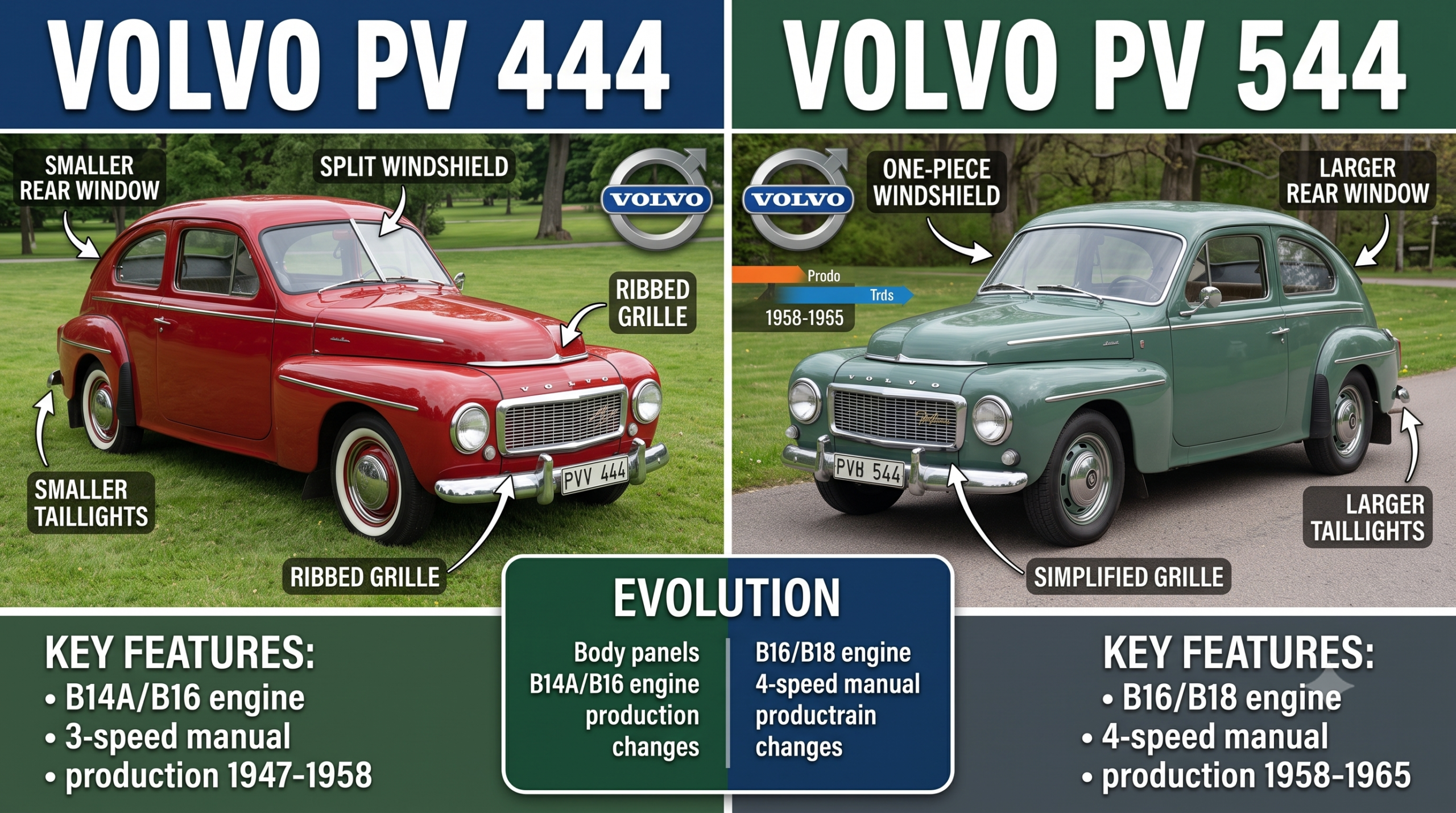
- The PV544 arrived in August 1958 with a curved one-piece windshield, larger taillights, and a ribbon-style speedometer.
- The 444’s 3-speed manual became a 4-speed on the 544.
- In 1962, the 544 gained the new B18 engine and switched from 6-volt to 12-volt electrics.
- Combined, the two models sold 440,000 units over their 18-year run.
Same Bones, Different Face
The PV444 and PV544 share the same basic body shell — Volvo didn’t reinvent the car in 1958, it refined it. The big news for the 544 was that it was designated as a five-seater. The changes were about visibility, comfort, and mechanical modernization, not a ground-up redesign.
Think of it like a well-loved recipe getting a few key ingredient swaps — still recognizably the same dish, but noticeably improved where it counted.
Quick Tip: If you’re sourcing parts, always specify 444 or 544 (and even the letter-coded series) — body glass, dashboards, taillights, and interior trim generally don’t interchange between the two models.
Volvo PV444 vs PV544: Side-by-Side
| Feature | PV444 | PV544 |
|---|---|---|
| Production years | 1947–1958 | 1958–1965 |
| Units built | 196,005 | 243,990 |
| Windshield | Two flat panes of glass | Curved one-piece windshield |
| Transmission | 3-speed manual | 4-speed manual (later series) |
| Seating | 4-passenger design | 5-passenger, wider rear seat |
| Speedometer | Standard gauge | Ribbon-type “thermometer” speedometer — a red strip shows the speed |
| Electrical system | 6-volt | Switched to 12-volt in 1962 |
| Engine (final form) | Up to B16, 1.6L (from 1957) | B18, 1.8L (from 1962) with five main bearings |
| Wagon variant | PV445 (Duett precursor) | Continued as the Duett (P210) |
Bottom line: the PV544 kept the 444’s rugged bones but modernized visibility, comfort, and drivetrain — most notably the shift to a one-piece windshield, a fifth seat, and eventually the more powerful B18 engine.
Pros and Cons by Buyer Type
The Purist Restorer
- ✅ PV444 offers the earliest, most historically significant Volvo unibody design.
- ✅ Simpler mechanicals across its run, especially pre-B16 models.
- ❌ Two-piece flat windshield and narrower rear seat feel more dated to drive today.
The Driver-Focused Collector
- ✅ PV544, especially post-1962 B18 examples, offers noticeably more power and a modern 4-speed gearbox.
- ✅ Better visibility thanks to the larger curved windshield and rear window.
- ❌ Later, more desirable B18 544s can command a price premium over comparable 444s.
The Rally and Motorsport Enthusiast
- ✅ The PV544 built a strong competition reputation, including a Safari Rally win in 1965 with a second-hand PV544 memorably taking the top spot.
- ✅ Standard seat belts arrived on the PV544 well ahead of most American competitors.
- ❌ Genuine rally-history cars are rare and expensive to acquire or replicate.
Expert Insight: Volvo enthusiast clubs consistently emphasize that even late PV444 and early PV544 models share major mechanical components, but body, glass, and interior trim generally do not interchange between them — a detail that trips up first-time parts buyers.
Real-World Scenario: Sourcing a Restoration Part
Picture a restorer ordering a replacement taillight for what they believe is a “PV” without specifying the model. Because taillights relocated and changed size between the 444 and 544 generations, an unspecified order is a near-guaranteed mismatch. Confirming the exact model — and ideally the letter-coded series — before ordering saves real time and cost.
Alternatives Worth Considering
- Choose the PV445/Duett if: you want the PV444’s mechanical DNA in a wagon body, useful for cargo-focused restorations.
- Choose a late-series B18 PV544 if: you want the most power and modern feel available within the PV lineage before Volvo moved to the Amazon and 1800 series.
FAQ
What’s the main difference between the Volvo PV444 and PV544?
The PV544 introduced a curved one-piece windshield, larger taillights, a ribbon-style speedometer, and eventually a more powerful B18 engine, while keeping the same basic body shell as the PV444.
Do PV444 and PV544 parts interchange?
Many mechanical components carry over between late PV444 and early PV544 models, but body glass, dashboards, taillights, and interior trim generally do not.
Which is more valuable, the PV444 or PV544?
It varies by condition and specific series, but later B18-equipped PV544s are often especially sought after for their added power and modern gearbox.
When did Volvo switch from the PV444 to the PV544?
The PV544 was introduced in August 1958, succeeding the PV444 with a series of visibility and comfort updates.
How many PV444 and PV544 models were built in total?
Combined, Volvo built roughly 440,000 units across both models over their 18-year production run.
Key Takeaways
- PV544 replaced PV444 in August 1958 with a curved windshield, larger taillights, and updated speedometer.
- The 444’s 3-speed manual became a 4-speed on the 544.
- The 544 gained the B18 engine and 12-volt electrics starting in 1962.
- Body, glass, and interior parts generally don’t interchange between the two models.
- Combined production reached about 440,000 units across both generations.
Next Step
If you’re shopping for a PV444 or PV544, always confirm the exact letter-coded series before buying parts or negotiating price — small variations within each model line affect both fitment and collector value.