Volvo EX30 vs Jeep Avenger: Small Electric SUV Showdown (2026)

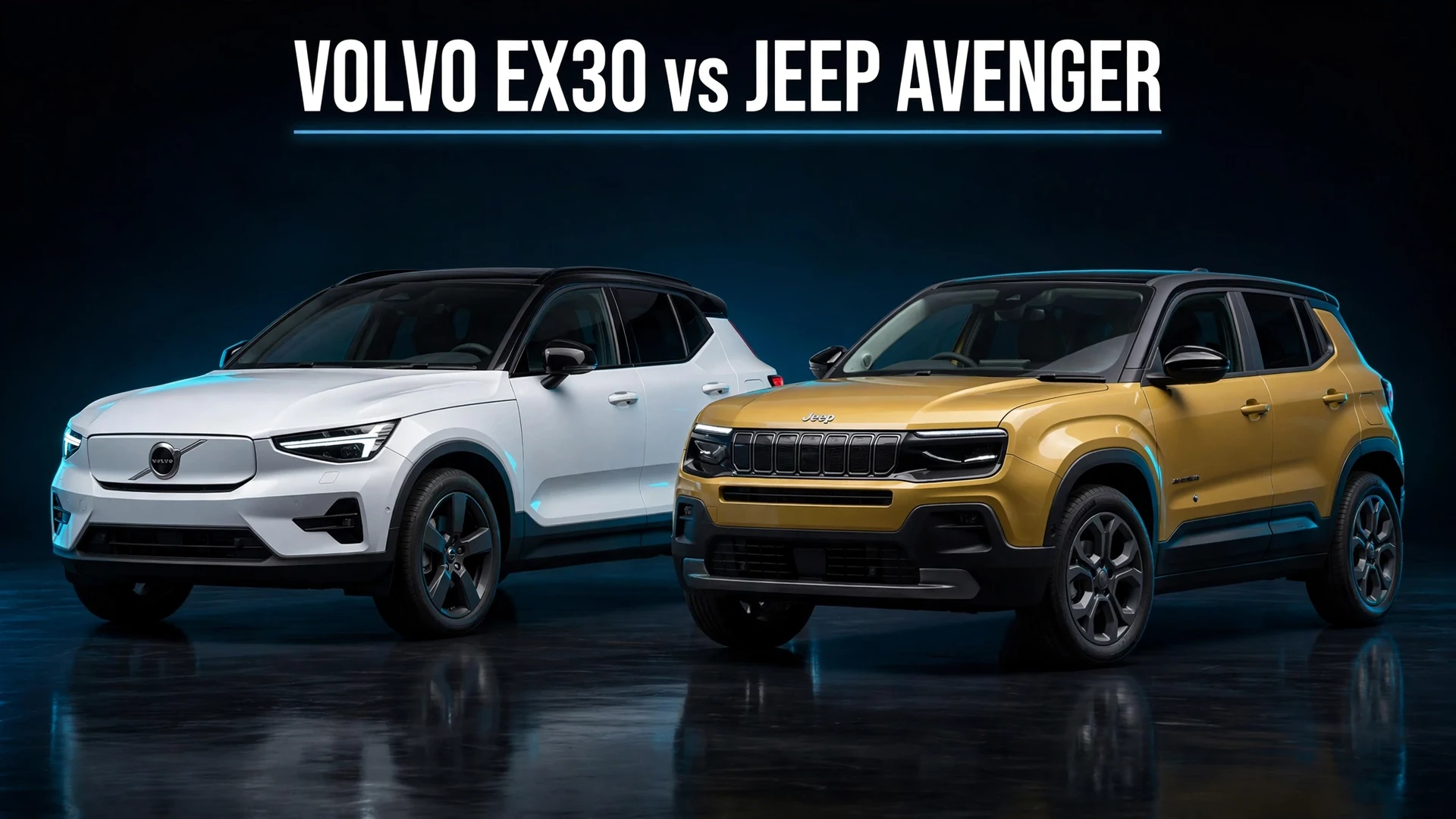
The Volvo EX30 and the Jeep Avenger are the two small electric SUVs Europe keeps cross-shopping — and they could hardly be more different. One is a Scandinavian speed merchant on a Chinese-engineered skateboard platform, with up to 428 hp and a 3.6-second 0–100 km/h time that embarrasses hot hatches twice its price. The other is an American badge on French-Italian underpinnings, built in Poland, with a modest 156 hp, a genuine soft-roader brief, and a 2023 European Car of the Year trophy. Here is where the numbers land, what each is like to live with, and which buyer each suits in 2026.
- Power is not close: the EX30 Twin Motor makes 428 hp and hits 100 km/h in 3.6 s; the Avenger makes 156 hp and needs 9.0 s. Even the base EX30 (272 hp, 5.7 s) is in another league.
- Range favours the Volvo: up to 476 km WLTP for the EX30 Extended Range against 400 km (550 km urban) for the Avenger — though the Jeep is the more efficient car around town.
- Safety is a split decision: the EX30 earned 5 Euro NCAP stars in 2024; the Avenger managed only 3, criticised for weak vulnerable-road-user protection and safety assist.
- America is out of the picture: the Avenger was never sold in the US, Canada or China, and the EX30 is not currently on sale in the US — this is a Europe-first comparison.
- Price overlaps: both start in the mid-€30,000s in Europe, with the Avenger generally a little cheaper at entry level and the EX30 climbing higher in Twin Motor trim.
Two small EVs, two opposite answers
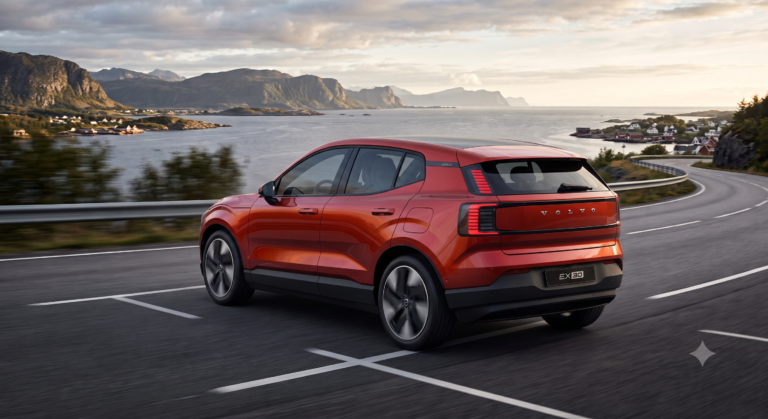
Most comparisons pretend these two are natural rivals. They are the same size and price, but they were designed to answer completely different questions. The EX30 answers: “how much performance can we squeeze into the smallest possible Volvo?” It rides on Geely’s SEA platform — the same electric skateboard as the Smart #1 and Zeekr X — and Volvo tuned it to be the quickest car it has ever built: taut chassis, near-silent motorway manners, and a Stockholm-showroom interior.
The Avenger answers: “what does a Jeep look like at 4 metres long?” It rides on Stellantis’s eCMP/STLA Small platform, shared with the Peugeot e-2008 and Opel Mokka-e, and Jeep spent the budget on character: 200 mm of ground clearance, Selec-Terrain modes, Hill Descent Control, and approach angles that shame most crossovers. Reviewers call it the more fun-natured car at sane speeds — charm the Volvo cannot quite fake.
Then there is geography. The Avenger was designed in Italy, built in Tychy, Poland, and never offered in the US, Canada or China — it is a car for Europe, Turkey, Morocco, Japan and South Korea. The EX30 was built in Zhangjiakou, China (with Ghent, Belgium production added in 2025), sold strongly across Europe, but is not currently on sale in the US. So this comparison lives where both cars exist: Europe.
The spec sheet, head to head
| Spec | Volvo EX30 | Jeep Avenger Electric |
|---|---|---|
| Production | 2023–present | 2023–present |
| Platform | Geely SEA (dedicated EV skateboard) | Stellantis eCMP / STLA Small (shared with Peugeot e-2008, Opel Mokka-e) |
| Built in | Zhangjiakou, China; Ghent, Belgium (from 2025) | Tychy, Poland |
| Battery (nominal) | 51 / 69 kWh (49 / 65 usable) | 54 kWh (51 usable) |
| Power | 272 hp (single) / 428 hp (twin) | 156 hp |
| Torque | 343 / 543 Nm | 260 Nm |
| 0–100 km/h | 5.7 s / 5.3 s / 3.6 s | 9.0 s |
| Top speed | 180 km/h | 150 km/h |
| WLTP range | 337 / 476 / 450 km | 400 km (550 km urban) |
| DC fast charging | 134 kW (base) / 153 kW — 10–80% in 26–28 min | 100 kW — 20–80% in 24 min |
| AC charging | 11 kW onboard | 11 kW onboard (~5.5 h full charge) |
| Driven wheels | Rear-wheel drive / all-wheel drive | Front-wheel drive only |
| Length | 4,233 mm | 4,084 mm |
| Ground clearance | ~165 mm | 200 mm |
| Boot, seats up | 318 litres | 380 litres |
| Euro NCAP (2024) | 5 stars (88% adult / 85% child) | 3 stars (79% adult / 71% child) |
| European Car of the Year | — | Winner, 2023 (first Jeep ever) |
| Starting price (Europe) | ~€36,000 | ~€36,000–€38,500 (often cheaper at entry) |
| Sold new in the US | No — not currently on sale | Never — Europe and select markets only |
Manufacturer figures for representative variants; prices vary by market and trim. Ground clearance for the EX30 is approximate.
Speed: no contest whatsoever
The performance gap is the single biggest difference between these cars. The EX30 Twin Motor Performance reaches 100 km/h in 3.6 seconds — quicker than a Porsche Macan Turbo of a generation ago, and the fastest-accelerating Volvo ever built. The Avenger needs 9.0 seconds: honest city-car pace, nothing more. What stings for the Jeep is that even the cheapest EX30, the 51 kWh Single Motor at 272 hp, does the sprint in 5.7 seconds.
0–100 km/h times. Shorter bar = quicker.
Top speed tells the same story: 180 km/h for every EX30 against 150 km/h for the Avenger. The Avenger’s 156 hp is plenty for a city runabout — its light weight and 260 Nm of instant torque make it feel perkier than the numbers suggest around town. But beyond about 80 km/h, the EX30 walks away.
Size check, drawn to scale
On the outside these two are close enough that shoppers cross-shop them: 149 mm separates them in length. Drawn to the same scale:
Bars drawn to scale at 1 px per 10 mm.
The surprise is inside. Despite being the shorter car, the Avenger offers 380 litres of boot against the EX30’s 318 — one of the few objective wins for the Jeep, and genuinely useful in a family runabout. The EX30 counters with a more spacious-feeling cabin (the flat SEA floor helps), though its rear legroom is merely adequate and the single central screen handles almost everything, which divides opinion.
Charging and real-world running costs
On paper the EX30 charges faster: up to 153 kW DC on the 69 kWh versions, taking 10–80% in about 28 minutes, against the Avenger’s 100 kW and a 20–80% time of 24 minutes. In practice the gap is smaller than the kilowatt figures suggest, because the Avenger’s smaller battery means less energy to replace — and on a 100 kW charger, which is what most public infrastructure actually delivers, both cars will be limited by the plug rather than the car.
Efficiency is where the Jeep fights back. The Avenger’s 14.7 kWh/100 km WLTP consumption undercuts the EX30’s 17.1–17.5, and UK reviewers have recorded 3.9–4.9 miles per kWh in real-world mixed driving — roughly 320–400 km in temperate conditions. Its 550 km urban-cycle figure, while optimistic, shows how little it sips in stop-start traffic. The EX30 Extended Range counters with the bigger number for road trips: up to 476 km of WLTP range, meaning fewer charging stops.
Running costs are otherwise a wash: both cover the battery for 8 years or 160,000 km, servicing is minimal, and insurance sits in the same affordable bracket. The EX30’s tyres cost more in Twin Motor form — 428 hp finds weak rubber quickly — while the Avenger’s simpler running gear keeps consumables friendly. Both are transformed by a home wallbox, and both are compromised by exclusive reliance on public rapid chargers.
Safety: the uncomfortable gap
This is the section that decides the comparison for many family buyers. In 2024 Euro NCAP testing, the EX30 earned a full five stars — 88% adult occupant, 85% child, 79% vulnerable road user, 82% safety assist — with maximum points in the side-impact test. The Avenger managed three stars: 79% adult, 71% child, a poor 59% for vulnerable road users and 54% for safety assist. Euro NCAP called out poor chest protection for a 10-year-old in the side-impact test, weak pedestrian/cyclist detection, and no child presence detection. Jeep has since improved the forward-collision warning audio on current production cars, but the structural scores stand.
The Avenger’s 2023 European Car of the Year win — the first ever for Jeep — shows how much the industry liked the concept. But awards are voted by journalists; crash ratings are measured by engineers. If the car will carry children regularly, five stars against three is not a footnote — it is the decision.
Which one is for you?
Pick the buyer you most resemble — each pane names a winner and the single biggest caveat.
Verdict
Buy the Volvo EX30 if you want the objectively better electric car: far more performance, longer range, faster charging, and a five-star safety rating. In Twin Motor form it is legitimately thrilling — no other small EV at this price offers that combination.
Buy the Jeep Avenger if you are buying with your heart or watching the entry price: it is cheaper to buy, more characterful, more efficient around town, roomier in the boot, and the only one with any pretence of off-road ability. Just go in with eyes open about the three-star safety rating — for a car that will carry kids, that matters more than charm.
Frequently asked questions
Is the Jeep Avenger sold in the United States?
No. The Avenger is sold in Europe, Turkey, Morocco, Japan and South Korea, but Jeep never offered it in the United States, Canada or China. It is built in Tychy, Poland on Stellantis underpinnings.
Which is faster, the Volvo EX30 or the Jeep Avenger?
The EX30, by a huge margin. The Twin Motor Performance makes 428 hp and reaches 100 km/h in 3.6 seconds; the Avenger makes 156 hp and needs 9.0 seconds. Even the cheapest 272 hp EX30 (5.7 s) is far quicker.
Which has more range, the EX30 or the Avenger?
The EX30 Extended Range, at up to 476 km WLTP. The Avenger manages up to 400 km combined (550 km on the urban cycle). In real-world mixed driving, UK reviewers recorded roughly 320–400 km from the Avenger; the EX30’s bigger battery gives it the edge on longer trips.
Is the Volvo EX30 safer than the Jeep Avenger?
Yes, according to independent testing. The EX30 earned 5 Euro NCAP stars in 2024 (88% adult, 85% child occupant); the Avenger earned 3 stars, criticised for poor vulnerable-road-user protection, weak safety-assist scores and no child presence detection.
Which is cheaper, the EX30 or the Avenger?
The Avenger is generally cheaper at entry level — both start in the mid-€30,000s in Europe, but the Avenger’s range tops out lower while the EX30 Twin Motor climbs well into the €40,000s. Incentives vary by country and can change the maths significantly.