
Is Volvo C40 Electric? An In-Depth Look

You’re on the highway, wind in your hair, not a care in the world. But wait – there’s no engine noise. No, you haven’t gone deaf. You’re just driving the future – the all-electric Volvo C40 Recharge. But is it really electric? Let’s dive in and find out!
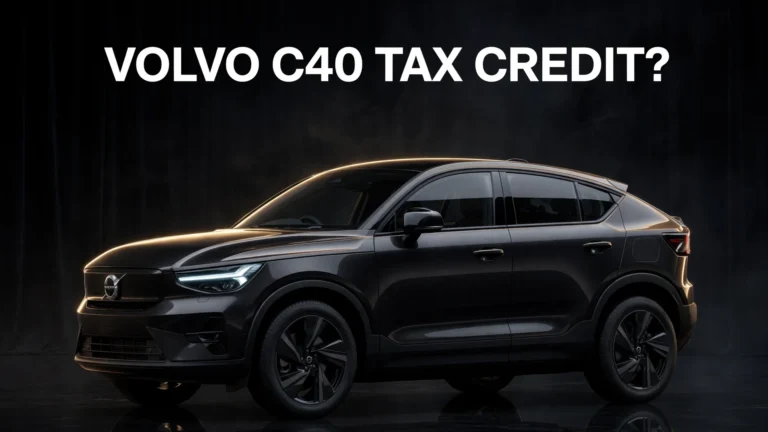
Yes, the Volvo C40 is indeed 100% electric. This sleek, stylish crossover SUV is Volvo’s latest foray into the world of electric vehicles (EVs). It’s like the cool, eco-friendly cousin of the XC40, but with a more streamlined, coupe-like design. Trust me, it’s turning heads faster than a squirrel on an energy drink.
What Makes the Volvo C40 a Fully Electric Vehicle?
Now, let’s get down to the nitty-gritty. The C40 Recharge isn’t just playing dress-up – it’s electric to its core. At its heart lies a powerful electric powertrain that would make even the Energizer Bunny jealous.
The star of the show is the 78 kWh battery pack. It’s like the C40’s personal power bank, but way cooler and definitely not something you’d want to accidentally drop in the toilet. This battery powers either one or two electric motors, depending on whether you go for the single-motor (rear-wheel drive) or dual-motor (all-wheel drive) version.
Unlike its cousin, the XC40 Recharge, which started life as a gas-powered vehicle, the C40 was born to be electric. It’s never known the taste of fossil fuels – kind of like how I’ve never known the taste of caviar (but that’s a story for another day).
Battery Life and Range of the Volvo C40 Recharge
Now, I know what you’re thinking: “That’s all well and good, but how far can this thing actually go?” Well, hold onto your hats, folks, because the answer might surprise you.
The single-motor C40 Recharge can cruise for up to 297 miles on a single charge. That’s like driving from New York to Washington D.C., and still having enough juice left to circle the National Mall a few times (not that I’ve ever done that, of course).
But here’s the kicker – your actual range can vary quite a bit. It’s like trying to guess how many jellybeans are in a jar – there are a lot of factors at play. Your driving style, the weather, and even whether you’re blasting the AC can all affect your range.
In real-world usage, city driving tends to be more efficient for EVs. All that stop-and-go traffic means more opportunities for regenerative braking, which is like a magic trick that turns your kinetic energy back into electricity. Highway driving, on the other hand, can be a bit more power-hungry.
Charging the Volvo C40 Recharge
Types of Charging (AC vs. DC)
Alright, let’s talk juice – and no, I don’t mean the kind you drink with breakfast. Charging your C40 Recharge is a bit like feeding a picky toddler – you’ve got options, but some are definitely better than others.
First up, we’ve got Level 2 home charging. This is your standard AC charging, kind of like plugging in your phone overnight, but for your car. It’s not the fastest option, but it’s perfect for topping up while you’re catching some Z’s or binge-watching your favorite show.
Then there’s DC fast charging, the speed demon of the charging world. With this bad boy, you can charge your C40 from 10% to 80% in about 28 minutes at a 150 kW DC station. That’s faster than I can decide what to order at a drive-thru!
How to Optimize Charging Times
Now, if you want to really maximize your charging efficiency, there are a few tricks up Volvo’s sleeve. One of my favorites is the pre-conditioning feature. It’s like preheating your oven, but for your car battery. Trust me, a warm battery is a happy battery.
As for where to charge, you’ve got options. The C40 uses the CCS charging standard, which is compatible with most public charging networks. And here’s some exciting news – Volvo is working on giving C40 owners access to Tesla’s Supercharger network. It’s like getting the keys to the cool kids’ clubhouse!
Performance and Driving Experience
Power and Acceleration
Let’s talk performance, because let’s face it, that’s where the rubber meets the road (pun absolutely intended). The C40 Recharge comes in two flavors: single-motor and dual-motor.
The single-motor version is like that friend who’s always chill – it’s rear-wheel drive and packs a respectable punch. But the dual-motor variant? That’s the friend who’s always up for an adventure. With all-wheel drive and two motors working in harmony, it’s got enough oomph to make you forget you’re driving an eco-friendly vehicle.
In terms of raw numbers, we’re talking about 402 horsepower in the dual-motor version. That’s enough to propel you from 0 to 60 mph in about 4.5 seconds. To put that in perspective, that’s faster than it takes me to decide what to watch on Netflix!
Handling and Comfort
But the C40 isn’t just about straight-line speed. It’s got the moves to match its muscle. The low center of gravity (thanks, battery pack!) means it corners like it’s on rails. It’s like a ballet dancer, if ballet dancers wore eco-friendly materials and ran on electricity.
Speaking of comfort, the C40’s got it in spades. The coupe-like design isn’t just for looks – it helps with aerodynamics too. And inside, you’ve got features like Google built-in and adaptive cruise control that make driving a breeze. It’s like having your own personal assistant, but one that can’t judge you for singing off-key to your favorite tunes.
Comparing the Volvo C40 Recharge with Competitors
Volvo C40 vs. Tesla Model Y
Now, I know what you’re thinking – “But how does it stack up against the competition?” Well, let’s start with the elephant in the room: the Tesla Model Y.
The Model Y might have a slight edge in range, boasting up to 330 miles compared to the C40’s 297. But the C40 fights back with its unique Scandinavian design and arguably more intuitive infotainment system. It’s like comparing apples and oranges, if apples and oranges could drive themselves.
Price-wise, they’re in a similar ballpark, but the C40 often comes out a bit cheaper, especially when you factor in available incentives. It’s like getting a designer outfit on sale – you look great, and your wallet doesn’t hate you.
Volvo C40 vs. Audi Q4 e-tron
Next up, let’s pit the C40 against its German rival, the Audi Q4 e-tron. Both cars scream “premium” louder than a toddler in a candy store, but they go about it in different ways.
The Audi might have a slight edge in interior space, but the C40 counters with its sleeker exterior design. It’s like choosing between a perfectly tailored suit and a cutting-edge fashion statement – both look great, but in different ways.
Where the C40 really shines is in its user experience. The Google-based infotainment system is more intuitive than a smartphone, making the Audi’s system feel a bit like using a flip phone in comparison.
Volvo C40 vs. Hyundai Ioniq 5
Last but not least, let’s talk about the dark horse in this race – the Hyundai Ioniq 5. Now, I know what you’re thinking. “Hyundai? In a premium EV comparison?” Trust me, I was surprised too.
The Ioniq 5 brings a lot to the table, especially in terms of value for money. It’s like finding a gourmet meal at fast-food prices. But the C40 fights back with its more premium feel and Volvo’s legendary reputation for safety.
Tech-wise, it’s a close call. Both cars are packed with features that would make a Silicon Valley startup jealous. But the C40’s more cohesive integration of tech into the overall driving experience gives it a slight edge.
As for warranty, Hyundai’s famous 10-year/100,000-mile powertrain warranty is hard to beat. But Volvo’s not far behind, and let’s be honest – with an EV, you’re less likely to need that warranty anyway. It’s like buying insurance for your pet rock – nice to have, but you probably won’t need it.
Sustainability Features of the Volvo C40 Recharge
Volvo’s Commitment to Electric-Only Future
Now, let’s talk about something that’s close to my heart – and should be close to yours too: sustainability. Volvo isn’t just dipping its toes in the electric pool; it’s doing a full cannonball.
Volvo has committed to going fully electric by 2030. That’s right, in just a few years, every new Volvo rolling off the production line will be powered by electricity. It’s like watching your favorite band announce a world tour – exciting and a little bit unbelievable.
This commitment isn’t just talk. The C40 is a prime example of Volvo putting its money where its mouth is. It’s not a converted gas car or a half-hearted attempt at an EV. It’s a purpose-built electric vehicle that shows Volvo is serious about its electric future.
Eco-Friendly Design Elements
But Volvo’s commitment to sustainability goes beyond just the powertrain. The C40 is like a rolling advertisement for eco-friendliness.
First off, let’s talk about the interior. It’s completely leather-free. Now, I love leather as much as the next person (especially on a nice pair of shoes), but cows everywhere are breathing a sigh of relief. Instead, Volvo uses a range of sustainable materials that look and feel just as premium.
Many of the interior components are made from recycled materials. It’s like the C40 is wearing the automotive equivalent of vintage clothing – stylish and environmentally conscious.
Even the design of the car itself is eco-friendly. The sleek, aerodynamic shape isn’t just for looks – it helps reduce energy consumption, making the C40 more efficient. It’s like the car equivalent of those fancy reusable straws – stylish and good for the planet.
Pricing and Variants of the Volvo C40 Recharge
Available Trims and Pricing
Now, let’s talk money. After all, even the most eco-conscious among us need to keep an eye on our bank accounts.
The C40 Recharge comes in a range of trims, from the base “Core” model to the top-of-the-line “Ultimate” variant. It’s like choosing between different flavors of ice cream – they’re all good, but some have a few extra sprinkles.
Pricing starts around $55,300 for the Core model and can go up to about $60,100 for the Ultimate. Now, I know what you’re thinking – “That’s a lot of dough!” But remember, this is a premium electric vehicle we’re talking about. It’s like buying a designer handbag – expensive, yes, but you’re paying for quality and style.
Cost of Ownership
Here’s where things get interesting. While the upfront cost might make your wallet wince, the long-term savings can be significant.
Electricity is generally cheaper than gas, especially if you’re charging at home. It’s like switching from branded groceries to store brand – the product is just as good, but your bank account will thank you.
Maintenance is another area where EVs shine. With fewer moving parts, there’s less that can go wrong. No oil changes, no timing belts to replace – it’s like having a pet rock instead of a dog. Less maintenance, but just as lovable.
User Experience and Tech Integration
Infotainment System
Let’s talk tech, because let’s face it, in 2023, a car without good tech is like a smartphone without apps – functional, but not much fun.
The C40 comes with Google built-in. It’s like having a really smart, really helpful friend always riding shotgun. Need directions? Just ask. Want to change the music? Just ask. Wondering about the air quality in your area? Yep, you guessed it – just ask.
And for those of you who are Team Apple, don’t worry. The C40 also supports Apple CarPlay. It’s like being bilingual – the car speaks both Google and Apple.
Safety Features
Now, it wouldn’t be a Volvo if we didn’t talk about safety. Volvo has a reputation for safety that’s stronger than my grandma’s fruitcake.
The C40 comes packed with all sorts of safety tech. We’re talking collision avoidance systems that are more alert than a caffeinated squirrel, and driver-assistance features that make you feel like you’ve got a professional co-pilot.
It’s got everything from automatic emergency braking to a 360-degree camera system that gives you eyes in the back of your head (figuratively speaking, of course). Driving the C40 is like being wrapped in a high-tech safety blanket.
Pros and Cons of the Volvo C40 Recharge
Advantages
Alright, let’s break it down. What makes the C40 Recharge a winner?
First off, style. This car turns heads faster than a tennis match. It’s sleek, it’s modern, and it screams “I care about the environment, but I also like to look good.”
Performance is another big plus. Whether you go for the single-motor or dual-motor version, you’re getting a car that’s more zippy than a caffeinated jackrabbit.
And let’s not forget about the eco-friendliness. Driving a C40 is like giving Mother Nature a big, warm hug every time you hit the road.
Drawbacks
But let’s be real – no car is perfect. Even my dream car (a flying DeLorean, in case you’re wondering) would have its downsides.
The coupe-like design, while stylish, does impact rear visibility a bit. It’s like wearing a really cool hat that sometimes blocks your vision – you look great, but you might need to crane your neck a bit.
The price point is also on the higher side. It’s a premium vehicle with a premium price tag. But hey, quality comes at a cost, right?
Frequently Asked Questions About the Volvo C40 Recharge
Is the C40 Recharge a Good Choice for Long-Distance Driving?
This is a question I get a lot, usually right after “Can you help me move this weekend?” (The answer to that one is always no, by the way).
The C40 Recharge, with its range of up to 297 miles, is definitely capable of long-distance driving. It’s like having a really efficient camel – it can go a long way between drinks.
But here’s the thing – you do need to plan your trips a bit more carefully than you would with a gas car. Charging stations aren’t as common as gas stations (yet), so you need to map out your charging stops.
The good news is that with fast-charging capabilities, these stops don’t have to be long. Just enough time to grab a coffee and stretch your legs. It’s like forced relaxation breaks on your road trip!
How Long Does the Battery Last on the Volvo C40 Recharge?
Ah, the million-dollar question. Or should I say, the 78 kWh question?
The battery in the C40 Recharge is designed to last for many years. Volvo provides an 8-year/100,000-mile warranty on the battery, which should give you some peace of mind.
In terms of degradation, most EV batteries retain about 70-80% of their original capacity after 8-10 years. It’s like how I’ve retained about 70-80% of my hair after 40 years – not perfect, but still pretty good!
Can the Volvo C40 Recharge Be Charged at Tesla Superchargers?
This is a bit like asking if you can use your friend’s Netflix account – the answer is changing.
Historically, Tesla Superchargers were exclusive to Tesla vehicles. It was like a cool kids’ club that the rest of us couldn’t join.
But things are changing. Volvo has announced that they’re working on giving C40 owners access to the Tesla Supercharger network. It’s like the cool kids’ club is finally opening its doors to everyone.
This is great news for C40 owners, as it significantly expands the available charging options. It’s like suddenly having access to a whole new set of restaurants in your neighborhood – more options, more convenience.
Should You Buy the Volvo C40 Recharge?
Ideal Buyer Profile
So, who’s the perfect match for the C40 Recharge? Well, if you’re someone who values style, performance, and sustainability in equal measure, you might have just found your automotive
soulmate. It’s like finding a partner who’s both smart and good-looking – a rare combo indeed!
The C40 is perfect for the urban dweller who wants to make a statement. If you’re the type who turns heads when you walk into a room, this car will do the same when you pull up to the curb. It’s for those who care about the environment but don’t want to sacrifice luxury or performance.
If you have a predictable daily commute and access to home charging, you’ll love the C40. It’s like having your own personal fueling station in your garage. And with its range, weekend getaways are totally doable too.
But let’s be real – if you’re regularly towing heavy loads or if the majority of your driving involves cross-country road trips, you might want to think twice. The C40 is more city slicker than country bumpkin.
Alternatives to Consider
Now, I know the C40 is pretty awesome (I might be a little biased), but it’s always good to shop around. It’s like dating – you want to make sure you’ve found “the one” before you commit.
If you love the idea of a Volvo EV but need more space, check out the XC40 Recharge. It’s like the C40’s slightly more practical cousin.
For those who prioritize range above all else, the Tesla Model Y might be worth a look. It’s like the Energizer Bunny of EVs – it just keeps going and going.
If you’re after something with a bit more traditional luxury flair, the Audi Q4 e-tron could be up your alley. It’s like the automotive equivalent of a tailored suit – classic and refined.
And for those watching their budget, the Hyundai Ioniq 5 offers a lot of bang for your buck. It’s like finding a designer outfit at a thrift store price – stylish and wallet-friendly.
Final Thoughts on the Volvo C40 Recharge
Well, folks, we’ve been on quite a journey, haven’t we? We’ve dissected the C40 Recharge more thoroughly than a frog in a high school biology class. So, what’s the verdict?
The Volvo C40 Recharge is more than just a pretty face in the crowded EV market. It’s a statement on wheels, a rolling testament to Volvo’s commitment to an electric future. With its sleek design, peppy performance, and eco-friendly credentials, it’s like the cool, environmentally conscious friend we all wish we had.
Sure, it’s not perfect. The rear visibility might make you crane your neck a bit, and the price tag might make your wallet wince. But hey, nothing worth having comes easy, right?
What really sets the C40 apart is how it seamlessly blends Volvo’s traditional values – safety, quality, and understated luxury – with cutting-edge EV technology. It’s like your grandpa finally figured out how to use a smartphone, but way cooler.
And let’s not forget the bigger picture. By choosing the C40, you’re not just buying a car – you’re voting with your wallet for a cleaner, greener future. It’s like planting a tree, but way more fun to drive.
As Volvo continues its march towards a fully electric lineup by 2030, the C40 Recharge stands as a shining example of what’s to come. It’s not just a glimpse into Volvo’s future – it’s a peek at the future of driving itself.
So, is the Volvo C40 electric? You bet your sweet bippy it is. And it’s so much more than that. It’s a rolling revolution, a four-wheeled freedom fighter in the battle against climate change. And the best part? You get to be the hero, just by sitting in the driver’s seat.
In the end, whether the C40 Recharge is right for you depends on your needs, your budget, and maybe a little bit on how much you like turning heads when you pull up to a stoplight. But one thing’s for sure – it’s a car that makes going electric feel less like a compromise and more like an upgrade.
So, there you have it, folks. The Volvo C40 Recharge – it’s electric, it’s exciting, and it’s ready to charge into the future. The only question left is: are you ready to join the ride?