Gemini Generated Image o5tsdmo5tsdmo5ts scaled

Volvo FWD vs AWD?

You’re staring at a Volvo configurator, and one checkbox is about to add thousands of dollars to your build — but does it actually matter for how you drive?

TL;DR

  • Volvo AWD typically costs $2,000-$3,500 more than the equivalent FWD trim, depending on the model.
  • Volvo’s AWD system sends about 95% of power to the front wheels in normal driving, shifting power rearward only when sensors detect slip.
  • AWD Volvos use roughly 5-10% more fuel than their FWD counterparts.
  • FWD is standard on entry-level trims of models like the XC40, S60, and V60; AWD is standard or available across most of the current EX and XC lineup.
  • If you live somewhere with real winters, tow regularly, or want maximum resale value, AWD is usually worth the premium. If you drive mostly dry pavement in a mild climate, FWD saves real money without much practical downside.

Every Volvo shopper eventually hits this fork in the configurator, and the honest answer is that neither drivetrain is objectively “better” — they’re built for different driving realities. This guide breaks down how Volvo’s AWD system actually works, what it costs, and when FWD is genuinely the smarter choice, so you’re not just guessing at the checkout screen.

How Volvo’s AWD System Actually Works

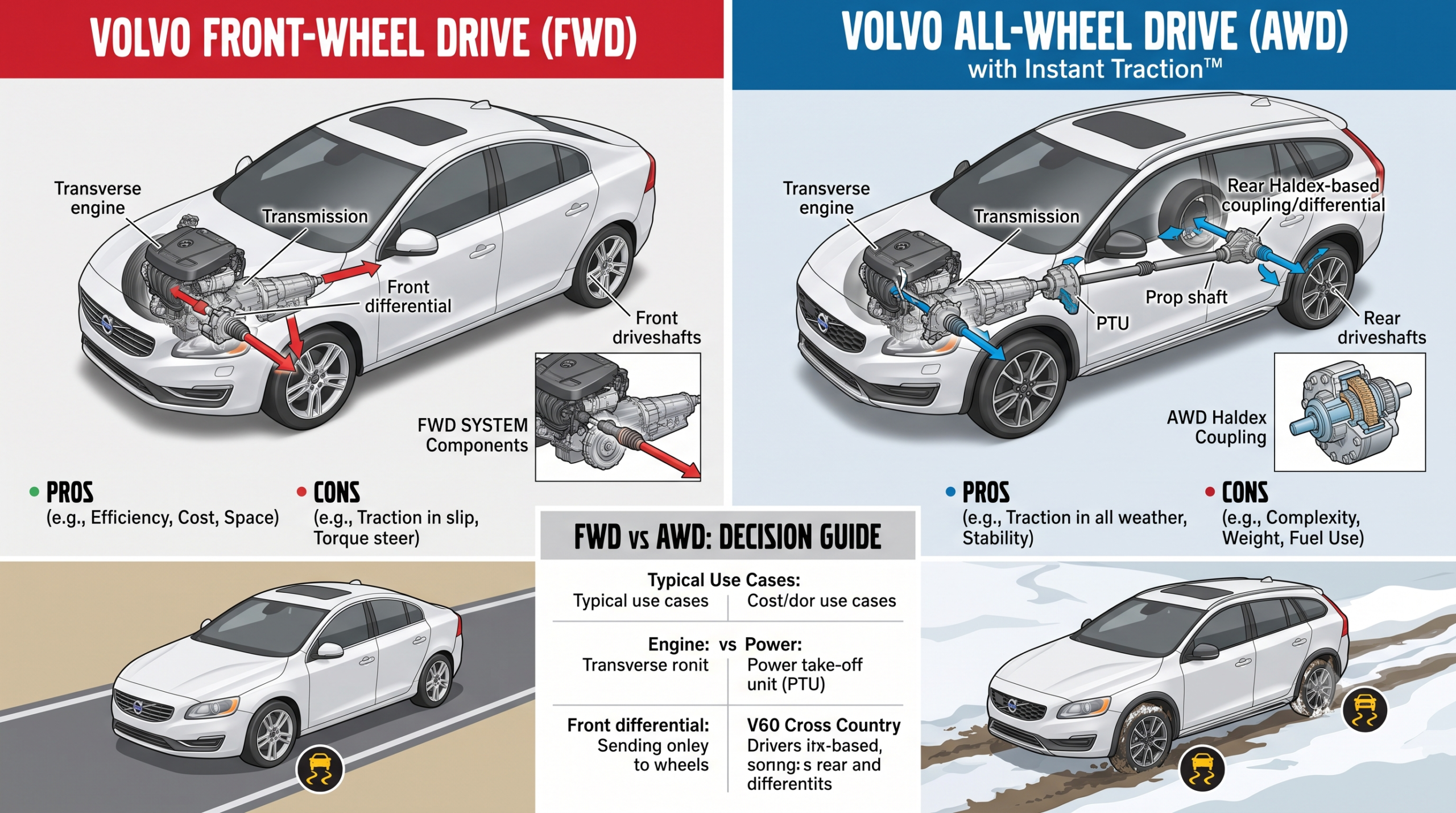
Volvo’s all-wheel drive isn’t a permanent 50/50 power split — it’s a front-wheel-drive system that only sends power rearward when it needs to. In normal driving conditions, Volvo’s AWD system sends approximately 95% of power to the front wheels, functioning essentially as a front-wheel-drive car for most of your daily commute.

That’s a deliberate design choice, not a limitation. Volvo’s system uses an electrohydraulic coupling, similar to Haldex-based technology, that reacts to wheel slip and redirects torque to the rear axle almost instantly, often before a driver even notices reduced traction. This on-demand approach is why Volvo AWD models don’t take as big a fuel-economy hit as older, permanently-engaged AWD systems did.

FWD: The Simpler, Cheaper Default

Front-wheel drive is Volvo’s standard configuration on entry-level trims, and for most everyday driving, it’s genuinely sufficient. FWD is available as the base setup on models like the XC40, S60, and V60, and it comes with real advantages: lower purchase price, better fuel economy, and less mechanical complexity to maintain over the vehicle’s life.

The XC40’s base B4 FWD engine, for example, produces 194 horsepower and 221 lb-ft of torque with its 2.0-liter turbocharged mild-hybrid setup — plenty for daily commuting and highway driving in normal conditions. Choose FWD if you live somewhere with mild winters, drive mostly on maintained roads, and want to keep the purchase price and long-term running costs as low as possible.

Quick Tip: Don’t assume FWD means “unsafe in rain.” Volvo notes that FWD models actually offer improved traction in wet conditions specifically because the engine’s weight sits directly over the driven wheels, adding grip exactly where it’s needed.

AWD: The Confidence Upgrade

All-wheel drive earns its premium in exactly the conditions where FWD starts to struggle — snow, ice, loose gravel, and towing. Stepping up from the XC40’s base B4 FWD to the B5 AWD trim bumps output to 247 horsepower and 258 lb-ft of torque, illustrating a pattern across Volvo’s lineup where AWD trims often pair with the more powerful engine option rather than being a pure traction add-on.

As of the current model year, AWD is standard or available across most of Volvo’s electrified lineup: the fully electric EX90, EX40, EX30, and EC40 (the XC40 Recharge and C40 Recharge were renamed EX40 and EC40 for the 2025 model year), plug-in hybrid versions of the XC90, XC60, V60, and S90, and mild hybrid versions of the XC90, XC60, V90 Cross Country, V60 Cross Country, S90, S60, and XC40.

Volvo FWDVolvo AWD
Typical price premiumBaseline+$2,000-$3,500
Fuel economy impactBaseline~5-10% lower MPG
Power deliveryFront wheels only~95% front / shifts rearward on slip
Best forMild climates, daily commuting, budget-conscious buyersSnow/ice regions, towing, mountain or rural driving
Available trims (example: XC40)B4, 194 hpB5, 247 hp

Real-World Trade-Offs: EX30 as a Case Study

The EX30 makes the FWD-vs-AWD trade-off unusually easy to see in hard numbers, since it’s offered in both configurations with a clear range and power gap. The single-motor rear-wheel-drive EX30 delivers 248 horsepower and 310 lb-ft of torque with 261 miles of EPA-rated range. The dual-motor AWD version jumps to 402 horsepower and 494 lb-ft of torque, but range dips slightly to 253 miles.

That’s a useful illustration of the broader pattern across Volvo’s EVs: AWD adds meaningful power and all-weather confidence, but it comes with a small efficiency cost, not a dramatic one. Real-world scenario: A commuter in Phoenix cross-shopping the EX30 has little practical reason to pay extra for AWD, since dry-pavement traction is rarely the limiting factor there. A commuter in Denver climbing to a mountain cabin most winter weekends will feel the AWD system earn its keep on the very first snowy pass.

Expert Insight: If you’re deciding between FWD and AWD purely for occasional winter trips rather than daily driving, a good set of winter tires on a FWD model often closes much of the traction gap for a fraction of the AWD price premium — though it won’t fully replicate AWD’s rear-axle backup in a genuine loss-of-traction event.

Pros and Cons by Driver Type

Budget-conscious daily commuters:

  • FWD: ✅ Lower purchase price, better fuel economy. ❌ Less margin for unexpected winter weather.
  • AWD: ✅ Extra peace of mind in bad weather. ❌ Higher upfront cost and running costs that may never pay off if you rarely need it.

Cold-climate or rural drivers:

  • FWD: ✅ Still capable with good winter tires. ❌ Lacks the rear-axle backup for genuinely icy or unplowed conditions.
  • AWD: ✅ Meaningfully better traction and stability on snow, ice, and gravel. ❌ Fuel economy penalty adds up over a long ownership period.

Resale-value-focused buyers:

  • FWD: ✅ Cheaper to buy new, but narrower resale appeal in snow-belt regions. ❌ May limit your buyer pool when it’s time to sell.
  • AWD: ✅ Broader resale appeal and often holds value better, especially outside mild-climate markets. ❌ Highest total cost of ownership among the two options.

FAQ

Is Volvo AWD worth the extra cost? It depends on your climate and driving habits — AWD’s $2,000-$3,500 premium tends to pay off for drivers in snowy, rural, or mountainous regions, but adds cost without much benefit for those driving mostly dry pavement.

Does Volvo AWD hurt fuel economy? Yes, modestly. AWD Volvo models typically use about 5-10% more fuel than the same model in FWD, largely due to the added drivetrain weight and complexity.

Which Volvo models come standard with AWD? Most of Volvo’s electrified lineup, including the EX90, EX40, EX30, and EC40, along with plug-in hybrid and mild hybrid versions of the XC90, XC60, V60 Cross Country, S90, and S60, offer AWD as standard or available.

Can I still get a Volvo with front-wheel drive only? Yes — entry-level trims of models like the XC40, S60, and V60 are offered in FWD configurations, typically at a lower price than their AWD counterparts.

Is Volvo AWD the same as 4WD? No. Volvo’s AWD is an on-demand, electronically controlled system that primarily powers the front wheels and shifts torque rearward as needed, whereas traditional 4WD systems are heavier, more mechanically complex, and typically found on larger trucks and SUVs rather than passenger cars.

Key Takeaways

  • Volvo’s AWD system runs mostly as front-wheel drive, sending about 95% of power to the front wheels until sensors detect slip.
  • Expect to pay $2,000-$3,500 more for AWD, along with roughly 5-10% lower fuel economy compared to the FWD equivalent.
  • FWD remains standard on entry-level XC40, S60, and V60 trims, while AWD covers most of the electrified EX and PHEV lineup.
  • The EX30 illustrates the trade-off clearly: AWD adds significant power but costs a small amount of range.
  • Choose FWD for mild climates and budget priorities; choose AWD for snow, towing, rural roads, or long-term resale value.

Still weighing your options? Book a test drive in both configurations of the same model if your dealer has them — the traction difference is far easier to feel on wet or gravel pavement than to judge from a spec sheet alone.

Similar Posts