Volvo Penta 280 vs 290?

Volvo Penta 280 vs 290?
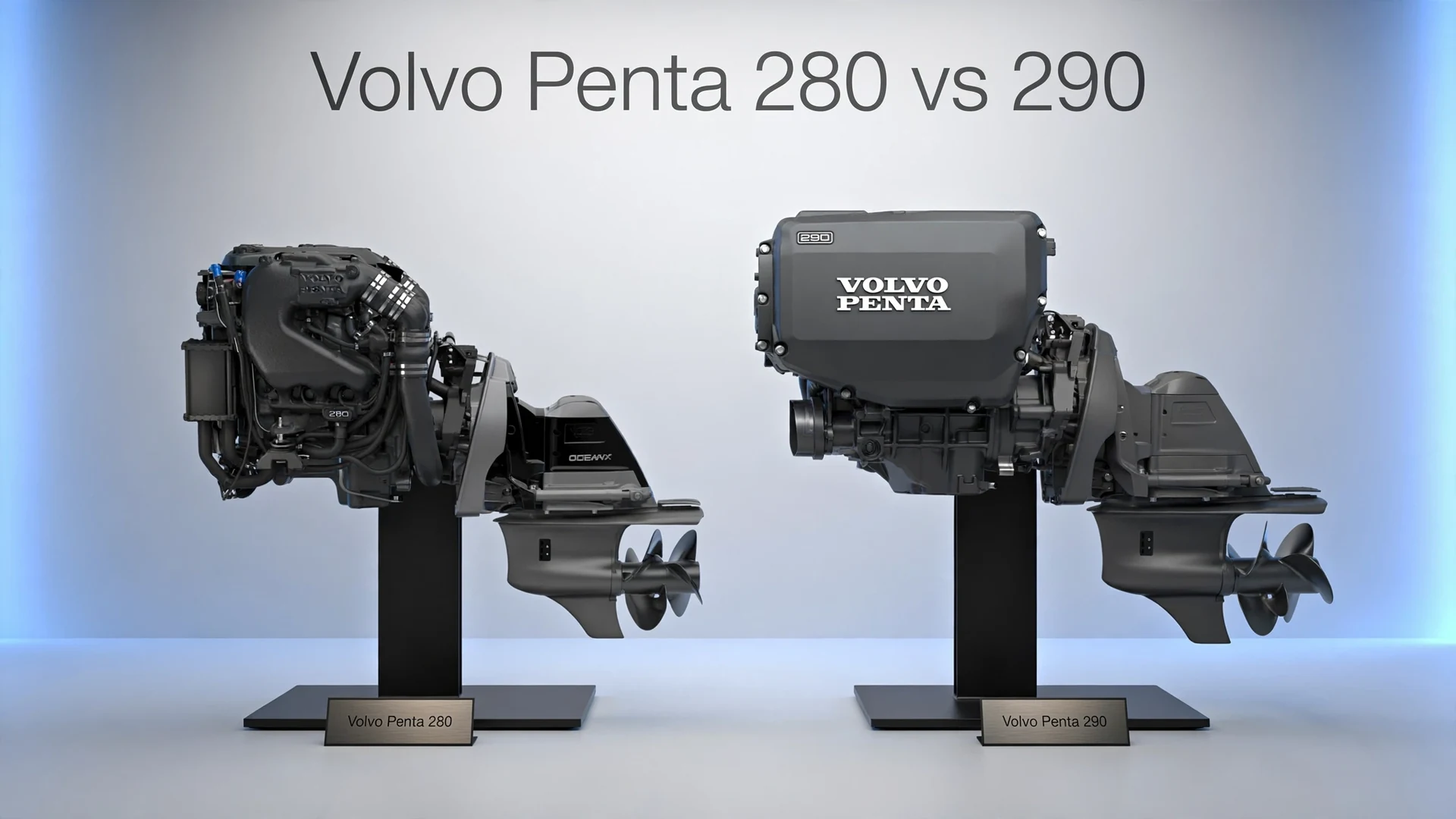
If you’re shopping for a classic Volvo Penta-powered boat — or keeping one alive — you’ll meet the 280 and 290 sterndrives constantly. They’re close relatives from Volvo Penta’s AQ-series era, and the internet is full of confident-sounding claims about which is “better.” The verified answer, from the mechanics who actually rebuild them: the 280 and 290 share the same upper transmission and lower-unit families — the differences are in the intermediate (mid) section and the tilt/trim arrangement, plus detail changes like the trim-sender design. Neither is categorically superior; the 290 is the later evolution with better parts availability today. Here’s everything that actually differs.
- Core difference: 280 vs 290 = different intermediate housing and tilt/trim systems; upper transmission and lower unit are the same families.
- Gear ratios: all 280 transmissions share one reduction; lower units came in 2.15:1 (4-cyl), 1.89:1 (inline-6), and 1.61:1 (V8).
- DuoProp: both drives were offered in single-prop and DuoProp (counter-rotating twin-prop) form; DuoProp debuted in 1983, initially on diesels.
- Trim senders differ: the 280 uses the cable-type “YO-YO” sender; the 290 uses a plastic-gear sender on top of the drive.
- Parts today: consumables (bellows, hoses) are available aftermarket across the AQ200–290 families; 290 hard parts are easier to find than 280.
- Verdict: buy on the boat’s condition and the drive’s service history — but all else equal, the 290 is the easier drive to keep running.
Where These Drives Sit in History
The 280 and 290 belong to Volvo Penta’s long-running AQ series of sterndrives — the drives that made Volvo Penta a household name in recreational boating from the 1960s onward. The 280 is the earlier design (broadly a late-1970s through 1980s-era drive), and the 290 is its evolutionary successor (broadly a 1980s–90s-era drive), sitting just below the later DP-A and subsequent DuoProp generations in the lineage. Exact changeover years are fuzzy in the surviving documentation — Volvo Penta iterated continuously rather than in clean model years — so treat any single “1975–1995” parts-catalog range you see online as a compatibility span, not a production history.
What matters for owners is that these drives are now 30–50 years old, still numerous on the used market, and still serviceable — with caveats. Understanding what the 280 and 290 share (most of the expensive parts) versus what differs (the parts that cause swap headaches) is the key to buying, maintaining, or repowering around them.
The Real Difference: Midsection and Tilt/Trim
Ask experienced Volvo Penta mechanics what separates a 280 from a 290 and you’ll get a remarkably consistent answer: the tilt/trim system and the intermediate (mid) section — not the transmission, and not the lower unit. The upper transmissions interchange within families (with attention to bearing-retainer diameter and spline counts on some variants), and the lower units share gearcase designs across the 270/275/280/285/290/SP range. It’s the middle of the drive — the housing between the transmission and the lower unit, and the hardware that tilts and trims it — that defines which drive you have.
| Component | 280 | 290 |
|---|---|---|
| Upper transmission | Same family — all 280 transmissions share one reduction ratio | Same family — interchanges with attention to retainer/spline detail |
| Lower unit (gearcase) | Shared family (ratios below) | Shared family |
| Intermediate (mid) housing | 280-pattern housing | 290-pattern housing (bearing race/shim must transfer on swaps) |
| Tilt/trim arrangement | Earlier tilt/trim design | Revised tilt/trim design |
| Trim sender | Cable-type “YO-YO” sender (bind-prone) | Plastic-gear sender on top of drive |
| Transom shield | 280-pattern shield | 290-pattern shield (more available used) |
| DuoProp availability | Yes (280DP) | Yes (290DP) |
One practical consequence: a 280 transmission can be fitted atop a 290 lower unit, but the swap requires moving the bearing race and shim from the 290’s intermediate housing into the 280’s, setting preload per the factory manual, and running the correct heavier gear oil. It’s routine work for a Volvo Penta specialist — and a trap for the unwary.
Gear Ratios and Engine Pairings
The ratio logic of the AQ series is straightforward once you see it. All 280-series upper transmissions use the same reduction — the transmission doesn’t care which engine it’s behind. The lower unit is where the ratio changes to match the engine: lower-horsepower engines get deeper (numerically higher) reduction so the prop turns slower with more torque multiplication.
| Engine type | Lower-unit ratio | Notes |
|---|---|---|
| 4-cylinder | 2.15:1 | Most common and durable; 4-cyl lowers “don’t wear out” per specialists |
| Inline-6 | 1.89:1 | Lower demand today as 6-cyl boats age out |
| V8 | 1.61:1 | Highest demand — V8 lowers and V8 flywheel covers command the best used prices |
Serial-number detail worth knowing when buying parts: 280 transmissions are designated B, C, or D in the serial number, with “D” denoting the 4-cylinder transmission. Since all share the same reduction, a 4-cylinder unit (less wear) is actually the savvy buy for a rebuild core — less internal wear for the same part.
Single-Prop vs DuoProp
Both the 280 and 290 were sold in single-propeller and DuoProp (counter-rotating twin-propeller) versions. DuoProp was Volvo Penta’s landmark 1983 innovation — initially launched on diesel applications, with gasoline applications following around 1986 according to owner and specialist histories. The twin counter-rotating props grip the water far better than a single prop: planing is quicker, straight-line tracking improves, prop torque steer largely disappears, and low-speed maneuvering gets noticeably easier.
On the used market, a DuoProp lower unit (280DP/290DP) is the desirable find — better performance and typically a sign of a higher-spec original installation. The trade-off is complexity and cost: two propellers to buy, replace, or repair, and DuoProp-specific lower-unit parts are pricier than single-prop equivalents. For a restoration where originality matters less than drivability, converting a single-prop boat to DuoProp is possible within the family but requires the correct lower unit and correct shimming to your intermediate housing — specialist work.
Parts and Service Reality in 2026
Here’s the honest state of keeping these drives alive. Consumables are fine: bellows (drive and exhaust), water hoses, gaskets, seals, anodes, and gear oil remain available aftermarket across the AQ200–290 families — the same parts fit a huge span of drives, which keeps them in production. Routine maintenance (bellows every few seasons, gear oil annually, anodes as needed) is entirely feasible.
Hard parts are the constraint: transom shields (especially V8 double-exhaust-relief versions), Y-pipes, and some trim components are obsolete from Volvo Penta and live on the used/NOS market — eBay, marine salvage yards, and freshwater-region part-outs. This is where the 290 has its clearest advantage: as the later and more numerous drive, its shields and midsection parts surface far more often and cheaper. One specialist’s rule of thumb: 290 parts are “everywhere,” 280-specific trim parts require patience.
The other reality check is technician familiarity. Any longtime Volvo Penta shop knows these drives intimately — but that generation of mechanics is retiring. Before buying a 280/290 boat far from a known specialist, confirm someone within reasonable distance still works on AQ-series drives. A pre-purchase survey by a Volvo Penta-experienced surveyor, including bellows condition, gear-oil inspection (milky oil = water intrusion), and a check of the gimbal bearing and U-joints, is money well spent.
Which Boat Should You Buy?
Verdict: Siblings, Not Rivals
The 280 vs 290 debate dissolves once you know what actually differs: same transmission family, same lower-unit family, different midsection and tilt/trim hardware. The 290 is the refined successor — easier to source parts for, with a better trim-sender design — and deserves a small premium on the used market. But a well-kept 280 with documented maintenance will outlast a neglected 290 every time. Buy the maintenance history, match the lower-unit ratio to the engine, and budget for bellows: the drive model is the least important line on the survey.
Sources
- iBoats forums — “Volvo Penta 280 verses 290 outdrive question”: 280 vs 290 = tilt/trim and midsection, not trans/lower; bearing race/shim swap procedure.
- MarineEngine forums — “Penta 280, what’s it worth”: lower-unit ratios (2.15:1 4-cyl, 1.89:1 I6, 1.61:1 V8), B/C/D serial designations, V8 parts demand.
- MarineEngine forums — “275 A Volvo Penta”: lower-unit interchange across 270/275/280/285/290/SP; shimming requirements.
- OffshoreOnly forums — 270T/280T trim discussion: 290 parts availability vs obsolete 280T-specific parts.
- iBoats forums — 290 trim issue thread: 290 plastic-gear trim sender vs 280 cable “YO-YO” sender.
- JLM Marine / BoatBlurb — AQ200–290 consumable compatibility; DuoProp 1983 introduction history.
Frequently Asked Questions
What is the difference between a Volvo Penta 280 and 290?
The 280 and 290 share the same upper transmission and lower-unit families. The differences are in the intermediate (mid) housing and the tilt/trim arrangement, plus detail changes like the trim-sender design (cable-type on the 280, plastic-gear on the 290).
Can you put a 280 transmission on a 290 lower unit?
Yes, with caveats: you must transfer the bearing race and shim from the 290’s intermediate housing, set preload per the factory manual, and run the correct heavier gear oil. It’s routine for a Volvo Penta specialist but not a casual bolt-on.
What gear ratios did the 280/290 come in?
All 280 transmissions share the same reduction; the lower unit sets the ratio: 2.15:1 for 4-cylinder engines, 1.89:1 for inline-6s, and 1.61:1 for V8s. The V8 1.61:1 lower is the most sought-after on the used market.
What is a DuoProp 280 or 290?
DuoProp versions (280DP/290DP) use counter-rotating twin propellers instead of a single prop, for better grip, faster planing, and easier low-speed handling. DuoProp debuted in 1983, initially on diesels, with gas applications following around 1986.
Are parts still available for the 280 and 290?
Consumables (bellows, hoses, seals, anodes) are available aftermarket across the AQ200–290 families. Hard parts like transom shields and Y-pipes are obsolete new and depend on used/NOS supply — 290 parts are notably easier to find than 280-specific parts.
Which is better for a used boat, 280 or 290?
All else equal, the 290 — it’s the later evolution with better parts availability and a revised trim sender. But a well-maintained 280 beats a neglected 290 every time; buy on service history, bellows condition, and clean gear oil.