Volvo PV801-10: The “Sugga” Taxi Story — Specs, History and Why It Matters

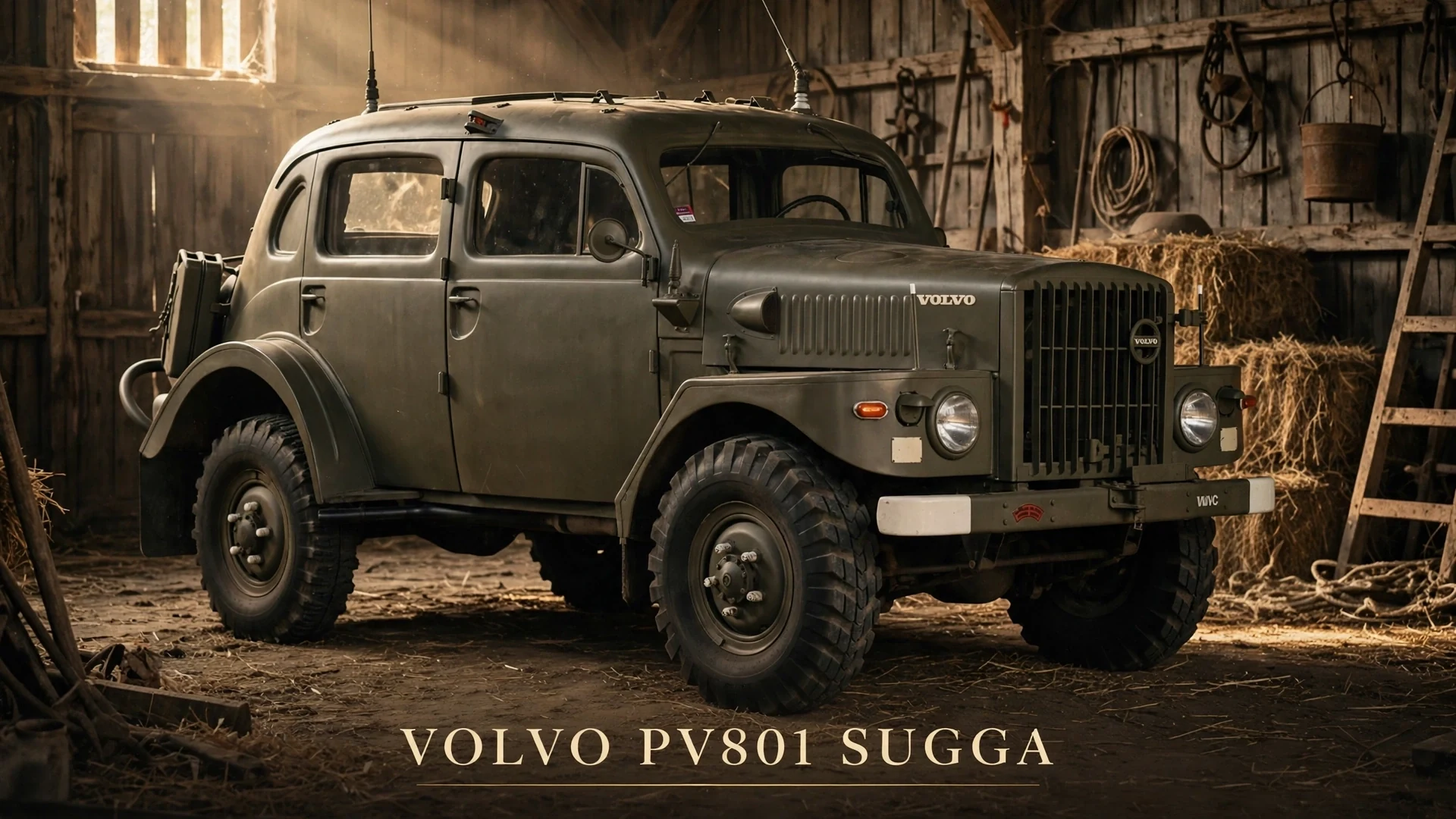
Most cars earn their nicknames from something flattering — speed, beauty, or a famous owner. The Volvo PV801-10 earned its nickname from Swedish taxi drivers who looked at its bulbous, American-influenced bodywork and called it the Sugga: the Sow. The name was meant as a joke. Nearly ninety years later, it is a term of endearment, and the stubby pre-war taxi it described is one of the most recognizable Volvos ever built.
Between 1938 and 1947, Volvo built just 1,848 examples of the PV801-10 family — the PV801 taxi with its glass partition, the PV802 without it, the long-wheelbase PV810 commercial chassis, and the PV800 bare chassis. Yet the Sugga’s influence runs far beyond its tiny production run: its body lived on in the post-war PV821–832 taxi series and, improbably, on a military 4×4. This is the story of how a workhorse taxi became a Swedish icon.
- The Volvo PV801-10 was Volvo’s purpose-built taxi and commercial-chassis family of 1938–1947, replacing the earlier TR670 series.
- Only 1,848 were built: 550 PV801s (glass partition taxi), 1,081 PV802s (open interior, ambulance-capable), 180 PV810 long-wheelbase chassis, and 37 PV800 bare chassis.
- Power came from a 3,670 cc side-valve inline-six making 84–90 hp, with a 3-speed manual and hydraulic brakes on all four wheels.
- Swedish drivers nicknamed the family the Sugga (Sow) for its rounded, American-influenced styling — a name that followed the body onto the later military Volvo TP21.
- There is essentially no active resale market: survivors are museum and heritage-collection pieces, and the related TP21 military Sugga is the more available alternative for collectors.
Why a 1930s Taxi Still Deserves Your Attention
It is easy to overlook the PV801-10. Volvo’s greatest hits are the Amazon, the P1800, the 240 — cars with decades of production and hundreds of thousands of buyers. The Sugga family sold in the low thousands. Obscure and unimportant, though, are not the same thing.
First, the PV801-10 is where Volvo’s taxi heritage becomes a deliberate product line. Before the PV800 series, taxi operators bought adapted Volvo passenger cars. With the PV801, Volvo designed the taxi first: a glass partition, a chassis built for shift work on cobblestones, running gear chosen for durability over fashion. That philosophy — the taxi as a purpose-built tool — carried through to the post-war PV831 and the generations of Volvos that served as taxis across Europe for decades.
Second, the nickname made it immortal. Sugga is not a marketing creation; it is what the drivers themselves called it, every day, for years. A vehicle that earns a folk nickname and keeps it for the better part of a century has crossed from transportation into culture.
Third, the body refused to die. After the PV801-10 gave way to the updated PV821–832 series in 1947, the same basic Sugga bodywork found its most famous second life on the Volvo TP21 — a military 4×4 built on a truck chassis for the Swedish armed forces in the 1950s. A taxi that became a soldier’s truck is not a normal career arc.
Where It Came From: The TR670 Gives Way
To understand the PV801-10, you have to look at what it replaced. Through the mid-1930s, Volvo’s taxi and commercial business rested on the TR670 series — big, upright cars that were essentially lengthened versions of Volvo’s passenger models. They were honest machines, but by the late 1930s their styling and engineering were aging.
The PV800 series, launched in 1938, was Volvo’s answer: a clean-sheet approach to the professional-vehicle market with modern, rounded bodywork clearly influenced by contemporary American design. Its separate chassis carried a roomy, tall-roofed body with space for a proper taxi interior, engineered around one brutal requirement — survive a taxi driver’s entire working life with minimal complaint.
The timing was remarkable: the entire first generation was built during the Second World War and its immediate aftermath. That a small Swedish manufacturer kept a low-volume professional vehicle in production through that decade — and that taxi fleets kept buying it — speaks volumes about the car’s reputation and its operators’ loyalty.
Built for the Taxi Stand: What Made It a Proper Taxi
A taxi is not just a car with a meter. The difference between a car that happens to carry fares and one designed to carry fares for a decade shows up in the details, and the PV801 was full of them.
The most visible was the glass partition in the PV801 proper, separating the driver from the rear compartment — the defining feature of a serious taxi of the era. The PV802 skipped the partition for a simpler, more flexible interior that could serve as a private hire car or, in a pinch, an ambulance.
Underneath, the priorities were durability and simplicity. The 3,670 cc side-valve inline-six made just 84 to 90 horsepower depending on the variant, but a side-valve six is one of the most forgiving engine layouts ever devised: smooth, understressed, tolerant of indifferent maintenance, and easy to work on with basic tools. For a 1940s fleet operator, those virtues mattered far more than outright speed.
The chassis backed it up with hydraulic brakes on all four wheels — genuinely modern equipment for a 1938 commercial vehicle — and a 3-speed manual gearbox operated by a floor lever. The whole package was deliberately conventional: every component was something a provincial mechanic could understand, adjust, and repair. When your business depends on the car earning money every single day, exotic engineering is a liability, and the Sugga had none of it.
The Three Variants: PV801, PV802 and PV810
The PV801-10 was not a single model but a small family of three, each aimed at a different professional buyer:
Under the Skin: Specifications
The numbers tell the story of a vehicle engineered for the long haul rather than the headline. Everything about the specification prioritizes strength, simplicity, and ease of maintenance:
| Specification | Detail |
|---|---|
| Production years | 1938–1947 (PV801–810); the wider PV800 family continued to 1958 |
| PV801 production | 550 units — taxi with glass partition |
| PV802 production | 1,081 units — no partition, ambulance-capable |
| PV810 production | 180 units — long-wheelbase commercial chassis |
| Engine | 3,670 cc inline-six, side-valve (EC) |
| Output | 84–90 hp depending on variant |
| Transmission | 3-speed manual, floor lever |
| Brakes | Hydraulic, all four wheels |
| Body style | Separate chassis; 4-door sedan (PV801/802), bare chassis (PV810) |
| Nickname | Sugga — Swedish for “Sow” |
For a 1938 commercial vehicle, the specification shows Volvo’s priorities clearly: strength, simplicity, and ease of maintenance over outright performance.
What Came Next: The Sugga Refuses to Retire
The PV801-10 did not end so much as evolve. In 1947, Volvo replaced the first-generation family with the PV821–832 series — the same Sugga concept with an updated engine and a steering-column gear lever, built through 1958. A Sugga-bodied taxi from the 1950s is almost certainly a PV821-series car rather than a PV801-10, and telling them apart is one of the first skills a Volvo historian learns.
But the strangest second act belonged to the body itself. In the early 1950s, Volvo needed a light military 4×4 for the Swedish armed forces, and rather than design a new body, it dropped the familiar PV800-series bodywork onto a rugged truck chassis. The result was the Volvo TP21 — universally known, inevitably, as the military Sugga. It is mechanically a different vehicle from the PV801-10 taxi — truck chassis, four-wheel drive, military specification — but the family resemblance is unmistakable.
This is why the PV801-10 matters more than its production numbers suggest: the root of a family tree running from 1930s Stockholm taxi stands to 1950s military service — one body, two completely different working lives, and a nickname that covered both.
Collecting One Today: A Museum Piece, Not a Project Car
Let us be direct: you are almost certainly not going to buy a Volvo PV801-10. This is not a car with an active market or a price guide entry. Searches of the major classic-car sales databases turn up essentially no recorded transactions for the PV801, PV802, or PV810 — the cars simply do not change hands often enough to establish a reliable price range.
The closest available reference point is the later, related PV831 taxi — the same Sugga body in its post-1947 form — where one documented example sold in the $10,000–$13,500 range at a general auction. Treat that strictly as a loose indication of what the Sugga family trades for when it trades at all, not as a valuation for a genuine PV801-10.
That scarcity shapes everything about ownership. Parts support is minimal — unlike the Amazon or PV544, there is no deep aftermarket for Sugga mechanicals, so restoration means fabrication, specialist help, and patience. Provenance matters enormously: with so few cars, a verifiable history — ideally traceable through Volvo’s own heritage archives — is what separates a real car from an expensive question mark. And specialist channels beat marketplaces: the Volvo Owners’ Club and Volvo’s heritage archive team are the useful hunting grounds, because the marque community usually knows where the surviving cars are.
If the Sugga shape is what you love but a PV801-10 proves unobtainable, the honest alternative is the Volvo TP21 military Sugga. It shares the body and the nickname, it was built in larger numbers for military service, and it has an established, well-documented collector following. It is a different vehicle — a 4×4 truck, not a taxi — but for many enthusiasts it is the achievable way into the Sugga story.
For the serious marque historian, a genuine PV801-10 is a cornerstone pre-war Volvo — but expect a multi-year search and restoration-grade patience. For the museum or heritage curator, the Sugga nickname gives the car real display storytelling power. For the weekend driver, look elsewhere: this is a preservation project, not a usable classic — the TP21 gives you the Sugga experience in a vehicle you can actually maintain and drive.
Frequently Asked Questions
Why is the Volvo PV801-10 called the “Sugga”?
Swedish taxi drivers nicknamed it Sugga — “sow” in Swedish — for its rounded, American-influenced styling. The name was affectionate, and it stuck so firmly it was later applied to the related military Volvo TP21 as well.
How many Volvo PV801-10s were built?
Just 1,848 between 1938 and 1947: 550 PV801 taxis with a glass partition, 1,081 PV802s without the partition (often used as ambulances), 180 PV810 long-wheelbase commercial chassis, and 37 PV800 bare chassis.
What is the difference between the PV801 and the PV802?
The PV801 has a glass partition separating the driver from the rear passengers, marking it as a purpose-built taxi. The PV802 has an open interior — a private-hire car that could double as an ambulance.
Is the PV801-10 the same as the Volvo TP21 “Sugga”?
No. The TP21 is a 1950s military 4×4 that reused the PV800-series body on a truck chassis. It shares the nickname and the family resemblance, but mechanically it is a completely different vehicle from the PV801-10 taxi.
Can you actually buy a Volvo PV801-10 today?
It is extremely difficult. There is essentially no active resale market — survivors are mostly in museums, heritage collections, or long-term private hands. The Volvo Owners’ Club and Volvo’s heritage archives are the useful channels, and the related TP21 military Sugga is the more obtainable alternative.