Volvo V40 vs Audi A3?

Volvo V40 vs Audi A3?
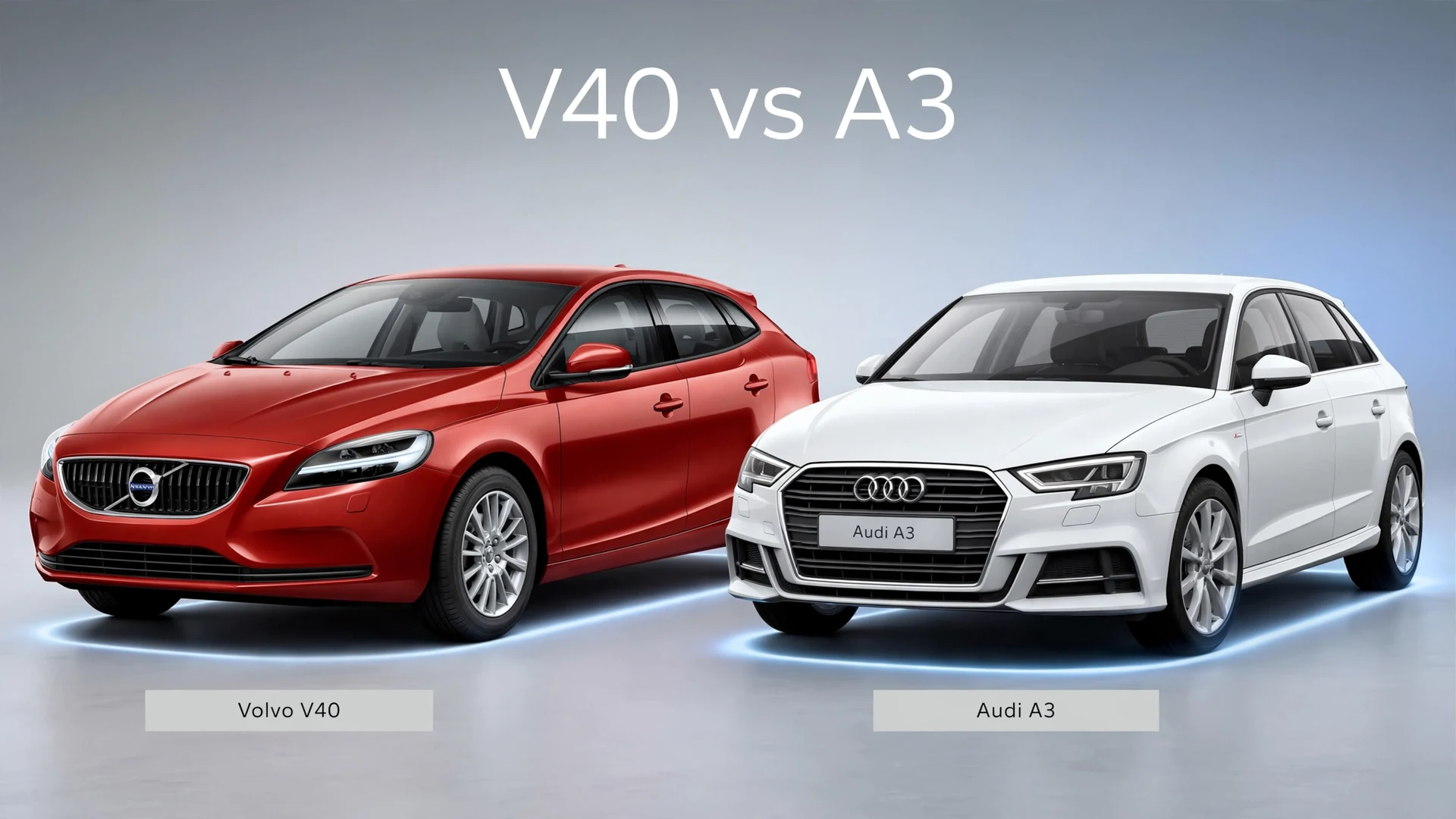
The premium-hatch duel of the 2010s: the Volvo V40 (2012–2019), Volvo’s rakish five-door, against the Audi A3 Sportback 8V (2012–2020), the class benchmark it was chasing. Here’s the honest answer: the A3 is the better all-rounder — bigger boot (380 vs 335 litres), better rear space, sharper to drive, cheaper to run, and stronger residuals. The V40 is the left-field charmer: gorgeous to look at, supremely comfortable seats, five-star safety, and — especially as a used buy — significantly cheaper than the equivalent Audi. If you need a family hatch, buy the Audi. If you want a stylish commuter and rarely use the back seats, the Volvo is the bargain.
- Space: A3 Sportback — 380 L seats-up, 1,220 L folded, proper adult rear seats; V40 — 335 L, 1,032 L, cramped rear.
- Diesels: V40 D2 — 120 hp, 280 Nm, 0–100 in 11.9 s, 3.4 L/100 km claimed; A3 1.6 TDI — 105/110 hp, 0–100 in ~10.8 s, 3.9 L/100 km. The Volvo is thriftier, the Audi’s 2.0 TDI (150/184 hp) is the stronger engine.
- Gearboxes: the A3’s 7-speed S tronic is slick but needs servicing; the V60-era… the V40’s manuals are tough and its conventional autos are dependable.
- Towing: A3 1.6 TDI is rated to 1,500 kg braked.
- Used prices: the V40 is typically much cheaper than the equivalent A3 — the Audi’s badge holds value, the Volvo’s doesn’t.
Cabin and Space: Where the Audi Justifies Its Price
This is the V40’s weakest chapter and there’s no point softening it. The Volvo is a style-led hatch: the tapering roofline and high beltline look fantastic from outside and feel cocooning from the front seats — Volvo’s seats remain the most comfortable in the business — but rear legroom is tight, headroom is pinched, and the 335-litre boot (1,032 litres folded) is smaller than a Golf’s. It’s a 2+2 in spirit: fine for kids, a compromise for adults.
The A3 Sportback is the grown-up tool. It’s 4,310 mm long on a 2,636 mm wheelbase — shorter overall than the V40 (4,369 mm) yet roomier inside, which tells you everything about packaging priorities. The boot is 380 litres seats-up and 1,220 folded, the rear seats take adults without apology, and visibility is better all round. Cabin quality is a genuine Audi strength: soft-touch materials, precise switchgear, and an interior that still looks modern a decade on. The V40’s floating centre console is a lovely design piece, but its button-heavy layout has aged less gracefully.
| Specification | Volvo V40 (2012–2019) | Audi A3 Sportback 8V (2012–2020) |
|---|---|---|
| Length / wheelbase | 4,369 mm / 2,647 mm | 4,310 mm / 2,636 mm |
| Boot, seats up | 335 L | 380 L |
| Boot, seats folded | 1,032 L | 1,220 L |
| Braked towing (1.6 TDI) | — | 1,500 kg |
| Euro NCAP | 5 stars (2012) | 5 stars (2012) |
| Drive | Front-wheel drive | Front-wheel drive (quattro on some) |
The Diesel Decision: D2/D3 vs 1.6/2.0 TDI
Volvo’s diesel lineup changed mid-life, so read the badge carefully. Early V40s (2012–2015) used Volvo’s own five-cylinder diesels: the D3 (150 hp, 350 Nm, 0–100 in 9.6 s, 4.3 L/100 km claimed) is a strong, characterful unit — buttery smooth for a diesel and good for 200,000 miles with servicing. From 2015, Drive-E four-cylinder power took over: the D2 (120 hp, 280 Nm, 0–100 in 11.9 s, 3.4 L/100 km) is the economy hero — one of the most frugal cars of its era — while the D3/D4 fours (150/190 hp) are quicker but carry the Drive-E’s EGR baggage. Petrols ranged from the 1.6 T3 to the 2.0 T5 (245 hp).
The A3’s range is simpler to navigate. The 1.6 TDI (105 hp early, 110 hp later, 0–100 in 10.9/10.7 s, 3.9 L/100 km claimed) is the economy pick — adequate, not exciting, and happiest on longer runs where the DPF stays clean. The 2.0 TDI in 150 hp or 184 hp forms is the sweet spot: strong, refined, and genuinely quick in 184 hp guise, with the kind of mid-range flexibility that makes motorway driving effortless. Petrols: the 1.4 TFSI (125/150 hp, later with cylinder-on-demand) is the smart low-mileage choice, and the 2.0 TFSI (190 hp) is the driver’s pick. All are proven VW Group units with vast parts and knowledge support — any independent VAG specialist will know them inside out, and pattern parts are cheap and widely available online.
| Engine | Power / torque | 0–100 km/h | Claimed consumption |
|---|---|---|---|
| V40 D2 (Drive-E, 2015+) | 120 hp / 280 Nm | 11.9 s | 3.4 L/100 km |
| V40 D3 (5-cyl, 2012–15) | 150 hp / 350 Nm | 9.6 s | 4.3 L/100 km |
| V40 D4 (5-cyl, 2012–15) | 177 hp / 400 Nm | ~8.6 s | ~4.5 L/100 km |
| A3 1.6 TDI 110 (S tronic) | 110 hp / 250 Nm | 10.7 s | 3.9 L/100 km |
| A3 2.0 TDI 150 | 150 hp / 320 Nm | ~8.6 s | ~4.2 L/100 km |
| A3 2.0 TDI 184 | 184 hp / 380 Nm | ~7.4 s | ~4.4 L/100 km |
Gearboxes: The Big Differentiator
This is where the two cars genuinely diverge in ownership character. The A3’s 7-speed S tronic dual-clutch is brilliant when healthy — fast, smooth, and worth 0.2 s over the manual — but it’s a gearbox that demands respect: fluid and filter changes every 40,000 miles (many owners skip them), and mechatronic failures on neglected cars run to four figures. The 6-speed manual is the safe, cheap choice and still a lovely shift.
The V40 counters with conventional torque-converter automatics (Geartronic) and manuals that ask for nothing but occasional fluid. They’re slower-shifting and duller than the S tronic, but there’s no mechatronic to fail and no £600 service every 40,000 miles. For a buyer who wants to forget the gearbox exists, the Volvo’s simplicity is a genuine asset — particularly on a high-mileage used car where a neglected dual-clutch is a ticking bill. Early V40s also used Ford-sourced Powershift dual-clutch units on some engines — check exactly which gearbox your car has, because the advice above applies to the conventional autos, not those.
Reliability and Running Costs
V40. The five-cylinder diesels are the reliability sweet spot — simple, strong, well understood, with the timing belt the main scheduled expense. Drive-E D2/D3/D4 cars need the EGR recall checked and can suffer the same oil-consumption issues as the V60’s D4 on 2014–2016 builds. DPFs clog on short-trip diesels (both cars). Otherwise the V40 is a solid citizen: suspension wear, infotainment glitches, and the odd electrical niggle, but nothing systemic. Insurance and parts are cheaper than the Audi’s, and independent Volvo specialists are plentiful.
A3 8V. The EA288 diesels are proven, but check for EGR and DPF issues on high-mileage or city cars, and the 2.0 TDI’s water pump/thermostat housing is a known weep point — a coolant smell or dropping level is the tell. The S tronic’s service history is the single most important document on an automatic car; a freshly serviced box with receipts is worth real money. Petrol 1.4 TFSIs can suffer timing-chain tensioner issues on early builds (listen for rattle on start-up); the 2.0 TFSI is stronger. Suspension and wheel bearings wear as on any Golf-platform car — cheap fixes. Both cars want a timing belt around 100,000–130,000 miles on belt-driven engines; verify by receipt, not by promise.
Which Spec to Buy
Verdict: Head Says Audi, Heart (and Wallet) Says Volvo
The Audi A3 Sportback 8V is objectively the better car: more space, better packaging, sharper dynamics, stronger engines across the range, and residuals that reward you at resale. If this is the family workhorse, buy the Audi without guilt.
But the V40 is the smarter used buy for the solo commuter. It’s thousands cheaper than the equivalent A3, the seats are better, it’s quieter on the motorway, and the five-cylinder D3 is one of the great forgotten diesels. Just be honest about the back seats: if you need them weekly, the Volvo’s style tax is paid in passenger comfort — and the Audi wins.
Sources
- AutoExpress — Volvo V40 D3 road test: early D3 five-cylinder, 150 hp, 350 Nm, 0–100 in 9.6 s, 4.3 L/100 km.
- Volvo Cars (Gaborone) — V40 2015 brochure: D2 120 hp/280 Nm, 0–100 in 11.9 s, 3.4 L/100 km; dimensions 4,369 × 1,802 × 1,435 mm.
- automaniac.org — V40 D3 spec: 335/1,032 L boot.
- ultimatespecs.com — Audi A3 8V Sportback 1.6 TDI 110 S tronic: 0–100 in 10.7 s.
- analyticauto.com — A3 Sportback 1.6 TDI 105 S tronic: 0–100 in 10.9 s, 3.9 L/100 km, 1,500 kg braked towing.
- motor.com (Ford of Europe) — Mk5 Mondeo estate boot figures used for cross-checking class context.
Frequently Asked Questions
Which is bigger inside: Volvo V40 or Audi A3 Sportback?
The A3 Sportback: 380 litres of boot seats-up (1,220 folded) versus 335 (1,032) for the V40, plus genuinely adult-sized rear seats. The V40 is the style-led car; the Audi is the practical one.
Is the Volvo V40 D2 reliable?
The Drive-E D2 is economical but needs its EGR recall verified, and 2014–2016 builds can suffer oil consumption. The earlier five-cylinder D3/D4 diesels (2012–2015) are simpler and widely regarded as the reliability sweet spot.
What goes wrong with the Audi A3 8V S tronic gearbox?
Neglect. The 7-speed S tronic needs fluid and filter changes every 40,000 miles; skipped services lead to mechatronic and clutch failures costing four figures. Demand full service history on any automatic.
Which is cheaper to run: V40 or A3?
The V40: lower purchase prices, cheaper insurance and parts, and the D2’s 3.4 L/100 km claim. The A3 counters with stronger residuals — you’ll get more back at resale.
Can the Audi A3 tow?
Yes — the A3 Sportback 1.6 TDI is rated to tow 1,500 kg braked. The V40 was not marketed as a tow car in the same way; check your specific car’s plate for its rating.
Which used premium hatch should I buy?
Buy the A3 Sportback 2.0 TDI 150 if you need space and plan to resell. Buy the V40 — ideally a five-cylinder D3 manual or a late D2 — if you commute solo and want maximum style and comfort per pound.