Will This Tire Pressure Sensor Work on My 2010 XC90?

Not every TPMS sensor labeled “fits Volvo” will actually work on your 2010 XC90 — get the frequency or type wrong and you’ll install four sensors that your car simply never hears. Here’s what actually matters before you buy.
TL;DR
- Yes, replacement TPMS sensors work on a 2010 XC90 — but frequency and protocol must match, not just the brand name on the box.
- US and Canadian XC90s use 315 MHz sensors; rest-of-world models use 433 MHz.
- OE-style “pre-programmed” sensors (Schrader, VDO, HUF) typically work right out of the box once installed and driven.
- Universal/blank programmable sensors must be programmed to the correct protocol with a TPMS tool before they’ll ever register.
- Your XC90’s computer auto-learns new sensor IDs after a drive — no dealer visit or OBD pairing procedure needed for that part.
Bottom line: a replacement TPMS sensor will work on your 2010 XC90 as long as it matches your market’s frequency (315 MHz for US/Canada) and carries the correct Volvo protocol — simply being labeled “TPMS sensor” isn’t enough on its own.
Why “Will It Work” Isn’t a Simple Yes
This is exactly where owners get burned. A sensor can be 315 MHz, look identical to the OE part, and still never register — because frequency and protocol are two different things, and both have to match.
A specialist breakdown circulating on Volvo forums put it plainly: “the statement ‘any 315 MHz sensor works’ is only half-true, the protocol must match, not just the frequency” — which explains why some cheap online listings fail even when the frequency is technically correct. Both pieces have to line up, not just one.
Quick Tip: If a sensor listing doesn’t specify whether it’s “pre-programmed for Volvo” versus a “universal/blank” sensor, assume it needs programming and plan accordingly.
Frequency: 315 MHz vs. 433 MHz
Your XC90’s market determines which frequency it needs, and getting this wrong means the sensor will physically never communicate with your car.
US and Canadian 2010 XC90s use 315 MHz sensors. Rest-of-world models use 433 MHz instead. Forum owners have documented real confusion here — one 2008 XC90 owner discovered his sensors had somehow been programmed to 433 MHz despite being a US-market car, and reprogramming them to 315 MHz resolved a warning light that had persisted for over a year.
Expert Insight: If you’re troubleshooting a persistent TPMS light after a “successful” sensor replacement, checking the actual programmed frequency with a scan tool — not just assuming it matches your market — is worth doing before replacing anything else.
Three Types of Replacement Sensors
Not all TPMS sensors sold as “compatible” work the same way once you get them home, and knowing which type you’re buying determines whether a tire shop can just bolt it on or needs extra steps.
OE-Style Pre-Programmed Sensors
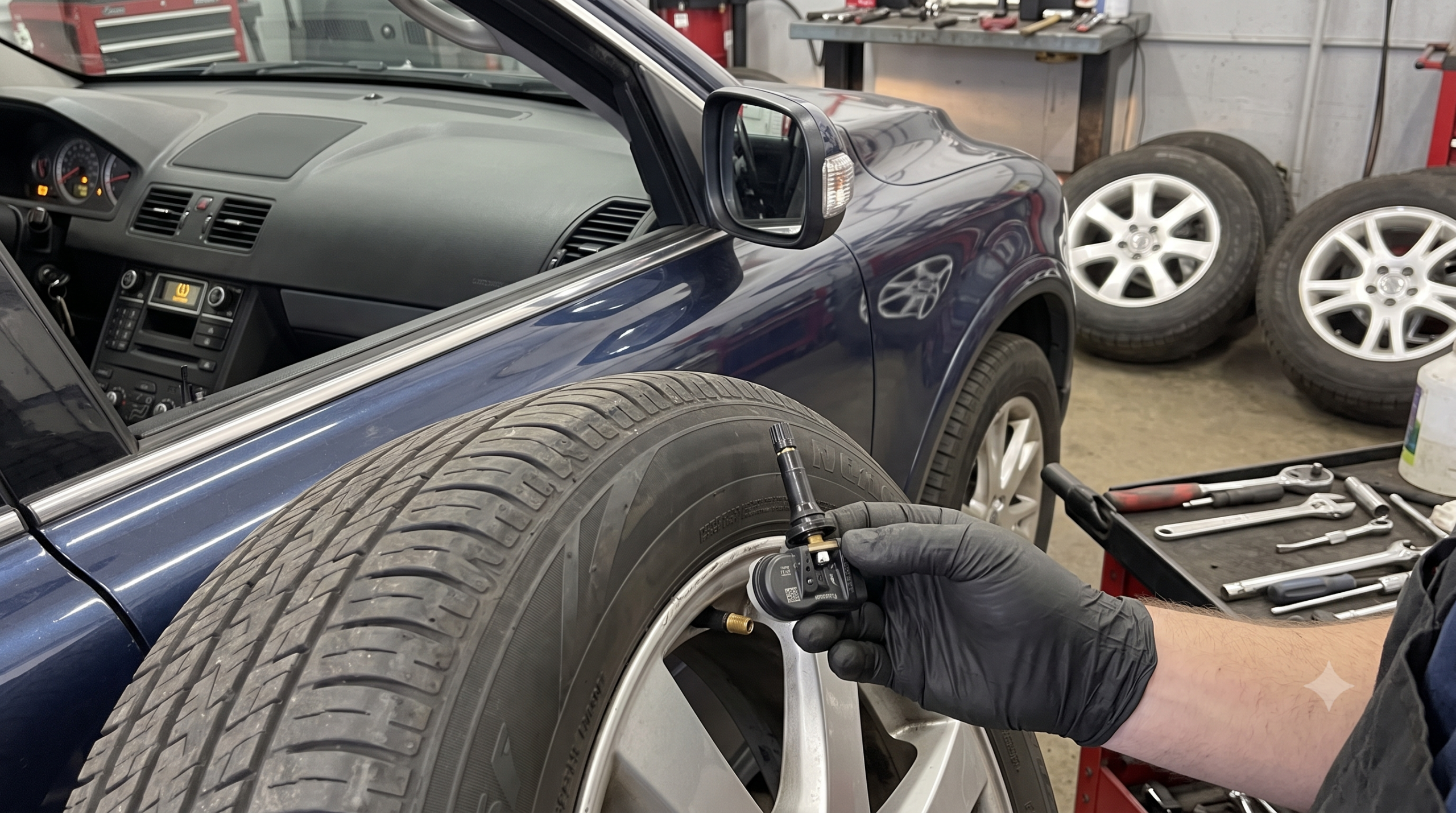
Brands like Schrader, HUF, and VDO sell sensors specifically built for the XC90’s protocol at the correct frequency. These typically work immediately after installation — mount them, drive for 10–20 minutes above 25 mph, let the car sit, and the system learns the new sensor IDs on its own.
Universal Programmable (“Blank”) Sensors
Sensors like the Schrader EZ-sensor or Autel MX-Sensor ship without any protocol loaded. These must be programmed to the Volvo XC90 protocol using a dedicated TPMS tool before installation, or your car will never recognize them no matter how long you drive.
Multi-Protocol “Redi-Sensor” Style
Sensors like the VDO REDI-Sensor carry several vehicle protocols preloaded at the correct frequency. On the XC90, these are generally treated the same as OE-style sensors — install and drive, no separate programming step required.
How Pairing Actually Works on This Car
Here’s the good news buried in all this frequency talk: your 2010 XC90 doesn’t need a dealer visit or OBD pairing procedure to accept new sensor IDs — that part is automatic.
Once correctly matched sensors are physically installed, the standard relearn procedure is: inflate all tires to the pressure listed on the placard, drive above 25 mph for at least 10 minutes, then let the vehicle sit with the key off for about 15 minutes. The system automatically learns the new sensor IDs during this process — no special tool required for that specific step, even though getting the sensors themselves programmed correctly beforehand might require one.
Comparison Table: Sensor Type vs. What You’ll Need
| Sensor Type | Programming Needed Before Install? | Works After Standard Drive Relearn? |
|---|---|---|
| OE-style pre-programmed (Schrader, VDO, HUF for Volvo) | No | Yes |
| Universal/blank programmable (EZ-sensor, generic Autel) | Yes — TPMS tool required | Yes, once programmed correctly |
| Multi-protocol “Redi-Sensor” style | No | Yes |
| Wrong frequency for your market | Cannot be fixed by programming alone | No — will never register |
Pros and Cons by Reader Type
The Budget DIYer
- Pros: OE-style aftermarket sensors from Schrader or VDO run significantly less than dealer pricing and work without a special programming step.
- Cons: Buying based on price alone risks landing a universal/blank sensor that needs professional programming you weren’t expecting to pay for.
The Careful Researcher
- Pros: Confirming frequency and protocol before buying means a smooth, one-visit tire shop installation with no surprises.
- Cons: Genuinely conflicting information exists even among Volvo owners about which years use which frequency — worth verifying your specific VIN’s spec rather than assuming by year alone.
The Tire Shop Customer
- Pros: Most tire shops can handle correctly-matched TPMS sensors as a routine part of a tire installation.
- Cons: Not every shop stocks or owns a TPMS programming tool for blank universal sensors — confirm this before dropping off your wheels.
A Real-World Scenario
Picture a 2010 XC90 owner replacing worn TPMS sensors themselves, buying a set of cheap universal sensors online without checking the listing closely. After installation and the standard drive-and-sit relearn procedure, the warning light never clears.
The sensors were “315 MHz” as advertised, but were blank universal units that needed dedicated Volvo protocol programming first — a step the listing never mentioned. A trip to a shop with a TPMS programming tool solved it in minutes, but it was an avoidable extra cost from not knowing which sensor type was actually being purchased.
Choose This If: Picking the Right Sensor
Choose OE-style pre-programmed sensors if: you want the simplest install experience — mount, drive, done, with no programming step to coordinate with a shop.
Choose universal programmable sensors if: you’re working with a shop that already owns a TPMS programming tool and you’re comfortable confirming the correct protocol is set before installation.
Choose to verify with your VIN first if: you’re at all unsure whether your specific 2010 XC90 is set to 315 MHz or 433 MHz — this single detail determines whether any sensor works at all.
Quick Tip: A shop with a TPMS diagnostic tool can read your car’s currently programmed frequency directly, which is the most reliable way to confirm what you actually need before buying anything.
Frequently Asked Questions
Do TPMS sensors need to be programmed to my specific 2010 XC90 by a dealer? No — your car auto-learns new sensor IDs on its own after a standard drive-and-rest procedure; no dealer visit or VIN-specific programming is required for that step.
What frequency TPMS sensor does a US 2010 Volvo XC90 use? 315 MHz for US and Canadian market vehicles; 433 MHz for rest-of-world models — confirm your specific market before buying.
Can I use any aftermarket TPMS sensor labeled 315 MHz on my XC90? Not necessarily — frequency alone isn’t enough; the sensor also needs the correct Volvo protocol, either pre-loaded (OE-style) or programmed onto a universal sensor with a TPMS tool.
Why does my TPMS light stay on after installing new sensors? Common causes include a frequency/protocol mismatch, a sensor that needed programming but wasn’t programmed, or simply not completing the full drive-and-rest relearn cycle.
Can I move TPMS sensors between different sets of wheels on my XC90? Volvo specifically advises against regularly swapping sensors between wheel sets, and recommends replacing the sensor’s seal, nut, and valve core any time a sensor is moved or a tire is changed.
Key Takeaways
- Replacement TPMS sensors do work on a 2010 XC90, but frequency (315 MHz US/Canada, 433 MHz elsewhere) and protocol must both match.
- OE-style pre-programmed sensors (Schrader, VDO, HUF) typically work immediately after install with no extra programming step.
- Universal/blank sensors need protocol programming with a dedicated TPMS tool before your car will ever recognize them.
- Your XC90 auto-learns sensor IDs through a simple drive-and-rest procedure — no dealer visit needed for that part.
- When in doubt about your car’s exact frequency, a shop TPMS tool reading is more reliable than assuming based on model year alone.
Next Step
Before ordering any sensor, confirm two things: your market’s frequency (315 MHz for US/Canada) and whether the sensor is pre-programmed or needs a TPMS tool — that combination determines whether it’ll actually work the first time.