2015 Volvo XC60 Oil Type?

Pour the wrong oil into your 2015 XC60 and you’re not just wasting money — you could be setting up your turbo for an early grave.
This guide is compiled from Volvo’s official service specifications, technical service bulletins, and cross-referenced dealer documentation, so you’re getting factory-accurate numbers, not guesswork.
TL;DR
- The 2015 XC60 came with three engine options, and each one takes a different oil.
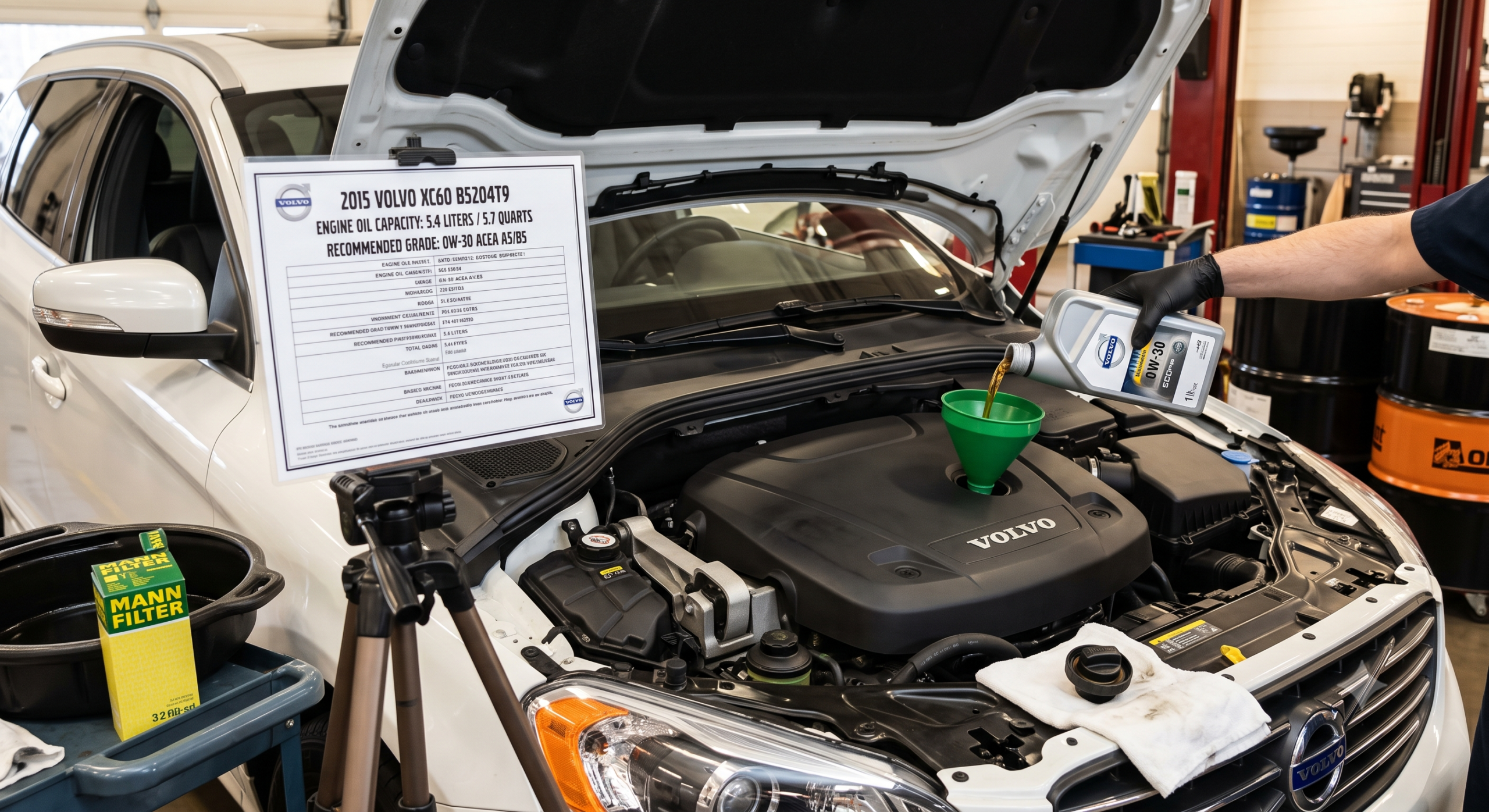
- Four-cylinder turbo (T5/T6): 5W-30, ACEA A5/B5, roughly 5.7 quarts with filter.
- Six-cylinder 3.2L: 0W-30 or 5W-30, roughly 7.2 quarts with filter.
- Volvo issued a technical bulletin later switching some 2.0L engines to 0W-20, so check your specific service history.
- Always use full synthetic oil meeting Volvo’s ACEA spec — it’s a warranty requirement, not a suggestion.
Here’s the short answer: your 2015 Volvo XC60 takes full synthetic oil, and the exact grade depends on which engine is under the hood — 5W-30 for most versions, with 0W-30 as an approved alternative for the six-cylinder, and 0W-20 for some four-cylinder cars that received a later factory update.
Which Engine Does Your XC60 Have?
Your engine determines your oil, full stop — so check the badge on your XC60 or the engine code on your build sheet before buying anything. Volvo offered three distinct engine options for the 2015 model year, and they don’t share an oil spec.
The T5 and T6 four-cylinder turbo (2.0L, engine code B4204T) was the most common configuration by 2015. The naturally aspirated 3.2L six-cylinder was still available on lower trims. A 2.5L five-cylinder turbo also appeared on some 2015.5 models. Mixing these up is an easy mistake, since all three look similar from the driver’s seat.
Quick Tip: Pop the hood and check the oil cap or the sticker on the underside of the hood — it lists the exact spec Volvo wants for your specific engine.
2015 XC60 Oil Type by Engine
Each engine has its own approved oil grade and fill capacity, so match yours carefully before your next service.
| Engine | Oil Type | Capacity (w/ filter) | Change Interval |
|---|---|---|---|
| 2.0L Turbo (T5/T6) | 5W-30 ACEA A5/B5 (some later 0W-20) | ~5.7 quarts | 7,500–10,000 mi |
| 2.5L Turbo (T5) | 5W-30 ACEA A5/B5 | ~5.7 quarts | 7,500–10,000 mi |
| 3.2L Naturally Aspirated | 0W-30 or 5W-30 ACEA A5/B5 | ~7.2 quarts | 7,500–10,000 mi |
Bold takeaway: the 3.2L six-cylinder holds about 1.5 quarts more oil than the four-cylinder turbo, so don’t assume one bottle fits every XC60.
The 2.0L Turbo Oil Recommendation Change
This is the one that trips people up. According to owner reports and dealer correspondence, Volvo issued a technical service bulletin that revised the oil spec on some early 2.0L engines from 5W-30 down to 0W-20, citing oil consumption issues tied to piston design. The switch was meant to reduce fuel and emissions impact, but some owners and technicians pushed back, worried a thinner oil wouldn’t protect an aging engine as well.
If your XC60 has over 60,000 miles and a history of using 5W-30, it’s worth asking your service center whether the 0W-20 update was ever applied to your specific VIN. There’s no harm in sticking with what’s already been running in the engine if it’s been trouble-free — but if you’re chasing a factory-fresh oil consumption fix, the updated spec is worth discussing.
Expert Insight: A vehicle’s oil history matters as much as the factory spec. Switching viscosity mid-life on a high-mileage turbo isn’t automatically wrong, but it’s a conversation to have with a Volvo-familiar mechanic, not a random quick-lube counter.
Real-World Scenario: The Wrong Oil at a Chain Shop
Picture this: you pull into a national quick-lube chain for a routine top-up, and the tech reaches for whatever bulk 5W-30 conventional oil is on the shelf — not the ACEA A5/B5 synthetic your XC60 actually needs. It’ll run fine that day. Over a few thousand miles, though, you risk accelerated wear on the turbo bearings and a service department that flags “improper oil” if you ever file a warranty claim.
The fix is simple: bring your own oil, or specifically ask for ACEA A5/B5-rated full synthetic by name before they start.
Pros & Cons by Reader Type
The DIY Owner
- Pros: Saves $30–$60 per change; full control over oil brand and quality
- Cons: Needs to source the correct ACEA-rated oil, which isn’t always on a regular auto parts shelf
The Warranty-Conscious Owner
- Pros: Dealer service guarantees spec-correct oil and documents it for warranty protection
- Cons: Costs more per visit, typically $80–$150 at a dealership
The High-Mileage Owner
- Pros: Flexibility to adjust viscosity (5W-30 vs 0W-20) based on how the engine is actually running
- Cons: Requires more research and a mechanic willing to have that conversation, rather than defaulting to whatever’s printed under the hood
Alternatives Worth Considering
Castrol Edge Professional — choose this if you want the oil Volvo itself references in its own service documentation; it’s formulated to the exact ACEA A5/B5 spec.
Mobil 1 or a comparable ACEA A5/B5-rated full synthetic — choose this if Castrol isn’t available locally; just confirm the ACEA rating on the bottle before buying.
Quick Tip: Skip anything labeled only “conventional” or “high mileage” unless it’s also explicitly rated ACEA A5/B5 or the equivalent VCC spec — the rating matters more than the marketing label.
Oil Change Intervals and Cost
Most 2015 XC60 engines run on a 7,500 to 10,000 mile interval with full synthetic oil, though severe driving conditions — short trips, extreme heat or cold, towing — can cut that closer to 5,000 miles. A dealership oil change typically runs $80–$150, while independent Volvo specialists and quick-service chains often land in the $45–$85 range. DIY brings it down further, mainly limited by the cost of the oil and filter themselves.
Quick Tip: Reset the oil life monitor after every change, even if a shop does the work — some quick-lube chains skip this step, and it can throw off your maintenance tracking.
FAQ
What oil does a 2015 Volvo XC60 T6 take? The T6 four-cylinder turbo uses full synthetic 5W-30 meeting ACEA A5/B5, though some engines were later updated to 0W-20 per a factory bulletin.
How many quarts of oil does a 2015 XC60 need? It depends on engine size — roughly 5.7 quarts for the four- and five-cylinder turbos, and about 7.2 quarts for the 3.2L six-cylinder.
Can I use 0W-20 instead of 5W-30 in my XC60? Only if your specific engine received Volvo’s technical bulletin update; check with a Volvo-familiar mechanic before switching viscosity on your own.
Is synthetic oil required for the 2015 XC60? Yes — Volvo’s ACEA A5/B5 spec is a full-synthetic-only requirement, and using conventional oil can affect both performance and warranty coverage.
How often should I change the oil in a 2015 XC60? Every 7,500 to 10,000 miles under normal driving, or every 5,000 miles if you do a lot of short trips or stop-and-go driving.
Key Takeaways
- Your oil type depends entirely on which of the three 2015 XC60 engines you have.
- Four- and five-cylinder turbos generally take 5W-30 ACEA A5/B5; some were later updated to 0W-20.
- The 3.2L six-cylinder takes 0W-30 or 5W-30 and holds noticeably more oil, around 7.2 quarts.
- Always confirm ACEA A5/B5 or the equivalent Volvo spec on the bottle — the viscosity number alone isn’t enough.
- Check for a TSB update if your four-cylinder XC60 is still running the original 5W-30 spec at higher mileage.
Next Step
Check your under-hood oil cap sticker or call a Volvo dealer with your VIN to confirm your exact engine and current spec before your next oil change.