
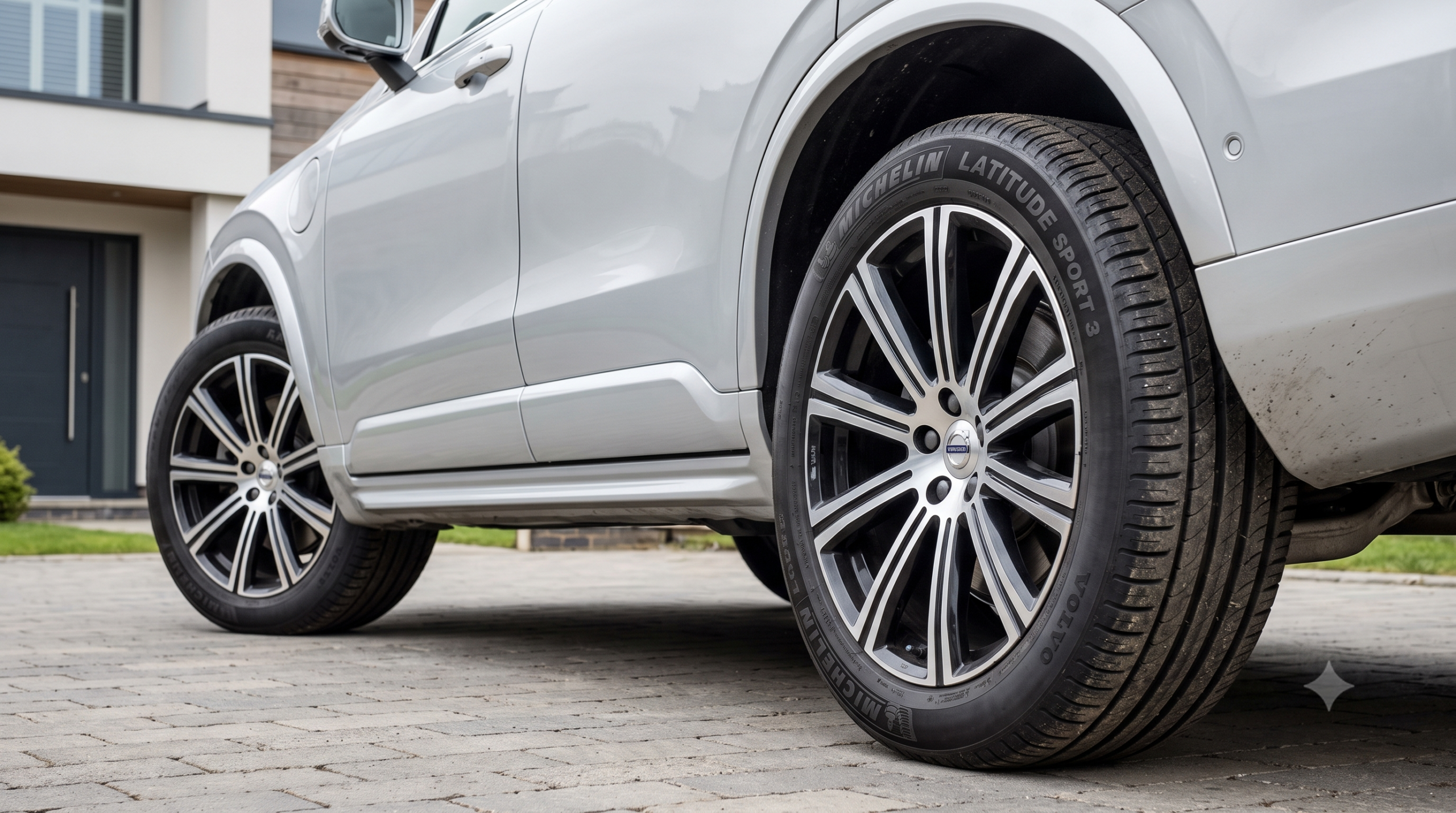
Which Tires for a Volvo XC90?

Standing in a tire shop trying to figure out which size and brand actually belongs on your XC90? The right answer depends on two things most people skip past — your exact model year and trim — so here’s how to nail down both before you buy.
TL;DR
- Check your door jamb sticker first — it lists your XC90’s exact factory tire size, which varies by trim even within the same model year.
- Common sizes range from 235/65R17 on base first-generation models up to 245/40R21 on current top trims.
- For most owners, a quality all-season tire is the right everyday choice; Volvo specifically recommends dedicated winter tires if you regularly drive on snow or ice.
- Standout picks include the Bridgestone Alenza A/S Ultra for comfort and tread life, Pirelli Scorpion All Season Plus 3 for balanced all-weather grip, and Michelin Latitude Sport 3 if your XC90 came with it from the factory.
- Volvo recommends replacing tires after 6 years regardless of remaining tread, since rubber compounds degrade with age.
The Short Answer: Your Size Depends on Model Year and Trim
Before picking a brand, confirm your exact tire size — it’s the one detail that determines everything else, and it varies more across the XC90 lineup than most owners expect.
The fastest way to check is the tire placard on your driver’s door jamb, which lists the size Volvo specified for your exact vehicle. This matters because two XC90s from the same model year can wear different factory tire sizes depending on trim and wheel package.
Quick Tip: Don’t just match the size on your current tires if you’re not sure they’re original — a previous owner may have already changed wheel sizes. The door jamb sticker reflects the vehicle’s factory-approved fitment, which is the safer reference point.
Tire Sizes by Generation
Every XC90 generation carries a different range of sizes, so find your era below.
First generation (2003–2014): Common factory sizes include 235/65R17, 235/60R18, 255/50R19, and 255/45R20, depending on trim — base and 3.2/V8 models typically ran the smaller 17- and 18-inch sizes, while Sport and R-Design trims moved up to 19- and 20-inch wheels.
Second generation (2016–2022): Sizes span 235/65R17 on base configurations up through 235/60R18, 235/55R19, 255/45R20, and 21-inch options on higher trims and the T8 plug-in hybrid.
Current generation (2023–2026): Sizes typically run 235/55R18 on Core trims, 235/50R19 on Plus trims, and 245/45R20 or 245/40R21 on Ultra and higher trims.
Expert Insight: If you’ve upgraded your wheels since buying the car, or you’re shopping for a used XC90 with non-factory wheels already installed, measure the tire sidewall directly rather than assuming it matches any generation chart — aftermarket wheel swaps are common on this platform.
Comparison Table: Tire Type by Driving Priority
| Tire Type | Best For | Trade-off |
|---|---|---|
| All-season | Most owners in moderate climates | Not rated for severe ice/snow |
| All-weather (3PMSF-rated) | Owners who see occasional snow but don’t want a seasonal swap | Slightly less dry-pavement precision than a pure all-season |
| Dedicated winter | Owners in consistently snowy or icy regions | Requires a second set and seasonal swaps |
| Performance/luxury OE-matched | Owners prioritizing the original factory ride and handling feel | Typically shorter tread life and higher cost |
What Volvo Recommends Directly
Volvo’s own guidance is worth following closely here, since it leads with a few specific, non-obvious points.
Volvo recommends winter tires on all four wheels for icy or snow-covered roads — not just all-season tires, which the automaker notes only provide “slightly better” grip than non-all-season tires on slippery surfaces, not true winter-level traction.
Volvo recommends replacing tires after 6 years from their first use date, regardless of remaining tread depth, since heat, UV exposure, and heavy loads can degrade rubber compounds over time even on a lightly driven vehicle. Check the DOT code on the sidewall if you’re unsure of a tire’s actual age.
Volvo recommends matching all four tires in size, type, and ideally manufacturer, since mismatched tires can alter braking performance and how well the vehicle clears rain and slush.
Quick Tip: Volvo’s original-equipment tires carry a “VOL” marking on the sidewall, meaning they’ve been specifically tuned for that vehicle’s ride and handling characteristics. You’re not required to replace like-for-like with VOL-marked tires, but doing so is the closest way to preserve the factory feel.
Recommended Tires by Priority
For quiet comfort and long tread life, choose the Bridgestone Alenza A/S Ultra. It’s built with a steel-belted casing and silica-rich tread specifically engineered for high-speed stability and noise reduction — a strong match for a heavy, comfort-focused SUV like the XC90.
For balanced all-weather performance, choose the Pirelli Scorpion All Season Plus 3. Its asymmetrical tread and 3D sipe design are built to handle wet and light-snow conditions while supporting the XC90’s substantial curb weight.
For matching the factory ride and handling feel, choose the Michelin Latitude Sport 3 or Pirelli P Zero PZ4 Luxury. Both are original-equipment options on various XC90 trims, so replacing with the same tire preserves the steering feel and ride character Volvo tuned the vehicle around.
For true winter traction, choose a dedicated 3PMSF-rated winter tire rather than relying on an all-weather option, especially if you regularly drive on packed snow or ice — Volvo’s own guidance backs this up directly.
For budget-conscious replacement without sacrificing too much quality, choose the Kumho Solus TA51A. It’s positioned as a lower-cost all-season option that still includes hydroplaning-resistant grooves and a silica-rich compound for wet and light winter traction.
Expert Insight: The XC90’s weight — pushing close to 5,000 lbs on AWD and plug-in hybrid trims — accelerates tread wear on softer, sportier tire compounds. If you’re chasing maximum grip, budget for more frequent replacement than you might expect on a lighter vehicle.
Pros and Cons by Owner Type
The Daily Commuter in a Moderate Climate
- Pros: A quality all-season tire covers nearly all your driving needs without seasonal swaps
- Cons: Still won’t perform like a dedicated winter tire if an unexpected ice storm hits
The Snow-Belt Owner
- Pros: A dedicated winter set genuinely transforms cold-weather confidence and stopping distances
- Cons: You’ll need a second set of wheels or plan for seasonal tire swaps, adding cost and hassle
The Ride-Quality Purist
- Pros: Sticking with OE-matched tires like the Michelin Latitude Sport 3 preserves the exact factory feel
- Cons: These options are rarely the cheapest or the longest-lasting choice on the market
Alternative worth knowing: If you split your time between mild winters and don’t want the hassle of a seasonal swap, choose a 3PMSF-certified all-weather tire like the General Altimax 365AW — it’s rated for severe winter service while still functioning as a year-round tire.
Frequently Asked Questions
How do I find my exact XC90 tire size? Check the tire placard sticker on your driver’s door jamb — it lists the exact factory size for your specific vehicle and trim.
Can I put different-sized tires on my XC90 than the factory size? You can, within Volvo-approved alternatives, but going outside those specs risks altering stability, braking characteristics, and voiding certain warranty coverage tied to unapproved combinations.
Does the XC90 need winter tires? Volvo specifically recommends dedicated winter tires on all four wheels if you regularly drive on ice or snow-covered roads, rather than relying on all-season tires alone.
How long do XC90 tires typically last? Tread life varies by tire choice, but Volvo recommends replacing any tire after 6 years from its first use date regardless of remaining tread, due to age-related rubber degradation.
Should all four XC90 tires be the same brand? Yes — Volvo recommends matching all four tires in size, type, and ideally manufacturer to preserve consistent braking and handling characteristics.
Key Takeaways
- Confirm your exact tire size from the door jamb placard before shopping, since it varies by both model year and trim.
- First-generation XC90s typically run 17- to 20-inch sizes; current models run 18- to 21-inch depending on trim.
- Volvo directly recommends dedicated winter tires for snowy/icy climates, not just all-season tires.
- Standout picks include the Bridgestone Alenza A/S Ultra for comfort, Pirelli Scorpion All Season Plus 3 for balanced all-weather grip, and OE-matched Michelin or Pirelli options for preserving factory ride feel.
- Replace tires after 6 years regardless of tread depth, per Volvo’s own age-based guidance.
Your Next Step
Check your door jamb sticker for your exact factory tire size, then decide whether an all-season, all-weather, or dedicated winter tire best matches your actual climate — that combination will narrow the field to just a handful of solid options.